|
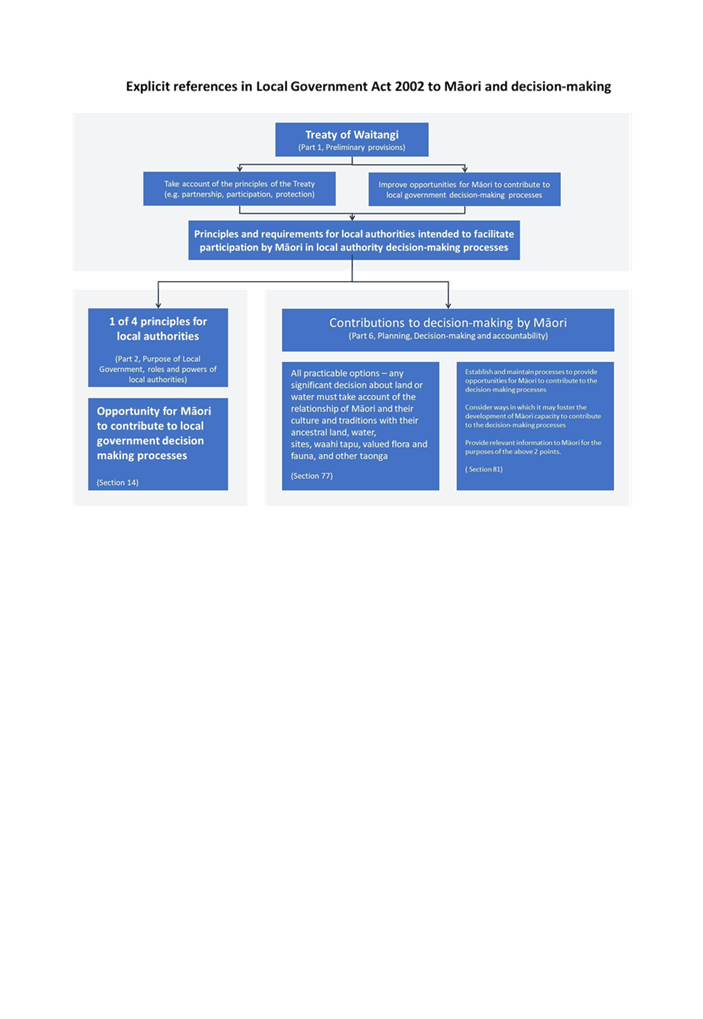
Local Government Act 2002 requirements for Māori and decision-making |
Item 2 - Attachment 1 |
Ngā Mānukanuka o te Iwi (Māori Committee) - 26 November 2021 - Open Agenda
Ngā Mānukanuka o te Iwi (Māori Committee)
Open Agenda
|
Meeting Date: |
Friday 26 November 2021 |
|
Time: |
9.00am |
|
Venue: |
Council Chamber |
|
|
Livestreamed via Council’s Facebook site |
|
Committee Members |
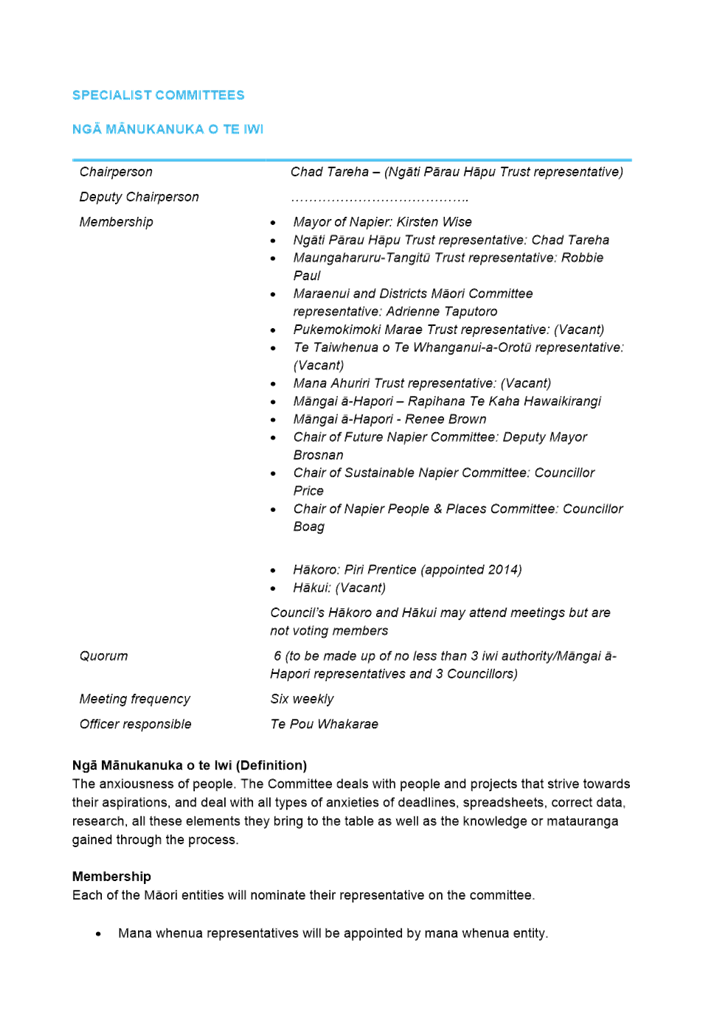
Ngāti Pārau Hapū Trust – Chad Tareha (Chair) Maungaharuru-Tangitū Trust – Robbie Paul Maraenui & Districts Māori Committee - Adrienne Taputoro Māngai ā-Hapori - Renee Brown Māngai ā-Hapori – Rapihana Te Kaha Hawaikirangi Mayor Kirsten Wise Deputy Mayor Annette Brosnan Councillor Maxine Boag Councillor Keith Price
Mana Ahuriri Trust – (Vacant) Te Taiwhenua o Te Whanganui-a-Orotū – (Vacant) Pukemokimoki Marae – (Vacant) |
|
Officer Responsible |
Pou Whakarae (Mōrehu Te Tomo) |
|
Administration |
Governance Team |
|
|
Next Ngā Mānukanuka o te Iwi (Māori Committee) Meeting 25 February 2022 |
ORDER OF BUSINESS
Karakia
Apologies
Conflicts of interest
Public forum
Announcements by the Chairperson
Announcements by the management
Confirmation of minutes
That the Minutes of the Ngā Mānukanuka o te Iwi (Māori Committee) meeting held on Friday, 3 September 2021 be taken as a true and accurate record of the meeting....................................................... 208
Agenda items
1 NCC Trade Waste and Wastewater Drainage Bylaw Renewal........................................ 4
2 Progress update - Integrating Ngā Mānukanuka o te Iwi into Council’s current governance structure 8
3 Model for integrating Ngā Mānukanuka o te Iwi into Council’s Governance Structure....59
Reports from Standing Committees
Reports from Napier People and Places Committee held 4 November 2021
2 Safer Napier's Reaccreditation Application.................................................................... 60
Prosperous Napier Committee did not proceed
Reports from Sustainable Napier Committee held 11 November 2021
2 Napier Environmental Enhancement Fund Proposal..................................................... 65
3 Report on Napier Water Supply Status End of Q1 2021-2022....................................... 71
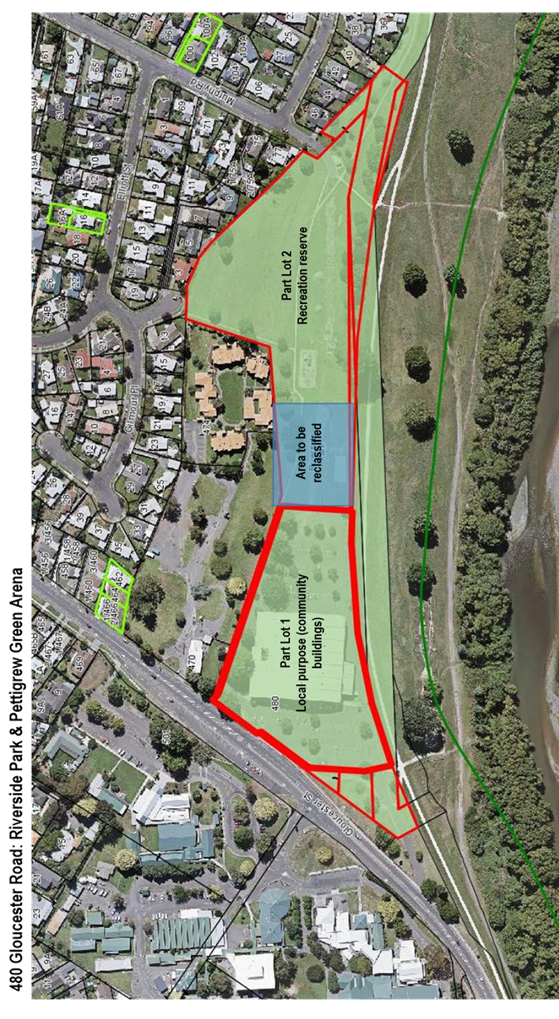
4 Pettigrew Green Arena development: Reclassification of Reserve................................ 77
5 Pettigrew Green Arena extension: agreements for council approval.............................. 82
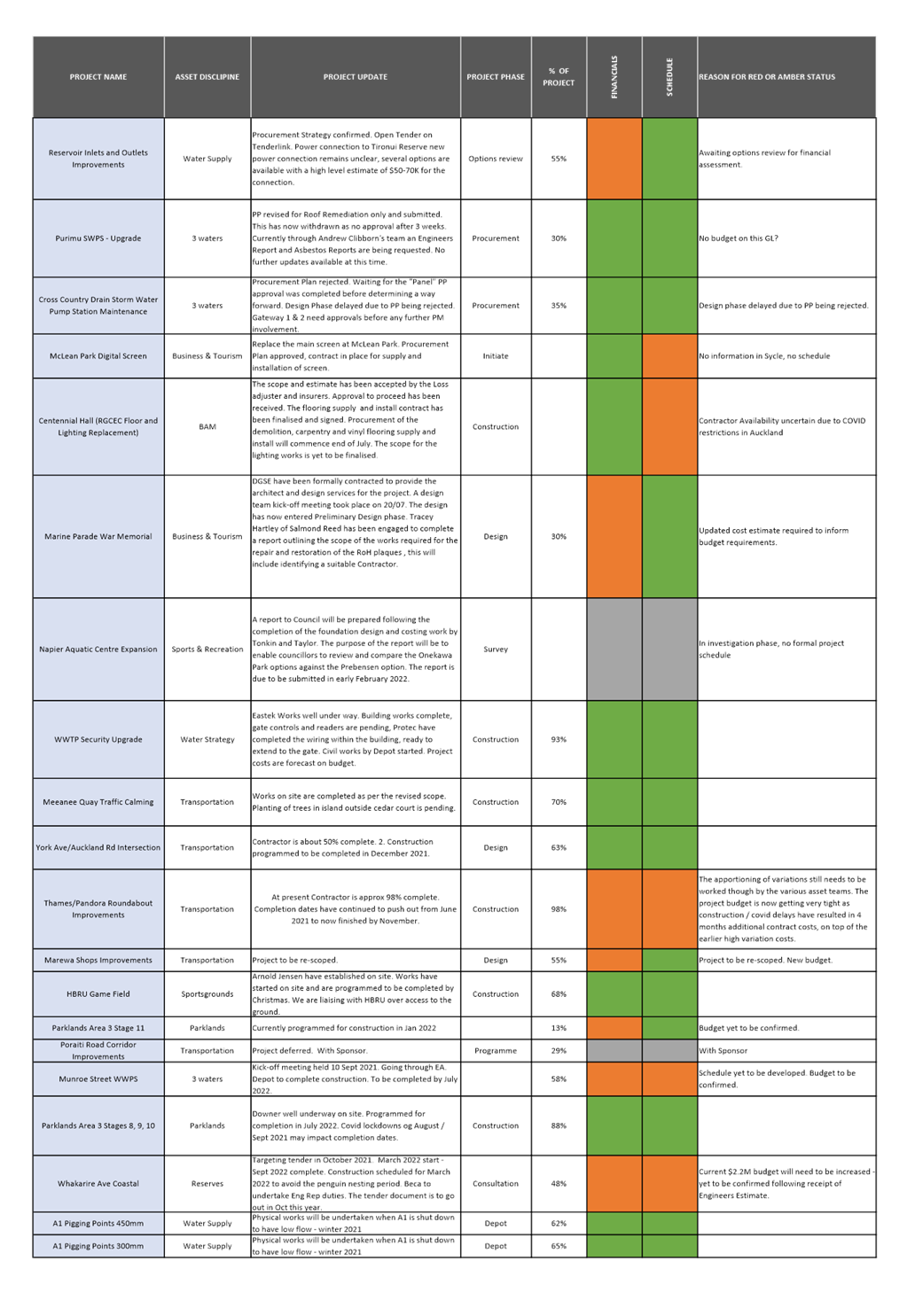
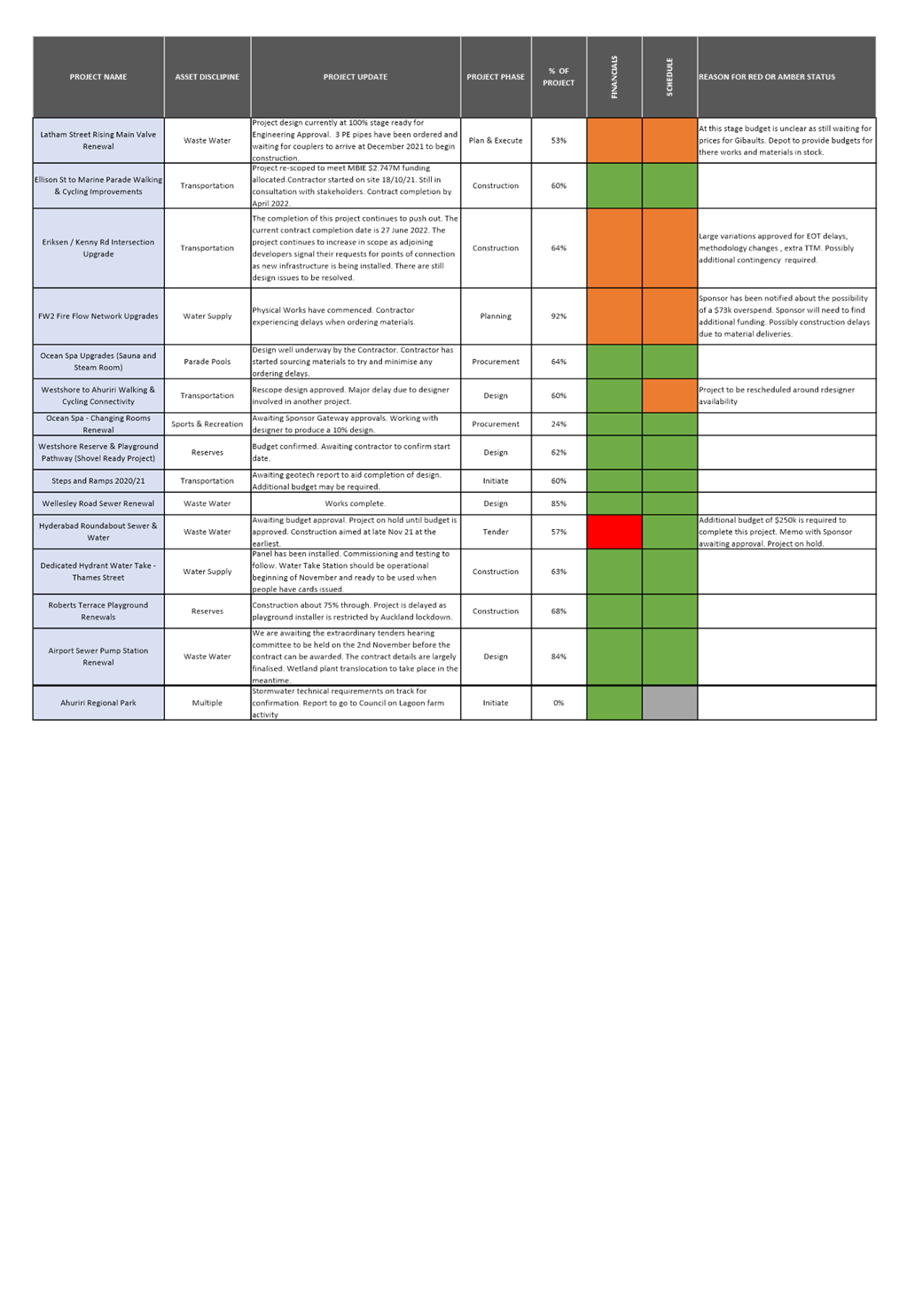
6 Capital Programme Delivery......................................................................................... 86
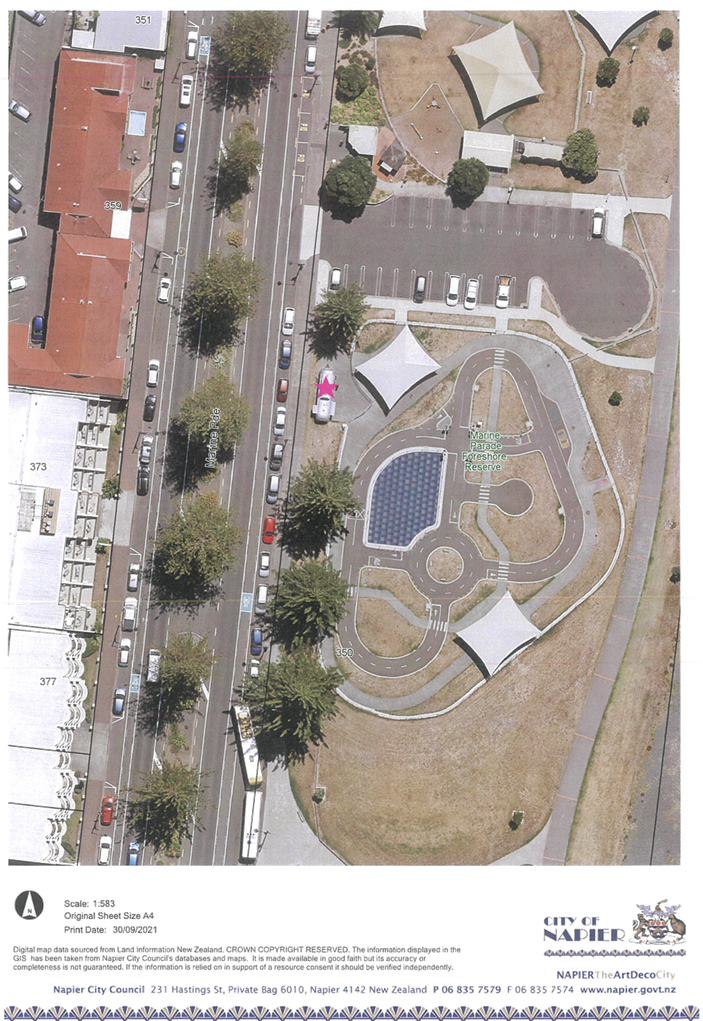
8 Lease of Reserve - Coffee Caravan (Silver Bullet)........................................................ 92
Reports from Future Napier Committee held 11 November 2021
3 Library and Civic Area Plan........................................................................................... 95
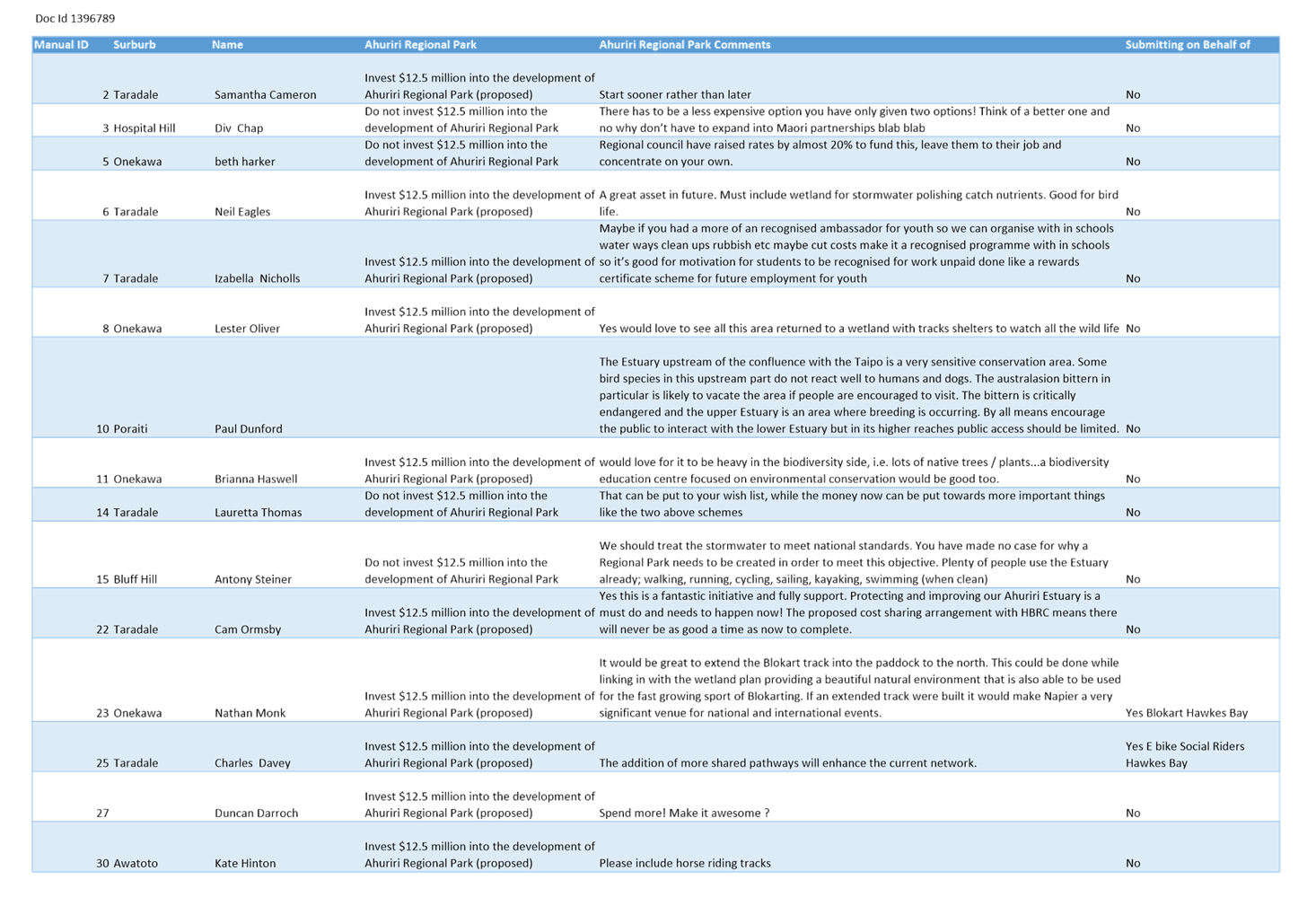
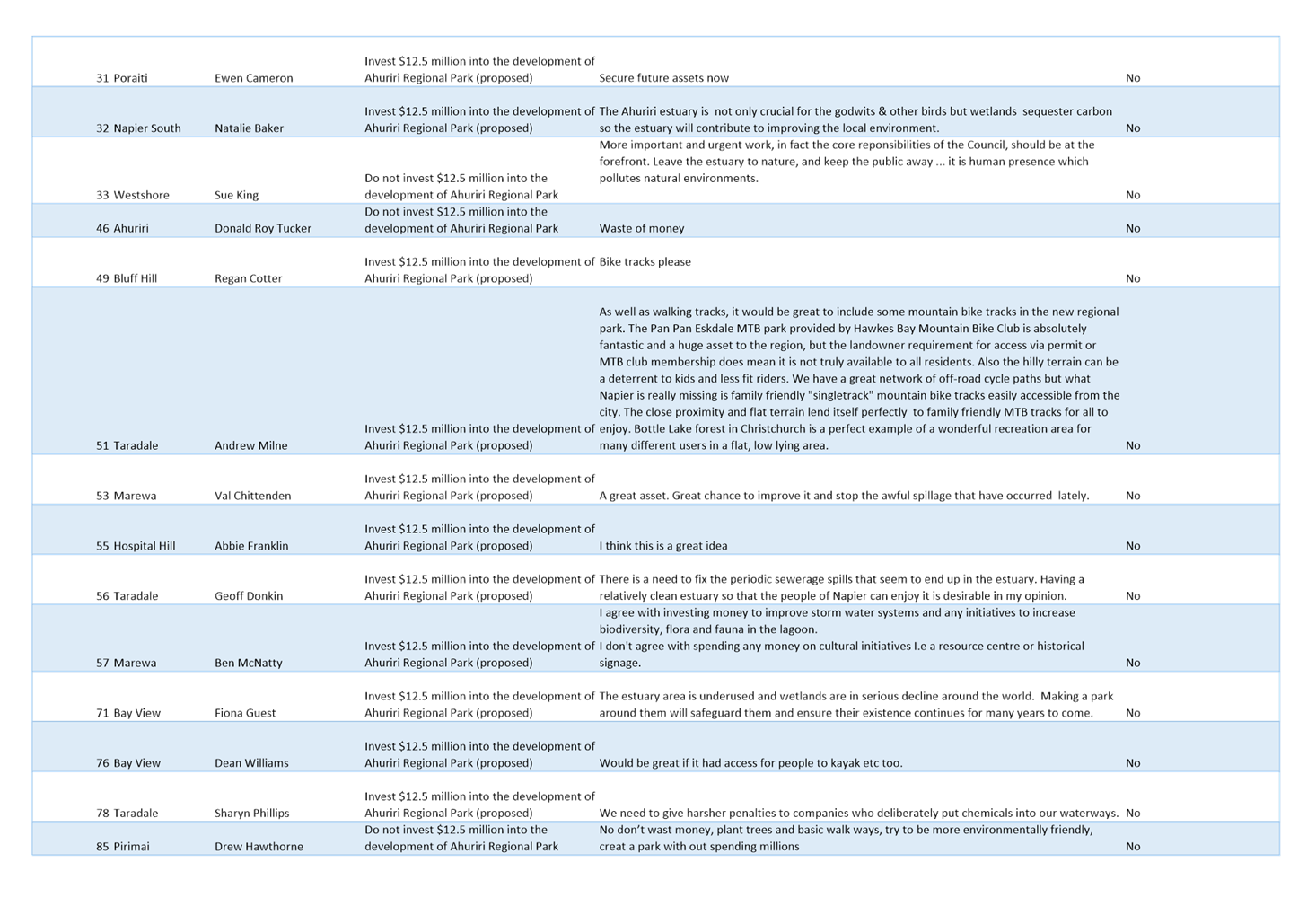
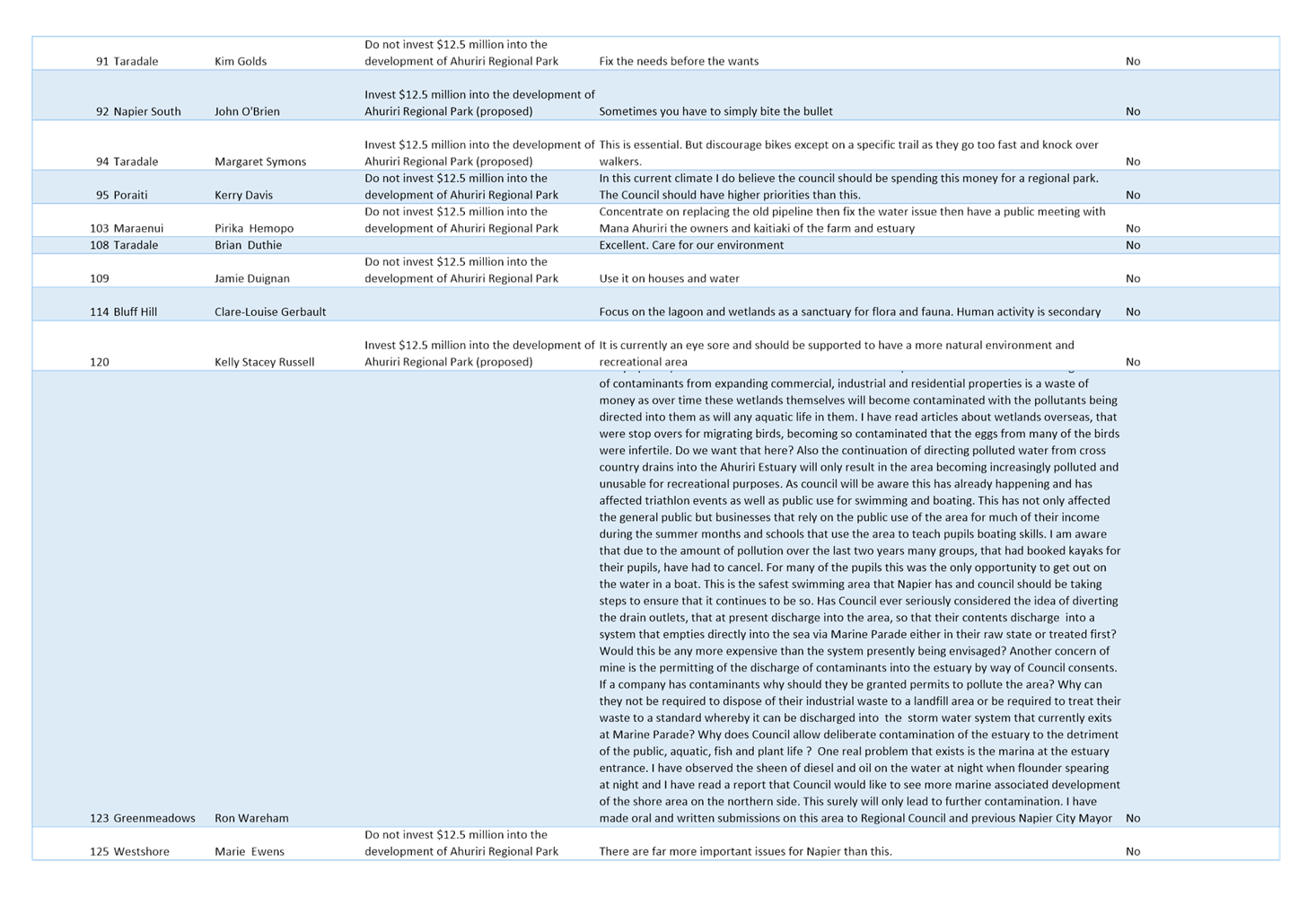
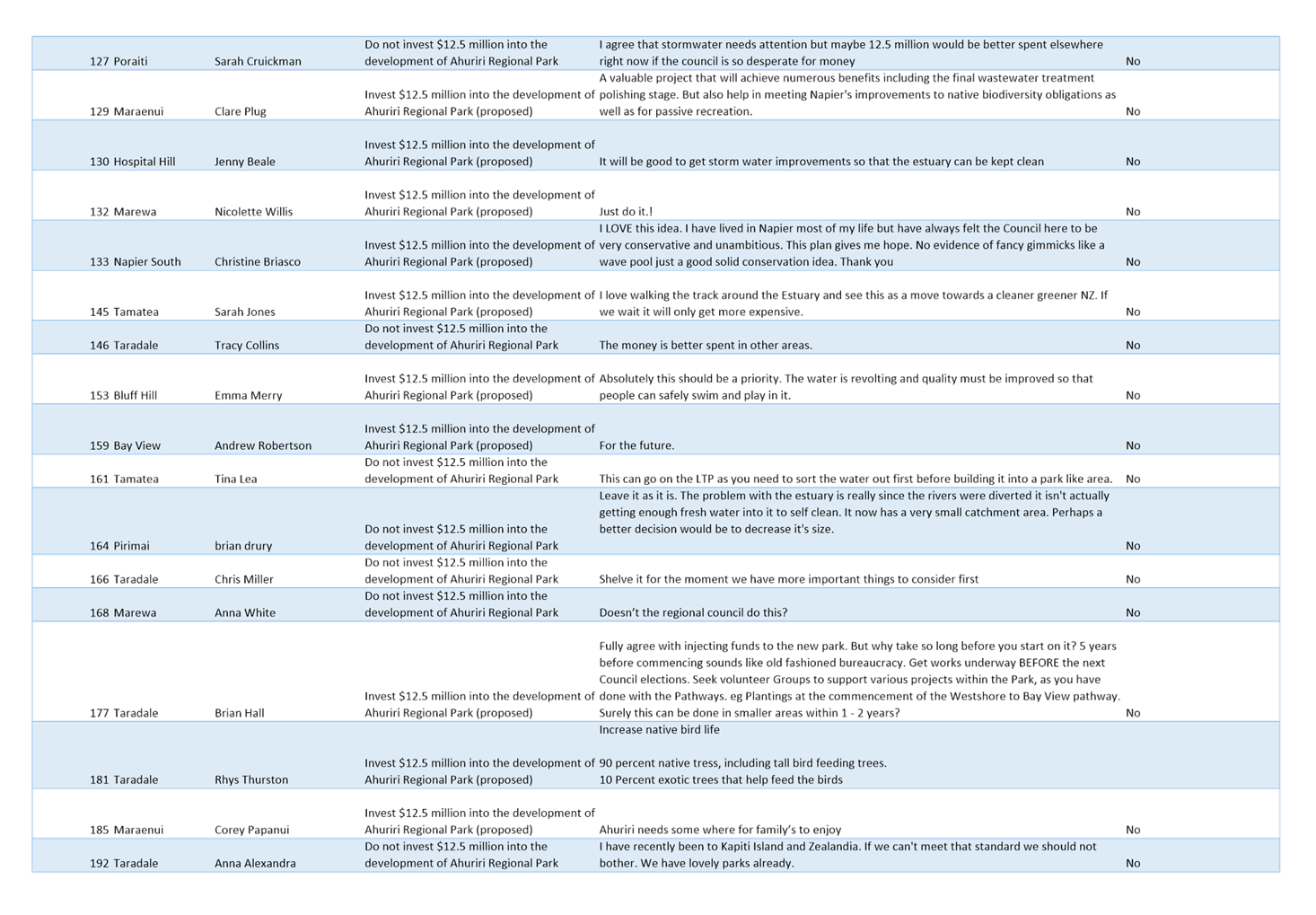
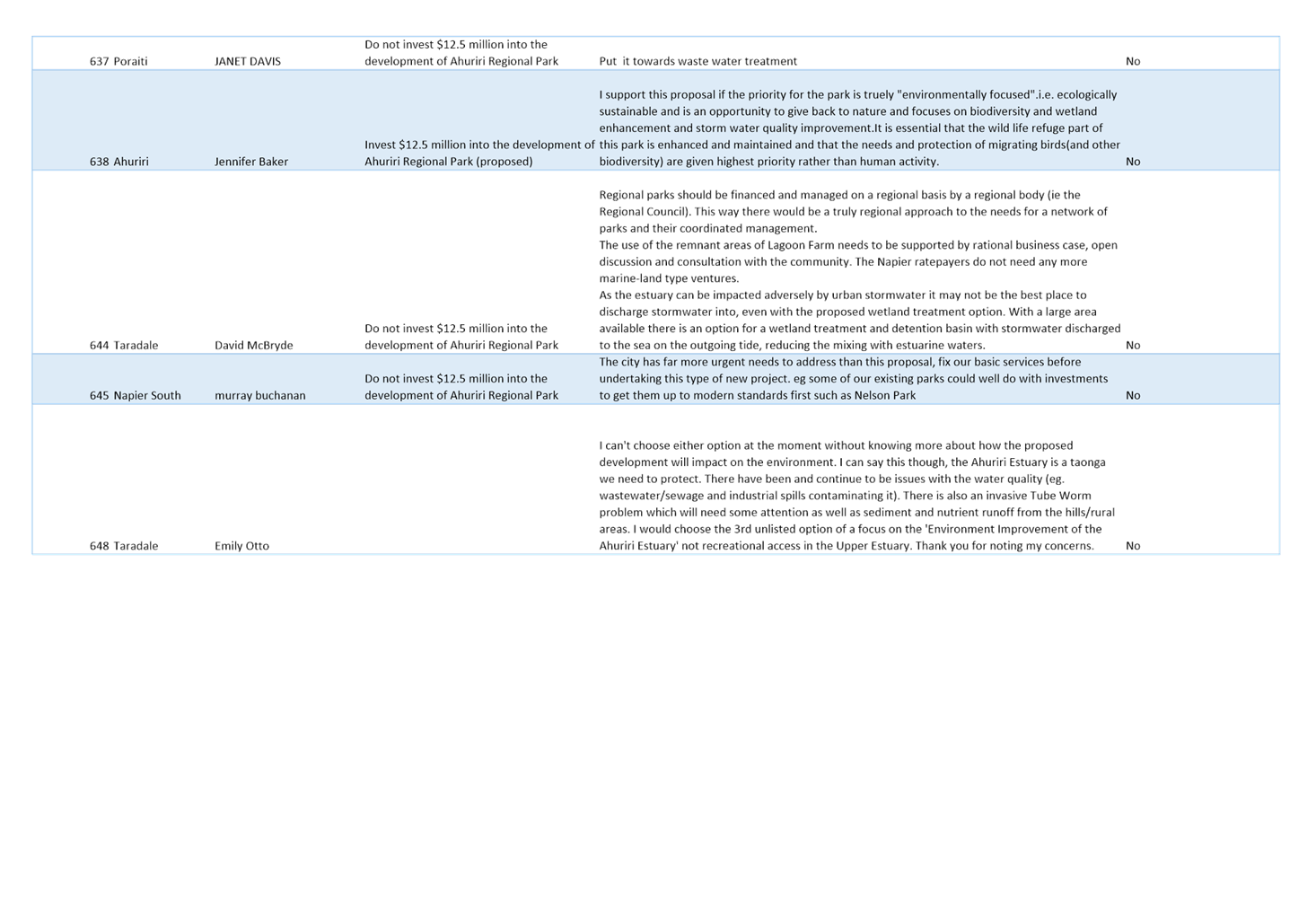
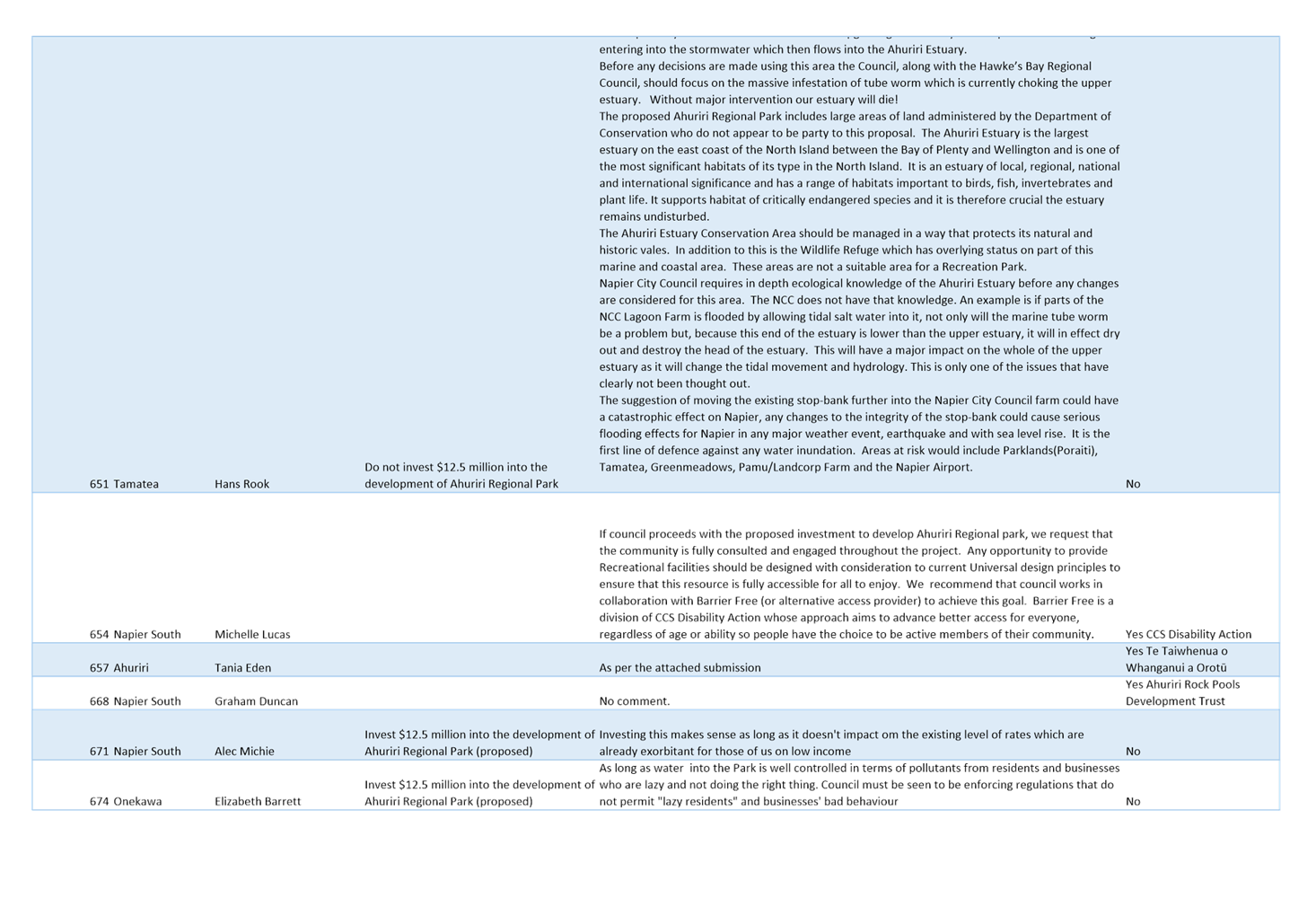
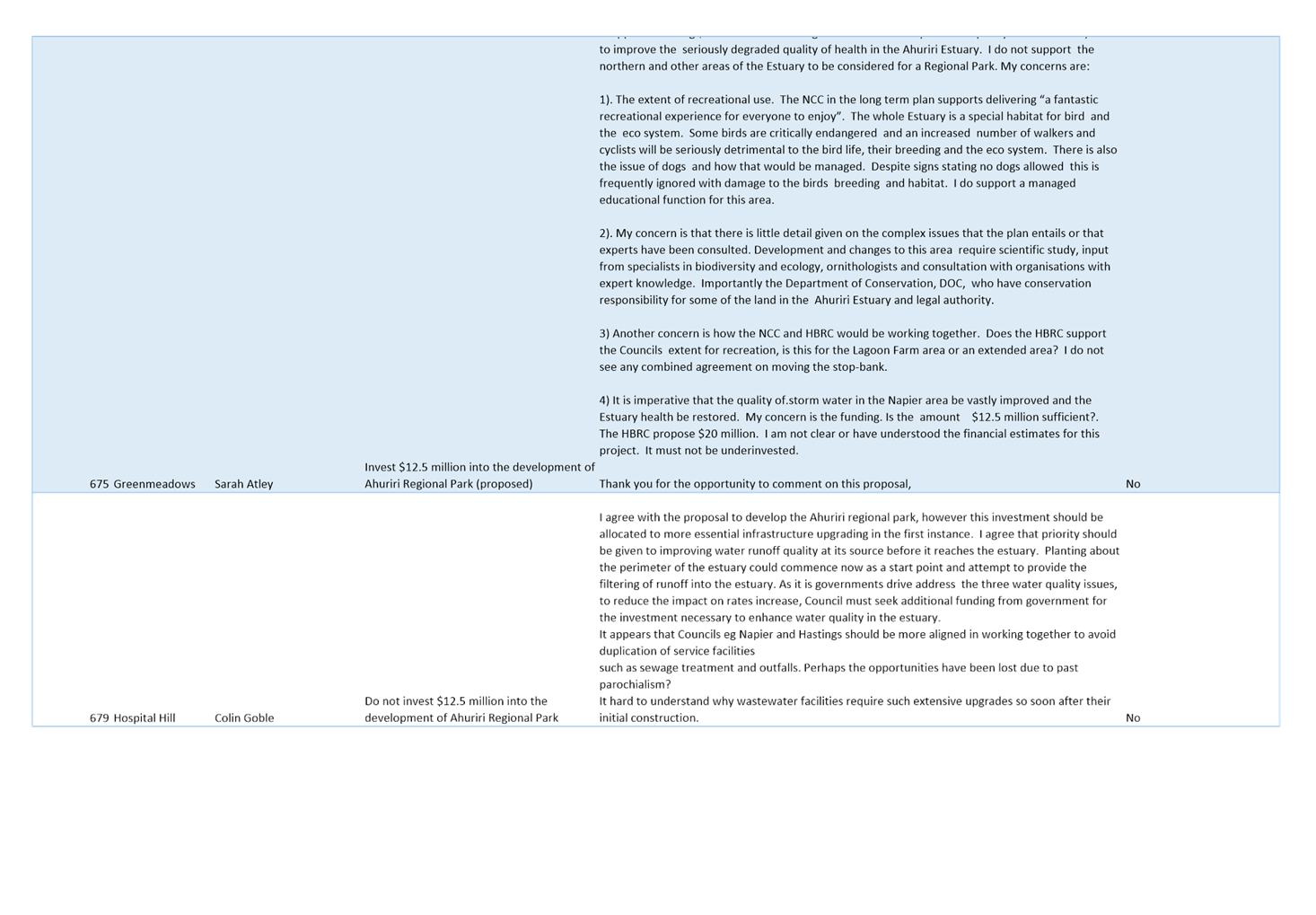
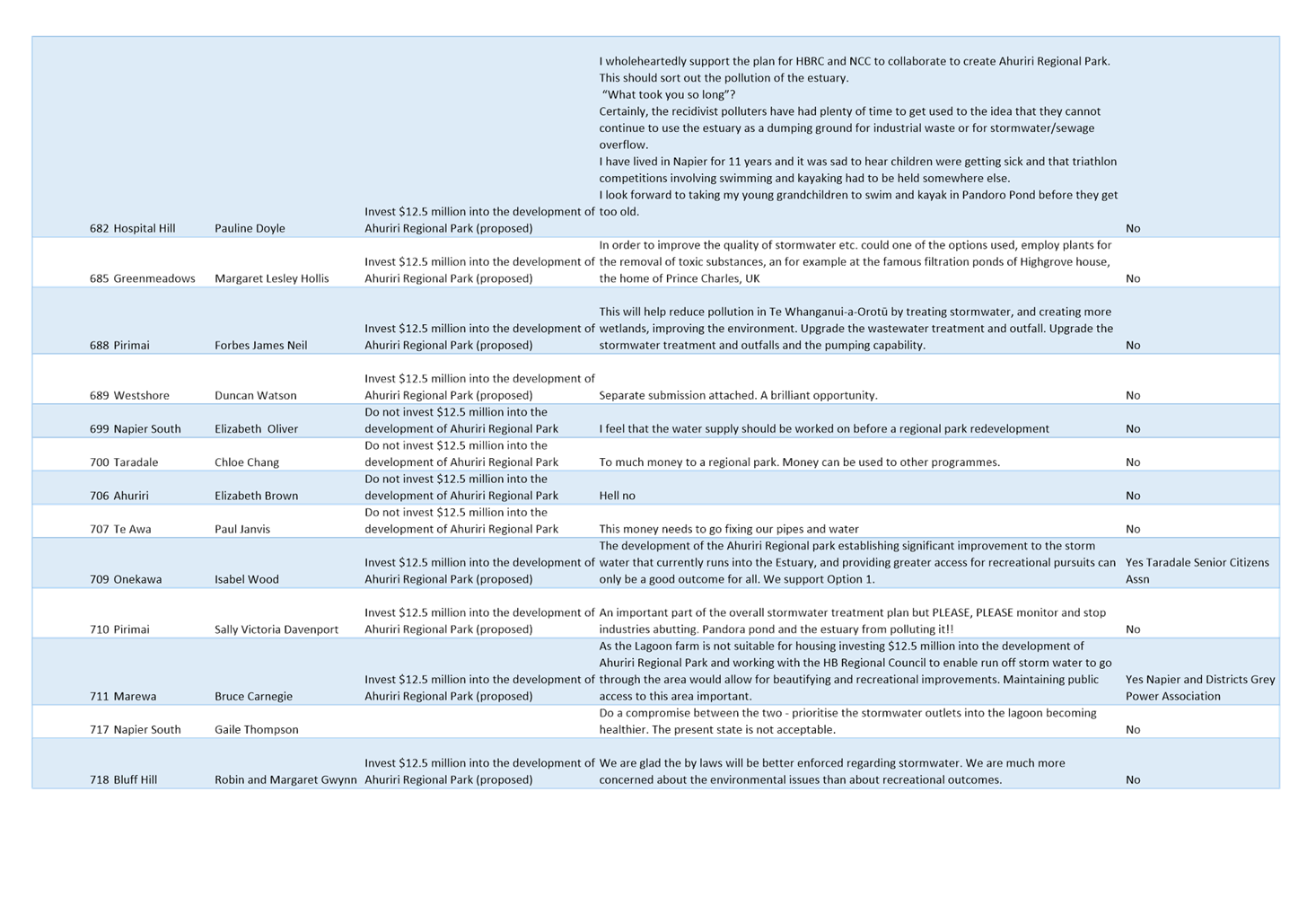
4 Update on Ahuriri Regional Park Project..................................................................... 103
5 Housing Capacity Assessment.................................................................................... 157
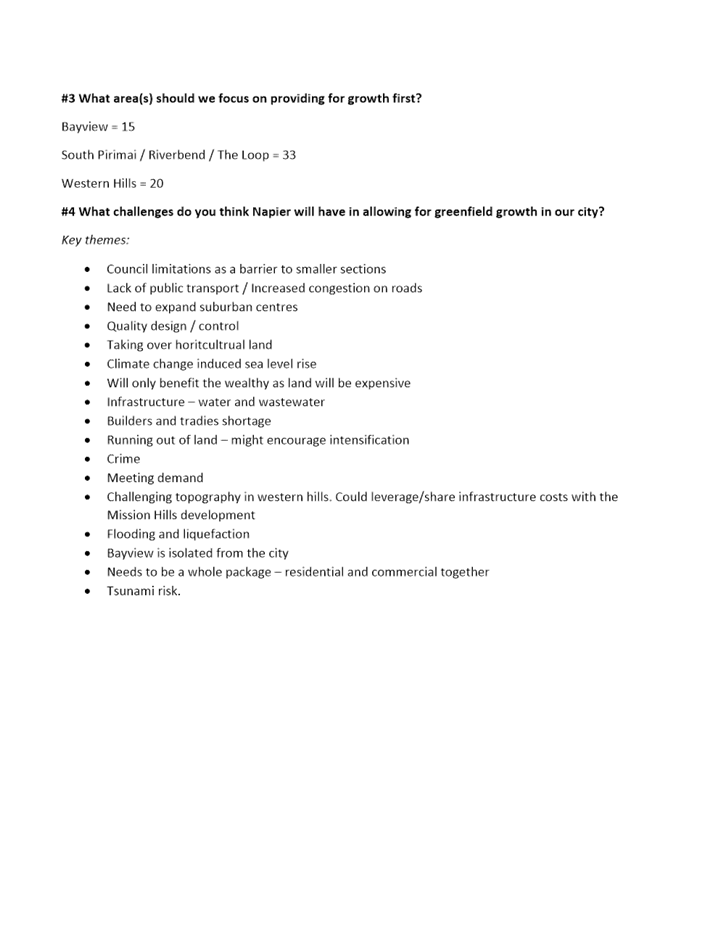
6 Feedback on Spatial Picture....................................................................................... 167
7 Proposed District Plan Notification.............................................................................. 193
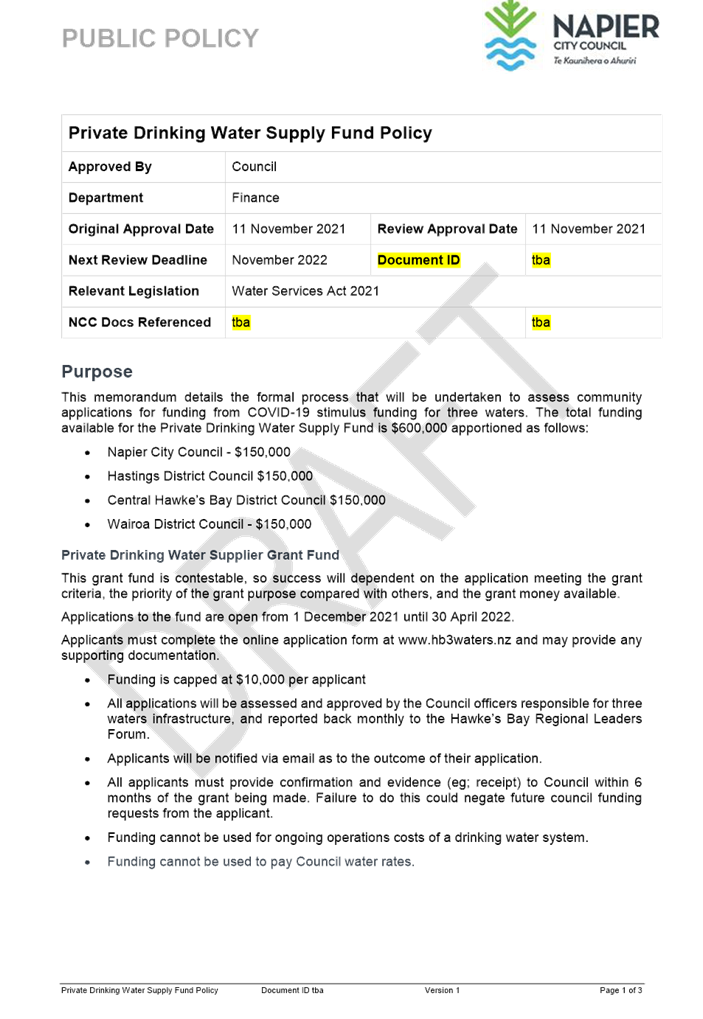
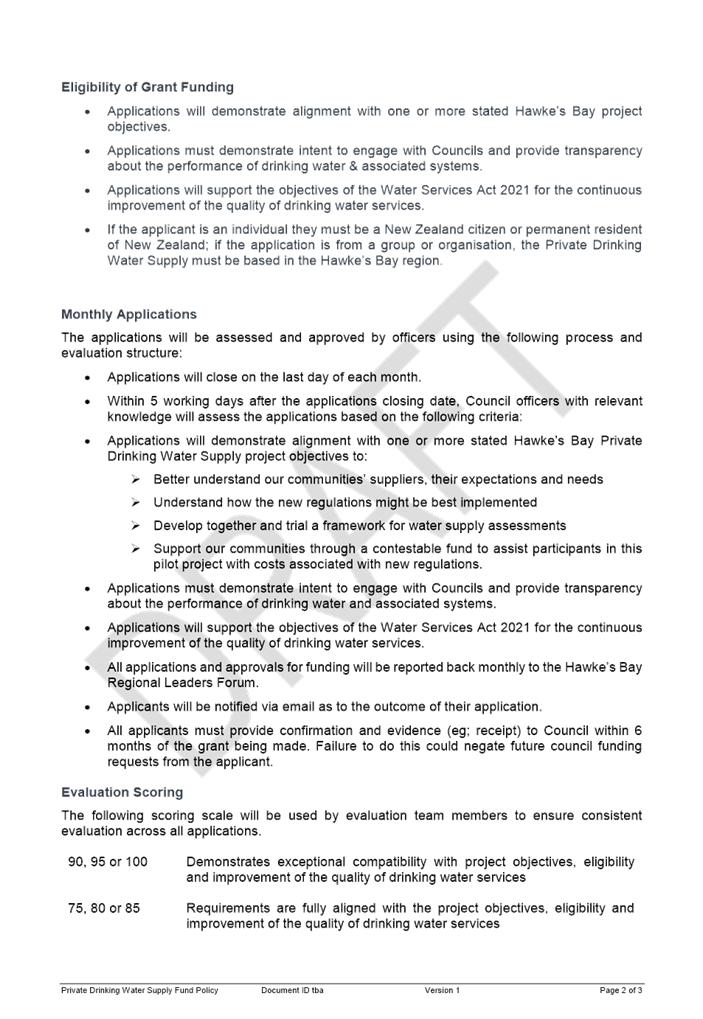
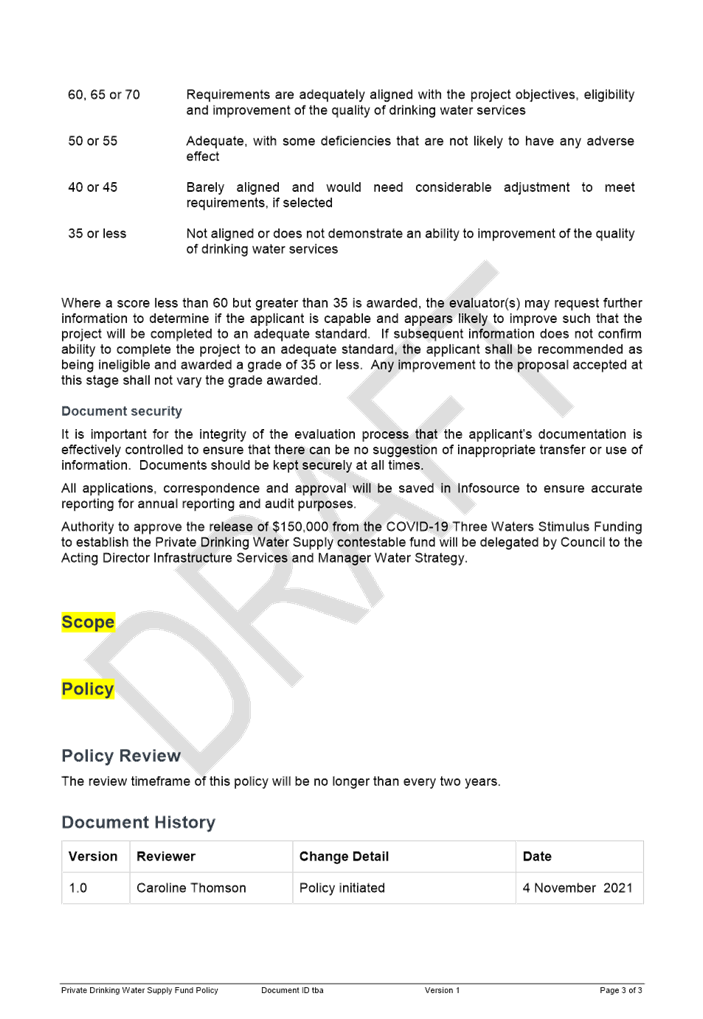
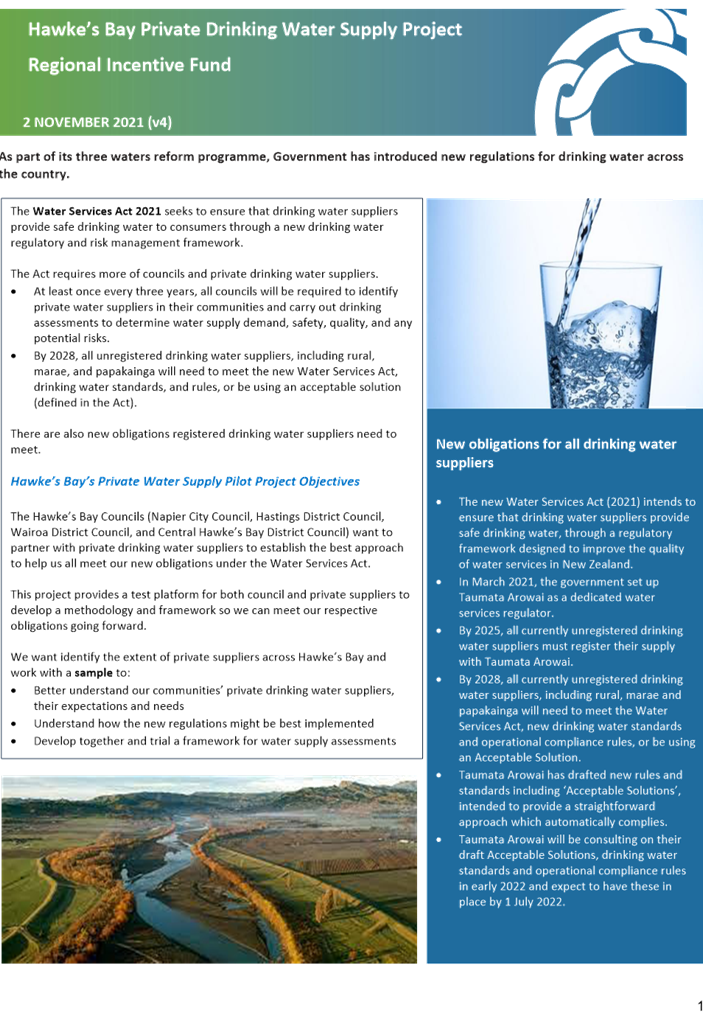
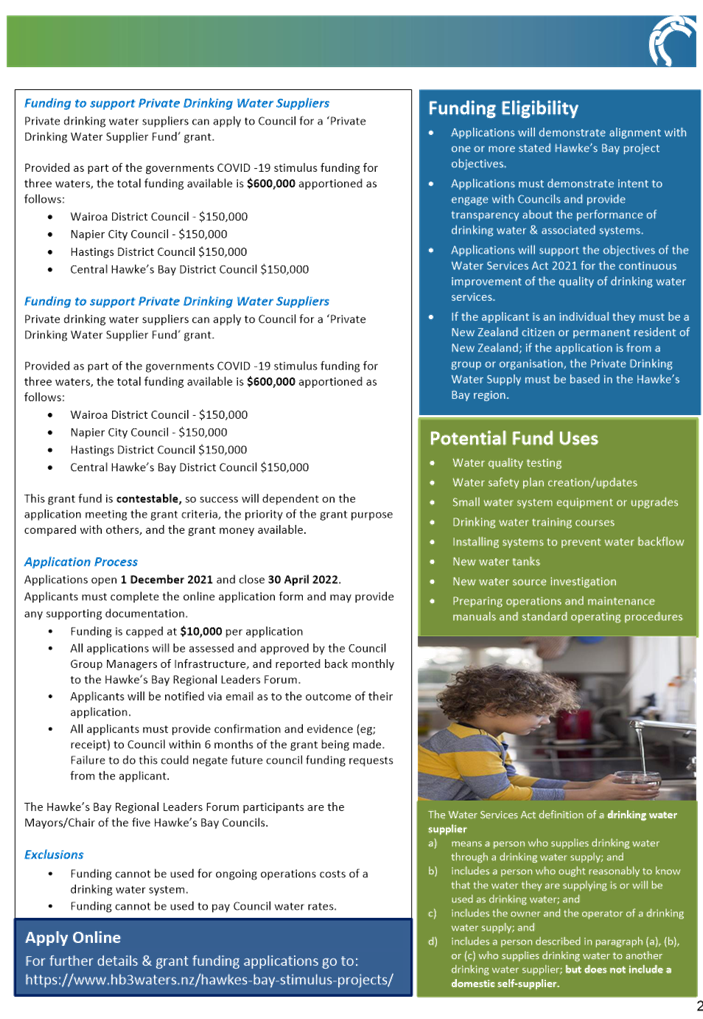
8 Private Drinking Water Supply Fund Policy - Decision of Council............................. 198
Updates from Partner Entities
Ngāti Pārau Hapū Trust – Chad Tareha
Maraenui and Districts Māori Committee – Adrienne Taputoro
Napier City Council – Mayor Kirsten Wise
Maungaharuru-Tangitū Trust – Robbie Paul
Renee Brown
Rapihana Te Kaha Hawaikirangi
Update from Pou Whakarae
General business
Whakamutunga Karakia
Ngā Mānukanuka o te Iwi (Māori Committee) - 26 November 2021 - Open Agenda Item 1
1. NCC Trade Waste and Wastewater Drainage Bylaw Renewal
|
Type of Report: |
Operational |
|
Legal Reference: |
Local Government Act 2002 |
|
Document ID: |
1381795 |
|
Reporting Officer/s & Unit: |
Caitlin Egan, Environmental Compliance Officer |
1.1 Purpose of Report
The purpose of this document is seek approval to renew and consolidate the Wastewater Drainage and Trade Waste Bylaws.
|
The Ngā Mānukanuka o te Iwi (Māori Committee): a. Receive this update on the proposed Trade Waste and Wastewater Bylaw renewal; b. Note that Officers are recommending the consolidation of the Wastewater Drainage and Trade Waste Bylaws; c. Note that Officers are recommending a timeline for the Wastewater Drainage and Trade Waste Bylaw review; and d. Support Napier City Council to conduct consultation with, and receive input from, mana whenua to inform the Consultation Plan and Statement of Proposal.
|
Napier City Council (NCC or the Council) provides Three Waters services to our community; drinking water, stormwater and wastewater. Trade waste is part of what makes up the total wastewater, uses the same infrastructure and is constrained by the same resource consent.
Wastewater is the liquid waste that has water as the largest component, along with various types of impurities like human waste and used water from premises including houses, offices, factories, schools, hospitals, and industrial sites. The discharges from industrial sites that contain used water, solids (except that from toilets or bathrooms) and chemicals are called trade waste.
Presently, wastewater is governed by separate Wastewater Drainage and Trade Waste Bylaws. It is the view of Officers that it is more practical to have one consolidated bylaw for the city.
While the current bylaws do not expire until 2024, the trade waste consents held by industry in the city are due for renewal at the end of this financial year, i.e. 30 June 2022. In order to assist with control of discharges to the wastewater network and clarify the charging process, it is recommended to coincide the trade waste consents and existing bylaws reviews. Officers are also recommending the consolidation of the two existing Bylaws.
This consolidated bylaw will focus on the wastewater services provided to residential, commercial and industrial customers. The proposed bylaw intends to achieve better management and control of the negative effects of wastewater and particularly trade waste (industrial wastewater) on the environment, people and wastewater treatment plant.
It will also provide an enforceable means of regulating and controlling trade waste discharges into the public wastewater network and treatment plant. It will enable Council to achieve best practice and meet resource consent compliance (issued and monitored by Hawkes Bay Regional Council).
Trade waste comprises a significant part of the wastewater that is conveyed, treated and discharged into Hawke Bay by Council. The volume and loads of contaminants, are detrimental to the environment and can damage infrastructure.
The proposed Trade Waste and Wastewater Bylaw must enable Council to have control over the quality and quantity of wastewater it receives from industry.
Ideally, the renewed consolidated wastewater drainage and trade waste bylaw should help NCC to achieve:
· Improved health of the marine environment into which the treated trade waste is currently discharged;
· Allow for cost recovery of the additional load on the wastewater network and treatment plant;
· Set effective control mechanisms for the discharge of trade waste into the network; and
· Meet best practice standards and regional consistency.
Current scenario
At present, all industry in Napier has the same generic concentration limits for contaminants. These are not calculated based on what we are able to accept and treat at our plant and what we are permitted to discharge into Hawke Bay. In addition, there is limited penalties for breaching those limits – other than on-charging lab costs.
Our aim with the review is to incentivise trade waste customers to treat their waste and avoid discharging higher chemical loads into the wastewater system in order for us to meet limits that are imposed by our resource consents. The environment and the conditions outlined in the coastal permit to discharge treated wastewater into Hawke Bay are the drivers behind this renewal.
Our current bylaw is detailed and prescriptive with what it allows Council to control and achieve under its conditions. Our aim is to provide Officers with the ability to control quality and quantity of trade waste and provide clarity for our trade waste customers with regard to charges for discharge.
The conditions of the proposed bylaw will be informed by the trade waste model which will allow proper allocation of loads and consideration for future upgrades to the plant, as well as allowing for things such as seasonal peaks for different industries and water conservation. It should be driven by a more holistic view of water management and advocate that the wastewater drain is no longer a ‘bin’.
Bylaw Composition
Our aim is to develop a clear and effective bylaw which provides:
- Ability to use a model to control trade waste loads and charges
- Ability to refuse trade waste during emergency situations e.g. heavy rainfall
- A review of trade waste classifications
- A review of trade waste consent application consideration criteria
- A review of triggers for volume, flow
- More detail and control in consents, not in the Bylaw itself
- A solution for cultural issues with funeral homes trade waste
- Ability to fine transgressors
Administration Manual
This document will be developed and will sit under the proposed bylaw and provide:
- Technical information to which proposed bylaw refers
- Ability to update this information as necessary without renewing the bylaw itself.
Trade Waste Charging Model
This document will be the definitive document by which charges are calculated over a certain threshold and will ensure:
- Clarity of costs to the customer
- User pays: charge users fair ‘cost to treat’
- Incentivise trade waste customers to invest in infrastructure to treat wastewater
- Ability to allocate load based on our resource consent and what our plant is able to treat.
Cultural impact
Environmental impacts have been a big driver as have technical impacts on plant and infrastructure. However, cultural impacts also play an important role in this and we have are seeking to bring mana whenua and iwi into the discussion.
In July, we met with Council’s Te Waka Rangapū team to introduce the topic of trade waste and request the consultation with, and input from, mana whenua. It was agreed this matter be referred to Ngā Mānukanuka o te Iwi.
Consultation and insight on the Trade Waste and Wastewater Bylaw is sought in the following areas:
- Waste from funeral homes
- New categories of trade waste operators to include the hospitality industry, truck washes etc.
- User pays system
- Any cultural implications/considerations around wastewater that should be included/enabled by a bylaw.
- Any potential areas of improvement in the regulation of all wastewater.
1.3 Significance and Engagement
This issue will be of moderate to high significance to industry stakeholders and of significance to the majority of the Napier community.
The proposed bylaw review and timings will be put to the Sustainable Napier Committee on 11 November 2021 for debate, along with the Consultation Plan and Statement of Proposal. We seek Ngā Mānukanuka o te Iwi’s support to consult with mana whenua to inform the debate and prepare the Consultation Plan and Statement of Proposal.
A Special Consultative Procedure will be put in place in order to ensure stakeholders have the opportunity to engage on this topic.
1.4 Implications
Financial
The Trade Waste Charging Model will ensure Council is able to fairly charge users for the amount of trade waste discharged from their industrial sites. It will provide clarity for users and Council officers alike.
Social & Policy
N/A
Risk
As outlined above, the aim of this bylaw renewal is to ensure that by controlling the limits and loads industry are able to discharge we can ensure the amount of contaminants in the wastewater are equivalent to what the system is able to cope with.
1.6 Recommendation
That Ngā Mānukanuka o te Iwi receive this update on the Trade Waste and Wastewater Bylaw renewal and support NCC to begin consultation with mana whenua to inform the Consultation Plan and Statement of Proposal.
Ngā Mānukanuka o te Iwi (Māori Committee) - 26 November 2021 - Open Agenda Item 2
2. Progress update - Integrating Ngā Mānukanuka o te Iwi into Council’s current governance structure
|
Type of Report: |
Operational |
|
Legal Reference: |
Local Government Act 2002 |
|
Document ID: |
1381297 |
|
Reporting Officer/s & Unit: |
Mōrehu Te Tomo, Pou Whakarae Jane McLoughlin, Corporate Planner |
2.1 Purpose of Report
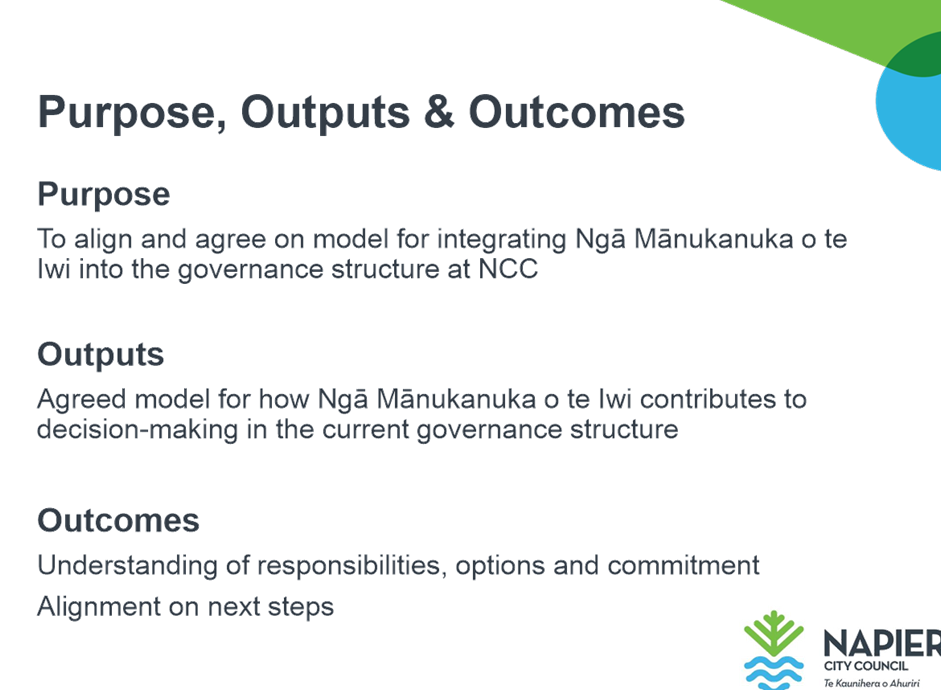
To provide a record of progress made to date on how best to integrate Ngā Mānukanuka o te Iwi into Council’s governance structure, and gain the Committee’s agreement to:
- definition of challenges
- desired outcome.
|
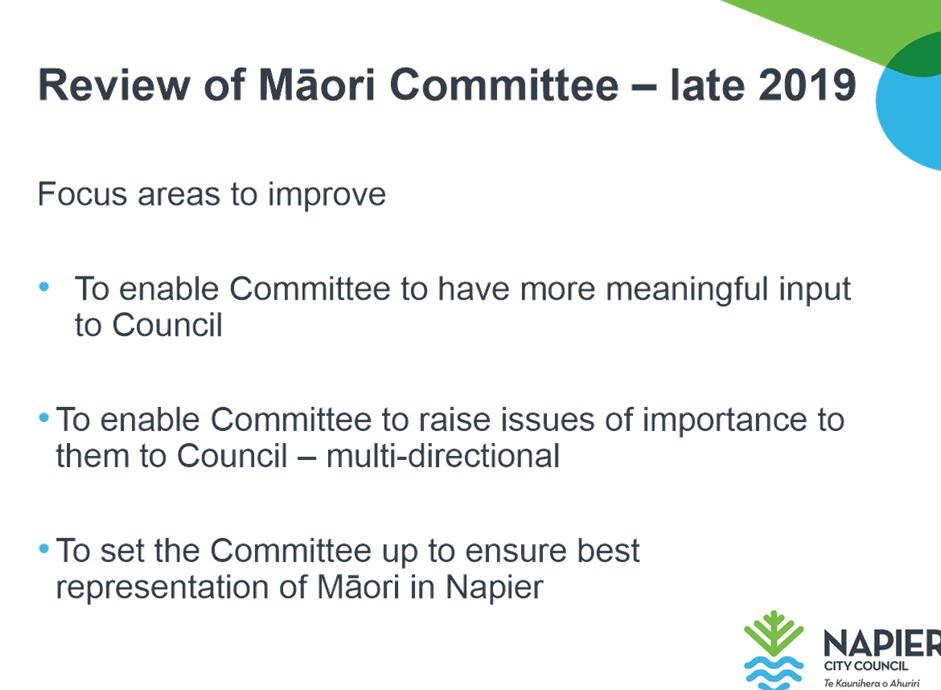
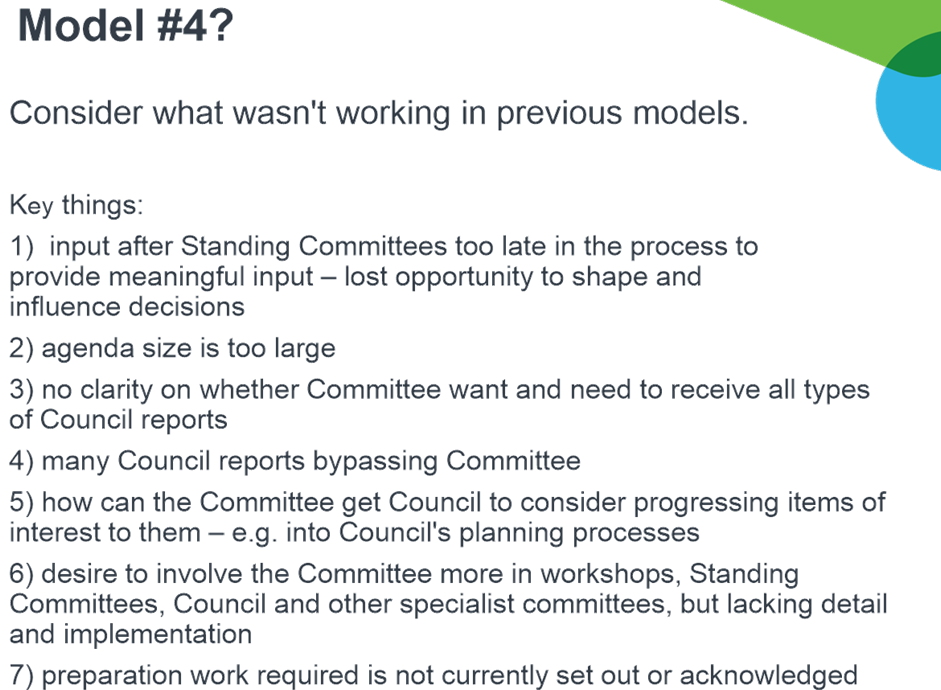
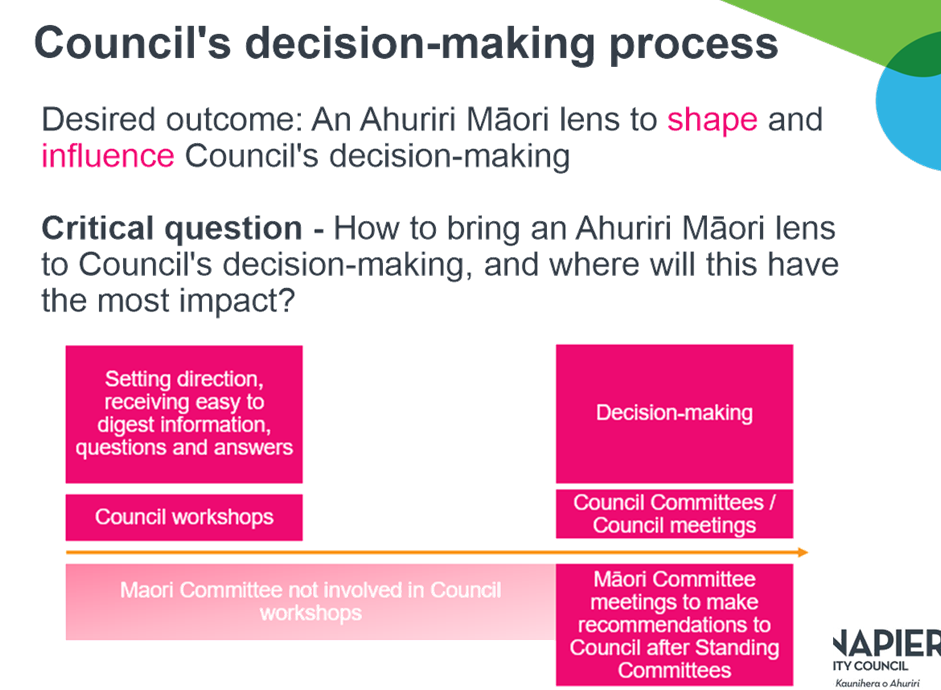
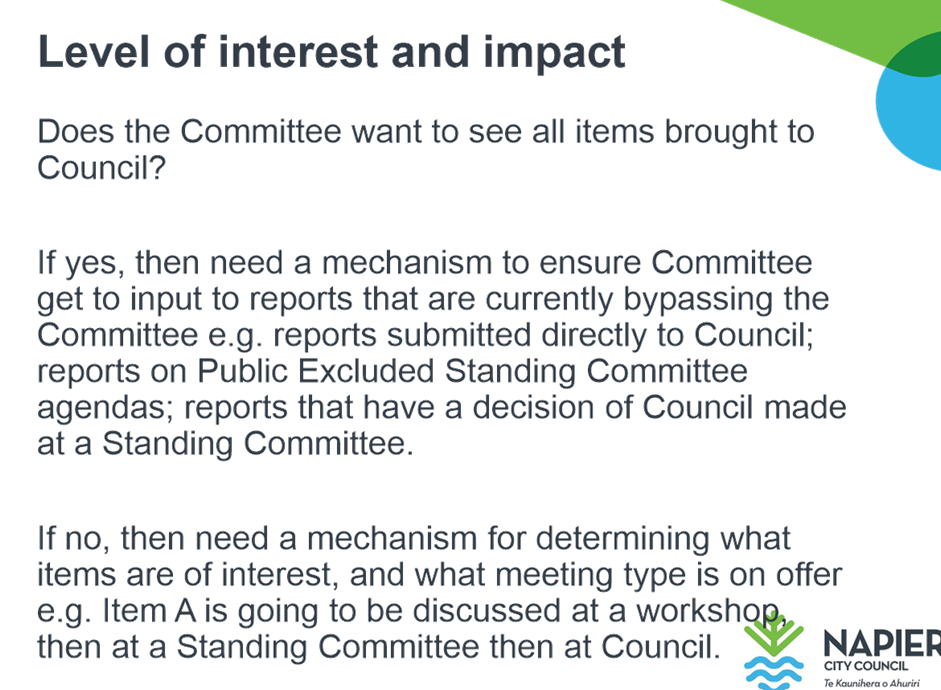
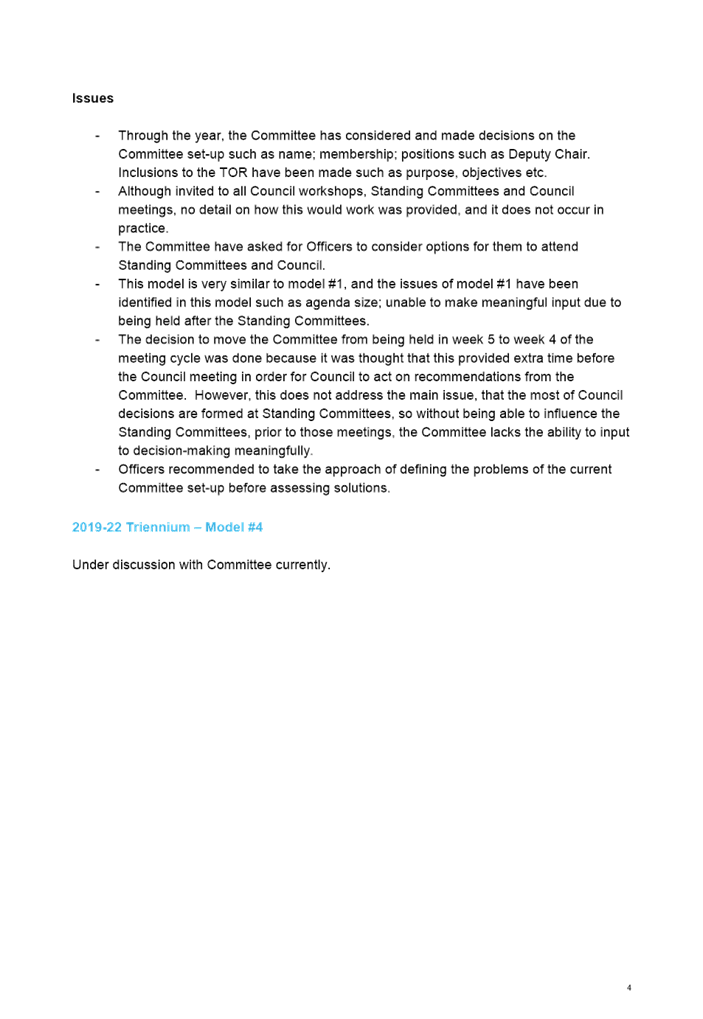
Ngā Mānukanuka o te Iwi: a. Note the progress to review Ngā Mānukanuka o te Iwi in Council’s current governance structure. b. Agree to the following aspects that form the definition of challenges of Ngā Mānukanuka o te Iwi’s set-up within Council’s governance structure: i. being held after the Standing Committees, does not provide this Committee with adequate opportunity to shape and influence decision-making, as the majority of Council decisions are formed at Standing Committees. ii. the agenda, consisting of open agendas of four Standing Committees plus bespoke reports, is too large for one meeting. iii. the Committee do not participate in the early stages of the decision-making process e.g. Council workshops for setting early direction. iv. there is currently no mechanism for Officer’s to determine to what extent a Te Ao Māori (Māori worldview) should be incorporated from the initiation of a project, however this needs to be clarified to avoid duplication, gaps and efficiencies. v. the value for the Committee members to see and input to all Council reports is unknown, and there is no mechanism to determine whether there are types of reports, or particular topics, that are of more interest to the Committee. vi. the Committee members want a better understanding of reports, in particular the impact to Ahuriri Māori, so they can be more informed and engaged. vii. the Committee are not provided with an opportunity to participate in decision-making in Council’s processes to develop the annual and long term plan. viii. there is a gap in current representation of Māori in Napier as three out of five Māori Entities that have been invited to be part of the Committee have chosen not to participate. ix. Committee members are busy and have limited time to be able to dedicate to their role. Quorum has been difficult to achieve in the past. x. decisions to involve the Committee more in Council workshops, Standing Committees, Council meetings and other specialist committees have not been realised and lacked detail on time commitment. xi. preparation work for the Committee members is not currently set out or acknowledged. c. Agree to the desired outcome sought by integrating the Committee into Council’s governance structure; ‘an Ahuriri Māori lens to shape and influence Council's decision-making’. d. Agree that any changes to the Committee must be informed by the current state definition including issues and needs; the desired outcome; and the reality of any options including time commitment and responsibilities.
|
Ngā Mānukanuka o te Iwi (the Committee) and Officers are exploring how to best integrate it into Council’s governance structure. To do this, the following process is being followed:
- Define current state – including issues; who do the Committee members represent; what are the members’ needs.
- Define desired outcome – what are the Committee members and Council trying to achieve with the Committee within Council’s governance structure.
- Define options – understanding of options, responsibilities and time commitment
- Alignment on next steps.
- Agreement on model - agreed model for how the Committee can best contribute to decision-making in Council’s current governance structure.
Timeline involving the Committee includes:
|
15 September 2021 |
Committee wānanga (workshop) – (held) -
Workshop 1 – defining needs and challenges |
|
15 October 2021 |
Committee hui (meeting) - this report - update on progress, agreement to definition of current state and desired outcome |
|
18-20 October 2021 |
Māori Ward Hearings |
|
5 November 2021(date tbc) |
Committee wānanga (workshop) – Workshop 2 – agreement on model |
|
26 November 2021 |
Committee hui (meeting) – approval of model |
|
9 December 2021 |
Council Meeting – to consider recommendation from Committee |
|
Dec 2021/Jan 2022 |
Set-up |
|
1 February 2022 |
New model within current governance model commences |
Starting to build the Whare
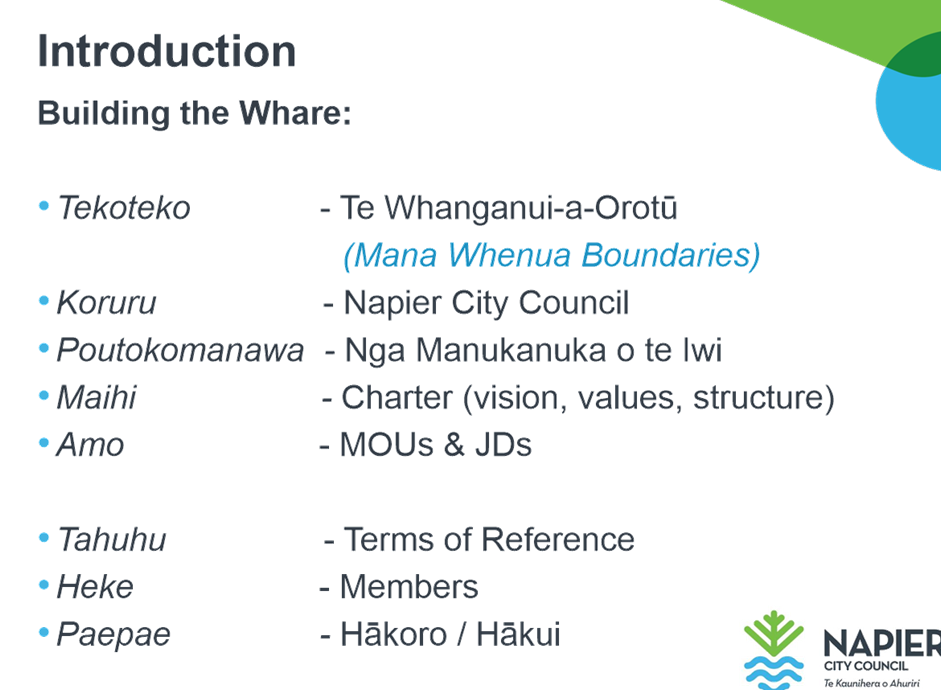
The concept of building a Whare was raised by Te Waka Rangapū as a way of conceptualising the work that needs to occur to build the Committee – that, there are many aspects to the Whare that are important and each require to be defined. These individual components also need to fit in with the other components as a solid whole to ensure the Whare is built well and is strong. For example, you need a Tahuhu to support Amo and vice versa to build a strong Whare.
· Tekoteko (prominent ancestor is Ahuriri) - Te Whanganui-a-Orotū
(Mana Whenua Boundaries)
· Koruru (face part of the whare) - Napier City Council
· Poutokomanawa - Nga Manukanuka o te Iwi
· Maihi (arms down the whare) - Charter (vision, values, structure)
· Amo (side parts of the whare) - MOUs & JDs
· Tahuhu (backbone inside the house) - Terms of Reference
· Heke (ribs) - Members
· Paepae - Hākoro / Hākui
Committee members have suggested options such as attendance at Standing Committee meetings and Council should be explored[1]. Before selecting options, Officers have recommended that the focus be to define the current state of the Committee including any issues. This focus is to ensure a collective understanding is gained on what the current issues are, and what is to be achieved, so that any solutions can be assessed against the issues and desired outcome. Then aspects like a Charter, and Memorandum of Understanding can be further developed. This approach will help ensure attention is being provided to all aspects of the Whare.
Process to date
Officers collated information for the Committee’s workshop on 15 September 2021 including:
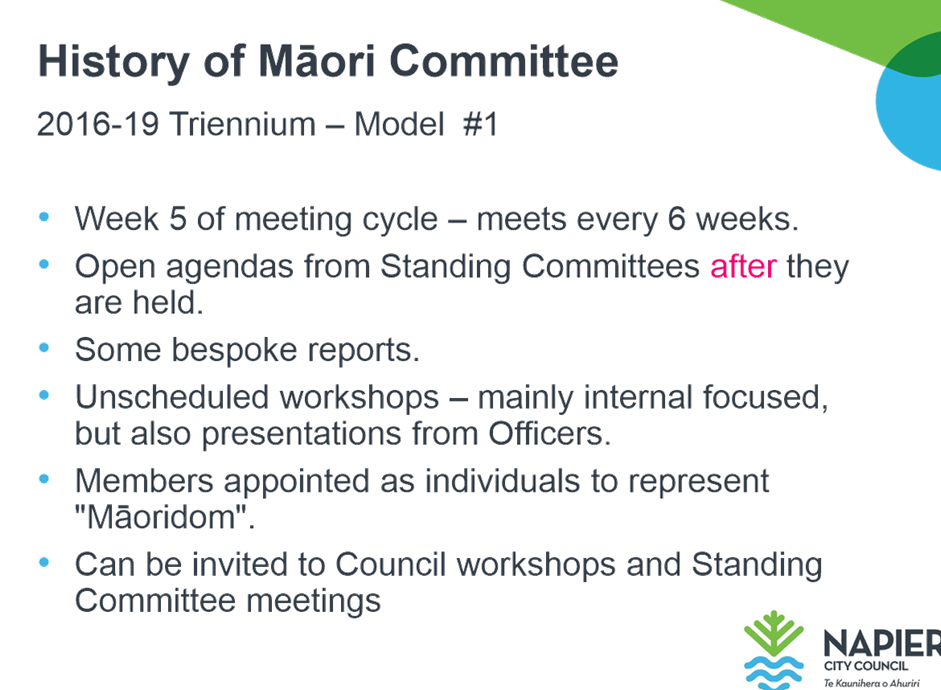
- Council’s current governance model and how it operates – this information was provided to give a sense of scale and time commitment, and to show how decision-making currently occurs and at which parts of the model.
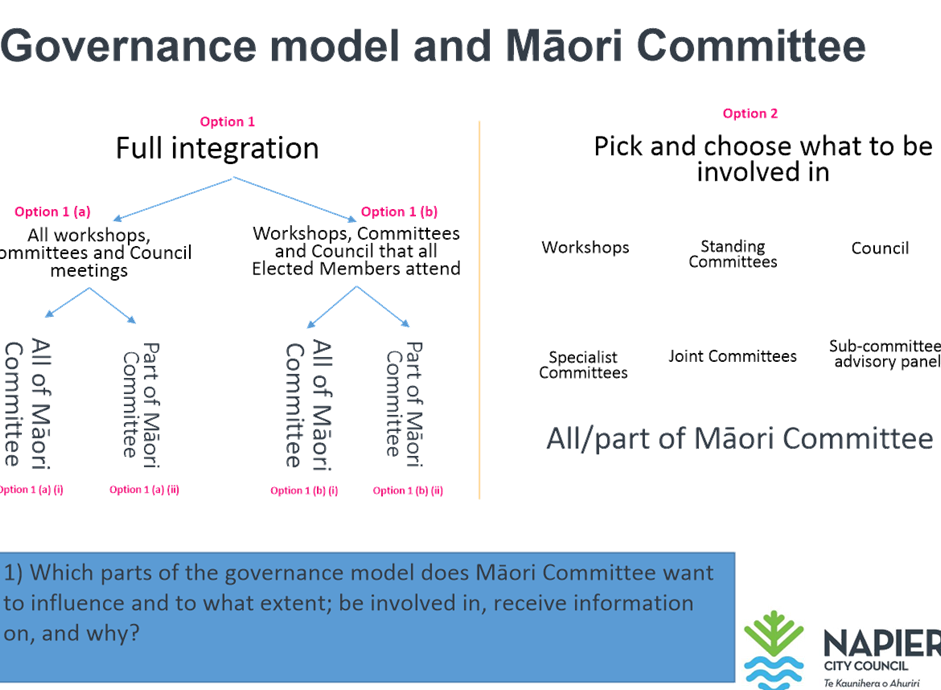
- Options to best integrate the Committee into Council’s governance model – this information was provided to lay out all the options for consideration including options for bringing Committee members onto other Council meetings/workshops, and options for Officers to use the Committee in different ways.
The following information is a collection of the key findings from the 15 September 2021 workshop. More detailed information can be found in Appendix A.
Defining the current state of Ngā Mānukanuka o te Iwi
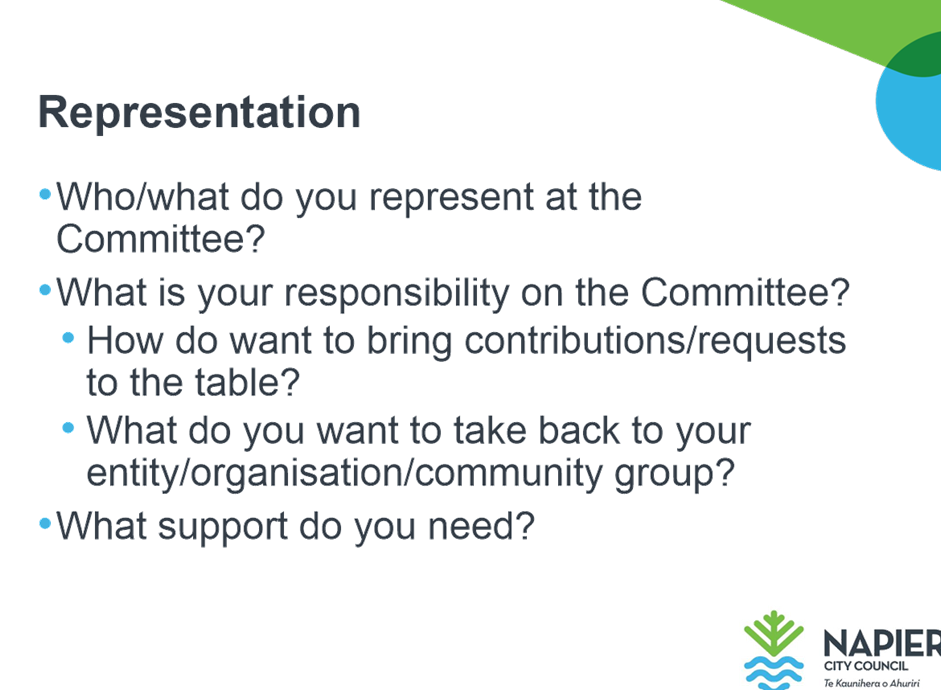
Questions for reflection were sent to Committee members to inform the whakaaro at the Committee’s wānanga on 15 September 2021 including:
· Who/what do you represent at the Committee?
· What is your responsibility on the Committee?
• How do want to bring contributions/requests to the table?
• What do you want to take back to your entity/organisation/community group?
· What support do you need?
Discussions
were held to identify what the current challenges are. The following
section presents the definition of challenges.
Challenges
Opportunity to shape and set direction
- The Committee have limited opportunity to set direction early in the decision-making process. Although the Committee are invited to Council workshops, there are no details around how this works and, in practice, this does not occur. There is currently no mechanism to determine to what extent and how Te Ao Māori (a Māori worldview) should be incorporated from the initiation of a project.
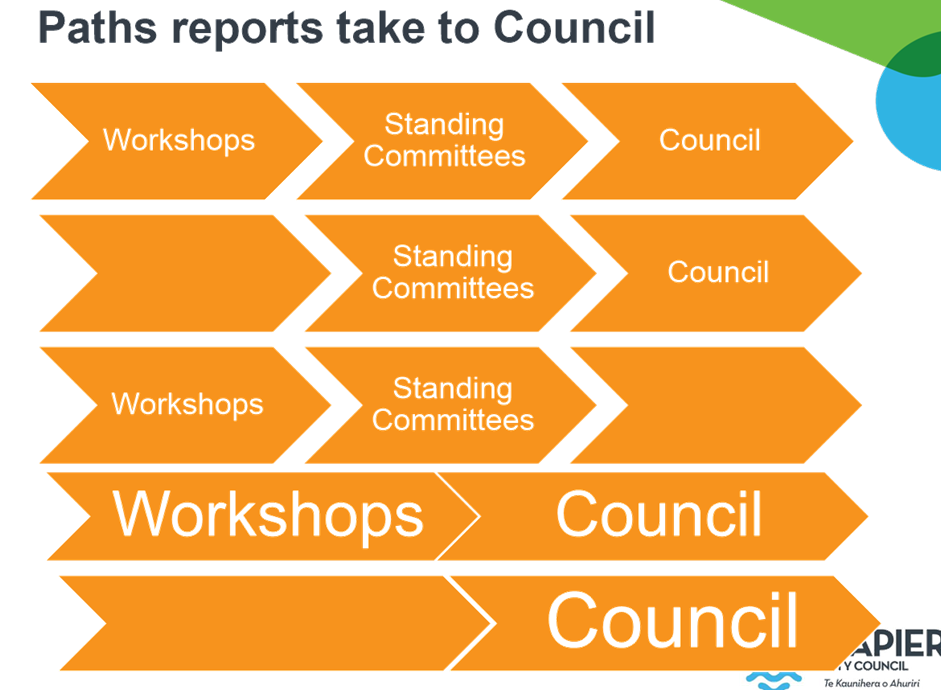
- The Committee are not provided with an opportunity to participate in decision-making in Council’s annual and long term planning processes. There is currently no mechanism for including the Committee in Council’s planning processes e.g. annual planning and long term planning, as direction is set at workshops and decisions are made at Council meetings, bypassing the Standing Committees due to timeframes.
Opportunity to influence decision-making
- Standing Committees are where the majority of Council’s decisions are formed. Holding the Committee after the Standing Committees does not provide the Committee with adequate opportunity to influence and shape decision-making.
- The Committee’s agenda is too large – consisting of the open agendas of 4 Standing Committees and bespoke reports. The preparation time for this large meeting is unreasonable and it is difficult for the members to focus on any particular issues in depth.
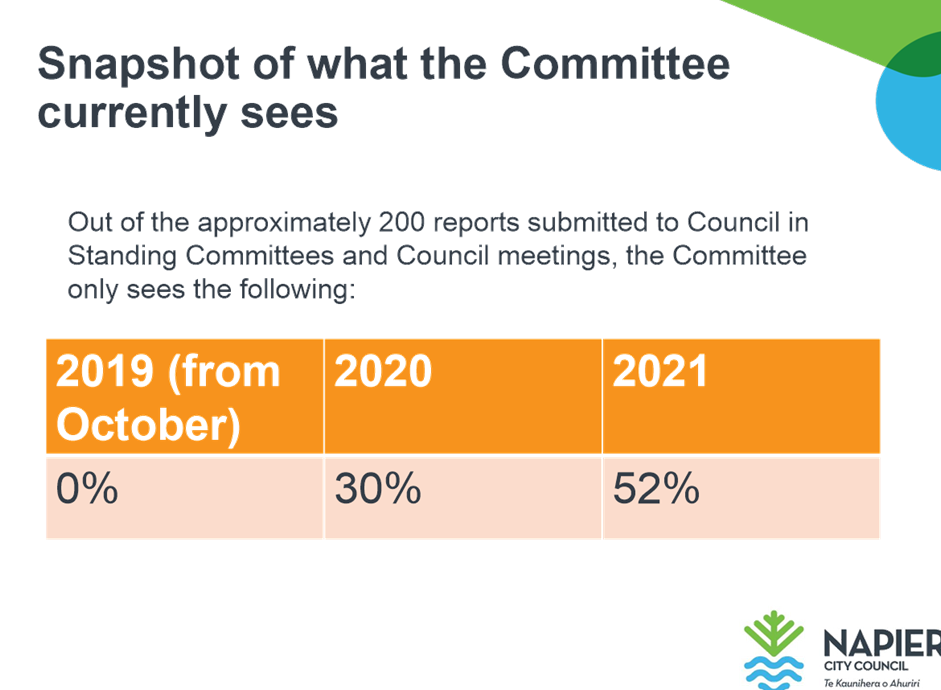
- It is unclear whether there is value for the Committee members to see and input to all Council reports or whether there are types of reports or particular topics that are of more interest to the Committee. Currently the Committee receive less than approximately 50% of all Council reports due to reports being submitted directly to Council, thus bypassing Standing Committees; decisions of Council at Committee meetings; or reports in public excluded that they are not provided with.
- Although the Committee is invited to attend Standing Committee meetings and Council meetings, there are no details around how feasible and efficient this is, and it is not practiced.
- Members voiced their interest in being able to bring items to the Committee table at their own volition, perhaps to bring a matter to Council’s attention, or to initiate work on a particular issue, without having to wait for it to be brought to them by Officers.
Opportunity to develop Committee’s capacity to participate in decision-making
- The Committee members want a better understanding of reports so they can be more informed and engaged. There is currently no mechanism to provide the Committee (or Council) with analysis to show how a report will impact on Ahuriri Māori, or clarity around who might be best placed to formulate that advice.
- The Committee want a better understanding across Council business so they can make more informed decisions about their level of participation in the governance process. Members stressed that they did not want the Committee’s involvement to be a tick box exercise, but providing meaningful input. There is limited induction provided to Committee members.
Opportunity for all members to participate
- The Committee members are busy and have limited time to be able to dedicate to their role.
- Quorum has been difficult to achieve in the past.
- There is no membership from 3 out of 5 Māori entities.
- Preparation work required is not currently set out or acknowledged.
Who do the Committee members represent?
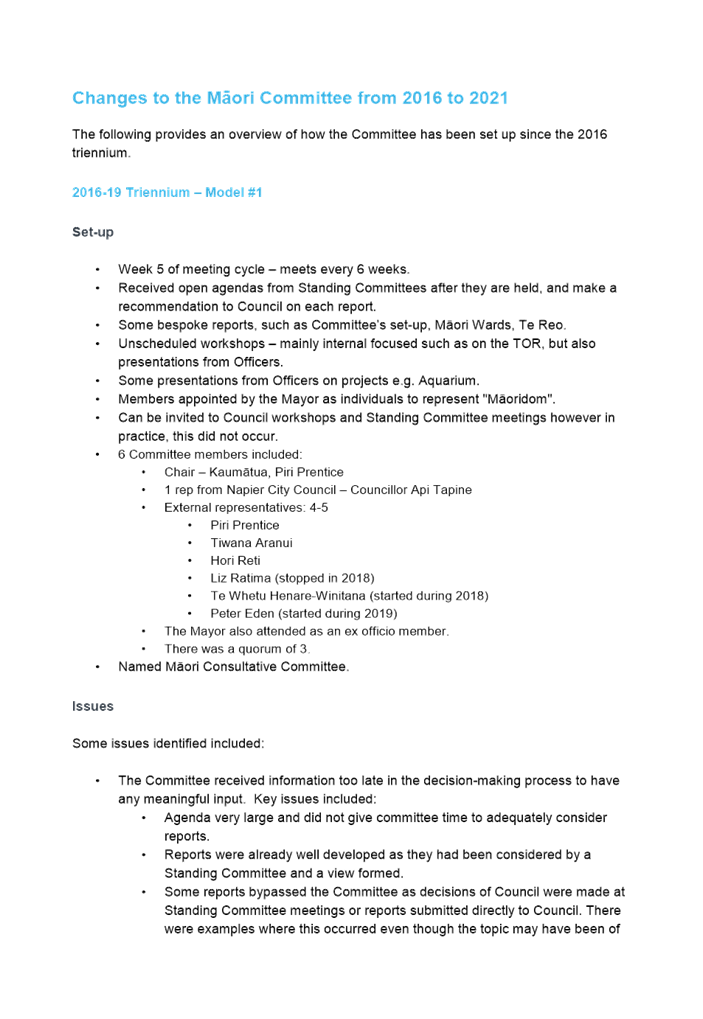
Committee members do not all represent the same people. Some members see themselves as representing all Māori in Napier, whereas other members represent members of a particular Hapū. This is similar to the concept of wards and at large representation of Elected Members. Committee members highlighted whom they represent when they are on the Committee. Responses included:
- Hapū Trust
- Hapū members
- Māngai ā-Hapori
o Any Māori that live in Napier
o Whānau-specific views
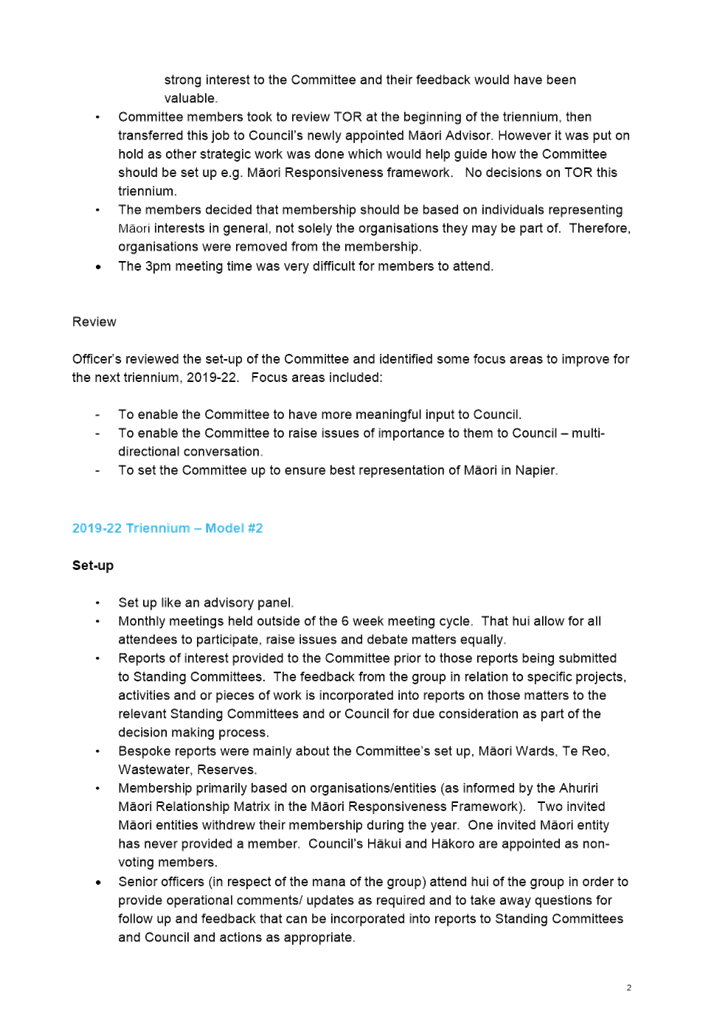
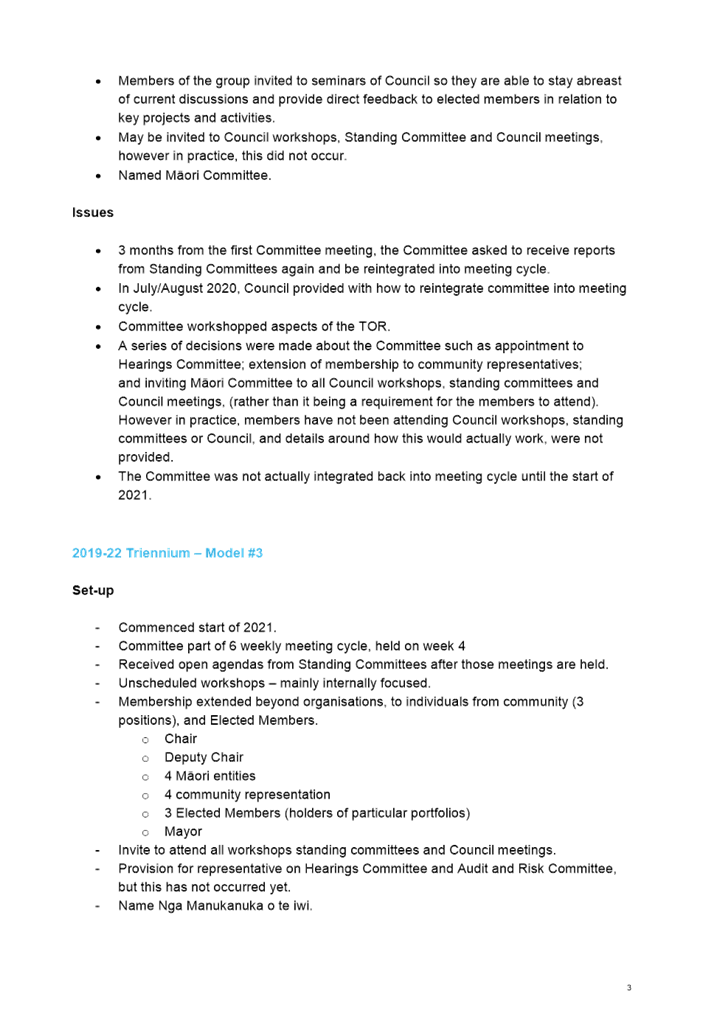
The current membership make-up was based on the Māori Responsiveness Framework to ensure Council meet all its legal obligations to particular groupings of Māori in Ahuriri. The membership was then expanded to include Māngai ā-Hapori (individuals from the community) as a way of bringing specific skill sets to the Committee e.g. financial or governance experience and for meeting quorum. Subsequently, the membership expanded again to include three more Elected Members to enable them to share their knowledge of the workings of Council with the Committee[2].
Responsibilities for representation
There is a lot of intersessional work between meetings for the Committee members, both prior to a meeting and after a meeting, to gain views, and share information with those people the Committee members represent. At the meetings, Committee members are trying to reflect on what the item in front of them may mean for those they represent and represent their views.
What are the particular needs of Committee members
The Committee members highlighted that they require:
- better induction so they can understand how Council works and how they fit in;
- more targeted information on impacts to Māori; and
- more time to reflect on information provided.
Outcomes
To bring focus to what the outcome of integrating the Committee into Council’s governance structure should be, the following suggestion was made by Officers:
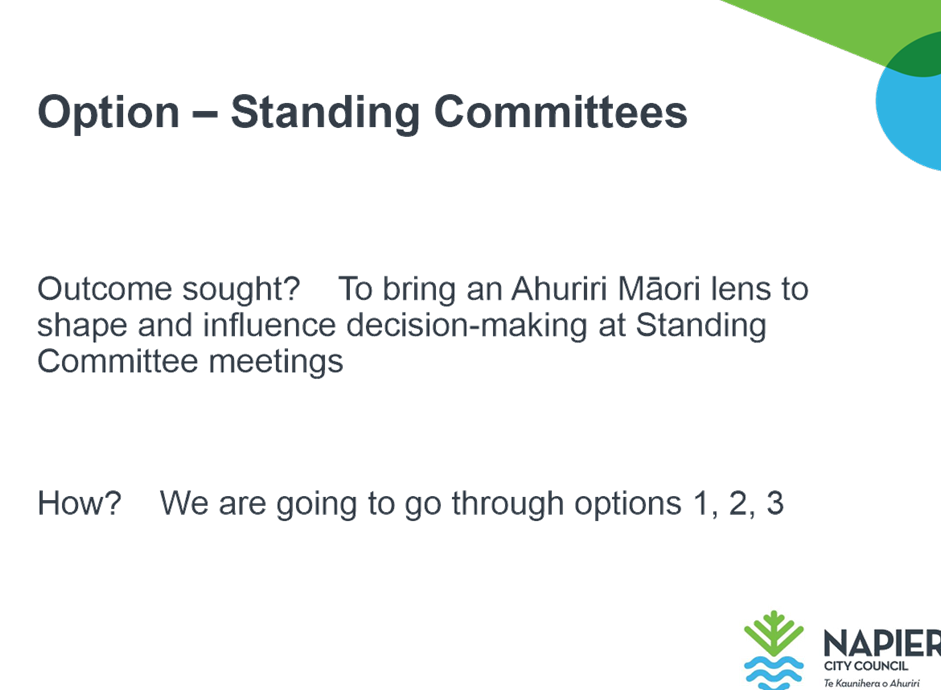
an Ahuriri Māori lens to shape and influence Council's decision-making.
This outcome was selected to demonstrate the desired impact of the Committee on Council’s decision-making – that the Committee is active and effecting change to decision-making.
The critical question then is how to bring an Ahuriri Māori lens to Council's decision-making, and where will this have the most impact? This question is explored in the section below on options.
Options to integrate the Committee in Council’s governance model
Options must address the needs and issues raised, and what the outcome sought is, otherwise meaningful change will not occur. One of the main implications of the needs and issues raised is that the current Committee model is not fit for purpose and needs to change. The outcome sought will also help guide the options for solutions to address the needs and issues. Options must also be grounded with responsibilities and time commitment – there is no merit in having a policy position that cannot be fulfilled as it is not feasible.
A process approach was taken to define options, exploring options for representation of the Committee in Council’s current governance model. The limitations of this approach are that only options within Council’s current governance model have been included. Options such as removal of Council's current double debate structure, or if Council agreed to establish Māori Wards, have not been included as significant changes such as these are reviewed, planned and, where appropriate, consulted on based on legislative timeframes and in line with triennial arrangements.
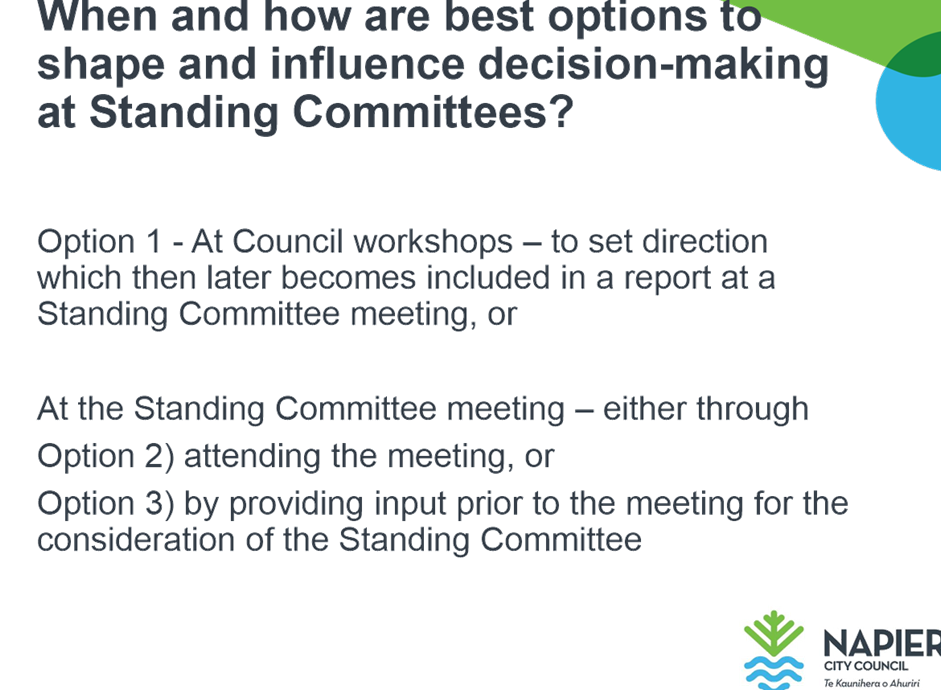
When and how are best options to shape and influence decision-making?
Discussion and debate at, or before, Standing Committees, matters because most Council decisions flow on from recommendations made at Standing Committees[3]. Those recommendations are in turn informed by Officers’ recommendations which are also informed by Council workshops. This means that when considering how to bring an Ahuriri Māori lens to Council's decision-making, and where it will have the most impact, Standing Committees must be considered.
There are three main options for shaping and influencing Standing Committees, and therefore Council decisions:
Option 1 - At Council workshops – to set direction which then later becomes included in a report at a Standing Committee meeting, or
At the Standing Committee meeting – either through
Option 2 - attending the meeting, or
Option 3 - by providing input prior to the meeting for the consideration of the Standing Committee
Option 1 – attending Council Workshops
|
Time commitment |
97+ hours per annum. Typically workshops are held for a couple of hours at a time. |
|
Advantages |
· Time to reflect, ask questions, shape direction early in decision-making process. · Build knowledge of complex items in Council business, helps with induction and understanding Council business. · Privy to discussions occurring prior to Standing Committee meetings. · Ability to participate in annual and long term planning workshops. |
|
Disadvantages |
· Significant time commitment. Workshops can be called outside of routine slots and often with short notice, which may make it difficult for representatives to attend. · Not all Standing Committee reports or Council reports have a workshop. So would miss out on those reports. · May feel unable to speak freely with all Elected Members there. · If Committee only participates in these workshops, it does not allow for transparency on what direction Committee members are providing as the workshops are not held in public. · Attendance of only selected members of the Committee may require an additional mechanism for gaining views of all Committee members and report back. |
|
Things to consider |
· Is there value for the Committee members in attending all Workshops or only some? If so, how are workshops of interest identified? · Is there value in the Committee being represented by one or two Committee members at a Workshop? · What would be the point of difference or value of having specific workshops for the Committee instead of the Committee being involved in Council workshops? |
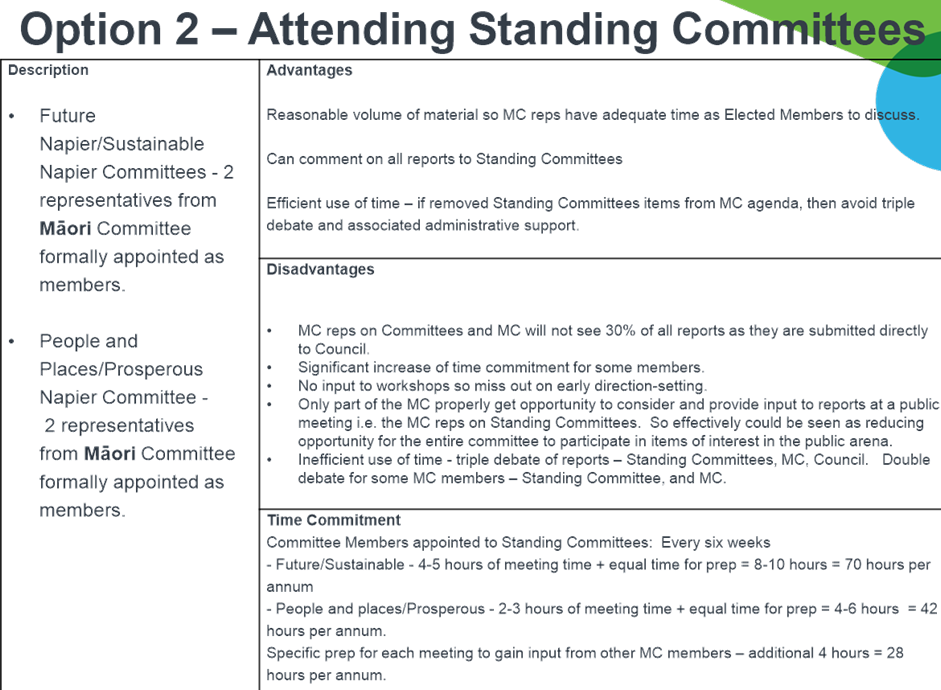
Option 2 – attending Standing Committee meetings
Committee Members either formally appointed to Standing Committees as a full member with speaking and voting rights, or provided with speaking rights.
|
Time commitment |
Every six weeks · Future Napier Committee/Sustainable Napier Committee - 4-5 hours of meeting time + equal time for prep = 8-10 hours = 70 hours per annum · People and Places Committee/Prosperous Napier Committee - 2-3 hours of meeting time + equal time for prep = 4-6 hours = 42 hours per annum. · Specific prep for each meeting to gain input from other Committee members– additional 4 hours = 28 hours per annum. · All Committee members to read through specific reports, or all reports, to provide view and seek views from those they represent – 2 -3 hours = 21 hours per annum. |
|
Advantages |
· Reasonable volume of material in a meeting so the Committee representatives have adequate time, like Elected Members do, to reflect and discuss. · Can comment on all reports to Standing Committees · Efficient use of time – if removed Standing Committees items from the Committee agenda, then avoid triple debate and associated administrative support. |
|
Disadvantages |
· The Committee’s representatives and the rest of the Committee still will not see 30% of all reports as they are submitted directly to Council. · Significant increase of time commitment for some members. · No input to workshops so miss out on early direction-setting. · Only part of the Committee properly get opportunity to consider and provide input to reports at a public meeting i.e. the Committee’s representatives on Standing Committees. So effectively could be seen as reducing opportunity for the entire Committee to participate in items of interest in the public arena. · If keep Standing Committee agendas on the Committee’s agenda, inefficient use of time due to triple debate of reports. Double debate for some Committee members – Standing Committee, and then the Committee. |
|
Things to consider |
If appointed to a Standing Committee as a member of that Committee, - Appointment of a particular person is required. Full attendance at each meeting is required by the particular member appointed. - As two Standing Committees are held on the same day, realistically any representative should be appointed to and attend two Committees. To only attend one would mean the attendee would need to wait as the two Committees switch through open and closed agendas, and there is no knowing how long a Committee meeting will go for. - Mechanism for representation of the rest of the Committee and feedback to the Committee is required. - Quorum may need to be updated. - Votes and casting vote to be considered. If want to retain odd number as majority, then would require 2 representatives in addition to the 13 Elected Members. - Council decision whether to appoint external representative(s) to a Committee and appoint a particular person. If appointed with only speaking rights, more discretion for the members of whether they attend and who attends. |
Option 3 - provide input prior to the meeting for the consideration of the Standing Committee
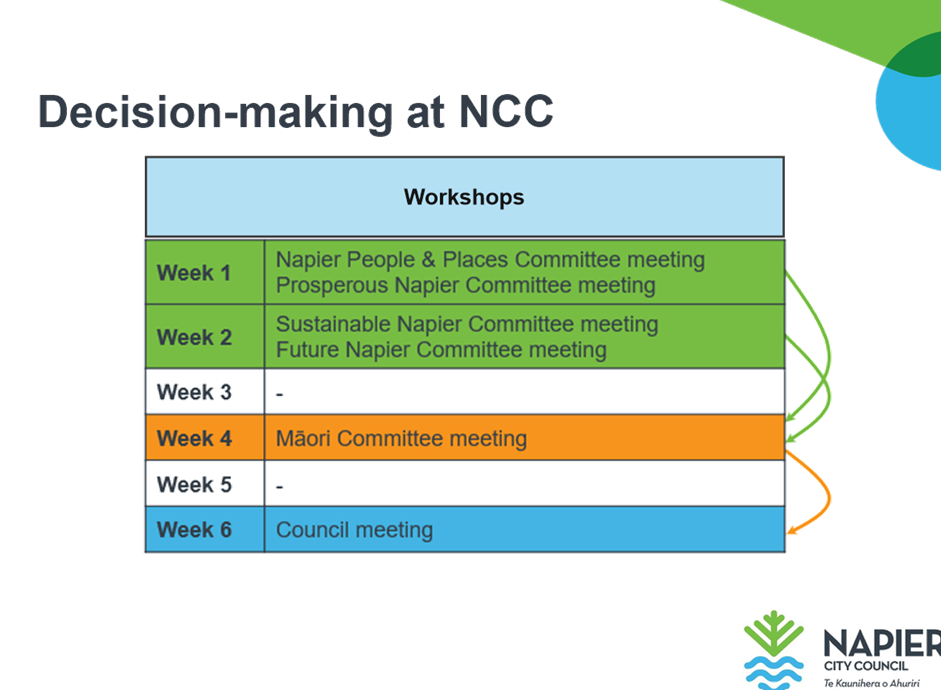
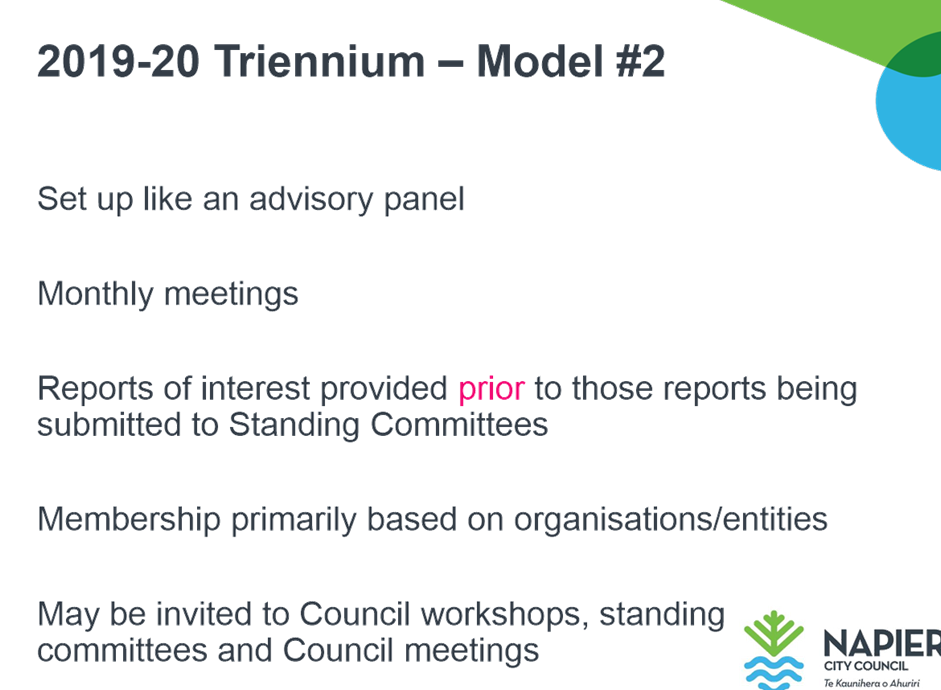
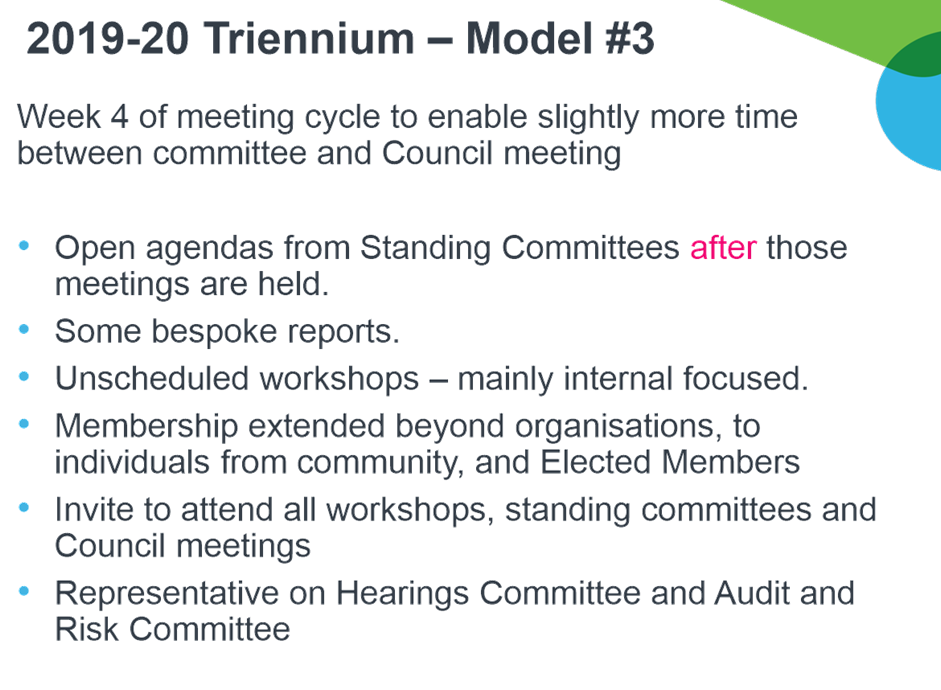
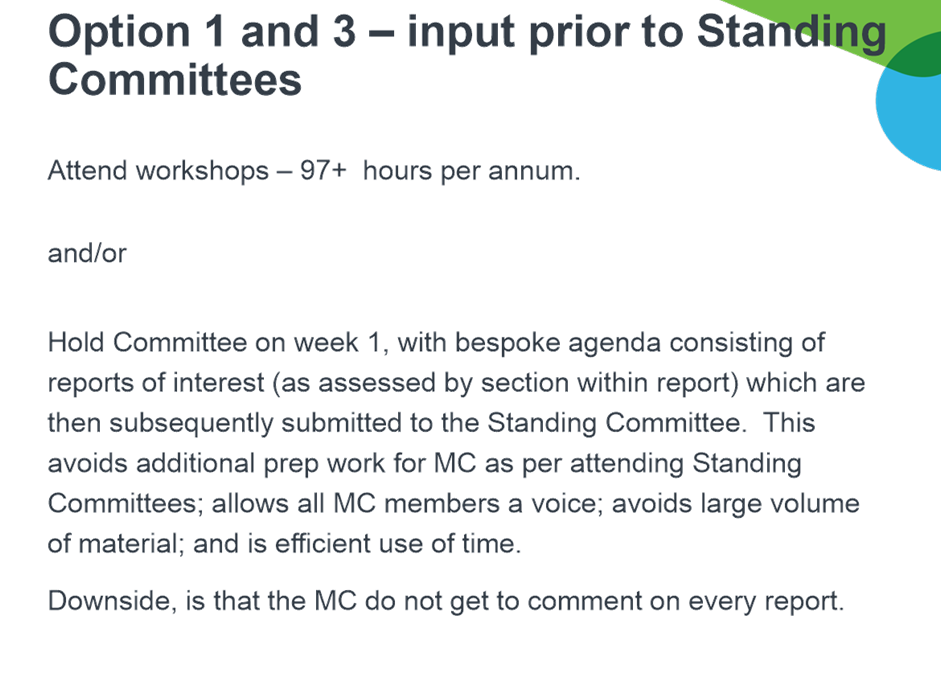
The Committee could be held prior to the Standing Committees, in Week 1 of the meeting cycle. The Committee receive bespoke reports of interest (pre-selected, method tbc). Committee makes a recommendation on those reports to the Standing Committee.
|
Time commitment |
Every 6 weeks: 2 hourly meeting + equal prep time = 4 hours every 6 weeks, 7 meetings per annum = 28 hours per annum. |
|
Advantages |
· Achieve as similar outcome as Option 2 above to influence Standing Committees · More time efficient - takes only 18% of the time that option 1 takes. · Avoids the need for additional preparation work as per attending a Standing Committee meeting · Allows all members of the Committee to voice their own views on Standing Committee reports of interest to them. · Avoids large volumes of material for the Committee to sift through as in current model – so efficient use of time, and allows Committee to spend greater time of items of interest. |
|
Disadvantages |
· Do not get to comment on every report being submitted to Council. · Do not get to attend a Standing Committee meeting or Council meeting and speak so might lose ability to influence Elected Members on the day. · No input to Council workshops so miss out on early direction-setting. |
|
Things to consider |
Method for determining which reports are provided to the Committee needs to be defined. Committee has never been held prior to the Standing Committees, but has received only bespoke reports. |
Option 4 - Attendance at Council meetings
|
Time commitment |
134+ hours per annum.
|
|
Advantages |
· Can feed into the 30% of reports that are submitted directly to Council and bypass Standing Committees. |
|
Disadvantages |
· Cannot legally be an appointed member, can only be allowed speaking rights, not voting rights. · Large time commitment for both scheduled and Extraordinary Council meetings. Extraordinary meetings are used frequently so the timings for these are not known until a week or so prior to the meeting, and typically have hearings which mean the meeting length can be very long e.g. all day, or multiple days. · Large time commitment for only 30% of reports. · Too late in decision-making to have ability to change decision-making based on Standing Committees, could result in delaying Council business, or input could be ignored by Council. Without voting rights, this could lead Committee to become very disengaged as they do not have ability to influence at this level at this time. |
2.3 Issues
How to achieve the right balance
At the forefront of thinking through the most effective and efficient options for how the Committee should be integrated into Council’s governance structure, are the following points,
- enabling the Committee to shape and influence Council decision-making
- effective use of the limited time of the Committee members
- efficient use of Officers’ time to support the Committee.
There are advantages and disadvantages to every option, and the Committee can consider for themselves what works for them at this particular point.
Options need to be informed by lessons from the past
The Committee set-up has changed several times in the last triennium. In order to move forward with the Committee, it is important to consider what has not worked previously in order to not repeat that. For example, although well-intentioned, a policy position such as, Committee “members will be invited to attend Council workshops, standing committee meetings and Council meetings”, lacks substance if the details around implementation have not been thought through and it is not practical.
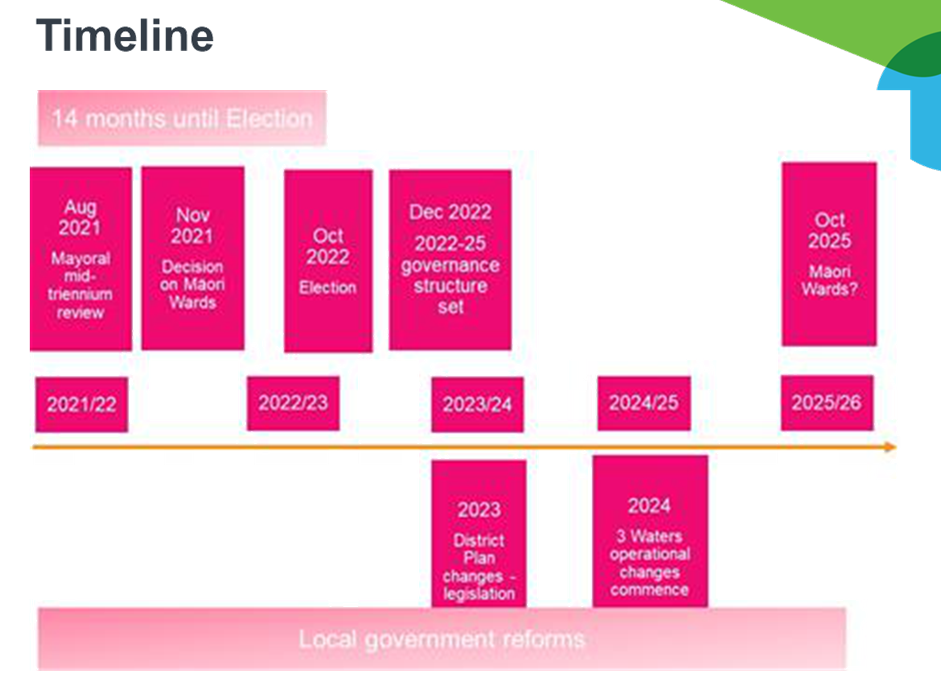
Whatever option is selected this year, it should be set up to commence in 2022, and a review of it should occur no later than August 2022 so that the findings can inform the options and issues for consideration in setting the next governance structure after the Local Government election in October 2022.
Options need to be grounded in reality
The current reality for the Committee, is that the members are saying they need more induction in order to know what are the right questions to ask; they need better targeted information to make informed input on reports; they need time to reflect on reports; and time to talk with those people they represent.
The members are also busy with their own jobs, and making themselves available for the Committee meetings and workshops is challenging - let alone being called in for Council workshops which can be held at any time, or Standing Committee and Council meetings in which the length of a meeting is unknown and the meetings can go for half a day or even days.
The current expectation of Committee members to read through, seek feedback from those they represent and comment on all reports from Standing Committees in one meeting is unrealistic - it does not provide the Committee with the ability to provide meaningful input.
Being a Committee member is not the same as being an Elected Member, and the role needs to be based on what is a feasible time commitment so that members can actually participate and that they are remunerated appropriately.
Resourcing requirements must also be considered and efficient decision-making. For example, within Council’s current governance structure, due to report review and approval processes and double-debate, it can take 2 months from when an officer has finalised a report, to the point that Council provide a decision on the report.
Council business – defining the value and impact to members
Some critical question that are unanswered include:
- what value do members gain from participating in the Committee?
- what value would members gain under various options for change?
- are there particular areas of Council business that are of more interest due to the impact on Māori?
- how much time can members commit to the Committee?
Time commitment and responsibilities – not just attending a meeting
There is no indication of a time commitment requirement of the members e.g. the Committee’s hui and wānanga, Council workshops, Standing Committees and Councils meetings. Preparation time must be factored in based on the type of meeting/workshop that is being held. Once the time commitment is known, members could make an informed decision on the extent to which they can participate, including what value they would gain from attendance.
Representation
Any option in which only part of the Committee, for example, 1-2 members are appointed to represent the Committee on Council’s other Committees, Council, or at Council workshops, assumes that the Committee can, and are happy to be, represented as a collective, despite the various different groupings they each represent.
It would require a mechanism for the Committee’s representative to gain input from other Committee members on items in the workshop/meetings, in order to be able to represent the Committee’s views. Ascertaining those perspectives would not necessarily tidily align to Ngā Mānukanuka o te Iwi meetings, so some of that discussion would have to take place ‘offline’, via email for example, which doesn’t foster a space for constructive discussion as a group. To be able to provide this input, other Committee members would need to be provided with information on the topics, which means there would be a time commitment involved for them too, even though they are not the representative on the Standing Committee.
If a mechanism as outlined above is not used, then this would mean that the members appointed outside of the Committee to other Council workshops/meetings would be either representing their own views of their entity or community they represent; or they would be taking a pan view across “Māoridom”. This would result in a lack of representation of all members of the Committee, members of which were selected based on the Maori Responsiveness Framework to meet Council’s legal obligations for engagement (see Policy section).
Participation in Workshops/Meetings outside of the Committee
The Local Government Act 2002 sets out which types of meetings external representatives i.e. non Elected Members, can be appointed to, and under what basis. Council sought legal advice on the matter. In summary:
- the Council cannot formally appoint a person to the governing body of the Council or provide voting rights.
- the Council can appoint members of the Committee to its standing or specialist committees, provided the appointee has the necessary skills, attributes or knowledge to assist the work of the particular committee.
- a person formally appointed by the Council to a committee becomes a member of the committee and has voting rights.
- alternatively, the Council can provide (through standing orders), for a Committee representative to attend as an observer/advisor and have speaking rights, at either Council or committee meetings.
- There are some risks with appointing observers/advisors to Council/Committees with speaking rights, such as whether an observer/advisor with speaking rights but no voting rights could be regarded as a defacto member of the Council or Committee, as a result of their influence over that body through their right to speak.
- Representatives can remain in public excluded parts of any meeting, if the representative has knowledge that will assist the Committee/Council for the matters being considered, and there is a resolution made that provides for them staying in the room.
2.4 Significance and Engagement
Engagement is occurring with the Committee members through wānanga and hui. However, there are invited members who have chosen not to join the Committee. It is recommended that Te Waka Rangapū reach out to those Māori entities to advise about this work that is underway, and invite them to the upcoming wānanga.
2.5 Implications
Financial
There are likely to be financial implications if changes are made to the Committee, e.g. such as if Committee members are appointed to a Standing Committee, or attend Council workshops, then an appropriate remuneration model would need to be assessed and budgeted for within the 2022/23 annual plan. Any changes effective of 1 January 2022 will need to be found within current budgets for 2021/22.
Social & Policy
Council has two policy documents about Māori and decision-making:
1) Council’s Māori partnerships team developed the Māori Responsiveness Framework in 2018. This document is still in draft form. It includes objectives and a Ahuriri Māori Relationship Matrix which informs what entities Council includes in the Committee.
It sets out objectives such as:
- Kei Runga – Governance: To enable effective Māori participation in NCC's governance processes through the facilitation of governing body and local board Māori responsiveness programmes, building capacity to foster effective Māori participation in NCC business.
- Kei Waho – Māori: To contribute to significantly uplifting Māori social and economic wellbeing through the facilitation of cross-organisation and cross-regional Māori well-being programmes.
- Kei Roto – Organisation: To embed Māori responsiveness as a core element of NCC's culture, operations and service delivery. To put in place measures to evaluate NCC’s ‘Māori Brand’ performance.
- Te Waka – Department: To develop a high performance team culture through the effective implementation of the Māori Cultural Competency Framework and Māori Cultural Development Plan.
Council now has a Māori Partnerships Directorate, Te Waka Rangapū, with a Director and 3 FTEs to progress partnerships with Māori.
2) The Significance and Engagement Policy includes a specific section about engagement with Māori, particularly to engage in a range of ways to ensure their views are appropriately represented in the decision-making process (not solely through the Committee). This policy includes engagement with mana whenua and tāngata whenua. In particular, engagement with mana whenua, for any significant decision in relation to land or a body of water.
Risk
Not meeting legislative requirements.
Knowing that the current model does not enable the Committee to provide meaningful input to Council’s decision-making; and the Committee feel they require more targeted information and induction to enable them to participate in decision-making, the risk of not making change is:
- Napier City Council could be seen to provide insufficient opportunity for Māori to participate in decision-making and could be argued that the requirements of sections 77 and 81 of the Local Government Act 2002 are not being met (Appendix A includes a diagram of legislative requirements from the Local Government Act 2002).
Setting up an undesirable and/or unfeasible model
The risk is that without a clear understanding of the time commitment and resourcing requirement to support an option, any decision on an option may result in an unaffordable model.
There is a risk that members cannot commit to a particular option due to the time commitment and responsibilities required, or that they do not see any value in a particular option, so they do not participate as a member or do not attend all meetings.
Missed opportunity
The risk is that both Council and the Committee are missing an opportunity for the Committee to hear and input to long term planning and annual planning, and this could result in:
· frustration for the Committee where they realise they are limited in their ability to provide recommendations to Council for consideration;
· Council misses out on valuable insights from the Committee;
· reputation risk as stakeholders may perceive that Council is not enabling the Committee to be able to influence key budgetary decisions.
Unknown position of iwi entities not currently participating in the Committee
There is risk involved in that options for change are being worked through without a detailed understanding of the concerns held by those iwi entities who have opted not to participate in the current Committee. There may be more issues with the current model that are currently unknown, or strong opinions about potential models that would not be factored into decision making, that ultimately result in an outcome that continues to be unappealing/unfit for purpose to those entities. Targeted engagement with those groups to understand their concerns and aspirations should be pursued.
2.6 Options
The options available to the Committee are as follows:
a. Agree to the definition of challenges and desired outcome provided
b. Modify
the definition of challenges problem and desired outcome and then agree
to it.
2.7 Development of Preferred Option
Either option a or b.
a Local Government Act 2002 requirements for Māori and decision-making
b Presentation for Ngā Mānukanuka o te Iwi's wanānga on 15 September 2021
3. Model for integrating Ngā Mānukanuka o te Iwi into Council’s Governance Structure
This report will be a supplementary agenda item, and will be published two business days prior to the meeting to meet with legislative requirements.
Reports from standing committees
|
Māori COMMITTEE RECOMMENDATION That the Māori Committee Recommendations arising from the discussion of the Committee reports be submitted to the Council meeting for consideration. |
Reports from Napier People and Places Committee held 4 November 2021
2. Safer Napier's Reaccreditation Application
|
Information |
|
|
Legal Reference: |
N/A |
|
Document ID: |
1388097 |
|
Reporting Officer/s & Unit: |
Michele Grigg, Senior Advisor Policy |
2.1 Purpose of Report
To provide an update on Safer Napier’s reaccreditation application.
|
Mayor Wise / Councillor Simpson The Napier People and Places Committee: a. Note the Safer Napier reaccreditation application, which was submitted on 1 October 2021. b. Note the outcome of the Safer Napier reaccreditation application will be confirmed on 1 December 2021. Carried
|
The Safe Community model is widely known internationally and is recognised by the World Health Organization as an effective intervention to address community and individual safety, resilience, and wellbeing.
Napier City is proud to be an accredited Safe Community after being first accredited in 2010 and then reaccredited in 2016. Reaccreditation every five to seven years is a requirement for Safe Communities that wish to retain their accreditation status.
Community safety remains a key priority for Napier residents and Council. The Safe Communities model provides an effective framework to address community safety in a collaborative way. Napier City Council is the lead agency for the Safer Napier programme, which is driven by the Safer Napier Strategic Group (SNSG), comprising representatives from 16 agencies and organisations.
Safer Napier Reaccreditation Application
The Safer Napier 2019-2020 annual summary to Council referred to the SNSG’s intention to apply for reaccreditation. Our intent to reaccredit was also endorsed by many of Safer Napier’s coalition partners who attended the annual planning workshop in May 2021.
The national Safe Communities Foundation of New Zealand (SCFNZ) identified Safer Napier as meeting the criteria for reaccreditation ‘Pathway One: Confirmation”. This is one of three pathways to reaccreditation. Pathway One is identified for communities that are “fully functioning and are demonstrating ongoing sustainability of the adoption of the Safe Community model.” This allows for a flexible, innovative application where compliance with the four reaccreditation performance measures, is already established.
Safer Napier’s reaccreditation application was submitted on 1 October 2021. The application development involved by a wide range of agencies, organisations, and community groups who share a common goal of improving safety in all its forms in Napier. Guidance for preparing the application was provided by a sub-group comprising members of the Safer Napier Strategic Group.
The application sets out Safer Napier’s key highlights since our last reaccreditation and considerations for the future (Attachment A). The application also demonstrates a range of evidence against each of the four required performance measures (Attachment B):
· Collaborative governance
· Priority setting
· Effective strategies
· Shared learnings.
The application is supported by a number of documents, which illustrate our wide-ranging commitment to the programme (Attachment C).
Coalition Partners
Accreditation of the Safer Napier programme encourages commitment to a collaborative approach between organisations, agencies and the community to foster a safe and healthy city. This is reflected in the number of coalition partners who have recommitted to the kaupapa by indicating they will sign a new Memorandum of Commitment at the reaccreditation site visit and ceremony later in 2021.
The Memorandum is a mutual agreement to work together for the benefit of the community across a range of safety issues. New partners have also committed to joining the Safer Napier network. Our signatory partners have increased in total from 43 in 2016 to 58 (as at October 2021).
Assessment and Site Visit
Our application is being reviewed by a team of six, including an international assessor based in Australia. The review team includes representatives from the SCFNZ, Te Hiringa Hauora (Health Promotion Agency), and other long-standing Aotearoa New Zealand Safe Communities.
The assessment team plans to visit Safer Napier on 1 December 2021 (if possible under Covid alert levels). This site visit is an opportunity for Safer Napier to present and showcase our achievements, and our commitment to the kaupapa.
We anticipate this visit will be followed that same day by a reaccreditation Ceremony, hosted by Mayor Wise as Safer Napier’s Ambassador (also alert level-dependent). This is also when coalition partners will be invited to sign the 2021 Memorandum of Commitment to confirm their ongoing support of the programme.
2.3 Issues
The national Safe Communities Foundation of New Zealand is ceasing to operate from late 2021. The current 20 accredited Safe Communities is working to establish a national network of communities (led, managed and coordinated by the collective) to ensure sustainability and continued connection. We are part of a small working group who are scoping this work at present.
The upcoming transition provides an opportunity to enable more flexibility around priority setting, while at the same time benefiting from being part of a wider network. There is a continued need for some form of national network to enable a strong collective voice to advocate for community safety where more can be achieved in partnership than as individual entities. We have also benefited from the sharing of best practice and learnings with other accredited communities – the continuation of these opportunities within a national network remains important.
2.4 Significance and Engagement
Reaccreditation offers an opportunity to review the strategic direction of the programme, reconfirm commitment from partners, and ensure alignment with relevant national and regional strategies. Alignment internationally is also important, in particular how the programme’s goals link with the United Nation’s Sustainable Development Goals (Attachment D).
Reaccreditation enables Safer Napier to remain a member of the Pan Pacific Safe Communities Network (PPSCN), which includes all Safe Communities in New Zealand, Australia, and the United States of America.
2.5 Implications
Financial
Council provides ongoing funding for the part-time Safer Napier Coordinator through the Long Term Plan 2021-2031. Project funding is sought through external channels wherever possible. It is anticipated the transition to a national network of communities will attract other funding opportunities for the wider programme going forward.
Social & Policy
The Safer Napier programme plays an important role in community safety, in all its forms, as it demonstrates collective action across a range of agencies and organisations under the one umbrella.
The Ambassador of the Safer Napier programme is Napier’s Mayor, Mayor Wise, which further strengthens its profile and reputation, both locally and nationally.
Risk
Council is currently the primary funder for delivery of Safer Napier and many of its flagship projects and events. Reaccreditation along with transition to a new community network model provide an opportunity to broaden support nationally for the Safe Communities programme.
2.6 Options
The options available to Council are as follows:
a. Note the Safer Napier reaccreditation application which was submitted on 1 October 2021.
2.7 Development of Preferred Option
N/A
|
The Officer spoke to the report and showed a short video which accompanied Napier City Council’s (NCC) application for reaccreditation. In response to questions from the Committee it was clarified: · Safer Napier is a member of the Pan Pacific Safe Communities Network (PPSCN). That network will continue to establish the framework for the reaccreditation and the accreditation model. · With the national Safe Communities Foundation of New Zealand ceasing to operate the current 20 accredited Safe Communities is working to establish a national network of communities. How this will operate and look will come back through Council. · The Child and Youth Wellbeing Strategy is currently being developed by NCC and has started a working partnership with the Napier Pilot City Trust on this. A workshop will be held on the 20th of November, which is International Children’s Day, which is seen as the beginning of the consultation process and will look at engaging with the Community around what they would like to see in the Strategy. · The development of a Multicultural Strategy is not on the current work programme, but will be coming up in the next year. · A number of years ago there was a Council group which morphed into the Safer Napier Strategic Group (SNSG). It is an operational working group rather than a governance group. Some of the members have Councillor representatives as part of them. There is recognition that Governance needs input into this group and that is why the Ambassador position was established for the Mayor. If it is decided that more governance input is required on the SNSG, Councillor portfolios could be looked at to see who might be most appropriate to include and Officers could provide feedback to Council about how it could work.
|
2.8 Attachments
a Safer Napier Reaccreditation Overview (Under Separate Cover)
b Safer Napier Reaccreditation Evidence Table (Under Separate Cover)
c Safer Napier Reaccreditation Table of Contents (Under Separate Cover)
d Safer Napier and Sustainable Development Goals (Under Separate Cover)
Ngā Mānukanuka o te Iwi (Māori Committee) - 26 November 2021 - Open Agenda
Reports from Sustainable Napier Committee held 11 November 2021
2. Napier Environmental Enhancement Fund Proposal
|
Operational |
|
|
Legal Reference: |
N/A |
|
Document ID: |
1391716 |
|
Reporting Officer/s & Unit: |
Cameron Burton, Manager Environmental Solutions |
2.1 Purpose of Report
This report provides information on a proposed Environmental Enhancement Fund to receive and redistribute money from:
· Reparations from enforcement action under the Stormwater, Trade Waste and Wastewater and Solid Waste Bylaws;
· money applied for from the Ministry for the Environment (MfE), and;
· bequests or the like.
It is proposed the money would be used to provide a fund for research, remediation, planting, and biodiversity enhancement, or for use by community groups to increase connectivity and identity to Napier’s environment.
|
Councillors Brosnan / Chrystal The Sustainable Napier Committee: a. Approve i. The creation of a Napier Environmental Enhancement Fund to receive money awarded to NCC as the result of reparation, applications to Government bodies or bequests or the like, which will be reviewed and reported on annually. ii. The use of the money in the Napier Environmental Enhancement Fund for research, remediation, planting, and biodiversity enhancement, or for use by community groups to increase connectivity and identity to Napier’s environment. Carried
|
Napier City Council recently carried out the first prosecution in New Zealand in relation to a breach of a Stormwater Bylaw. The result of this was that a significant amount of money was to be pledged for the remediation of the impact caused, but Council did not have a fund available for this to be deposited into, therefore deposit to a third party Trust was proposed. To avoid this, Council Officers request the establishment of a Napier Environmental Enhancement fund to be used for this purpose.
2.3 Issues
In this particular case, the Judge was not able to legally bind the Company to make this donation, although he did point out that their discharge without conviction was influenced strongly by their reparation towards a planting proposal.
The practical difficulty with the replanting proposal is that NCC already has remediation plans in train for the area involved but due to the contaminated state of the chosen environment and its surrounds, replanting cannot occur until required and extensive decontamination work has taken place. There is a very real risk that if the Company were to proceed with the planting proposal now, the plants would not survive and the contribution would be wasted.
While it would be unfair to suggest that the Company’s planting proposal is not a genuine offer, it may be that if we ask the Company to delay their contribution for the time it will take for remediation work to take place, the organisation’s priorities may have changed. There will be no legal requirement to produce the money as the Judge was not able to enforce this.
As Council matures in the enforcement of bylaws (particularly in relation to the environment) and the good work being done to enhance the city’s waterways, there is an increased likelihood of the receipt of funds becoming a factor that we need to consider. Given the precedent set by the Judge in the recent case, it may be that the result of future prosecutions provides additional funds for planting or remediation proposals.
The administration of this fund will be undertaken by Environmental Solutions Team supported by Infrastructure Administration and Corporate Services.
The aim of this fund would be to support environmental projects which would contribute to the enhancement of Napier’s environment, particularly areas which can directly or indirectly improve the environment of Te Whanganui-a-Orotū (Ahuriri Estuary). It is hoped that this would encourage community groups to take a kaitiaki/guardianship of Napier’s environment, or further financially support enhancements carried out by Council. This would align with the Community Outcomes in the Annual Plan, and the intent of the Ahuriri Estuary & Coastal Edge Masterplan.
It also enables financial support to be given to projects from citizens who wish to bequest monies to support environmental enhancement of the city, through supporting Council or community groups who are working towards enhancement, remediation, and ecological improvement of the environment.
Maintenance of plantings and enhancement works and success of the future of the sites will need to link carefully into the current plans that Council has funded, and need to be well controlled to ensure that adequate ongoing maintenance and replacement programmes (for example) are managed and funded consistently. To assist with this goal, it is also proposed that projects are able to be match funded by Council where appropriate and at the discretion of Council Officers.
2.4 Significance and Engagement
N/A
2.5 Implications
Financial
Funding will be received from:
· Grants sought out from stakeholders or central or government funding opportunities.
· Proceedings from prosecutions for (or reparation in relation to) contraventions of the Solid Waste, Trade Waste, Wastewater Drainage, or Stomwater Bylaws.
· Making amends prior to the carrying out of enforcement action of the above.
· Bequests, Donations or Endowments from members of the public or stakeholder groups.
An annual review and report to Council is proposed to transparently detail monies received and what those monies (or part thereof) are to be spent on, with the intent of spending received funds within a calendar year of their receipt. The spending within a year (within reason) is so that a physical outcome of the monies can tangibly be seen.
It is proposed that this money be ringfenced in a reserve fund, assigned to Council, for the purposes within this paper.
Social & Policy
Projects to be funded will be considered based on the following:
· Proposed environmental outcome
· Conflict with other priorities e.g., flood flows and water egress
· Realistic targets in relation to known scientific or cultural data of the proposed site/activity
· Team/community capability and energy (Is there a team of people keen to be involved in and support the project? Is there existing capability within the community?)
· Location (Is the location of the proposed project feasible, practical?)
· Alignment (Does the project align with Council’s Ahuriri Estuary & Coastal Edge Masterplan, Thames Tyne Catchment Management Plan and other Council planning documents? Does the project align with other possible funding sources, eg HBRC?)
· Longevity (Is there a likelihood that the project will remain sustainable over time? What additional commitments are necessary e.g., external time/funds, maintenance, council time/funds)
· Potential leverage (Is there a possibility the project could be further developed over time to incorporate other approaches, stakeholders or cultural groups, for example social enterprise opportunities?)
· Supporting local (Does the project support local businesses and/or incorporate a social/cultural procurement approach?)
Projects that emphasise one or more of the following, will be particulary encouraged:
· Planting and native ecology enhancement (terrestrial, avian, aquatic)
· Flora and fauna (eg, attracting birds, bees, native species)
· Riparian planting, water quality treatment
· Enhanced waterway identity and education opportunities
· Green streets
· Pest and weed control
· Community gardens/Maara kai
· Fruit forests
· Clean, green spaces and waterways.
Risk
This fund will focus on the following critical success factors:
· Great idea – project teams will have an idea for enhancing a waterway which can be easily implemented and fits one or more of Council’s project areas (listed above).
· Community team – projects will involve a group of residents who may already be part of an existing network or who may come together specifically to implement their project.
· Energy and enthusiasm – project teams will demonstrate a ‘can do’ attitude and show interest in being involved in both the implementation and maintenance of their project .
· Community guardians/kaitiaki – project teams will undertake to provide ongoing guardianship of their project.
· Open dialogue – project teams will be open to working in partnership with and receiving advice from Napier City Council staff and other potential providers.
Projects of this nature are typically reliant on a handful of people for implementation and maintenance. If key individuals move on, there is a risk that projects fall over. In other instances, projects may be time limited (ie: community needs may change, community motivation may shift). Council is keen to ensure sustainability, but also recognises that this is not always possible, so gaining an understanding of the ongoing commitment from Council is key.
Application Process
The receipt of donated monies to be accepted should be ring-fenced and kept as a reserve fund specifically for the environmental purposes set out in this report.
Projects will be identified through an Expression of Interest (EOI) process. This will be promoted to the community and stakeholders.
Assessment process
All submitted EOIs will be assessed by staff from the Environmental Solutions Team in conjunction with Parks, Reserves and Sportsgrounds and 3 Waters Teams (where relevant).
Assessment will ensure the project is eligible, aligns with the intent of the fund and contributes to meeting the goals of the fund. All assessments will be undertaken using a customised assessment form.
Approval Process
For projects requesting funding valued up to $25,000, the assessment and recommendation will be sent to the Manager Environmental Solutions and the Environmental Projects Lead.
Budget/Ongoing Financing
The budget will not be required to draw on general rates or capital reserves, but will be administered only for the purposes set out in this report. As with Waste Levy funding (for example), amounts paid into this fund will be ring fenced for the purpose of waterway enhancements.
Reporting
Successful applications and amounts funded to be reported for information to the Executive Leadership Team/Sustainable Napier on a six weekly basis.
An annual review and report to Council is proposed to transparently detail monies received and what those monies (or part thereof) are to be spent on.
2.6 Options
The options available to Council are as follows:
a. Approve the creation of a Waterway Enhancement Fund.
b. Decline the creation of a Waterway Enhancement Fund.
2.7 Development of Preferred Option
Officers have developed the proposed options with the creation of the Waterway Enhancement Fund being the preferred option for the reasons set out in the report.
|
The Council Officer spoke to the report and in response to questions from the Committee it was clarified: · This fund’s focus is to enhance the biodiversity of Napier city. The outcomes of the Waste Management and Minimisation Plan (WMMP) come under a different fund. · This fund would be ring fenced, report on, and kept for the purposes for which it was set aside. · Fines that come to Council through prosecutions are handled differently as the mechanisms for them are slightly different. Where there is a discharge without conviction, and the reparation is for the purpose of environmental enhancement, this fund is where the money would go. Often reparation payments have conditions imposed on their use by the Court. · In relation to contestable applications, the operational procedures around that are yet to be established. This paper was to see if the Committee approved in principle of the fund being established. · Allocating money to projects from this fund would need to be managed to make sure the best outcomes were achieved, based on the funds available at the time. · Significant capital funding is already allocated to environmental projects, particularly to the quality of stormwater. This fund would be for reparation payments to go to particular areas which may not already have a capital project assigned, although this would not prevent the money from being used for a capital project if appropriate. · The Community may also be able to have input into what the money is used for through this process. · Whether Council promotes what the fund is used for will have to be decided as money is received. · Council will look to have a conversation with the Hawke’s Bay Foundation about money that comes from bequests, as they are very active in that space.
|
2.8 Attachments
Nil
Ngā Mānukanuka o te Iwi (Māori Committee) - 26 November 2021 - Open Agenda
3. Report on Napier Water Supply Status End of Q1 2021-2022
|
Operational |
|
|
Legal Reference: |
N/A |
|
Document ID: |
1392321 |
|
Reporting Officer/s & Unit: |
Anze Lencek, Water Quality Lead |
3.1 Purpose of Report
To inform the Council on:
- the status of Napier Water Supply (NAP001) at the end of first quarter (Q1) of 2021-2022 compliance year
- the Annual Compliance Napier Drinking-water Supply report by Drinking Water Assessor, for the 2020/2021 compliance year
|
Councillors Simpson / Mawson The Sustainable Napier Committee: a. Recommend Council endorse the: i. Report on Napier Water Supply Status end of Q1 2021-2022. ii. Annual Compliance Napier Drinking-water Supply report for the 2020/2021 compliance year.
Carried
|
Information presented in this Report is NCC 3 Waters Team’s best understanding and interpretation of Drinking-water Standards for New Zealand 2008 (revised 2018) (DWSNZ) and Health Act requirements and our adherence to those requirements – the regulator body (Taumata Arowai) might have a different view when undertaking an annual compliance assessment at the end of the compliance year.
3.3 Issues
The following points highlight the main issues and events relating to the supply that occurred in Q1.
A) Summary of any significant events that have occurred and changes to any of the supply elements, WSP and regulatory framework
§ Dechlorinated Water Stations. On 18 August 2021 both stations have been temporarily shut down due to Covid-19 lockdown. Both stations have been put back into service on 9 September, after the government lowered Covid-19 restrictions to Level 2, however only two taps (out of four) at each station are in operation to enable social distancing.
§ C1 bore. Due to increased demand C1 bore has been reintroduced to supply on 26 August 2021.
§ Water Safety Plan (WSP). Consultants Tonkin & Taylor have facilitated four risk assessment workshops with all relevant stakeholders to NCC water supply, including HBRC, HDC, Water Testing Hawkes Bay and various internal stakeholders. The draft WSP is expected to be shared with NCC for review mid October 2021.
§ Mains cleaning. This year’s 9-week annual mains cleaning programme (aka pigging) has started on 10 August and is due for completion 21 October. Next areas have been included in the programme: Onekawa, Marewa, Pirimai, Bay View, Tamatea and Parklands – unfortunately last two areas were dropped from schedule due to Covid-19 lockdown in August and September and works will be carried out next year.
§ Taumata Arowai. New regulator Taumata Arowai will be taking over as regulatory body from Ministry of Health on 15 November 2021. At this stage it looks like the existing DWSNZ and compliance requirement will not change before 30 June 2022 (end of 2021-2022 compliance year). It is expected that new draft DWSNZ and draft Operational Rules will be released early 2022 and will undergo public consultation.
B) Summary of progress against the WSP Improvement Plan
At the end of Q1 (as at 31 September 2021) there were 17 actions to be completed in the WSP v4.4 Improvement Plan, out of those 2 were overdue (Action 24 and 39 below).
- Action 24 - ‘Develop dedicated location for taking water from hydrants (Thames Street Water Take Site)’ was scheduled for completion end of June 2021. Project is close to completion and was delayed due to unforeseen road works arising from changed operations at one of the adjacent industrial sites and the Covid-19 lockdown period in August and September 2021.
- Action 39 – ‘Update Napier City Water Supply Bylaw 2021 to include Health Act 69ZZR(4) and 69ZZV sections’ requirements on offences for persons taking water from a hydrant’ was due end of June 2021. The timeline as well as the scope will be reviewed during the Water Safety Plan update which is currently underway.
C) Summary of significant reactive maintenance and major operations events
Q1:
- Nil.
D) DWSNZ Treatment Plant / Bores Compliance overview
To date, no transgressions have been recorded at Treatment plants / Bores in 2021/2022 compliance year. Compliance per category per quarter and Overall Compliance is presented in the table below.
|
Bore / Plant name |
Bacterial Compliance |
Protozoa Compliance |
Chemical Compliance |
Radiological Compliance |
Overall Compliance |
||||||||||||
|
Q1 |
Q2 |
Q3 |
Q4 |
Q1 |
Q2 |
Q3 |
Q4 |
Q1 |
Q2 |
Q3 |
Q4 |
Q1 |
Q2 |
Q3 |
Q4 |
2020-2021 |
|
|
A1 Bore |
|
|
|
|
|
|
|
|
|
|
|
|
|
|
|
|
pending |
|
C1 Bore |
|
|
|
|
|
|
|
|
|
|
|
|
|
|
|
|
pending |
|
T2 Bore |
|
|
|
|
|
|
|
|
|
|
|
|
|
|
|
|
pending |
|
T3 Bore |
|
|
|
|
|
|
|
|
|
|
|
|
|
|
|
|
pending |
|
T5 Bore |
|
|
|
|
|
|
|
|
|
|
|
|
|
|
|
|
pending |
|
T6 Bore |
|
|
|
|
|
|
|
|
|
|
|
|
|
|
|
|
pending |
|
T7 Bore |
|
|
|
|
|
|
|
|
|
|
|
|
|
|
|
|
pending |
E) DWSNZ Distribution Zone Compliance overview
To date, no transgressions have been recorded within Distribution Zone in the 2021/2022 compliance year. Compliance per category per quarter and Overall Compliance is presented in the table below.
|
Distribution zone name |
Bacterial Compliance |
Chemical Compliance |
Overall Compliance |
||||||
|
Q1 |
Q2 |
Q3 |
Q4 |
Q1 |
Q2 |
Q3 |
Q4 |
2021-2022 |
|
|
Napier NAP001NA |
|
|
|
|
|
|
|
|
pending |
F) Health Act 69ZE – ‘Duty to investigate complaints’ summary figures
Customers’ Service Requests (SR) are captured in MagiQ software. From a water quality and risks perspective, the main focus is given to clarity, odour, taste and pressure/flow issues. Numbers of SRs received for each of these categories are presented in the table below.
|
Service Request category |
Q1 |
Q2 |
Q3 |
Q4 |
||||||||
|
Jul21 |
Aug21 |
Sep21 |
Oct21 |
Nov21 |
Dec21 |
Jan22 |
Feb22 |
Mar22 |
Apr22 |
May22 |
Jun22 |
|
|
Q – Clarity |
4 |
7 |
9 |
|
|
|
|
|
|
|
|
|
|
Q – Odour |
0 |
1 |
1 |
|
|
|
|
|
|
|
|
|
|
Q – Taste |
0 |
0 |
1 |
|
|
|
|
|
|
|
|
|
|
Q – Pressure / Flow |
1 |
0 |
1 |
|
|
|
|
|
|
|
|
|
G) Production summary figures and water take Resource consent compliance
Summary of the drinking-water production (abstraction):
|
Water Production – All Bores |
Q1 |
Q2 |
Q3 |
Q4 |
||||||||
|
Jul21 |
Aug21 |
Sep21 |
Oct21 |
Nov21 |
Dec21 |
Jan22 |
Feb22 |
Mar22 |
Apr22 |
May22 |
Jun22 |
|
|
Production [m3 x1000] |
649 |
667 |
677 |
|
|
|
|
|
|
|
|
|
Summary on the current Resource Consent compliance and conditions:
- To date NCC has been fully
compliant with Resource Consent conditions for 2021/2022. 
H) Report on Annual Compliance Napier Drinking-water supply for 2020/2021 compliance year
On 15 November 2021 Drinking Water Assessor at the Hawke’s Bay District Health Board issued a report (presented below) on annual compliance of Napier’s drinking-water supply for 2020/2021 compliance year, stating that the supply has demonstrated full compliance against the requirements set in the Health Act 1956 and the Drinking-water Standards for New Zealand 2005 (revised 2018).
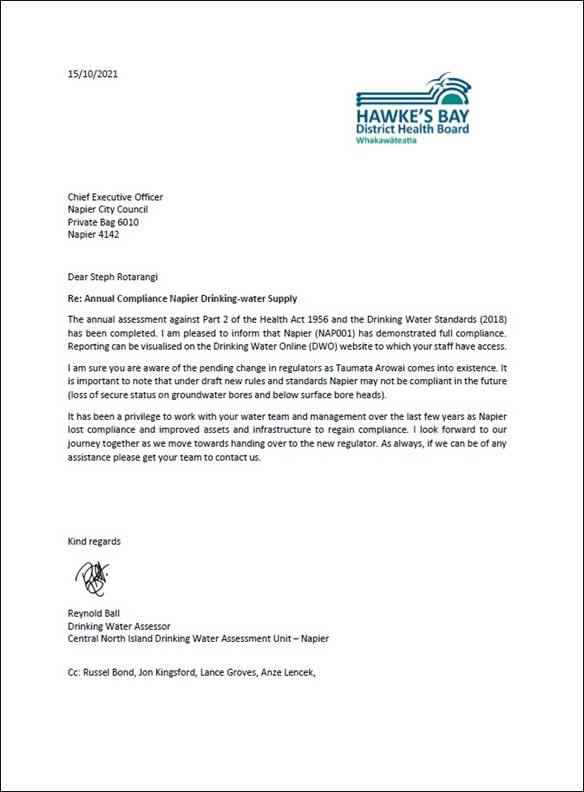
3.4 Significance and Engagement
N/A
3.5 Implications
Financial
N/A
Social & Policy
N/A
Risk
N/A
3.6 Options
The options available to Council are as follows:
a. The purpose of this report is to present information to Council. Options have not been presented.
3.7 Development of Preferred Option
N/A
|
The Officer took the report as read, noting Council have been fully compliant this year: · The number of discolouration complaints received by Customer Services has dropped substantially compared to recent years, which is encouraging. · There was a spike in complaints on the 23rd of October 2021 after ad hoc maintenance on a big water valve. · Council had consulted on installing up to four declhorination stations and from this have settled on installing two. · Taumata Arowai will be taking over as the regulatory body from Monday 15 November 2021. Going forward, the current drinking water standards are going to stay in place until 30 June 2022, and on 1 July 2022 new standards will come in to force. The new standards still have to go through a consultation process, so there may be changes made. Council would be noncompliant with the draft new standards if they were to go live today, but are working to have additional bores on line in time which will be compliant. · The conditions to for a city to have chlorine-free water come under the Health Act 1956, and are administered by the Ministry of Health, so there will be no change to these.
|
3.8 Attachments
Nil
Ngā Mānukanuka o te Iwi (Māori Committee) - 26 November 2021 - Open Agenda
4. Pettigrew Green Arena development: Reclassification of Reserve
|
Operational and Procedural |
|
|
Legal Reference: |
Reserves Act 1977 |
|
Document ID: |
1392538 |
|
Reporting Officer/s & Unit: |
Glenn Lucas, Manager Sport & Recreation |
4.1 Purpose of Report
For Council to resolve to initiate the Reserves Act process to reclassify part of Riverside Park in Taradale. This is to enable the Regional Sports and Events Centre (RISEC) Trust to expand the Pettigrew Green Arena (PGA) onto this area of the park.
|
Councillors Mawson / McGrath The Sustainable Napier Committee: a. Resolve to approve in principle to reclassify, in accordance with Section 24 of the Reserves Act 1977, approximately 8052m2 of Riverside Park, being Part Lot 1 DP 6891 and Part Lot 2 DP 6891 and held in CTs Y3/393, 198/4 and V2/616, from Recreation Reserve to Local Purpose (Community Buildings) Reserve to accommodate the extension of the Pettigrew Green Arena. b. Note that the proposal to reclassify is required to be publically notified and that after the notification period the matter will be brought back to Council for final consideration
Carried
|
Pettigrew Green Arena (PGA) was developed in 2003 on Riverside Park, Taradale. The arena is owned and managed by the Regional Sports and Events Centre (RISEC) Trust. RISEC Trust are undertaking an extension to the arena into approximately 8,052 m2 of the park.
This park is held as a recreation reserve under the Reserves Act 1977. To ensure the classification appropriately aligns with the land’s purpose when the extension of the indoor facility is developed, it is proposed the area be reclassified as local purpose (community buildings) reserve.
Proposed extension
The proposed extension is to construct a new building at the rear of the existing PGA over the current car park and into the adjacent grassed area of the park and will include a section of the Eastern Institute of Technology (EIT) land next door. The expansion will increase the provision of indoor courts from three to eight and enable the venue to be used for larger events and tournaments.
The area of Riverside Park that will be covered by the new development includes a dog agility park, a playground and some significant and critical water infrastructure. These assets and activities will need to be relocated to allow for the arena expansion. These relocations have either been completed, or are in progress.
Reclassification process
Currently the reserve is split into two parts: the part that houses the existing arena (Part Lot 1) and the part that is reserve (Part Lot 2). Part Lot 1 is classified as ‘Local purpose (community buildings) reserve, while Part 2 is classified as recreation reserve.
Classification involves assigning a reserve or part of a reserve a primary purpose, as defined in sections 17 to 23 of the Reserves Act, which aligns with its present values and use. The area of Riverside Park subject to this development is currently classified as a recreation reserve. The underlying principles applicable to recreation reserves include an emphasis on open space and outdoor recreational activities and freedom of entry for the public.
In order for the classification of this area of the reserve to align to the new purpose of the indoor arena it is proposed that this be reclassified in accordance with Section 24 of the Act as a local purpose (community buildings) reserve. This would then align to the classification of the parcel on which the existing arena is located, being Section 1 SO 425470.
By reclassifying the portion of the reserve that the new extension will sit on, this avoids a Reserves Act provision that the ‘public may not be charged for access to a recreation reserve for more than 40 days in any calendar year or more than 6 consecutive days.’ Given the nature of the operation of the arena, this would be restrictive to the intended operating model.
The process to change the classification requires:
a) mana whenua engagement
b) a decision in principle from Council to reclassify the reserve
c) a public notice in the local paper seeking the community’s comments on the proposed reclassification
d) consideration of any comments or objections to the proposal
e) a resolution of Council to endorse the reclassification
f) a survey verifying the site to be reclassified
g) a gazette notice, which is then noted on the title of the land.
Following the Council resolving to publicly notify the intention to reclassify the reserve, a public notice will be placed in the Napier Courier. The notice must outline the reasons for the proposed change in the reserve’s classification. The public will be provided at least a month to give feedback on the proposal.
The Council may choose to hold a hearing to be transparent around the consideration of any submissions or objections but this is not a requirement of the Reserves Act. It is therefore intended that a public hearing of submissions is held following the notification period.
Feedback to the proposal will be collated and summarised for either a hearings report or final report to the Council to endorse the reclassification, if it is concluded that this be supported.
To complete the process the resolution is published in the New Zealand Gazette and the Gazette Notice reference is added to the property title.
4.3 Issues
As the land being utilised for the RISEC Trust’s extension of the arena is subject to the Reserves Act, this reclassification process is mandatory to ensure the classification reflects the current purpose of the reserve. This purpose is about to change to provide for the indoor recreation facility and therefore the land should be reclassified.
4.4 Significance and Engagement
This proposal would not be considered significant in relation to Council’s Significance and Engagement Policy, but the Reserves Act sets out consultation requirements. This includes engagement with relevant iwi and providing the general public an opportunity to submit feedback on the proposed reclassification.
Ngāti Pārau and Te Taiwhenua o Te Whanganui ā Orotu have been engaged over this proposal and both have advised their support for the reclassification.
4.5 Implications
Financial
The costs of the public notification, survey and gazettal process will be funded from existing budgets.
Social & Policy
N/A
Risk
A resource consent has been granted to enable the expansion of the Arena. There is little risk seen around this Reserves Act process which seeks to apply the most appropriate classification to the land reflecting the expansion of the Arena.
4.6 Options
The options available to Council are as follows:
a. Reclassification (Preferred Option) described above.
b. Status quo – to retain the current land as a recreation reserve, but this would not reflect the new purpose of the reserve.
4.7 Development of Preferred Option
The preferred option is to proceed with the reclassification to bring the classification in alignment with the new purpose of this area of the park. Following the notification period and a public hearing, the reclassification will come back to Council for an endorsement to reclassify the reserve.
|
The Council Officer spoke to the report, noting the next stage in this project is public consultation. There were no questions from the Committee.
|
4.8 Attachments
a Site Map: 480 Gloucester Street
Ngā Mānukanuka o te Iwi (Māori Committee) - 26 November 2021 - Open Agenda
5. Pettigrew Green Arena extension: agreements for council approval
|
Legal and Operational |
|
|
Legal Reference: |
Reserves Act 1977 |
|
Document ID: |
1397968 |
|
Reporting Officer/s & Unit: |
Glenn Lucas, Manager Sport & Recreation |
5.1 Purpose of Report
The purpose of this report is to seek Council approval for the Chief Executive to sign three separate agreements on behalf of Napier City Council around land ownership and usage for the Pettigrew Green Arena site.
|
Councillors Taylor / Mawson The Sustainable Napier Committee: a. Approve the acquisition of a parcel of land by way of transfer from the Eastern Institute of Technology at no further consideration of compensation. This land is part of the land contained in records of title HBW 4/632 and HBW 4/631 and shown shaded in red in the scheme plan attached to the Agreement to Acquire Land. b. Pursuant to Section 48 of the Reserves Act 1977, to approve the granting to the Eastern Institute of Technology and Her Majesty the Queen a right of way easement over that part of the Council Land coloured (blue and red) on the Plan (“Easement Area B”) and a parking easement over that part of the Council Land coloured beige on the Plan (“Easement Area C”) attached to the Agreement to Grant Easement. The subject land is part of the land contained in record of Title 554016 and Record of Title HBY3/393. c. Acknowledge that in granting the above easement Council is exercising its delegated authority from the Minister of Conservation. d. Note that the granting of the above easement is conditional on the Eastern Institute of Technology granting a parking easement over that part of its land shaded orange in the plan attached to the Agreement to Grant Easement. e. Approve the granting of a Temporary Carpark Licence by the Eastern Institute of Technology to the Regional Indoor Sports and Events Centre Trust for the purposes of constructing and using a carpark on the Institute land. f. Note that the approvals above are conditional on the execution of all agreements. g. Delegate authority to the Chief Executive to sign the agreements on behalf of Napier City Council.
Carried
|
The Regional Indoor Sport and Events Centre (RISEC) Trust is the charitable trust that operates the Pettigrew Green Arena in Taradale. With funding from central government and a $4.1 million contribution from Council, RISEC is progressing with the extension to the existing Pettigrew Green Arena. This extension consists of five additional indoor courts to contribute towards a defined regional need for additional indoor court space for organised indoor sports, such as basketball, futsal, volleyball, netball, badminton and indoor bowls.
The extended facility is projected to be completed in July 2023.
The existing arena and the extension are located on Riverside Park, a Council-owned reserve. This reserve is bordered by the Eastern Institute of Technology (EIT) Student village and the Hawke’s Bay Regional Council (HBRC) governed stop bank and river reserve. EIT are an original development partner for the arena and continue to support and work closely with RISEC and the arena.
The previous plan to Council included a permanent carpark sited over the stop bank on HBRC governed land. Due to the requirement for a sizeable setback from the river bank and the subsequent impact on the design of the carpark this option wasn’t feasible. The reworked design has included the construction of a temporary carpark on a large piece of EIT land in front of the EIT Student Village. This project has been completed.
An agreement for this temporary carpark between RISEC, EIT and Napier City Council (NCC) was a requirement of the resource consent. This is largely an agreement to govern the usage of the carpark between RISEC and EIT, though NCC is a party of this agreement.
To enable the land required to construct the expanded facility and provide a service access lane around the facility a small portion of EIT land is required. EIT have agreed to transfer this land to council to enable the construction of the arena extension. In return, EIT require an easement for use of the right of way around the extended facility to be used to provide access to the student village.
These requirements of the arena extension have led to the development of the following three agreements:
· Agreement to Grant Easement: 352–58
o This agreement is for EIT granting an easement from their land between the new building and the temporary carpark (the orange shaded area indicated ‘58’), in return for NCC granting an easement for use of the blue shaded area as a right of way for access to the student village and a parking easement.
· Temporary Carpark Licence Agreement: 352–59
o This is covering the entire ‘temporary’ carpark to the north of the existing facility (indicated 59 on the attached site map). This has been constructed on EIT land and a condition of the resource consent was that EIT and the Trust establish an agreement for use during the construction period for the extended facility. NCC as landowner of the reserve is a party to this agreement.
· Agreement to Acquire Land: 352-60
o This covers the red triangle of land that is required to construct the facility and provide enough room for a ring road around the facility (indicated as ‘60’ on the attached site map). EIT agrees to transfer this piece of land to NCC as per the agreement with no payment required.
These have been developed between the three parties using Willis Legal as NCC’s legal representation.
5.3 Issues
There are no issues associated with this recommendation.
5.4 Significance and Engagement
There are no significance and engagement considerations with the recommendations. The community has been engaged with the project and the subsequent resulting changes to reserve through a number of different mechanisms, including resource consent, community engagement on changes to Riverside Park and the impending notification of reclassification of the reserve.
5.5 Implications
Financial
There are no financial implications of the recommendation beyond the revaluation of the reserve once the EIT land is transferred. This impact is not expected to be material.
Social & Policy
There are no social and policy implications of the recommendations.
Risk
As the agreements are formalising arrangements that are effectively in place and that have been conditions of the resource consent, the risks of the recommendations are low. The risks of not formalising the agreements are more significant and may lead to issues with project delivery on time and to budget.
5.6 Options
The options available to Council are as follows:
a. Endorse the officer’s recommendations to approve the three separate agreements and delegate authority to the Chief Executive to sign the agreements on behalf of Napier City Council.
b. Do not endorse the officer’s recommendation to approve the three separate agreements and delegate authority to the Chief Executive to sign the agreements on behalf of Napier City Council.
5.7 Development of Preferred Option
The preferred option is for Council to approve the signing of these agreements. Subsequent to Council approval, the Chief Executive officer can execute the agreements.
|
The Council Officer spoke to this report, noting it outlines the agreements required to provide the legal parameters for this project.
ACTION: Distribute an image of the current site with the proposed changes overlaid on top.
|
5.8 Attachments
a Site map of agreement areas (Under Separate Cover)
b Agreement to Grant Easement (Under Separate Cover)
c Agreement to acquire land (Under Separate Cover)
d Temporary carpark licence agreement (Under Separate Cover)
Ngā Mānukanuka o te Iwi (Māori Committee) - 26 November 2021 - Open Agenda
|
Information |
|
|
Legal Reference: |
N/A |
|
Document ID: |
1394417 |
|
Reporting Officer/s & Unit: |
Jon Kingsford, Director Programme Delivery |
1.1 Purpose of Report
To provide Council with information on the 2021 Long Term Plan Capital Programme and initiatives underway to improve Capital Programme Delivery.
|
Councillors Crown / Simpson The Sustainable Napier Committee: a. Receive the Capital Programme Delivery report.
Carried
|
With confirmation of the 2021 Long Term Plan (LTP), Council have committed to a significant increase in capital programme as well as operational work for the 10 years to 2031. This programme represents in excess of $827mill of investment over this period.
Almost half of this 10-year programme of work is associated with the 3 Waters (Water Supply, Wastewater and Stormwater) Services with almost $96mill of a total of $404mill of funding identified in the first 3 years of the programme.
Also of note are the significant funding provisions made for buildings/structure related renewals, totalling $66mill over the LTP period.
To improve programme delivery Council are in the process of recruiting additional resources. Council will also look for opportunities to augment delivery capacity with external resources.
Capital Programme Summary
Currently the Design and Projects team have 58 projects in progress, with a number of projects also being managed within each activity. These projects may have carry over funding associated with their delivery in the 2021/22 financial year.
With carry overs still to be finalised, carry over projects will not be reported on in this reporting round. Commentary will be provided in a subsequent report to this committee, particularly with regard to impact on project delivery of the LTP programme.
It is important to note that when funding becomes available for specific projects in the LTP, this funding is usually based on an identified problem or need, however there is generally little detail available on the extent of the problem or extent of the need. Consideration is only given to these aspects of a potential project in the first year of funding availability and is typically a requirement of the Asset/Activity Manager to complete this component of work.
Externally sourced input may be required to assist with this phase of work, including identifying possible concept options for further consideration. The timeframes to complete this component of work is variable and highly dependent on workloads and/or resource availability across the organisation. With business as usual demands already at a high level, new or reactive initiatives can place further demand on existing resources, thus impacting on the organisations ability to scope projects accurately and completely. A multiyear approach to project funding for more involved/complex projects has been implemented in recognition of this dynamic, in order to spread the project workload across multiple years.
Improving Council’s ability to better deliver this capital programme is receiving significant additional focus across the organisation, with the following additional initiatives underway.
Procurement Initiatives currently underway
The Infrastructure Directorate is currently implementing a procurement process to form a panel of consultants for the provision of Three Waters Technical Design and Support Services. This process is currently underway and has yet to be concluded.
The resulting Panel will enable both the Infrastructure Directorate and Programme Delivery Directorate to seek support from the panel.
The Programme Delivery Directorate has a simple procurement process underway to form a Panel of Providers of Project Management Services.
Both panels are expected to be confirmed by the end of the calendar year.
Project Going to Tender
The following notable projects are progressing through the tender in this reporting period:
· Whakarire Ave Revetment Construction
· Healthy Homes Heating and Ventilation
· Manganese Free Water – Drilling Contract
· Manganese Free Water – Treatment Plant Contract
· Manganese Free Water – Civil and Headworks Contract
· Mataruahou Reservoir Project Management Services
Projects nearing completion
The following notable projects are nearing completion of the construction phase in this reporting period:
· Thames/Pandora Intersection Improvements
· West Quay Traffic Calming
· Meeanee Quay Traffic Calming
· Marewa Shops Toilet Block Rebuild
Project Commencing Physical Works
The following notable projects are have commenced the construction phase in the previous reporting period:
· York / Auckland Intersection Improvements
· Roberts Terrace Playground
· Fire flows Project
The following notable projects will commence the construction phase in this reporting period:
· Centennial Hall floor Demolition/re-flooring
· Ellison / Chambers Pedestrian and Cyclist Safety
· Airport Wastewater Pump station Renewal
· Ocean Spa - Spa and Sauna refurbishment
The attached report (Appendix A) further demonstrates progress of notable projects currently underway.
1.3 Issues
Adopting a Council wide project based reporting approach is new to Council and will take
time to develop and embed. Council have further work to do to inform and train people
involved in project delivery across the organisation.
In order to improve programme delivery, existing vacant positions need to be filled and additional resources need to be found. This will take time to resolve.
1.4 Significance and Engagement
This report is for information purposes only.
1.5 Implications
Financial
The financial performance of individual projects does not form part of this report.
Social & Policy
There are no social and/or policy implications associated with this report.
Risk
Significant project risks are reported to Council separately via the Audit and Risk Committee.
1.6 Options
This report is for information purposes only.
1.7 Development of Preferred Option
This report is for information purposes only.
|
The Council Officer took the report as read, giving some updates on projects since the meeting’s agenda was published. · The Manganese Free Water – Treatment Plant Contract, was awarded by the Hearings Committee (For the Consideration of Tenders) this week. · The Centennial Hall floor demolition/re-flooring project is underway beginning with the demolition. There are some challenges with the specialist flooring contractor who are in lockdown in Auckland. Council is seeking an exemption from The Ministry of Business, Innovation and Enterprise for them to be allowed to travel to Napier to commence the re-flooring work. · The Marewa shops Improvement project design has come back well over budget. The Transport team are looking at how to scale back costs, while still meeting the safety requirements. Depending on the extend of changes made, the new design will likely go back to the retailers for consultation. · The project management consultant company working on the Maraenui Splash Pad has had staffing changes and this may have impacted on timelines. The project has recently received engineer’s approval, planting and speed humps have been installed, and it is now at the point of finalising the design and having a contractor commit to a build timeframe. · For the big screen installation at McLean Park, the contract has been awarded and the screen is en route to New Zealand, but Council does not have an installation date as yet. · The target for the new manganese free bores to be online is the end of March 2022, but it a tight timeframe so they may not be online until April. This work is part of the water reform programme of works.
ACTION: The Team Leader Parks Reserves and Sportsgrounds (Jason Tickner) will provide the timeline for the Maraenui Splash Pad build via Email to the Committee.
|
6.8 Attachments
a Attachment A
8. Lease of Reserve - Coffee Caravan (Silver Bullet)
|
Operational |
|
|
Legal Reference: |
Reserves Act 1977 |
|
Document ID: |
1383144 |
|
Reporting Officer/s & Unit: |
Bryan Faulknor, Manager Property Jenny Martin, Property and Facilities Officer |
8.1 Purpose of Report
To obtain approval to grant the Coffee Caravan (Silver Bullet) a lease by the Junior Bike Track in the mid to southern end of the Marine Parade Foreshore Reserve for a 3-year term plus a right of renewal of 2-years.
|
Councillors Taylor / Simpson The Sustainable Napier Committee: a. Recommend that Council agree to grant a new lease, under Section 54(1)(d) of the Reserves Act 1977, for the Coffee Caravan (Silver Bullet) to continue to occupy the mid to southern end of the Marine Parade Foreshore Reserve for a 3-year term plus a right of renewal of 2-years.
Carried
|
In 2013, a tender was awarded to provide and operate an Airstream Caravan at the Junior Bike Track along the Marine Parade Foreshore Reserve for the sale of non-alcoholic drinks and finger food.
The business has been sold several times with the current lessee operating since August 2018.
There have been three renewals with the final expiry occurring on 11 September 2021 with the agreement continuing to operate on a month-by-month basis. It is now necessary to obtain approval for a new lease.
The proposed term for the new lease is 3-years with a 2-year right of renewal.
The Silver Bullet is licensed by Council to prepare food on site and is attached to mains water. Wastewater is stored in a tank that is pumped out regularly and disposed of in a wastewater disposal facility. Outdoor tables, chairs and umbrellas are provided for customers.
The current position of the caravan is shown with a pink star on the attached aerial plan. At Council’s request in 2013, the wheels were removed from the caravan, however, these are available to be reattached should Council need the have the caravan moved to a site further south on the Reserve.
8.3 Issues
While the caravan is a commercial business operating on Reserve land, it is deemed to be for the convenience of the public using the Marine Parade Foreshore Reserve and thus allowed under the Reserves Act.
In March 2021, there was an issue raised with rubbish disposal but the owner has worked with Council Officers to rectify this.
8.4 Significance and Engagement
Not applicable.
8.5 Implications
Financial
There are no costs to Council. The current monthly rental is 5% of gross income plus $150 towards costs and power. It is proposed that this continue. Payments are currently made on time and there is/will continue to be provision for Council to ascertain or check the amounts by requesting a copy of the annual audited accounts.
Social & Policy
Not applicable.
Risk
There is no risk to Council.
8.6 Options
The options available to Council are as follows:
a. To approve the Coffee Caravan (Silver Bullet) a new licence to occupy by the Junior Bike Track in the mid to southern end of the Marine Parade Foreshore Reserve for a three-year term plus a right of renewal of two years.
b. To decline a new Licence to Occupy for the Coffee Caravan (Silver Bullet).
8.7 Development of Preferred Option
Option (a) is the preferred option as the Caravan provides a service to those using/passing along Marine Parade.
|
The Council Officer spoke to the report. It was noted by the Chair that when the redevelopment of the Marine Parade was carried out the placement of the bullet was part of the project design.
|
8.8 Attachments
a Coffee Caravan (Silver Bullet) location
Ngā Mānukanuka o te Iwi (Māori Committee) - 26 November 2021 - Open Agenda
Reports from Future Napier Committee held 11 November 2021
3. Library and Civic Area Plan
|
Procedural |
|
|
Legal Reference: |
Local Government Act 2002 |
|
Document ID: |
1390617 |
|
Reporting Officer/s & Unit: |
Fleur Lincoln, Strategic Planning Lead |
3.1 Purpose of Report
The purpose of this report is to provide an update on the feedback received during the public consultation phase of the Draft Library and Civic Area Plan; to recommend that Council adopt the Library and Civic Area Plan; and to provide information on the next steps of this project.
|
Councillors Chrystal / Wright The Future Napier Committee: a. Receive the feedback on the Draft Library and Civic Area Plan b. Adopt the Library and Civic Area Plan (Doc Id 1396319)
Carried
|
The Draft Library and Civic Area Plan was approved by Council for release to the public on the 16 September 2021, with public consultation commencing Monday 20 September. Feedback closed on Friday 15 October 2021.
Once adopted, Council Officers will work toward the delivery of a Design Brief and Business Case, which will progress the development of Stage 1 of the Area Plan. Further refinement of a design brief and development of a Business Case will provide a more accurate financial forecast of Stage 1, and enable the process of design of buildings and the public open spaces. Co-design as a tool for the delivery of these next phases of the project is still a very real option.
Preparation of the Station Street Site for the delivery of Stage One of the Masterplan has now commenced. This includes demolition of the Civic site and the removal of the connecting bridge to the Library Building. The project will also scope the removal of the old Library building annex and the implications that may have to the structural integrity and ongoing resilience of the Library Tower Building, with particular focus on the financial implications.
3.3 Issues
No issues. Refer to 1.5 Risks for an explanation of the risks.
3.4 Significance and Engagement
A total of 101 feedback forms were submitted during the consultation period. Feedback on the Plan in its entirety was generally positive, with 80% of submitters agreeing with the Plan and significant support (86%) for the Library being part of Stage 1. A more detailed report on the feedback received is provided in Attachment 1 (Doc Id 1396321). Following consideration of feedback received, no substantive changes were made.
3.5 Implications
Financial
The Area Plan provides Council with recommendations on how best to develop the site, as well as providing the community with a clear picture on what to expect in terms of both buildings and functions, and when this work would occur. The Long Term Plan is where the commitment of funding to this project sits, with $55m being allocated to the delivery of this project ($25m of this for the new Library). The Business Case will determine the partnership opportunities, space and delivery needs, and an operation model, which will refine the cost estimate to deliver Stage 1 of this Plan.
Social & Policy
The principles of the Library and Civic Area Plan, and what it seeks to achieve, align with a number of existing Council strategies and plans, including the City Vision Framework, the Library Strategy, our Community Outcomes, Disability Strategy, Positive Ageing Strategy, and the Youth Strategy.
In the next phases of this project, Council Officers will seek a partnership approach in the spirit of Te Tiriti o Waitangi, whereby we will explore with mana whenua the opportunities for a greater presence in this space and co-design possibilities.
Risk
The risks facing Council remain the same as those detailed in the report to the Future Napier Committee on the 19th August 2021, and are resolved to a certain extent through the staging of delivery, and the development of a detailed Business Case that will further explore the needs, operation model, and partnership opportunities. In summary, these risks are:
a. Understanding the needs for space for the future face of local government which will affect provision within precinct and the funding required to provide for it.
b. Funding required for a two stage approach, including the financial impact of delay on construction cost.
c. No detailed design has been undertaken to date, so full cost of both stages have not been fully quantified.
These risks do not impact on the adoption of the Area Plan, and will be unbundled in the next phases of this project.
3.6 Options
The options available to Council are as follows:
a. Adopt the Library and Civic Area Plan
b. Do not adopt the Library and Civic Area Plan
3.7 Development of Preferred Option
The Library and Civic Area Plan offers strategic direction for the development of the library and civic precinct publically endorsed in a way that is fiscally and operationally sensible, prioritises the needs of the community, and takes advantage of the opportunities the site offers. The nine founding principles will ensure this space is designed to be inclusive, accessible, sustainable, and beautiful, and will instil a strong sense of place. The delivery of this project in stages will provide the necessary time to understand what the future needs of Council administrative offices are, while delivering on those facilities and services that we know are of high need for the community, now and for future generations.
The development of the Library and Civic Area Plan has followed a robust process, with a significant level of input from our key mana whenua partners, and stakeholders throughout. Further feedback sought during the public consultation phase has endorsed support for the Plan and the ideas it contains.
|
The Strategic Planning Lead, Ms Lincoln advised that the draft Library and Civic Area Plan had been released for public consultation on 20 September 2021 and closed on 15 October 2021. A total of 101 feedback forms had been submitted and all were generally positive of the plan. No substantive changes were made to the plan following this feedback. In response to questions from councillors it was clarified that: · Work was being undertaken on the demolition programme of the existing Library Tower Building to deliver the first stage of the Plan. · In regard to Council Chambers and councillor rooms for democratic services the majority of feedback was against including these in Stage 1 of the Plan. · Although it was noted there had been some confusion in the term “governance” and additional information was provided to the public during the consultation period to what this actually meant, no further comments were made.
|
3.8 Attachments
a Attachment 1 - Submissions Analysis
b Attachment 2 - Final Library and Civic Area Plan (Under Separate Cover)
c Attachment 3 - Engagement Report (Under Separate Cover)
d Attachment 4 - Submissions Compiled (Under Separate Cover)
4. Update on Ahuriri Regional Park Project
|
Information |
|
|
Legal Reference: |
N/A |
|
Document ID: |
1390869 |
|
Reporting Officer/s & Unit: |
Fleur Lincoln, Strategic Planning Lead Richard Munneke, Director City Strategy |
4.1 Purpose of Report
The purpose of this report is to update Council on progress made toward what is currently known as the Ahuriri Regional Park project, and to seek the endorsement of Council to confirm the priorities for the future use and development of Lagoon Farm in a way that positions Napier as a leader in climate resilience and city sustainability.
The report also seeks to address how critical partnerships with Hawkes Bay Regional Council (HBRC) and Mana Ahuriri Trust (MA) can be fostered through the stages of park master-planning and implementation.
|
Councillor Brosnan / Mayor Wise The Future Napier Committee: a. Endorse that the future park to be located at Lagoon Farm be a platform for climate resilience and city sustainability, delivering flood mitigation, stormwater quality, biodiversity and estuarine environment restoration. b. Endorse that the boundary of the park currently known as the Ahuriri Regional Park be confined to the legal boundaries of Lagoon Farm (Lot 1 DP 388211). c. Endorse the preparation of a Masterplan for the park currently known as the Ahuriri Regional Park and the appointment of an independent project manager. d. Endorse Officer’s exploring options for project governance structures for the purpose of endorsing a draft masterplan (including a multi-party Regional Committee), for public consultation to be brought back for Council consideration next year. Carried
|
The Ahuriri Estuary and Coastal Edge Masterplan included an initiative which sought to capitalise on the opportunities brought by the Lagoon Farm land, located on the edge of the middle reaches of the Ahuriri Estuary immediately adjacent to Prebensen Drive. The size of the Farm, its proximity to the City and a nationally recognised wildlife reserve as well as being the discharge point of 70% Napier’s urban storm water, gave ample reason to explore the creation of a publicly-owned ‘park’. In Napier’s case the Lagoon Farm park could also hold flood waters in times of heavy rain and polish some of the City’s stormwater while at the same time growing the biodiversity and ecology of the estuary itself.
Napier City Council and HBRC have established a working party to advance the concept. The Terms of Reference for the working party can be found at Attachment 1. Importantly the working party identified high level potential work streams for their respective Councils which made their way into draft Long Term Plans.
During the LTP consultations, both Councils specifically identified a “Regional Park” at the Lagoon Farm area as a major project with sub projects identified spanning multiple years. The community supported the concept and the investment in the park in both LTP’s. A summary of NCC LTP submissions which can found at Attachment 2.
The project has substantial budget identified in both NCC and HBRC LTPs and is now at a crucial stage where:
· The Park needs an identity
· The boundaries of the Park are understood, and the priorities around stormwater detention clearly identified
· Partnerships with mana whenua is in place and formalised
· The values of the site investigated and information about the opportunities and constraints identified
· A draft masterplan based on the above programmed for stakeholder and public consultation
· The stages of development and the obligations of the core parties defined; and
· Appropriate governance structures considered for the various stages developed and agreed.
Of the contributing projects that potentially fall within the boundaries of the “regional park”, there are two stormwater related projects that make up the bulk of the capital and priority for investment into the park (see Attachment 3). Importantly recent further investigations to understand Napier’s stormwater capacity issues, the Stormwater Masterplan (which is currently being peer reviewed) has recommended development of a stormwater detention area located within the “regional park” as a high priority. This will enhance resilience to flood events for a substantial portion of the City. It is likely the detention of stormwater on this site should be progressed as a priority.
Our changing climate will see an increasing frequency and severity of extreme weather events as we have very recently experienced during last year’s floods. The stormwater detention area proposed will deliver not only a resilient stormwater network capacity, but also improved biodiversity outcomes and potentially recreational values in time.
This project gives both Councils a unique opportunity to show case how Napier City can demonstrate climate resilience and sustainability outcomes in a highly visible way transforming an area right in the middle of our City from pasture to a place that will help us keep our people dry during extreme weather events, clean the stormwater and actively foster environmental improvements to the estuary.
4.3 Issues
1. Purpose, size and scope
The identification of a “regional park” in the Ahuriri Estuary Masterplan was notional. Recent investigations have shown that Council can provide flood and water quality benefits by developing this site. HBRC have identified significant opportunities for biodiversity and environmental improvements along the Taipo confluence with the estuary. Preliminary discussions between both Councils have identified that we have an opportunity to realise those benefits in a very visible way, layering cultural, recreation and education opportunities with a central overarching goal for the park climate resilience.
2. Prioritisation of Essential Works.
Work is already underway to form partnerships with Hawke’s Bay Regional Council, the Department of Conservation, and mana whenua representatives to develop a ‘Regional Park’ at Lagoon Farm, with multiple purposes including stormwater management, habitat restoration and recreation. Although this will likely be the outcome for this site in the medium to long term, it is vital to prioritise Napier’s stormwater network needs for this property – specifically in relation to improving climate resilience through capacity enhancements, before other needs and desires are accommodated. Once this is fully understood other interventions such as biodiversity creation around the Taipo Stream or polishing wetlands before the floodgates can be overlayed without constraining the detention requirements.
3. Definition of the Site
The “Regional Park” was identified as being the parcel of land that is currently known as Lagoon Farm and is owned fee simple by Council. Keeping the focus of the project on Lagoon Farm means that there is the ability for NCC to progress essential infrastructure without requiring any further approval outside of consultation through the LTP.
4. Identifying the correct legal instrument for Lagoon Farm to become “Regional Park”
As Lagoon Farm is in NCC ownership, consideration needs to be given as to how the site can be developed into a park for the people of Napier, and the rate payers specifically. There are various options in this regard including designations for the site for the water assets, formalising the land into a Regional Park or keeping ownership as it is and using the draft District Plan zoning to enable the range of activities contemplated in a park such as this. Officers have sought legal advice on the matter which has concluded that the latter may be the best option allowing maximum flexibility, full accountability to Napier rate payers, control over the delivery of key infrastructure projects and some protection from the asset being vested in any future three waters entity. Legal advice in relation to the ownership of land that has “Regional Park status has raised the question as to whether this project should continue to be called “Regional Park”. The implications of this title require further investigation, but the use of this term may result in the expectation that the ownership and management of this property is transferred to the Hawke’s Bay Regional Council, when this is not a decision that has yet been made. It is recommended that the project have a different working title in the interim.
5. Defining benefits
A significant amount of technical work is required to further understand our needs, starting with our detention needs including how much land is required, how much of that should remain dry and where on the site it should be. In terms of storm water quality, Council needs to understand polishing wetlands potential on the site using the extensive investigations done to date to understand whether this can achieve desired outcomes, and if so, how these interfere with storm water detention areas. Other data sets around biodiversity, flood structures, ground water and climate change implications also need to be identified. Further cultural overlays also require unbundling including aspirations of mana whenua through Te Komiti Muriwai o Te Whanga. These data sets can then form the of a basis masterplan.
6. Community endorsement of the masterplan
Currently there is no single vision of what a “regional park” on lagoon farm actually means. The masterplan process can provide that single vision, enable buy-in of stakeholders and get community support for the projects overall direction. This is a project of amazing potential that needs a “picture to paint a thousand words”. The master plan process and consultation should provide that picture in a similar way to that recently delivered on the Library and Civic precinct.
Once the various layers to this project are understood from the data sets, a masterplan will bring together how the site will be developed over time, taking into account those constraints and opportunities the site and its surrounds presents, and establish a vision for a park that delivers a resilient and sustainable Napier. This is seen as a crucial next step that can be developed alongside the flood detention project.
7. Partnerships with mana whenua
Through the working party stage of this project Te Komiti was fully consulted and invited to the table. It is likely in the not too distant future that Te Komiti will have full legal status through Te Tiriti settlement.
In that light it is essential that the partnership with Mana Whenua continue to be fostered, regardless of the stage of the project.
8. The stages of development and an integrated work programme.
The two Councils have identified work streams in various years in their respective LTP’s. Alignment and prioritisation of budgets may require clarification. For example whilst it is clear that the water detention project is fundamental, delivery occurs in year 6. This may be perfectly legitimate allowing detailed planning etc. to occur but it may also be impeding progress on other projects. An integrated project budget needs to be identified as a priority – using sufficient base information from the data sets. Therefore the data sets come first.
9. Single point project management
Sub projects of this magnitude between two Councils are a recipe for misunderstanding or inertia. Preliminary discussions between HBRC and ourselves agree that a single project manager similar to that being used on the Coastal work is the best way to advance matters in a coordinated way. There is now sufficient clarity in terms of the purpose of the park and what is involved to brief a project manager effectively. This is seen as a priority.
10. Appropriate and timely governance structures
A governance framework spanning both Councils and Mana Whenua needs to endorse the development of any masterplan as a draft before it is discussed formally with stakeholders and the community at large. There is time to consider the options noting that a Regional Committee may be a useful mechanism provided it takes into account the legal advice as to how lagoon farm should best be legally treated to enable the Napier community’s interest to best be served.
4.4 Significance and Engagement
Engagement with the community will be a significant feature of this project. A governance group is likely to oversee the release of a draft masterplan for public consultation. Input from our key partners and stakeholders, during the development of the masterplan will ensure opportunities are provided from those with specialist knowledge and interest.
4.5 Implications
Financial
LTP funding allocated to the stormwater detention area starts at Year 1, with the majority being available from Years 6 to 8. Although it is possible to bring this project forward, doing so would impact on the delivery of the wider Council programme (particularly three waters) as well as the rates cap, and so any decision to re-prioritise this project must consider Council’s entire work programme. Funding for the polishing wetlands is available in Years 4 and 5, allowing sufficient time for the three-year stormwater study to be completed and technical investigations and design. Funding is also available in this financial year to complete a masterplan, to provide ‘park-related’ assets, and from the Hawke’s Bay Regional Council (refer Attachment 3).
It is fair to say that there should be further refinement and coordination of the NCC and HBRC budgets and work programme. It is suggested that this matter will be revisited as part of the master-planning process.
Note: There is funding available to procure project management resources, initiate the data sets, and begin the master planning process.
Social & Policy
The work detailed in this report is consistent with the Ahuriri Estuary and Coastal Edge Masterplan. The matter has been considered in HBRC and NCC LTP’s. It is intended that any future masterplan fully consult with stakeholders and the wider community.
Risk
There is a real risk that progress stalls through lack of a compelling vision and clear project development process.
4.6 Options
The options are best considered within each issue identified. There is little benefit from identifying each possibility given the multitude of issues, we have opted instead to recommend as follows:
4.7 Development of Preferred Option
1. That the regional park be a platform for climate resilience and city sustainability
2. That full investigation work commence to design the extent and location of any flood water detention infrastructure.
3. That the site legally known as lagoon farm be confirmed as the boundary of the regional park.
4. That Council ensure that the zoning for lagoon farm is appropriate in the draft District Plan and that no further encumbrances are placed on the land.
5. That work commence on collating data sets into a full story board to underpin masterplan development.
6. That Council develop a Masterplan for the purposes of full community consultation on what is intended for the “regional park" including the order of works.
7. That NCC and HBRC engage with Mana Ahuriri Trust as a key partner in this project.
8. That the LTP budgets be reviewed in light of the data sets and investigations around water detention and storm water in particular. The review should be done as part of the masterplan development and in conjunction with HBRC and their LTP budget allocations.
9. That an independent project manager be appointed as soon as practical.
10. That options around governance structures appropriate to being able to endorse a draft masterplan for consultation (including a Regional Committee) be explored and brought back to Council next year.
11. That an appropriate name is developed for the Park in due course.
|
The Chair acknowledged the presence of the General Manager, Biodiversity (Debbie Monahan), Angie Denby (Ahuriri Protection Society) and noted the apologies from Councillor Hinewai Ormsby (HBRC) for this item. The Strategic Planning Lead, Ms Lincoln provided an update on progress made on the Ahuriri Park and sought endorsement of priorities for future use and development of Lagoon Farm. Substantial budget had been allocated in the Council’s and Hawke’s Bay Regional Council’s Long Term Plan and the next steps needed to be clearly programmed. In response to questions from councillors it was clarified that: · Through the LTP process there were a significant number of interested affected stakeholder partners interested in how Council would proceed with this project. · Legal advice received has questioned whether the project should continue to be called a “Regional Park”. · The Lagoon Farm site legal boundary should be confirmed as the boundary of the park. · The Ahuriri Masterplan was developed at a high level and will be unbundled into focused components on lagoon farm to develop a masterplan into which detailed design will be incorporated at that stage. · The committee endorsed the appointment of a Project Manager as soon as possible. · Investigation is to be undertaken to understand the parcels of land as to the number of hectares that need to be set aside for stormwater polishing and flood detention areas as a priority. · The Project Manager, when appointed will be considering all aspects of the development including Lagoon Farm continuing as a viable working farm and the short term lease of the Blowcart activity and would work with all parties going forward.
|
4.3 Attachments
a Attachment 1 Joint Working Party Terms of Reference
b Attachment 2 LTP submissions on Regional Park
c Attachment 3 - Project Background
Ngā Mānukanuka o te Iwi (Māori Committee) - 26 November 2021 - Open Agenda
Appendix 1
Lagoon Farm ‘Regional Park’ Background
1.0 Background
The concept of a ‘regional park’ located at Napier City Council-owned Lagoon Farm was one of the initiatives put forward in the Ahuriri Estuary & Coastal Edge Masterplan. Further investigations were required, however the vision involved the transformation of this 289 hectare farm into a multi-use park that provided stormwater retention and polishing wetlands; habitat restoration and creation; recreational, educational and cultural opportunities, and even potentially commercial or residential opportunities.
Since the Masterplan was adopted, progress has been made in further refining what can be achieved on this site, who Council will be partnering with to deliver this ambitious project, and how aspects of the project will be funded through the Long Term Plan.
Our climate is changing. An increase in the frequency and severity of high rainfall events is putting pressure on our stormwater network, with the need for added capacity featuring high on the priority list in the recently released stormwater masterplan. Using a portion of Lagoon Farm for detention is a cost-effective and low impact way of delivering that capacity shortfall, resulting in a more resilient Napier. In addition, the use of this property for polishing wetlands is consistent with our commitment to restoring the mauri of the Ahuriri Estuary through the removal and reduction of persistent toxins in the Purimu and Old Tutaekuri River Chennel watercourses during normal flow conditions. There are opportunities to build on purely functional purpose to one with many benefits including habitat restoration and creation of new habitats, improving biodiversity, educational opportunities, mahinga kai collection, and recreational opportunities.
The ‘regional park’ presents a significant opportunity to address climate resilience and to further our commitment to delivering on the UN Sustainable Goals.
2. Stormwater Projects
The 2021-2031 Long Term Plan funds a number of projects connected to the ‘Regional Park’, or within the boundaries of the Lagoon Farm site.
2.1 Lagoon Farm Big Channel
The Big Channel provides stormwater retention for the city in a 1:50 year flood event. The project is purely related to stormwater capacity and will accommodate up to 450,000m3 of water within the ‘regional park’. The team is currently investigating options for the configuration and location of this retention area. Further investigations and design work is needed, though the big channel could take up to 40% of the total farm site area. Additional work would be required to the stormwater network to direct overflows to the big channel including a new box culverts, inlet weir and diversion channel, as well as upgrades to the existing Purimu pump station.
In terms of improving the quality of stormwater entering the big channel, given the anticipated volume of water entering this channel and the ground soakage (as opposed to direct flow into the estuary), the level of contamination is expected to be low. Careful thought must be given to how to prevent water becoming stagnant (potentially resulting in algal blooms) while the water stands in this channel.
Approximately $13.2m has been allocated to this project from years 1 and 8, with the bulk of the spend happening in years 6 to 8.
|
Y.1 |
Y.2 |
Y.3 |
Y.4 |
Y.5 |
Y.6 |
Y.7 |
Y.8 |
Y.9 |
Y.10 |
|
100k |
206k |
211k |
216k |
222k |
1.1m |
935k |
10.2m |
|
|
2.2 Polishing wetlands
This project involves the construction of polishing wetlands located within the ‘regional park’ as shown on the aerial below (though not this whole area), that will take water from the Purimu and Old Tutaekuri River Chennel watercourses during normal flow conditions. The polishing wetlands would be designed to reduce residual suspended solids, uptake nutrients include nitrogen and phosphorus species, and remove particulate-bound heavy metals such as zinc and copper from these waterways prior to controlled discharge to Ahuriri Estuary. During a flood event, (the pumps will pump water to the normal outfall channel and through the Westshore Tidal Gates as normal/into the new ‘big channel’ retention area.
Approximately $2.5m has been allocated to this project in years 4 and 5.

|
Y.1 |
Y.2 |
Y.3 |
Y.4 |
Y.5 |
Y.6 |
Y.7 |
Y.8 |
Y.9 |
Y.10 |
|
|
|
|
325k |
2.22m |
|
|
|
|
|
2.3 ‘Regional Park’ Masterplan Implementation
This project sits within our Parks and Reserves team and is primarily for items such as planting, park amenities (eg lighting, seating, signage etc), a visitor centre etc.
$10m from years 8 to 10 has been allocated in the LTP for this project.
|
Y.1 |
Y.2 |
Y.3 |
Y.4 |
Y.5 |
Y.6 |
Y.7 |
Y.8 |
Y.9 |
Y.10 |
|
|
|
|
|
|
|
|
1.5m |
5m |
3.5m |
2.4 Softening the estuary channel in upper reaches of estuary
It seems no funding has been allocated to this project, and there are no plans to undertake this work. There is potential for HBRC to fund this project, either within the allocated funds for the overarching project, or as a new project as yet unfunded. If this project were to be pursued, it would require signficant prior geomorphological investigation – particularly in relation to the possibility of changing the estuary’s tidal prism and accelerating sedimentation in the upper reaches of the estuary itself. Although both the Ahuriri Estuary and Coastal Edge Masterplan and the Lagoon Farm Land Use Strategy both show the softening of the channel edge by breaking into the stopbanks as a possibility, changing the tidal reach may pose a threat to surrounding properties and the fragile upper estuarine ecosystem.
Similar to the Purimu and Old Tutaekuri Riverbed, the Taipo Stream is sediment laden and contains contaminants such as copper, zinc, nitrates and phosphorus, as well as ocasionally high microbiological readings. The Taipo discharges to Ahuriri Estuary without gross-pollutant filtration. There may be an opportunity to control the discharge of the Taipo through a series of created wetlands, again reducing the contaminant load to the upper Ahuriri Estuary. This should be considered by NCC, HBRC and DOC.
2.5 ‘Regional Park’ Masterplan
Funding has been allocated within the Planning Policy budget to complete a masterplan project which sets the direction for the development of the ‘regional park’ over the long-term. Associated with this work would be the establishment of a project team, partnerships, and governance structure, prioritisation of initiatives, funding allocation, and community involvement. $440,000 has been set aside to complete this work within the 2021/2022 financial year.
2.6 Hawke’s Bay Regional Council
In addition, the Hawke’s Bay Regional Council has committed funding to the ‘Regional Park’ in their 2021-2031 Long Term Plan as follows:
|
Y.1 |
Y.2 |
Y.3 |
Y.4 |
Y.5 |
Y.6 |
Y.7 |
Y.8 |
Y.9 |
Y.10 |
|
|
|
1.2m |
1.2m |
1.2m |
1.2m |
1.2m |
1.3m |
1.3m |
1.3m |
These funds have been allocated to support the regional park outcome put forward by the Ahuriri Estuary and Coastal Edge Masterplan, and not any specific component of this project.
3. Stormwater our No. 1 Priority
The Stormwater Masterplan, completed in 2021 (yet to be peer reviewed) has clearly demonstrated that a large stormwater retention area, located at Lagoon Farm (as it currently exists), to accommodate flows from a 1 in 50 year rainfall event, would have a signficant impact on the ability of Napier’s stormwater network to accommodate overflow stormwater volumes. The total volumes of stormwater overflow needed to be accommodated is 450,000m3. Further investigations and design work is needed, though the big channel could take up to 40% of the total farm site area. Additional work would be required to the stormwater network to direct overflows to the big channel including a new box culverts, inlet weir and diversion channel, as well as upgrades to the existing Purimu pump station.
4. Protecting Napier’s Asset
Although the management of stormwater will be the priority for this site, it will likely have multiple functions, including ecological restoration, recreation, education, and cultural opportunities (eg mahinga kai) as it develops over time. Napier City Council will also develop this site alongside its key partners including the HBRC and mana whenua. It is important that the ownership and ability to set the future direction of the property remains with the community of Napier, to the maximum extent possible. Legal advice has been obtained on how best to achieve this. Stormwater-related assets including the retention areas and polishing wetlands clearly serve a stormwater function and it appears inevitable that their ownership would likely be transferred to any future three-waters organisation. However providing a clear delineation between these assets and the remainder of the property through tools such as vesting the stormwater assets as a Local Purpose (Drainage) Reserve will hopefully ensure that the ownership and management of the remainder of this property stays in the Napier community’s hands. The recommendation is to do nothing at this stage. The construction of such infrastructure is some years off, and we will know the outcome of the three waters review well before any physical works commence.
6. Project Process
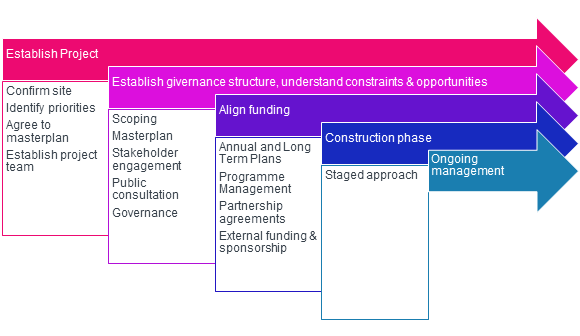
5. Understanding our opportunities and constraints
A ‘Regional Park’ Masterplan will consider Council’s needs and priorities alongside the many constraints and opportunities presented by this site. The technical information that comes from this will feed into a mapping exercise (a very conceptual example of which is shown below), resulting in a masterplan that sets the vision, direction and priorities for this property over the next 30+ years.
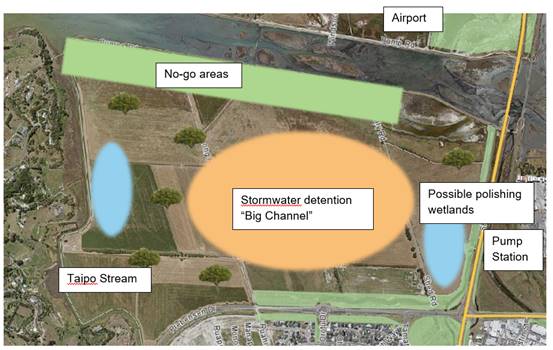
5. Housing Capacity Assessment
|
Legal and Operational |
|
|
Legal Reference: |
Resource Management Act 1991 |
|
Document ID: |
1393075 |
|
Reporting Officer/s & Unit: |
Dean Moriarity, Team Leader Policy Planning |
5.1 Purpose of Report
For Council to:
· receive the first Housing Capacity Assessment Report (HCA) prepared under the National Policy Statement on Urban Development 2020 (NPSUD) and
· note the next steps that need to be undertaken in accordance with the NPSUD to support urban growth.
|
Councillors Boag / Simpson
The Future Napier Committee:
a. Receive the first Housing Capacity Assessment Report (HCA) prepared under the National Policy Statement on Urban Development 2020 (NPSUD); b. Note the contents of the HCA and the next steps to fulfil the NPSUD requirements; c. Note the housing bottom lines that will be inserted into the Hawkes Bay Regional Policy Statement and Napier District Plan; and d. Note that the Spatial Picture sets out potential options for where Council can provide sufficient dwellings to meet the housing bottom lines identified in the HCA over the next 30-years.
Carried
|
The National Policy Statement on Urban Development 2020 (NPSUD) requires Tier 2 councils, which includes Napier City, Hastings District, and Hawkes Bay Regional Councils (the Council’s), to undertake an assessment of the expected demand and supply of housing in their areas over the next 30-years.
The purpose of the housing assessment is to ensure councils planning and infrastructure decisions enable at least sufficient development capacity to meet expected demand for housing and to assess the impact of those decisions on the affordability and competitiveness of the local housing market.
Council’s role is to ensure there is sufficient suitable land available in order to have competition in the market so that developers can respond to opportunities and build dwellings. Zoning land is the main area that Council can influence. Developers control when and where housing opportunities are realised including whether or not a development is “affordable”. Council therefore has a key role to enable land availability but by itself cannot deliver housing or affordable housing to meet expected demand.
The housing assessments must be undertaken every three years and in time to inform the Long Term Plan (LTP). The first assessment was required to be prepared this year (July), one year after the NPSU2020 was approved by Government. The NPSUD requires that Councils with overlapping or interrelated housing markets prepare a joint assessment and a jointly commissioned assessment has now been completed and attached as Attachment 2 (Doc Id 1396308).
The assessment is a comprehensive and technical piece of work, but one which provides evidence based information for forthcoming planning processes such the replacement of the Heretaunga Plains Urban Development Strategy (HPUDS) in the form of a Future Development Strategy (FDS) component of a Regional Spatial Plan (RSP) and ultimately the District Plans and LTPs.
Given the technical nature of the document, a separate executive summary has been prepared to provide a brief overview of the main demand and supply components as they relate to Napier and this is attached as (Attachment 1) (Doc Id 1396309).
Summary of Findings
The analysis suggests that Napier has sufficient development capacity over the short, medium and long term to meet demand, albeit noting that the HCA does not include any existing housing shortages that have built up over time (i.e. it is not capture the latent demand component).
The analysis also shows that there is significantly greater demand for housing up to $400,000 than the market is likely to provide resulting in a lack of affordable housing options.
The NPSUD requires that a housing bottom line for the short, medium and long term be included in the relevant regional policy statement and district plans as soon as practicable after the housing assessment is made publicly available.
The purpose of housing bottom lines is to clearly articulate the amount of development capacity that is sufficient to meet the expected demand including a buffer.
The table below, identifies the housing bottom lines for Hastings and Napier based on the findings from the housing capacity assessment.
|
|
Hastings |
Napier |
|
Short term (2020 – 2023) |
1,920 |
1,160 |
|
Medium term (2023 – 2030) |
3,360 |
2,040 |
|
Long term (2030 – 2050) |
7,590 |
4,060 |
Next Steps
In line with the NPSUD requirements the Councils must:
· Insert the Housing bottom lines into the Hawke’s Bay Regional Policy Statement, Napier District Plan and Hastings District Plan without using the Schedule 1 process as soon as possible.
· Publish the HCA and make it publicly available (via the HPUDS website);
· Implement a monitoring programme; and
· Prepare the business component of the HCA to inform the next iteration of a future development strategy and in any case prior to the 2024 LTP. The business assessment must estimate the demand from each business sector for additional business land in the region over the short, medium and long term and the Councils proposals to supply sufficient land to meet the demand;
5.3 Issues
The HCA is a mandatory requirement for Council and needs to be reviewed every 3 years. Housing bottom lines and quarterly reporting in the intervening periods have to be reported publicly. Council must also supply serviced land in areas to support urban growth that meets demand, is market feasible and which enables different housing typologies to improve affordability.
The assessment is a comprehensive and technical piece of work, but one which provides fundamental evidence based information for forthcoming planning processes such the replacement of the Heretaunga Plains Urban Development Strategy (HPUDS) in the form of a Future Development Strategy (FDS) component of a Regional Spatial Plan (RSP) and ultimately the District Plans and LTPs.
The HCA is therefore a core requirement for any future urban development strategy and must have commensurate funding through Councils LTP to support housing supply for the next ten years. It’s not a nice to have, it’s a must have. While the report itself is a technical document capturing key housing indicators, it signal’s the magnitude of commitment Council must have in any and all future LTP’s.
Spatial Picture
In response to the HCA, Council has developed a spatial picture that sets out potential options for where Council can provide sufficient dwellings to meet the housing bottom lines identified in the HCA, in other words the approximately 7200 dwellings that need to be provided in Napier over the next 30-years.
5.4 Significance and Engagement
The HCA has been developed with targeted stakeholder input and must be made publicly available. Its significance and engagement will however flow through other strategies and planning processes providing more specific opportunities for commentary and feedback on where and how its findings will be implemented. These are future bodies of work such as future development strategies, structure planning, LTPs and district plan changes.
5.5 Implications
Financial
Being a technical document there are no direct financial implications. There will however be significant future implications for Council in committing sufficient resources to provide for future urban growth on an ongoing basis.
Risk
Being a technical document there are no direct risks associated with the report. The risk to Council associated with the HCA however, is that if Council does not proactively deliver sufficient urban growth opportunities to meet demand Council must positively respond to market driven opportunities even if they are unanticipated or out of sequence. The Minister for the Environment and Minister for Urban Development may also exercise powers to directly influence how Council responds to providing for urban growth.
5.6 Options
Being a technical document Council’s options are constrained. The NPSUD prescribes minimum statutory requirements that Council must undertake to provide for urban growth. Council’s options around how it provides future urban growth can be explored through future work programmes.
5.7 Development of Preferred Option
The preferred option is for Council to:
· receive the first Housing Capacity Assessment Report (HCA) prepared under the National Policy Statement on Urban Development 2020 (NPSUD) and
· note the next steps that need to be undertaken in accordance with the NPSUD to support urban growth.
|
The Team Leader Policy Planning, Mr Moriarity spoke to the report and displayed a powerpoint presentation (Doc Id 1400459) which provided an overview for the following three items which were all linked to urban growth: · Item 5 - “Housing Capacity Assessment Report (HCA); · Item 6 - “Feedback on Spatial Picture”; and · Item 7 - “Proposed District Plan Notification
Mr Moriarity advised that the Hastings District Council, Napier City Council and Hawke’s Bay Regional Council were required to complete a joint housing assessment to estimate the expected demand and supply of housing in Napier/Hastings over the next 30 years.
Housing Capacity Assessment (HCA) – it was estimated that Napier would need approximately 3500 new dwellings over the next 10 years. Demand for affordable housing is greater than supply.
The HCA identified housing supply and demand, the spatial picture identified how Council could provide residential growth in greenfield and higher intensification areas and the District Plan enabled the growth direction of the spatial picture to be incorporated in the Plan as regulatory zones.
The housing assessment is being presented to all three councils and Hastings District Council has acknowledged a need for 6500 new dwellings in the next ten years.
In response to questions from councillors it was clarified that: · To achieve 3200 houses over the next ten years would require 320 houses per annum noting that development is dependent on economic drivers. Traditionally Napier was delivering 150-170 in depressed times, the figure currently is around 250 however this number is increasing as land becomes available and more houses being built. · It was necessary to have a continual pipeline of land to support housing with infrastructure and setting set the bar high meant it was easlier to slow down development than increase quickly. · Providing affordable housing is not Council’s specific role and it relied on a lot of participants ie social housing providers to leverage off government funding to make housing affordable. A lot of iwi authorities were looking at targeting housing for their own people. · Council can ensure it is not providing impediments in terms of planning provisions that end up constraining affordable housing options. Napier does not have a minimum lot size for subdivision so there is the ability to build small housing. However, there needed to be options available to build terraced housing without building impediments. · Council was trying to create a planning framework that does not only result in a 300m2 house on a 500-600m2 section, which ultimately becomes unaffordable. · Council can only provide the framework to achieve this and make options available and it was up to people to exercise those options and seek help from the social housing providers. · Council’s role is to make it as easy as possible for the right kinds of development. It is not responsible for providing affordable housing or the houses, that is up to the market to provide. · The National Policy Statement Urban Development specifically removes amenity as a reason for refusing intensification areas thereby reducing the ability to refuse consents based on amenity. · Council needs to decide the location of intensification areas which is most beneficial to access public transport and have a framework to manage amenity issues. · Council will need to decide which areas will be put into the District Plan for medium density housing, and compromises may need to be made as there will be impacts on individual properties and owners. · Prioritising heritage areas over medium density areas would be assessed through the spatial picture and structural planning multi-criteria assessment and included in the District Plan for consultation.
|
5.8 Attachments
a Housing Capacity Assessment Executive Summary for Napier - September 2021
b National Policy Statement on Urban Development 2020 Napier Hastings Housing Capacity Assessment 2021 (Housing) (Under Separate Cover)
6. Feedback on Spatial Picture
|
Operational and Procedural |
|
|
Legal Reference: |
Resource Management Act 1991 |
|
Document ID: |
1393181 |
|
Reporting Officer/s & Unit: |
Dean Moriarity, Team Leader Policy Planning |
6.1 Purpose of Report
For Council to:
· receive and consider the feedback on the Spatial Picture;
· adopt the recommendations based on feedback and amend the Spatial Picture in line with those recommendations; and
· endorse the recommended next steps that need to be undertaken around structure planning, multi criteria analysis on growth areas and potential rezonings in the Proposed District Plan.
|
Councillors Simpson / Tapine The Future Napier Committee: a. Receive and consider the feedback on the Spatial Picture; b. Adopt the recommendations based on feedback and amend the Spatial Picture in line with those recommendations; and c. Endorse the recommended next steps that need to be undertaken around structure planning, multi criteria analysis on growth areas and potential rezonings in the Proposed District Plan. Carried
|
The Spatial Picture is a non-statutory document that sets out potential growth options for Napier, both for housing, and for commercial/industrial growth. It has been developed using existing available information on opportunities and challenges; accessibility analysis; targeted stakeholder feedback and a review of statutory requirements. The Spatial Picture shows the options where growth may be accommodated within Napier.
The Spatial Picture was released for comment in parallel with the Draft District Plan during August/September. Napier City Council received 83 responses from a variety of people and organisations. A covering memo highlighting the feedback, key issues and recommendations for amending the Spatial Picture, recommended next steps to be undertaken as well as a full summary of submissions received is attached at Attachment 1 (Doc Id 1396303).
The memo identifies that the key issues raised which need Council confirmation in order to finalise the content of the Spatial Picture, are in relation to:
· Tsunami risk;
· Extent of intensification areas;
· Greenfield growth south of the city; and
· Awatoto industrial area
Minor changes are recommended to the Spatial Picture itself, primarily for clarification, but the key recommendations relate to the next steps that need to be undertaken to provide Council with the requisite information to commit to a 30-year growth strategy for the city.
6.3 Issues
The earlier report regarding the Housing Capacity Assessment assesses the expected demand and supply of housing in Napier/Hastings over the next 30-years. The report establishes housing bottom lines that are expected to be delivered by Council over the short, medium and long term, as shown in the table below.
|
|
Hastings |
Napier |
|
Short term (2020 – 2023) |
1,920 |
1,160 |
|
Medium term (2023 – 2030) |
3,360 |
2,040 |
|
Long term (2030 – 2050) |
7,590 |
4,060 |
The Spatial Picture sets out potential options for where Council can provide sufficient dwellings to meet the housing bottom lines identified in the table above. In order to commit to a long term growth strategy however, Council needs to understand and comparatively assess all growth options based on opportunities, constraints, ability to meet outcomes and provide services, mitigate adverse effects and financial feasibility for all relevant stakeholders. Further work will therefore be required to determine the feasibility and appropriateness of the form, density and type of development in each of the indicative growth areas shown in the spatial picture.
Given housing is the most pressing need, we recommend that high level structure planning be undertaken for all potential housing growth areas as an urgent next step. Structure planning provides an opportunity to look in further detail at issues that require demonstrable mitigation solutions and infrastructure upgrades required to facilitate quality development in each area. Structure planning also identifies the key infrastructure required to service growth including the indicative costs of providing that infrastructure which in turn allows Council to consider how and when the infrastructure will be funded.
Once completed, high level structure planning will inform a multi-criteria comparative analysis of the growth options, allowing Council to prioritise which growth areas to rezone in the Proposed District Plan. Detailed structure plans will form part of the evidence base to support rezoning and associated financial contributions in the Proposed District Plan. Inclusion of financial planning for infrastructure to service priority growth areas in the LTP will ensure the short-medium term (1-10 years) housing needs for the Napier community can be met. Additionally, this approach will allow Council to have an adopted “picture” of growth options, which can feed into the regional spatial strategy process.
Other long term potential growth areas in the spatial picture not included in the Proposed District Plan can be further investigated through the proposed regional spatial strategy which the Hawkes Bay Councils and mana whenua entities are currently considering.
1.4 Next Steps
· Undertake high level structure planning for all residential growth options
· Undertake a multi criteria assessment for all residential growth options
· Confirm preferred growth options for short-medium term for inclusion in the Proposed District Plan
· Undertake detailed structure plans and associated financial contributions for the evidential basis to support rezonings in the Proposed Plan.
· Investigate long term potential growth areas in the spatial picture as part of the proposed regional spatial strategy
6.5 Significance and Engagement
The spatial picture has been developed with targeted stakeholder input and has been notified for public feedback, receiving 83 comments.
6.6 Implications
Financial
The Spatial Picture and recommended next steps currently have funding through operational budgets.
Risk
The risk with the Spatial Picture lies in not following through on the next steps. The spatial picture is a key component of developing a future urban growth strategy, which is a mandatory requirement under the NPSUD.
6.7 Options
Council’s options are constrained. The NPSUD prescribes minimum statutory requirements that Council must undertake to provide for urban growth. The spatial picture is one important part of a process in developing a 30 year growth strategy.
6.8 Development of Preferred Option
The preferred option is for Council to:
· Receive and consider the feedback on the Spatial Picture.
· Adopt the recommendations on the key matters from the feedback to be considered and amend the Spatial Picture in line with those recommendations
· Note the recommended next steps that need to be undertaken around structure planning, multi criteria analysis on growth areas and potential rezonings in the Proposed District Plan.
|
The Team Leader Policy Planning, Mr Moriarity together with consultant, Ms Reaburn spoke to the report and providing an overview of the feedback on the spatial picture.
In response to questions from councillors it was clarified that: · Concern has been raised by the Hawke’s Bay Regional Council in relation to tsunami risk. Part of the multi-criteria assessment for proposed growth areas would consider this threat including mitigation options. · When officers undertake the high level structure plans part of the exercise will be looking at mitigation options and how to improve evacuation routes which will feed into the multi-criteria analysis. · One big component of high level structure planning process is looking at the infrastructure requirements. Council have the existing 30 year stormwater management plan and as part of the structure planning exercise will look at what additional infrastructure would be needed to be in place to facilitate growth in each of the possible growth areas. This will assess the effects of climate change, increased high intensity rainfall events as part of scope of that work. The multi-criteria analysis would include resilience to flooding effects as one of the criteria. · The high level structural plan is looking at future growth options and there is still an opportunity to look at Council’s existing services and whether in providing for urban growth it can improve infrastructure for existing dwellings with suitable infrastructure and mitigation hazards. · Hastings Placed based plan is a pilot model partnering with Central Government agencies and social housing providers to do place based recognition of the housing needs for different communities and localities. Napier has been trying to do something similar with those government agencies. However it is certainly the basis for discussions with all housing options to try and ensure that where housing goes Council has influence over it and can achieve good amenity outcomes. · Government has introduced medium density housing for all tier 1 big cities and that is looking at 3 houses of 3 stories height permitted with no resource consent across all residential areas in those cities. They will have no ownership where intensification can be directed. · Napier is not a tier 1 authority it is a tier 2 authority and at the moment still has control over planning and determining the most appropriate locations for intensification. It is very important to commence work on the high level structural planning and get rezoning in the District Plan to demonstrate to Government that Council is on top of it and listening to the policy direction of the National Policy Statement and responding to it. · The risk is if this does not happen Government can, under the proposed Bill introduce those requirements to Tier 2 authorities as well, including Napier. They haven’t yet and Council still has the opportunity to own those decisions.
|
6.4 Attachments
a Memo on spatial picture feedback and recommended next steps
b Spatial Picture (Under Separate Cover)
7. Proposed District Plan Notification
|
Operational and Procedural |
|
|
Legal Reference: |
Resource Management Act 1991 |
|
Document ID: |
1393846 |
|
Reporting Officer/s & Unit: |
Paulina Wilhelm, Manager City Development |
7.1 Purpose of Report
For Council to confirm the notification date of the Proposed District Plan.
To endorse the proposed notification date of June 2022, noting the work programme necessary to support the notification, and the Regional Spatial Planning context that underpins the plan’s development.
|
Mayor Wise / Councillor Price
The Future Napier Committee: a. Endorse the public notification date of June 2022 of the Draft District Plan as Proposed under Schedule 1, Part 1 section 5 of the Resource Management Act 1991.
Carried
|
The Draft District Plan and the draft Spatial Picture went out for public consultation for a period of 7-weeks ending 24 September 2021. 90 submissions were received to the Draft District Plan and 66 submissions to the Spatial Picture.
Officers will present the public feedback received to Council on both, the spatial picture and draft plan in due course.
It is imperative to progress promptly with the feedback received on the Spatial Picture to allow it to develop in advance of the Proposed District Plan. This is necessary to be able to incorporate the growth direction of the Spatial Picture into the Proposed District Plan as regulatory zones underpinned by infrastructure structure plans. By doing this, Council can formalise the strategic objectives for where and how Napier will grow in the next 10-years and beyond.
It is also very important to be able to notify the proposed plan by mid next year, as this is a crucial moment in terms of Napier’s future growth planning. The government has announced a number of legislative changes and has set the direction in relation to how local authorities should manage and cater for growth (as discussed in a Council paper presented at the Future Napier Committee meeting 6 May 2021). These changes include the release of the National Policy Statement for Urban Development Capacity (NPSUD) and the replacement of the RMA by three pieces of legislation:
1. The Natural and Built Environments Act (NBA)
2. The Strategic Planning Act (SPA)
3. The Climate Change Adaptation Act (CCAP)
Of particular relevance is the Strategic Planning Act, due for release in 2022. This Act suggests a new Regional approach in which neighbouring local authorities should collaborate when planning for growth. It is possible that this approach will be piloted in the Hawke’s Bay region. Council needs to cement the thinking and direction in the Draft District Plan by notifying as “proposed” to ensure it has regulatory weight. We want to be ready to participate and advocate for Napier’s interests.
7.3 Issues
The current District Plan is dated and based on a limited growth premise, putting Napier in a risky position when facing a rapidly changing legislative environment. Council have a small window of opportunity, to incorporate the current thinking from the spatial picture and the outcomes of the recent Napier Housing Assessment Capacity (required by the National Policy Statement Urban Development (NPSUD)) into the draft plan and to publicly notify this plan. Delaying the proposed plan may put Napier at risk of the NBA and the regional spatial plan process taking over and preventing the notification of the plan. If this happens, the current operative plan will be used as the planning base and work done to date in the spatial picture process and Draft District Plan could be ignored.
Further issues with delaying the update of the Operative Plan include:
· Lack of urban design control - particularly in the City Centre, but also for residential subdivisions. The operative District Plan has very limited ability to influence design, which results in poor outcomes and means we can only influence good urban design if the developer agrees. The sooner better design protections are in place throughout the city, the better new development outcomes will be for Napier. Design rules won't have statutory weight until decisions on submissions to the Proposed District Plan have been made, so getting to this stage should be a priority.
· Ad hoc development - without sufficient, well defined provision for growth in the operative plan (including intensification and greenfield growth areas), Council will receive ad hoc resource consent applications for residential development in areas that were not contemplated for growth. The new NPSUD require us to be "responsive" to these applications. This has significant risks in terms of infrastructure efficiency/costs, as well as urban form and quality living environments. If Council can get priority growth areas proactively planned, and into a statutory proposed plan, Napier will be better placed to meet our growth challenges.
A notified proposed plan enables Council to better influence any future regional planning and strategic documents such as the Regional Spatial Plan and the Future Development Strategy, as it will have the force of current or transitional regulation. The opposite is also true, in the absence of a proposed plan, the 20 year old operative plan may well be used to influence any Regional Spatial Planning exercise.
Regional Spatial Plan
The Strategic Planning Act will require councils to undertake spatial planning with the purpose of integrating social, environmental, economic and cultural wellbeing in the long-term (30-50 years) strategic direction for growth in the regions. It requires a collaborative process amongst local authorities, mana-whenua and government agencies.
Discussions around embarking on a Hawkes Bay Spatial Plan have already started at the Mayor, CE and mana whenua level.
The Ministry for the Environment (MFE) has indicated the possibility of Hawkes Bay becoming a pilot region for testing the development of a Regional Spatial Plan under the Strategic Planning Act. If selected, MFE would provide the funding and resources to progress quickly and support TLAs in this process. If this is the case, Napier will need to be ready to present its latest thinking in terms of future growth options. Despite Napier being in a good position having recently developed the spatial picture; there is still some way to go before that thinking can become part of the draft district plan document. To further refine the city’s growth options involves undertaking structure planning to validate each growth option, particularly in relation to infrastructure affordability and feasibility.
The preferred short-term growth options will be drafted into the proposed plan and rezoned once a detailed structure plan has been created for each of these areas.
Structure Plans work programme
Structure plans provide for an integrated approach to land use and infrastructure planning in a way that creates a quality urban environment for residents. This includes matters such as infrastructure upgrades, connectivity, resilience, and community facilities such as parks and neighbourhood centres. Importantly, this work identifies financial contributions required to develop each site.
The structure plan work programme recommends preparing a high-level structure plan for each housing growth area identified in the spatial picture (Bayview, South Pirimai, Riverbend Road, The Loop and intensification areas around commercial nodes within the city).
The investigation and development of structure plans is a cross Council intensive exercise. The development of structure plans are the major component of work that needs to be completed to enable Council to proceed towards notification of a proposed District Plan.
7.4 Significance and Engagement
The Proposed Draft Plan is a statutory document which provides the opportunity for any interested person to lodge a formal submission. The district plan affects, directly or indirectly, every person, business and property owner in Napier. The current District Plan is dated, as it has not been reviewed in more than 15-years. The proposed plan incorporates current strategic thinking and aims to contribute to the implementation of Council’s objectives. It allows the public to reflect on these objectives and participate in shaping the future of Napier in terms of growth, connectivity, amenity, transport and the cultural and natural environment.
Through the Spatial Picture consultation and Draft District Plan consultation the community has been taken along the journey from the beginning. Importantly, mana whenua engagement has occurred since the plan inception.
7.5 Implications
Financial
There is currently sufficient budget set aside for the notification of the proposed district plan and the work program associated with the development of structure plans.
Social & Policy
N/A
Risk
If Council do not notify the Proposed Plan in June 2022, there is a risk that Napier will be placed in a vulnerable situation when facing the wave of legislative changes imposed by government and participating in a Regional Spatial Plan. While the spatial picture and draft district plan does incorporate the latest strategic thinking, they are not statutory documents. For this thinking to have any legal weight, it must be notified as the “Proposed District Plan”.
If Council do not notify the proposed plan, the current Napier Operative Plan, which has legal status but it is dated, will be the one taken into consideration, not only for new legislations coming from the RMA review, but also any Regional Spatial planning exercise, and every resource consent for the foreseeable future.
Officers are currently progressing the Sites of Significance to Maori and Designations chapters, which were not included in the Draft Plan. There is a risk that we may not reach agreement on the sites of significance to Maori before June next year. This is mainly due to the complexity of the issues which may require more time to be resolved. We can mitigate this risk by allowing this section of the plan to be notified at a later date than the release of the Proposed Plan.
A June 2022 may be perceived as a rushed time
7.6 Options
The options available to Council are as follows:
a. Target the release of the Proposed District Plan in June 2022 for the purpose of engaging with the community and receiving submissions.
b. Not to endorse the release of the Proposed District Plan and place the review of the District Plan on hold until the new legislation replacing the RMA is in force.
c. Continue without a proposed District Plan notification date target.
7.7 Development of Preferred Option
The preferred option is for Council to confirm the notification of the Proposed District Plan for June 2022 for the purposes of undertaking public engagement with the Napier community and to put Napier in a strong position to be able to influence the development of a Regional Spatial Plan.
|
The Manager City Development, Ms Wilhelm spoke to the report reiterating the urgency to move forward and progress the feedback received on the spatial plan to develop the proposed District Plan. This would enable Council to formalise the strategic objectives for where and how Napier would grow in the next 10 years.
In response to questions from councillors it was clarified that: · Areas still being worked on in parallel with notification of the proposed district plan are the sites of significance to Māori, which has its own constraints in terms of engagement and is very complex with some sites being on privately owned land and significant natural areas which has some of the same issues. · If the deadline cannot be met for the Proposed District Plan with Iwi, for example then that section can be notified at a later date given that many of those sites are on privately owned land. · The other area outstanding is designation however, it is likely that we will achieve the notification timeline. · The priority is to cater for the future growth of Napier and we would want to have all documents ready by June 2022 accordingly.
|
7.8 Attachments
Nil
Ngā Mānukanuka o te Iwi (Māori Committee) - 26 November 2021 - Open Agenda
8. Private Drinking Water Supply Fund Policy
|
Operational and Procedural |
|
|
Legal Reference: |
N/A |
|
Document ID: |
1397885 |
|
Reporting Officer/s & Unit: |
Caroline Thomson, Chief Financial Officer |
8.1 Purpose of Report
The matter for consideration by the Council is the adoption of a new policy (the Private Drinking Water Supply Fund Policy) for a publicly accessible fund to support Private Drinking Water Supply (the Private Drinking Water Supplier Fund).
|
Councillors Simpson / Mawson The Future Napier Committee: a. Adopt the Private Drinking water Supply Fund Policy. b. Note the detail within the Private Drinking Water Supply Fund including the delegations for approving access to the fund, the eligibility criteria and the application process. c. That a DECISION OF COUNCIL is required so that the contestable fund can open by 1 December 2021. This will require the following resolution to be passed before the decision of Council is taken:
That, in terms of Section 82 (3) of the Local Government Act 2002, the principles set out in that section have been observed in such manner that the Napier City Council considers, in its discretion, it is appropriate to make decisions on the recommendation. Carried Council Resolution Councillors Mawson / Tapine a. Adopt the Private Drinking water Supply Fund Policy. b. Note the detail within the Private Drinking Water Supply Fund including the delegations for approving access to the fund, the eligibility criteria and the application process.
Carried
|
As part of its Three Waters reform programme, Government has introduced new regulations for drinking water across the country. The Water Services Act 2021 seeks to ensure that drinking water suppliers provide safe drinking water to consumers through a new drinking water regulatory and risk management framework.
The Act requires more of councils and private drinking water suppliers:
· At least once every three years, all councils will be required to identify drinking water suppliers in their communities and carry out drinking assessments to determine water supply demand, safety, quality, and any potential risks.
· By 2028, all unregistered drinking water suppliers, including rural, marae, and papakainga will need to meet the new Water Services Act, drinking water standards, and rules, or be using an acceptable solution (defined in the Act).
The Private Drinking Water Supply project seeks to prepare councils for new obligations and includes the development of a contestable fund and process developed where private schemes could seek assistance or funding for support and/or physical works to meet new standards.
The Hawke’s Bay councils identified a series of three waters projects for regional collaboration to help prepare the region for new legislation and standards.
The Private Drinking Water Supplier Project
Napier City Council, Hastings District Council, Wairoa District Council and Central Hawke’s Bay Council are collaborating on this project with the following objectives:
· Determine the number and location of private water suppliers in the Hawke’s Bay Region based on existing information held by councils and other stakeholder agencies
· Develop and test an assessment and engagement approach with a sample of private water suppliers
· Ensure that Hawke’s Bay Councils understand how best to assess private water supplies; support their communities to provide safe drinking water; understand their resource and capacity requirements for the new requirements
· Where possible, influence the way these assessments are carried out, both in terms of the methodology and communications and engagement approach, across the rest of New Zealand.
The Councils are seeking to capture information and work with a sample of private drinking water suppliers across the Hawke’s Bay region to:
· Better understand our communities’ private drinking water suppliers, and their expectations and needs
· Trial and develop a framework for water supply assessments in the future
· Understand how the new regulations might be implemented within the community.
This is an important project for Private Drinking Water Suppliers which will provide support and assistance to:
· Help them understand what the Water Services Act changes mean for them and the community they provide drinking water to.
· A technical assessment on their drinking water supply and recommendations to help them plan for meeting their obligations.
· Provide an opportunity to give feedback on the implications of the proposed regulations and acceptable solutions directly to Taumata Arowai (the regulator).
· The opportunity to apply for funding via Council incentive fund/grant to help meet the requirements of the Act and new standards.
Officers are seeking support to create a Private Drinking Water Supply Fund Policy to support the establishment and delivery of the Private Drinking Water Supply Fund.
The total funding available is $600,000 apportioned as follows:
Napier City Council $150,000
Hastings District Council $150,000
Central Hawke’s Bay District Council $150,000
Wairoa District Council $150,000
8.3 Issues
Due to the nature of allocating public funds to private residents, community groups or others, it is considered appropriate that this activity is governed/controlled by a formal Policy. In this case, for private water supplies, the available funding for Napier properties is capped to a total exhaustible amount of $150,000 to be allocated at a maximum amount of $10,000 per applicant. The funding can be used for operational, capital or professional services with respect to the applicants own private supply scheme.
A copy of the Policy with detail about the Private Drinking Water Supply Fund is appended.
The Policy is intended to be consistent regionally.
8.4 Significance and Engagement
In accordance with the Council's Significance and Engagement Policy, this matter has been assessed as being of some importance.
8.5 Implications
Financial
Council have already made decisions for the allocation of the Three Waters Reform Funding to be used on this listed initiative to investigate and support private water supplies. Through that decision, delegation was given to Council Officers to deliver and execute projects/programmes as needed.
Officers are seeking further endorsement of Council now to formally establish the Private Drinking Water Supply Fund and Policy due to it being Councils approach to date to gain Council endorsement for the granting of public money.
Beyond the adoption of the Fund and Policy today, delegation will be given again to Officers to execute and deliver on the Fund in accordance with the Policy.
Social & Policy
The establishment of this policy will provide criteria to enable officers to assess applications from community organisations and to allocate funding from the COVID-19 stimulus funding for three waters. The Private Drinking Water Supply project supports the Water Services Act 2021 for the continuous improvement of the quality of drinking water services.
Risk
There is a risk that Napier’s portion of the regional fund ($150,000) is not fully utilised by April 2022 with any unspent funding being returned to central government. This is considered a low risk and is expected to be minimised by good communications.
8.6 Options
The options available to Council are as follows:
a. Endorse the assessment criteria and adopt the Private Drinking Water Supply Fund Policy
b. Do not endorse the assessment criteria and do not approve the Private Drinking Water Supply Fund Policy
8.7 Development of Preferred Option
Endorse the assessment criteria and adopt the Private Drinking Water Supply Fund Policy. This will provide the necessary criteria and delegation required to assess the funding applications from private drinking water suppliers to meet their obligations under the Water Services Act.
|
The Chief Financial Officer, Ms Thomson spoke to the report which sought support to create a Private Drinking Water Supply Fund Policy to support the establishment and delivery of the Private Drinking Water Supply Fund. The reason for a Decision of Council is that all four Hawke’s Bay Councils are proposing to open up the fund on 1 December 2021. The four Hawke’s Bay Councils have collaborated on a drinking water supplier project to determine the number and locations of private water suppliers in Hawke’s Bay and to help them understand what the Water Services Act changes mean for them and the communities they supply water to. In response to questions from councillors it was clarified that: · Funding is part of a stimulus package already received and seeking approval distribute fund. If not fully subscribed by April 2022 it can be extended through to June 2022. · The purpose of project is to identify the number of private suppliers and understand its obligation to assess the volume, quality and risks associated with those water suppliers. · The funding is for water suppliers is an incentive to engage on this project. · First to look at information on systems and establish a spatial picture, looking at addresses and contacting those identified as potential private water suppliers for their consent to have a conversation with Council and potentially undertake some work as part of this project. · A drinking water supplier under the Water Services Bill is someone who provides to another party other than their own self water supply. · Identify and classify the different types of water suppliers under the Act it is the obligation on Councils going forward to undertake a risk assessment of that supplier. · The Project is due for completion in March 2022 however, the fund could run through to June 2022 when stimulus funding ceases. This will be an ongoing exercise and trying to establish as much information now that will support Council and provide feedback to Taumata Arowai. Legislation has been written but the practical implications on delivering those is perhaps something that can be influenced through this work. · Funding is specifically to assist to water suppliers to engage with Council. No additional funding has been received to cover the cost of administering the fund, it is expected that Council officers will carry out this function. · Additional funding has been made available for this project and some support has been engaged externally to assist in the assessment in the spatial picture. Funding of $600,000 has been received regionally for the project itself. · It was agreed that this was another additional burden internally for resourcing with regards to the overarching 3 waters reform of which Council is not receiving any support or financial funding for.
|
8.8 Attachments
a Attachment 1 - NCC Private Drinking Water Supply Fund Policy
b Attachment 2 - Hawke's Bay Private Drinking Water Supply Project Regional Incentive Fund
Ngā Mānukanuka o te Iwi (Māori Committee)
Open Minutes
|
Meeting Date: |
Friday 3 September 2021 |
|
Time: |
9.00am – 11.50am |
|
Venue |
Via Zoom and Livestreamed on Council’s Facebook page |
|
Present |
Ngāti Pārau Hapū Trust – Chad Tareha (In the Chair) Mayor Kirsten Wise Maungaharuru-Tangitū Trust – Robbie Paul Māngai ā-Hapori - Renee Brown Māngai ā-Hapori – Rapihana Te Kaha Hawaikirangi |
|
Also Present |
Councillor Keith Price Councillor Apiata Tapine |
|
In Attendance |
Chief Executive (Steph Rotarangi) Director City Strategy (Richard Munneke) Director Community Services (Antoinette Campbell) Director Corporate Services (Adele Henderson) Director Infrastructure Services, (Jon Kingsford) Pou Whakarae (Mōrehu Te Tomo) Strategic Planning Lead (Fleur Lincoln) Manager Community Strategy (Natasha Mackie) Manager Water Strategy (Russell Bond) Water Quality Lead (Anze Lencek) Team Leader Planning and Compliance (Luke Johnson) Team Leader Governance (Helen Barbier) Team Leader Parks and Reserves and Sportsgrounds (Jason Tickner) Manager Environmental Solutions (Cameron Burton) Manager Regulatory Solutions (Rachael Horton) Principal Resource Consents Planner (Paul O'Shaughnessy) Māori Partnership Manager – Te Kaiwhakahaere Hononga Māori (Beverly Kemp-Harmer) Event Manager (Kevin Murphy) |
|
Administration |
Governance Advisor (Anna Eady) |
Karakia
Chad Tareha opened the meeting with a Karakia.
Apologies
The Committee noted an apology from Robbie Paul for lateness.
Due to technical difficulty Adrienne Taputoro was not able to join the meeting.
Conflicts of interest
Nil
Announcements by the Chairperson
Nil
Announcements by the management
Nil
Confirmation of minutes
|
That the Minutes of the meeting held on 23 July 2021 were taken as a true and accurate record of the meeting.
Kua Mana |
Ngā Mānukanuka o te Iwi (Māori Committee) - 26 November 2021 - Open Agenda
1. Street Naming - Greenstone Development Te Awa
|
Type of Report: |
Procedural |
|
Legal Reference: |
N/A |
|
Document ID: |
1326190 |
|
Reporting Officer/s & Unit: |
Paul O'Shaughnessy, Principal Resource Consents Planner |
1.1 Purpose of Report
To obtain Council approval for two new street names for the recently approved ’Greenstone’ subdivision within the Te Awa Development Area.
|
Type of Report: |
Information |
|
Legal Reference: |
Local Government Act 2002s |
|
Document ID: |
1370457 |
|
Reporting Officer/s & Unit: |
Adele Henderson, Director Corporate Services Russell Bond, Manager Water Strategy Mōrehu Te Tomo, Pou Whakarae |
2.1 Purpose of Report
The purpose of this report is to update the
Māori Committee on the Government Three Waters Reform programme. This
report does not seek a decision, and is provided for information only, and
for the Committee to consider any questions and feedback it would like to
provide as part of the Reform submission. Government has provided for an
8-week consultation period on the proposal, with Councils being requested to
respond by the end of September 2021.
3. Māori Committee - Terms of Refence Proposal
|
Type of Report: |
Legal and Operational |
|
Legal Reference: |
Local Government Act 2002 |
|
Document ID: |
1370498 |
|
Reporting Officer/s & Unit: |
Helen Barbier, Team Leader Governance Mōrehu Te Tomo, Pou Whakarae |
3.1 Purpose of Report
The purpose of this report is seek approval for the latest updates in the Māori Committee Terms of Reference.
Robbie Paul joined the meeting at 9.48am
Reports from standing committees
|
Māori COMMITTEE RECOMMENDATION That the Māori Committee Recommendations arising from the discussion of the Committee reports be submitted to the Council meeting for consideration. |
Reports from Napier People and Places Committee held 12 August 2021
1. 2021 Stakeholder Satisfaction Survey
|
Type of Report: |
Information |
|
Legal Reference: |
N/A |
|
Document ID: |
1331110 |
|
Reporting Officer/s & Unit: |
Antoinette Campbell, Director Community Services |
1.1 Purpose of Report
To receive the 2021 Napier City Council Stakeholder Satisfaction Survey results (attached).
2. New Year's Eve Funding 2021-2022
|
Type of Report: |
Operational |
|
Legal Reference: |
N/A |
|
Document ID: |
1318340 |
|
Reporting Officer/s & Unit: |
Belinda McLeod, Community Funding Advisor |
2.1 Purpose of Report
To seek approval to apply for external funding to support the 2021-2022 New Year’s Event.
|
The Napier People and Places Committee: a. Note the discussion on Council’s future applications for gaming trust funding in the minor matters section of the Future Napier Committee meeting, 6 May 2021 (Attachment A). b. Direct that a workshop be held and a paper then be brought to Council through the Future Napier Committee covering: i. The amount Council has received from gaming trust grants in the last ten years. ii. Alternative sources of funding which Council could utilize. iii. Whether or not Council wishes to continue applying for gaming trust grants. c. Recommend staff explore alternate external funding sources, including non-gaming funding grants and sponsorship, for the New Year’s Eve event. d. Recommend existing Council budgets be examined to consider internal funding options.
|
|
The Napier People and Places Committee: c. Note the discussion on Council’s future applications for gaming trust funding in the minor matters section of the Future Napier Committee meeting, 6 May 2021 (Attachment A). d. Direct that a workshop be held covering: i. The amount Council has received from gaming trust grants in the last ten years. ii. Alternative sources of funding which Council could utilize. iii. Whether or not Council wishes to continue applying for gaming trust grants. Councillor Mawson voted AGAINST the Motion |
|
Council Resolution |
The Napier People and Places Committee: a. Approve the applications to external funders (Lion Foundation, Grassroots Central, Grassroots, Pub Charity and Eastern & Central Community Trust (non gaming trust) for the 2021-2022 New Year’s Eve Event. b. That a DECISION OF COUNCIL is required urgently due to the tight deadlines to apply for funding. This will require the resolution be passed before the decision of Council is taken.
Carried Councillor Taylor voted AGAINST THE Motion |
3. Napier Hastings Smokefree Policy Review - Joint Working Group Establishment
|
Type of Report: |
Procedural |
|
Legal Reference: |
N/A |
|
Document ID: |
1355120 |
|
Reporting Officer/s & Unit: |
Michele Grigg, Senior Advisor Policy |
3.1 Purpose of Report
The purpose of this report is to seek Council’s approval to appoint two elected members to a Joint Smokefree Policy Review Working Group in order to proceed with the review of the joint Napier City and Hastings District Councils’ Smokefree Policy.
Reports from Prosperous Napier Committee held 12 August 2021
1. Changes to fees and charges for 2021/22
|
Type of Report: |
Enter Significance of Report |
|
Legal Reference: |
Enter Legal Reference |
|
Document ID: |
1356273 |
|
Reporting Officer/s & Unit: |
Caroline Thomson, Chief Financial Officer |
1.1 Purpose of Report
To seek approval for changes to be made to the schedule of fees and charges for 2021/22.
With agreement of the Committee this item was taken out of order.
Reports from Sustainable Napier Committee held 19 August 2021
1. Napier Rotary Pathway Trust - Ōtātara Pā to Dolbel Reserve Walkway
|
Type of Report: |
Procedural |
|
Legal Reference: |
N/A |
|
Document ID: |
1354928 |
|
Reporting Officer/s & Unit: |
Jason Tickner, Team Leader Parks Reserves and Sportsgrounds |
1.1 Purpose of Report
To seek a decision on the location of the proposed public walkway linking Ōtātara Pā to Dolbel Reserve.
|
At the Māori Committee meeting The Council Officer took this report as read. It was noted that Option A used to be a traditional pathway many years ago. This project will help to reinstate that pathway for cultural and recreational reasons. |
|
Māori Committee's recommendation That the Council resolve that the Committee’s recommendation be adopted. |
|
Committee's recommendation Councillors Taylor / Simpson The Sustainable Napier Committee: a. Agree to proceed with the detailed design and construction of the proposed walkway between Ōtātara Pā and Dolbel Reserve which includes the off-road portion behind Webb Place – Figure 2, Option A (Doc ID: 1370665).
Carried
|
Reports from Prosperous Napier Committee held 12 August 2021 continued
2. 2020/21 Resident Survey Results
|
Type of Report: |
Information |
|
Legal Reference: |
N/A |
|
Document ID: |
1363630 |
|
Reporting Officer/s & Unit: |
Adele Henderson, Director Corporate Services |
2.1 Purpose of Report
This report provides the Prosperous Napier Committee with the results of Napier City Council’s Annual Resident Survey.
|
At the Māori Committee meeting The Council Officer spoke to the report and in response to questions it was noted that Stormwater had the biggest reduction in satisfaction. This was not because it had been trending downwards, but because of the significant flooding event which was experienced within the last year. Council is working hard to improve the resident’s satisfaction with the stormwater network. |
|
Māori Committee's recommendation That the Council resolve that the Committee’s recommendation be adopted. |
|
Committee's recommendation Councillors Crown / Price The Prosperous Napier Committee:
a. Receive the Napier City Annual Resident satisfaction survey to 30 June 2021
b. Note that satisfaction ratings and targets are part of Council’s planning and performing framework as outlined in Council’s Long Term Plan and reported on as part of its performance reporting in the Annual Report.
c. Note that Council may wish to consider the results of the Resident Survey in the development of the Annual Plan 2021/22.
Carried |
Reports from Sustainable Napier Committee held 19 August 2021 continued
2. Botanical Gardens Picnic Cinemas
|
Type of Report: |
Procedural |
|
Legal Reference: |
Reserves Act 1977 |
|
Document ID: |
1355825 |
|
Reporting Officer/s & Unit: |
Jason Tickner, Team Leader Parks Reserves and Sportsgrounds |
2.1 Purpose of Report
The purpose of this report is to seek approval from Council to allow Picnic Cinemas to hold a series of family/community-orientated movie nights at the Botanical Gardens over the next five (5) calendar years (four event seasons).
|
At the Māori Committee meeting The report was taken as read. In response to questions from the Committee it was clarified that: · These events will be run as zero waste events, something the organisers wanted, but also a condition of their resource consent. Council rubbish bins will either be removed or covered up. Attendees will be given paper bags if needed, so they can take their rubbish home with them. · Attendees can use the toilet facilities at the Botanical Gardens during the event. |
|
Māori Committee's recommendation That the Council resolve that the Committee’s recommendation be adopted. |
|
Committee's recommendation Councillors McGrath / Crown The Sustainable Napier Committee: a. Resolve that the report be received. b. Resolve i. Pursuant to the delegated authority provided to Council under the Instrument of Delegation for Territorial Authorities, dated June 2013, to grant a licence under Section 54(1)(d) of the Reserves Act 1977 for Picnic Cinemas over part of the land described in the Schedule below (being Recreation Reserve) for the purposes of operating the business of a cinema for a term of no more than two (2) events per summer season, consisting of a maximum of (4) days per event, over the next four (4) summer seasons (2021-2025) and otherwise in accordance with the Reserves Act 1977, subject to any other consents being granted. Schedule Legal Description Botanical Gardens Survey Office Plan 5010 Identifier HBW2/600
Carried |
3. Reserve Management Plan Approval to Proceed with Preparation
|
Type of Report: |
Procedural |
|
Legal Reference: |
Reserves Act 1977 |
|
Document ID: |
1355966 |
|
Reporting Officer/s & Unit: |
Jason Tickner, Team Leader Parks Reserves and Sportsgrounds |
3.1 Purpose of Report
To advise and update on the impending Reserve Management Plan (RMP) Review scheduled to commence in 2021.
The report seeks to advise of the legislative procedure stipulated by the Reserves Act (1977) for the preparation of each Reserve Management Plan. The process includes details on mandated and optional consultation and engagement.
This report also seeks endorsement of the following:
· The proposed Draft Reserve Management Plan Priority List – refer Attachment A;
· The proposed internal process set out in Section 3.3 of this report; and
· The intention to prepare Draft Reserve Management Plans (calling for suggestions) for a City Wide plan, Taradale Park and Maraenui Park.
· Inform of the additional recommendations from the Māori Committee - as part of the RMP review investigate co-governance models around parks and reserves and the continued engagement with mana whenua on the naming of parks.
This report follows on from the 9 December 2020 Māori Committee meeting. The Māori Committee have endorsed preparation approach and reporting. Note the amended recommendation regarding investigating co-governance models around parks and reserves and also the continual engagement of mana whenua around the naming of parks and reserves.
The process is clear, and appropriate, and continues to support effective engagement with Hapū and Iwi Authorities.
|
At the Māori Committee meeting The Council Officer took the report as read. This plan has been through the Māori Committee previously. In response to questions from the Committee it was clarified: · The first level of engagement is optional under the Reserves Act, and is purely calling for suggestions, any parks and reserves co-governance model conversations would occur after that but prior to the drafting of the Reserve Management Plans. That process has about a 12 month timeframe. · Once the over-arching co-governance framework, which Te Waka Rangapū is taking a lead in developing, is in place it can then guide any co-governance models that sit beneath it in regards to particular projects. |
|
That, in terms of Section 82 (3) of the Local Government Act 2002, that the principles set out in that section have been observed in such manner that the Napier City Council considers, in its discretion, is appropriate to make decisions on the recommendation. Carried
|
|
Council Resolution |
The Sustainable Napier Committee: a. Endorse the recommendation to proceed with Reserve Management Plan Review undertaking both the optional and mandated consultation and engagement for each plan in accordance with Section 41(5) and Section 41(5)(c) of the Reserves Act (1977) and subsequently the internal process set out in Section 1.3 of this report. b. Endorse the draft priority list included in Attachment A, noting that subsequent to the implementation of c. below, the Sustainable Napier Committee will be asked to endorse the Council’s intention to prepare the next tranche of Management Plans (in accordance with the prioritised list). c. Endorse Council’s intention to notify the preparation of the following Reserve Management Plans – City Wide, Taradale Reserve/Centennial Park, and Maraenui Park, calling for suggestions prior to drafting in accordance with Section 41 of the Reserves Act (1977). d. That the recommendation of the Māori Committee requesting Officers investigate co-governance models around parks and reserves be endorsed and that this be considered as part of Council’s co-governance framework which is currently under development. e. Endorse the recommendation of the Māori Committee requesting Officers engage with mana whenua around the naming of parks and their history. f. Note that Reserve Management Plans require endorsement by Council prior to adoption. |
4. Ahuriri Masterplan Project Update: Thames-Tyne Sediment Investigation
|
Type of Report: |
Information |
|
Legal Reference: |
N/A |
|
Document ID: |
1360308 |
|
Reporting Officer/s & Unit: |
Hannah Ludlow, Environmental Management Officer |
4.1 Purpose of Report
The purpose of this report is to inform the Sustainable Napier Committee of the results to date of the Pandora Sediment Assessment project.
|
At the Māori Committee meeting The Council Officer spoke to the information report. In response to a question from the Committee it was clarified that the sediment in the Thames and Tyne waterways, at a depth of 450ml, dates back to before the 1931 Napier earthquake. If it is decided the best option for remediating the waterways is to dredge 450ml of sediment off the top it could be done by Council with existing budget. |
|
Māori Committee's recommendation That the Council resolve that the Committee’s recommendation be adopted. |
|
Committee's recommendation Councillors Browne / Chrystal The Sustainable Napier Committee: a. Note the results of the sediment core sampling.
Carried |
5. Napier City Waste Management and Minimisation Plan (WMMP) Implementation Update
|
Type of Report: |
Operational |
|
Legal Reference: |
N/A |
|
Document ID: |
1360310 |
|
Reporting Officer/s & Unit: |
Alix Burke, Environmental Solutions Coordinator Rhett van Veldhuizen, Waste Minimisation Lead |
5.1 Purpose of Report
a. This report provides
information on new legislation that comes into effect from
01 January 2022; Waste Minimisation (Information Requirements) Regulations 2021
which requires the reporting of all materials received into and transported out
of transfer stations including diverted materials.
b. This report is to provide an update on the implementation of the Joint Waste Management and Minimisation Plan (WMMP) and recent activities undertaken by the NCC Waste Minimisation Team. A copy of the WMMP can be viewed on the NCC website
c. In addition, there is an update on an initiative provided by The Packaging Forum which provides a sustainable destination for soft plastics.
|
At the Māori Committee meeting This report was taken as read and there was no discussion by the Committee on the item. |
|
Māori Committee's recommendation That the Council resolve that the Committee’s recommendation be adopted. |
|
Committee's recommendation Councillors Brosnan / Simpson That Sustainable Napier Committee a. Receive the information regarding new Waste Minimisation (Information Requirements) Regulations 2021 b. Receive the Waste Minimisation Team’s WMMP implementation update.
Carried |
6. Kerbside Waste Services - Replacement receptacles & Terms of Service
|
Type of Report: |
Operational |
|
Legal Reference: |
Enter Legal Reference |
|
Document ID: |
1360311 |
|
Reporting Officer/s & Unit: |
Alix Burke, Environmental Solutions Coordinator Rhett van Veldhuizen, Waste Minimisation Lead |
Purpose of Report
a) To receive the attached Terms of Service for Napier’s kerbside rubbish and recycling services.
b) To seek Council’s approval for establishing fees for the replacement of Council owned wheelie bins which have been stolen, lost or damaged whilst using the service.
c) To seek a decision regarding provision of an additional wheelie bin for charitable organisations working from within a residential home in the collections area, to be invoiced for the service.
|
At the Māori Committee meeting The Council Officer spoke to this report. In response to a question from the Committee it was clarified that if a resident cannot afford to pay for a replacement bin, or a charity cannot afford to pay for an additional bin Council will work out a payment plan with them so they can receive the new bin as soon as possible. |
|
Māori Committee's recommendation That the Council resolve that the Committee’s recommendation be adopted. |
|
Committee's recommendation Councillors Simpson / Mawson The Sustainable Napier Committee: a) Receive the attached Terms of Service for kerbside collections. b) Agree to the establishment of an $85 incl. GST fee for replacement wheelie bins that have been stolen, lost or damaged whilst using the service, for the 2021-2022 financial year. c) Agree an additional wheelie bin will be provided, on application, to charitable organisations working from within a residential home in the collections area. They will be invoiced for the service. Carried |
7. Report on Napier water supply status end of Q4 2020-2021
|
Type of Report: |
Operational |
|
Legal Reference: |
N/A |
|
Document ID: |
1362757 |
|
Reporting Officer/s & Unit: |
Anze Lencek, Water Quality Lead |
7.1 Purpose of Report
To inform the Council on the status of Napier Water Supply (NAP001) at the end of fourth quarter (Q4) of 2020-2021 compliance year.
|
At the Māori Committee meeting The Council Officer took the report as read. There was no discussion on this item by the Committee. |
|
Māori Committee's recommendation That the Council resolve that the Committee’s recommendation be adopted. |
|
Committee's recommendation Councillors Simpson / Mawson The Sustainable Napier Committee: a. Recommend Council to endorse the: i. Report on Napier Water Supply Status end of Q4 2020-2021
Carried |
|
Type of Report: |
Information |
|
Legal Reference: |
N/A |
|
Document ID: |
1363765 |
|
Reporting Officer/s & Unit: |
Jon Kingsford, Director Infrastructure Services |
8.1 Purpose of Report
To provide Council with information on the 2021 Long Term Plan Capital Programme and initiatives underway to improve Capital Programme Delivery.
|
At the Māori Committee meeting The Council Officer spoke to the report. There was no further discussion on the item by the Committee. |
|
Māori Committee's recommendation That the Council resolve that the Committee’s recommendation be adopted. |
|
Committee's recommendation Councillor Crown / Mayor Wise The Sustainable Napier Committee: a. Receive the Capital Programme Delivery report. Carried |
|
Type of Report: |
Information |
|
Legal Reference: |
Local Government Act 2002s |
|
Document ID: |
1366132 |
|
Reporting Officer/s & Unit: |
Adele Henderson, Director Corporate Services Russell Bond, Manager Water Strategy Pip Connolly, Personal Assistant to Director Corporate Services |
9.1 Purpose of Report
The purpose of this report is to update the Committee on the Government Three Waters Reform programme. This report does not seek a decision, and is provided for information only. Government has provided for an 8 week consultation period on the proposal, with Councils being requested to respond by the end of September 2021.
|
At the Māori Committee meeting It was noted that this report is the same as item 3 on the agenda and no further discussion was required. |
|
Māori Committee's recommendation That the Council resolve that the Committee’s recommendation be adopted. |
|
Officer’s recommendation The Sustainable Napier Committee: a) Receive the report titled Three Waters Reform Update b) Note that Officers have work well underway to understand the changes taking place regards the future provision of Three Waters services, and to best position Napier City Council for any future decisions in regulatory, and/or structural changes for Three Waters Service Delivery.
Amended Committee Recommendation Mayor Wise / Councillor Brosnan The Sustainable Napier Committee: a) Receive the report titled Three Waters Reform Update b) Note that Officers have work well underway to understand the changes taking place regards the future provision of Three Waters services, and to best position Napier City Council for any future decisions in regulatory, and/or structural changes for Three Waters Service Delivery. c) That Council direct officers to undertake engagement with the community so that this feedback can be included in the Council report back to DIA on the proposed reform by 30 September 2021. d) That a Community meeting is organised by 10th September to provide the opportunity to inform the community in more detail of the proposed reform. Carried
|
Reports from Future Napier Committee held 19 August 2021
1. Resource Consent Activity Update
|
Type of Report: |
Information |
|
Legal Reference: |
Resource Management Act 1991 |
|
Document ID: |
1278532 |
|
Reporting Officer/s & Unit: |
Luke Johnson, Team Leader Planning and Compliance |
1.1 Purpose of Report
This report provides an update on recent resource consenting activity. The report is provided for information purposes only, so that there is visibility of major projects and an opportunity for elected members to understand the process.
Applications are assessed by delegation through the Resource Management Act (RMA); it is not intended to have application outcome discussions as part of this paper.
This report only contains information which is lodged with Council and is publicly available.
|
At the Māori Committee meeting The Council Officer took the report as read, noting that the lifestyle village which has been proposed at Willowbank is currently under appeal. The project went before a Commissioner who imposed a number of engineering and infrastructure conditions as part of the consent. The applicant is appealing these. |
|
Māori Committee's recommendation That the Council resolve that the Committee’s recommendation be adopted. |
|
Committee's recommendation Councillors Boag / Crown The Future Napier Committee: a. Note the resource consent activity update for the period 15 June to 27 July 2021. Carried
|
2. Draft Library and Civic Area Plan
|
Type of Report: |
Operational and Procedural |
|
Legal Reference: |
Local Government Act 2002 |
|
Document ID: |
1323545 |
|
Reporting Officer/s & Unit: |
Fleur Lincoln, Strategic Planning Lead |
2.1 Purpose of Report
The purpose of this report is to seek Council endorsement for the release of the Draft Library and Civic Area Plan prior to the notification of the Draft for public consultation.
|
At the Māori Committee meeting The Council Officer spoke to the report, noting an updated copy of the Draft Library and Civic Area Plan (Doc ID: 1372480) was circulated to the Committee just prior to this meeting. This Draft now establishes the relationship Council will have with mana whenua throughout this project, and also establishes some draft Māori design principles. It was also noted that Te Taiwhenua o Te Whanganui-a-Orotū, Ngāti Pārau Hapū Trust, and Mana Ahuriri are working with Council on this project. Mana Ahuriri is going through some elections at the moment, but once this process is complete the entities should be able to come together to discuss the proposed design. |
|
Māori Committee's recommendation That the Council resolve that the Committee’s recommendation be adopted. |
|
Committee's recommendation Councillor Brosnan / Mayor Wise The Future Napier Committee: a) That the Future Napier Committee resolve to discuss the “Draft Library and Civic Area Plan” that was left to lie on the table at the 8 July 2021 meeting. b) Approve release of the draft Library and Civic Area Plan (Doc ID 1372480) for community feedback, noting that there is a placeholder page relating to mana whenua partnership that will be updated for the Full Council Meeting. c) Note the Consultation Plan (Doc ID: 1372479) for this project is under development and will be presented to Council at the Full Council Meeting. Carried |
|
1 Final Draft Library and Civic Area Plan 2 Final Consultation Plan Library and Civic Area Plan - Alert level information |
The meeting adjourned at 11.02am and resumed at 11.09am
3. Parking Technology Upgrade - Pay by Plate
|
Type of Report: |
Contractual |
|
Legal Reference: |
Enter Legal Reference |
|
Document ID: |
1312927 |
|
Reporting Officer/s & Unit: |
Rachael Horton, Manager Regulatory Solutions |
3.1 Purpose of Report
To seek Committee approval to adopt ‘pay-by-plate’ parking technology for Napier, and to commence implementation of this upgrade.
|
At the Māori Committee meeting The Council Officer took the report as read. In response to questions from the Committee it was clarified: · Lollypop meters are not being made anymore and access to parts from decommissioned ones is becoming difficult. The blue Pay and Display meters come from a European supplier and access to parts is very difficult. · Pay-by-plate meters are made by a supplier in Aotearoa. · The data from the meters can be used to inform which areas of the city have a high demand for parking. The data collected may be useful for enforcement of outstanding fines. · There will not be an increase in parking charges with the installation of the new meters. |
|
Māori Committee's recommendation That the Council resolve that the Committee’s recommendation be adopted. |
|
Committee's recommendation Councillors Chrystal / Mawson The Future Napier Committee: a. Approve the existing parking meters to be upgraded to pay-by-plate meters. b. Approve $515,000 Parking Technology funding for 2022/23 to be bought forward to 2021/22 to fund the purchase of the replacement meters and related equipment. c. Note that, following this report, a proposal will be bought to Council to amend the Napier City Parking Bylaw 2014 to update the bylaw to pay-by-plate meter systems.
Carried |
4. City Ambassador & CCTV Programme Proposal
|
Type of Report: |
Operational |
|
Legal Reference: |
Enter Legal Reference |
|
Document ID: |
1327039 |
|
Reporting Officer/s & Unit: |
Rachael Horton, Manager Regulatory Solutions |
4.1 Purpose of Report
To seek Committee approval to adopt the service design for the City Ambassador & CCTV programme for Napier, and to commence implementation of the programme.
|
At the Māori Committee meeting The Council Officer spoke to this report and in response to questions from the Committee it was clarified: · The City Ambassador roles are not security roles, they are there to support safety initiatives. These roles will be filled by people who are community champions and who can interact with all kinds of people on the streets to support their needs. This may be helping tourists with directions, being in areas which do not feel safe at certain times of the day to be a presence supporting others as they pass through, it may also be calling Police if they see an incident unfolding that requires their attention. The Ambassadors will be dressed so they are easily identifiable. They will not only be in the central city, but also in the outer suburbs, as required. · Council Officers are exploring if there is an external option for the CCTV monitoring. If there is a good option this will be compared with the pros and cons of running it in-house. |
|
Māori Committee's recommendation That the Council resolve that the Committee’s recommendation be adopted. |
|
Committee's recommendation Councillor Brosnan / Mayor Wise Item of business to lie on the table a) That pursuant to Standing Order 25.2(d) that Item 4 – City Ambassador and CCTV Programme Proposal lie on the table to enable Council officers to obtain further information on the private supply and monitoring component prior to the Council meeting scheduled to be held on 16 September 2021. b) Note that feedback sought from the Māori Committee in regard to the City Ambassador and CCTV Programme Proposal” Carried |
5. Napier War Memorial Centre Policy
|
Type of Report: |
Operational |
|
Legal Reference: |
Local Government Act 2002 |
|
Document ID: |
1356597 |
|
Reporting Officer/s & Unit: |
Fleur Lincoln, Strategic Planning Lead |
5.1 Purpose of Report
The purpose of this report is to adopt the Napier War Memorial Centre Policy.
|
At the Māori Committee meeting The Officer spoke to the report. The Committee’s feedback was sought in specifically in regards to the appropriate use of the Napier War Memorial forecourt. · The Committee suggested Council engage with the RSA and local Kaumātua for feedback on this. · It was also suggested it could be used as a marae ātea, the formal area in front of a wharenui where pōwhiri, for example, might take place, but correct tikanga would have to be followed if it was used that way. · It could also be used to display art works. |
|
Māori Committee's recommendation That the Council resolve that the Committee’s recommendation be adopted. |
|
Committee's recommendation Councillors Brosnan / Tapine Item of business to lie on the table That pursuant to Standing Order 25.2(d) that Item 5 – Napier War Memorial Centre Policy lie on the table and that authority be delegated to the Mayor to select a small group of Councillors to work on the wording of the draft Policy (Doc ID 1367511) and report back to the 16 September 2021 Council meeting. Carried
|
6. Local Alcohol Policy Review
|
Type of Report: |
Procedural |
|
Legal Reference: |
Sale and Supply of Alcohol Act 2012 |
|
Document ID: |
1357811 |
|
Reporting Officer/s & Unit: |
Luke Johnson, Team Leader Planning and Compliance |
6.1 Purpose of Report
The purpose of this report is to provide an update to Council on the Hastings District Council and Napier City Council Joint Local Alcohol Policy (LAP) and to gain a resolution on when a formal review of the Policy must commence.
|
At the Māori Committee meeting The Council Officer spoke to the report and in response to a question clarified that if the review period adopted for the policy was six years it could still be reviewed earlier if needed. |
|
Māori Committee's recommendation That the Council resolve that the Committee’s recommendation be adopted. |
|
Committee's recommendation Councillors Taylor / Boag The Future Napier Committee: a. Note the contents of the “Local Alcohol Policy Review” of 19 August 2021; and b. Approve a review of the Hastings District Council and Napier City Council Local Alcohol Policy (Doc ID 1367514) in six years (commencing October 2024), or sooner if required, as per Section 97 of the Sale and Supply of Alcohol Act 2012. Carried |
7. Exemption to Trading in Public Places ByLaw
|
Type of Report: |
Procedural |
|
Legal Reference: |
Local Government Act 2002 |
|
Document ID: |
1360190 |
|
Reporting Officer/s & Unit: |
Stephanie Kennard, Planning Projects Facilitator |
7.1 Purpose of Report
The purpose of this report is to obtain a resolution of Council to allow trading within a road reserve for events run by Napier City Council, Art Deco Trust and Napier City Business Inc (NCBI) within the Napier CBD boundary until the end of October 2026.
|
At the Māori Committee meeting |
|
Māori Committee's recommendation That the Council resolve that the Committee’s recommendation be adopted. |
|
Committee's recommendation
Councillors Tapine / Chrystal
The Future Napier Committee:
a. Approve the sale of food and beverages to the public on public land within the city centre as part of the events hosted by Napier City Council, Art Deco Trust, Napier City Business Incorporated or Taradale Marketing Association until 31 October 2026, subject to the following conditions:
1. Trading must occur as part of a short term event or pop-up event 2. Trading must only occur within the street reserve (not on reserve land) 3. Trading of food and beverages only. 4. Permission must be obtained from the Transportation Team Leader. 5. Consultation with nearby retailers must be completed at least one week prior to the event and all issues resolved 6. Trading is limited to the following streets: Hastings Street; Market Street; Tennyson Street; Emerson Street; Dalton Street; Clive Square East; Herschell Street; Marine Parade 7. The usual road closure procedures will be followed if road closures are deemed necessary. Carried
|
Updates from Partner Entities
Maungaharuru-Tangitū Trust – Robbie Paul
· The main activity at the moment has been promoting the Covid-19 vaccination to whanau. They filmed Kaumātua, Robbie and rangatahi for this promotion, which is working really well and is in partnership with Te Kupenga Hauora.
· Due to the Covid Lockdown their AGM has been postponed until the end of September. They did have elections for two new trustees, but the votes were very close so they are having to do a recount. The results should be out today.
· The Trust is looking for a new Project Manager, a Team Leader, and six field crew for the restoration of their awa, Te Ngarue, and also Te Arapawanui project. These positions start with paid training at the Eastern Institute of Technology (EIT) for three months.
Napier City Council – Mayor Kirsten Wise
· Primary focus is the Covid-19 response. In the level four Lockdown everything was closed that needed to be, and staff have been working from home. The services that have needed to continue have, but with precautions in place to keep everyone safe.
· Council has an eight week period to make a formal submission on the Government’s Three Waters Reform proposal. Council aims to have a more in-depth informed conversation with the community about this.
· The Draft District Plan is open for consultation. This sets the rules and regulations for the growth of the city.
· The Spatial Picture is also open for consultation with the community now. This outlines parts of the city where Council is considering future development occurring. Approximately 2500 new dwellings are required in Ahuriri over the next ten years and Council also needs to consider areas for intensive development.
· Council is also consulting on Māori Wards currently. This consultation closes on the 10th of September.
Ngāti Pārau Hapū Trust – Chad Tareha
· Ngāti Pārau has teamed up with Karma drinks, an international company which is currently supporting eight villages in Africa with financial aid. They have an office in Auckland and are looking for kaupapa to support here. The company want to support environmental projects and heard about Ngāti Pārau’s environmental kaupapa and are interested in supporting it.
· Ngāti Pārau are working on creating a book on Ōtātara Pā in partnership with Huia Publishers.
· Ngāti Pārau teamed up with EIT to support the establishment of the Ōtātara Outdoor Learning Centre. They have created a learning and nature kaupapa, and this has been selected as one of two New Zealand finalists for the Green Gowns Awards Australiasia. These awards aim to inspire, promote and support change towards best practice sustainability within the operations, curriculum and research of the tertiary education sector.
Updates from Māngai ā-Hapori
Renee Brown
· Renee just wanted to remind whanau to stay safe and stick to the rules and guidelines the Government have set out in their Covid response.
· Use technology to stay connected to whanau.
Rapihana Te Kaha Hawaikirangi
· Congratulated Chad and Beverly Kemp-Harmer on their election to the Mana Ahuriri Trust.
· New nursary staff and Kaitiaki Rangers have been employed for the Te Wai Mauri kaupapa. The new Rangers are likely to be with Maungaharuru-Tangitū Trust’s new staff for the EIT three month training.
· Te Matau a Māui Waka Hourua - the team are working towards sailing to the Chatham Islands in January. The Waka has been practicing for this.
· Te Ātea-a-Rangi Trust – the equinox is on the 23rd of September. This is an early morning kaupapa.
· Waiohiki marae’s AGM was postponed from last week. The whanau are enjoying have a wharanui there again now.
Update from Council Pou Whakarae
· Te Waka Rangapū is busy with the Three Waters Reform and looking at how mana whenua are going to be represented in this reform. Also with the Māori Wards consultation. The consultation closes soon so hopefully whanau will get their submissions in. The Council Hearings will be held in October.
· Also congratulations to Chad and Beverly for their appointment to Mana Ahuriri. Hoping the relationship between Council and Mana Ahuriri can move forward.
General business
Nil
The meeting closed with a karakia at 11.50am
|
Approved and adopted as a true and accurate record of the meeting.
Chairperson .............................................................................................................................
Date of approval ...................................................................................................................... |
[1] At the 3 September 2021 meeting of the Nga Manukanuka O Te Iwi, the Committee requested a report be brought to the 15 October 2021 hui to provide options for the Committee members to participate as non-voting members in Council and Standing Committee meetings. At the 3 September 2021 meeting Officer’s advised that Committee representatives sitting on Council’s Standing Committees and Council meetings as non-voting members will be considered as part of a wider Council governance review. As part of this review, the extra time commitment by Committee members to attend these meetings would need to be considered.
[2][2] Membership details can be found in the latest iteration of the Terms of Reference in Appendix B.
[3] 30% of reports are not submitted through Standing Committees and are submitted directly to Council.