Napier People and Places Committee
Open Agenda
|
Meeting Date: |
Thursday 3 February 2022 |
|
Time: |
9.00am |
|
Venue: |
Via Zoom (Audio Visual Link) |
|
|
Livestreamed via Council’s Facebook site |
|
Committee Members |
Councillor Boag (In the Chair), Mayor Wise, Deputy Mayor Brosnan, Councillors Browne, Chrystal, Crown, Mawson, McGrath, Price, Simpson, Tapine, Taylor and Wright |
|
Officer Responsible |
Director Community Services |
|
Administration |
Governance Team |
|
|
Next Napier People and Places Committee Meeting Thursday 17 March 2022 |
Napier People and Places Committee - 03 February 2022 - Open Agenda
ORDER OF BUSINESS
Karakia
Apologies
Nil
Conflicts of interest
Public forum
Nil
Announcements by the Mayor
Announcements by the Chairperson including notification of minor matters not on the agenda
Note: re minor matters only - refer LGOIMA s46A(7A) and Standing Orders s9.13
A meeting may discuss an item that is not on the agenda only if it is a minor matter relating to the general business of the meeting and the Chairperson explains at the beginning of the public part of the meeting that the item will be discussed. However, the meeting may not make a resolution, decision or recommendation about the item, except to refer it to a subsequent meeting for further discussion.
Announcements by the management
Confirmation of minutes
That the Minutes of the Napier People and Places Committee meeting held on Thursday, 4 November 2021 be taken as a true and accurate record of the meeting........................... 32
Agenda items
1 Napier Civil Defence Siren Network Removal............................................................. 3
2 Strategic Housing Review......................................................................................... 11
3 Community Grants and Funding Overview................................................................ 28
Minor matters not on the agenda – discussion (if any)
Public Excluded
Nil
Napier People and Places Committee - 03 February 2022 - Open Agenda Item 1
1. Napier Civil Defence Siren Network Removal
|
Type of Report: |
Operational |
|
Legal Reference: |
N/A |
|
Document ID: |
1311200 |
|
Reporting Officer/s & Unit: |
Antoinette Campbell, Director Community Services Ian Macdonald, Group Manager/Group Controller Hawke's Bay Civil Defence Emergency Management Group |
1.1 Purpose of Report
To approve the decommissioning of Napier’s siren system and removal of the siren infrastructure.
|
The Napier People and Places Committee: a. Approve the decommissioning and removal of the remaining Napier City Council-owned siren warning system infrastructure. |
Napier City Council (NCC) had established a siren-based public alerting system from 1963 which was upgraded in the late 1990s. Two additional sirens were added in the 2000s to address the more critical gaps in the network. The last siren to be installed was in 2014 at a site close to the Hawke’s Bay airport. The network has not been operational or maintained since 2019 for reasons outlined below.
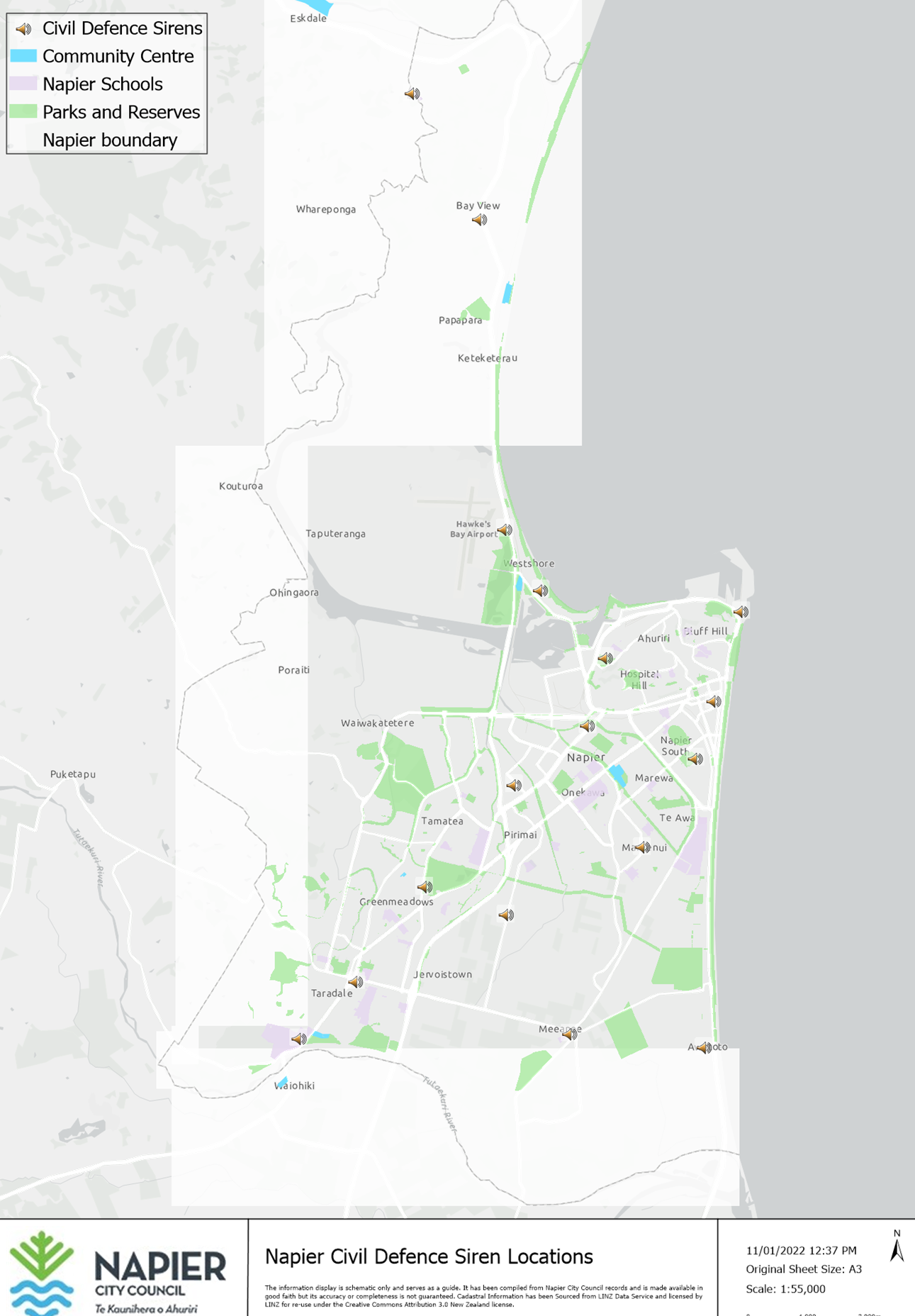
The siren system was based on a network of 17 rise and fall tone sirens which are affixed to buildings and in some cases, are on stand-alone towers. Four of these sirens are dual purpose sirens. Three are owned by FENZ, located on their property and are also used for fire volunteer activations. One is owned by, and located at, the Port of Napier and is also used for the emergency evacuation of the Port for fire and hazardous substances emergencies. The sirens are powered by three-phase mains power and are activated using a VHF radio network. The locations of the sirens are set out on the map attached. (Attachment 1).
Prior to 2018, the network was maintained and tested by the NCC civil defence manager. An ongoing maintenance budget of $50,000 per annum was provided and a public test of the network took place twice a year (typically on the daylight savings beginning and end dates).
With the move to concentrating the delivery of the region’s Civil Defence Emergency Management (CDEM) functions in 2018, HBCEDM took over the responsibility of the siren testing and maintenance requirements on behalf of NCC, who continued to fund the system. The system was last tested publicly in 2018/19, however with the closure of the Napier City Civic Administration buildings, the ability to trigger the sirens was limited as the aerials and communications equipment was removed. The sirens continued to the tested until the end of 2019 by way of an individual ‘flick test”.
In late 2019 Fire and Emergency New Zealand (FENZ) removed the ability for sirens under their control or on their property to be used for public alerting. This was in response to a false alarm in the Bay of Plenty where the VHF system was compromised by a third party, activating the sirens, causing public alarm. This national direction has seen the removal of three of the NCC sirens from the 17-siren network (Taradale, Bayview and Napier City Fire Stations).
In July 2020, the National Emergency Management Agency (NEMA) technical standard on Tsunami Warning Sirens [TS03/14] came into force. As the sirens do not meet this standard in terms of tone, they can no longer be used as tsunami warning sirens. This standard goes further and also states “Sirens (signal-only or PA capable) are not regarded as effective or reliable alerting mechanisms in local source tsunami events… the use of fixed coastal sirens for tsunami warning is not advised”.
Given the inability of the system to be used for tsunami warning, and the removal of the FENZ sirens creating gaps in the network, it is recommended that this method of public alerting is replaced fully by the already in use, nationally recognised Emergency Mobile Alerts (EMA) supported by mobile apps as recommended by the Hawke’s Bay Regional Systems Alerting Review (Attachment 2). The remaining sirens in the network should therefore be decommissioned and removed.
1.3 Issues
In August 2021, the HBCDEM Group commissioned a review into Hawke’s Bay’s regional alerting systems which was carried out by the Joint Centre for Disaster Research in conjunction with Massey University. The purpose of the review (the Review), completed in December 2021, was to conduct a gap analysis and assess the current suite of public alerting options in the Hawke’s Bay region. The two most critical considerations for alerting the public were identified as providing (1) a “heads-up” ahead of the threat and (2) instruction on the detail i.e. what is happening, where, when and what action is required in response to the threat.
This review has yet to be presented to the HBCDEM Group or Coordinating Executive Group (CEG) for consideration and action from a regional perspective. However, given the analysis, this has particular implications for the Council as the owner of the Napier siren system. This is especially the case given the issues identified above which means that timely decisions need to be made on the future of the system.
In the report, the cost, reliability, reach functionality and effectiveness of each alerting option was assessed using a range of criteria developed from information from international and national case studies and theory-based research. Indicative costs of each option were derived from past studies’ estimates and will have likely increased since however are useful for the purposes of comparing cost-effectiveness of options.
The Review recommends that Emergency Mobile Alerts (EMA) through cell broadcasting, supported by mobile apps (e.g. Red Cross Hazard app) , should be considered the “backbone” of public alerting in Hawke’s Bay.
Specifically to the Napier Siren System, the Review identified that the current signal-only siren system in Napier is not fit for the purpose of contemporary public alerting. Although it provides a heads-up, it cannot provide detailed instructions. The rise and fall signal only intends to communicate the need to seek more information. The public might not know what the siren signal means unless this system is accompanied by extensive education on the appropriate actions to take when the signal is heard. This is further complicated by the fact that a number of private agencies use a similar siren tone for on-site emergencies.
Upgrading the current system to a PA (public address) loudspeaker system can be considered, so instructions can also be provided. However, a PA loudspeaker system has a high start-up cost and will have substantial ongoing maintenance costs. Its coverage is also restricted to narrow geographical areas and impacted by weather. It is therefore considered that the costs do not outweigh effectiveness in areas with already existing or alternative alerting options. Napier City, as an urban area, already has excellent coverage with EMA and mobile apps.
CDEM Groups and CDEM Group members are responsible for evacuations. The Tsunami Warning and Advisory Plan covers the three different categories of tsunami (distant-source, regional-source, and local-source). NEMA and GeoNet work to provide threat advice for all tsunami. However, an official warning may not be possible for local-source tsunami. The National Tsunami Warning and Advisory Plan makes further clarification that official warnings are unlikely and should not be relied upon to take action. Natural felt signs are the primary warning for local-source tsunami.
1. Distant-source tsunami: generated from a long way away, such as from across the Pacific in Peru or Chile. In this case, we will have more than three hours warning time for New Zealand. These tsunami sources have been modelled to a maximum wave height at the coast of around 5m (red and orange zone). The deployment of Deep Ocean Assessment of Tsunami (DART) buoys around the Pacific and international warning and assessment centres means that there is likely to be time to issue detailed public warnings and evacuation advice using a variety of systems from mainstream media, social media and the cell phone enabled emergency mobile alerting system.
2. Regional-source tsunami: generated between one and three hours travel time away from their destination and limited warnings may be received. An eruption from an underwater volcano in the Kermadec Trench to the north of New Zealand, could generate a regional tsunami – sources modelled under 5m (red and orange zone).
3. Local-source tsunami: The more serious risk to Hawke's Bay is from a local source tsunami, such as those generated by a subduction zone earthquake (Hikurangi Subduction zone). This type of tsunami is very dangerous because we may only have a few minutes natural warning from the earthquake itself. The earthquake itself will result in significant damage to infrastructure and buildings across the Hawke's Bay. If a tsunami is generated this could arrive at the coastline within 15 to 40 minutes and is modelled to reach heights of up to 13.5m at the Napier coast (all zones). Currently official warnings with advice and time for people to react, cannot be issued in this timeframe. In New Zealand, public information (e.g. Long or Strong – Get Gone) is the preferred method of increasing community and individuals’ resilience to this threat.
As the sirens are “all hazard”, it they were to be activated for a distant or regional-source tsunami people would need to seek further information as to the nature of the threat and what actions to take. Despite public education programmes many members of public believe that the sirens are only tsunami sirens and if they are activated that they should immediately evacuate to higher ground. Most would try do this using motor vehicles. This uncoordinated approach to evacuations can result in unneeded risk to life and interfere with the movement of emergency services and evacuees to/from areas likely to be impacted.
If the event is a local-source generated tsunami, the issues and challenges will be entirely different. It is likely that the earthquake that generates a local source tsunami will severely damage the existing siren network and result in the power being cut. It is unlikely that the system will be usable in this scenario. Even if the system is operational after the earthquake, it is unlikely that there will be sufficient time for it to be activated given it is not an automated system.
For this reason, the Hawke's Bay CDEM Group public messaging over the last eight years has been, “if you feel a long or strong earthquake evacuate immediately from coastal areas” (Long or Strong – Get Gone). The earthquake itself is seen as the warning, not any other public alerting system such as sirens or mobile alerts.
The above conclusions are backed by international scientific research particularly after the 2011 Japanese earthquake and tsunami (Tsunami Evacuations: Lessons from the Great East Japan Earthquake and Tsunami of March 11 2011, GNS Report 2012/17). In a survey after the 2011 earthquake and tsunami in Japan, 17 out of 27 affected municipalities responded that their tsunami alert transmission system failed from power cuts or earthquake damage and did not function properly at the time of the disaster.
International research (especially from Japan) also shows that the existence of sirens creates a false sense of comfort with the public in that they expect to be warned by the siren, rather than making a decision to respond to the earthquake itself and immediately self-evacuate.
In other cases, sirens have led to people ignoring them or delaying evacuation due to false alarms. This was especially true in places where the sirens are triggered automatically without a human decision.
The research has found that casualty rates from the 2011 earthquake and tsunami were higher in municipalities that had a tsunami siren system, compared to those who did not. In the municipalities without sirens there was significant public investment in “tsunami tendenko” (which roughly equates to Long or Strong – Get Gone). In these areas many people and schools immediately self-evacuated. Waiting even a few minutes for a siren or other warning to sound had a negative impact on casualty rates.
The research with regards to the impact of false alarms on effectiveness is also relevant to the Napier system. The tone of the sirens is the same as used by FENZ at their fire stations and some private industrial site sirens. This has created several false alerts and resulting public enquires every year. This impacts on the public confidence in any warning system and therefore increasing complacency.
Another issue which has been identified through surveys after every public test of the Napier siren system, is the audibility which is impacted by topography, wind and rain. This is likely to be worse now given the removal of the three sirens on FENZ property.
It is likely that the operation of public warning systems such as the Napier sirens will come under greater scrutiny in the future and the fact this system is not compliant with the NEMA national standard means this may be a liability issue if they are used as such.
Since the siren system was put in place there have been significant changes to communications technology that allow for messages to be more efficiently and effectively distributed to the public in the event of an emergency. As mentioned, sirens in themselves cannot tell people what the threat is or what actions to take.
The implementation of the national Emergency Mobile Alert (EMA) system in 2018 has provided a tool which is far more effective and timelier in providing warnings and information to the public than sirens. The last national test of this system in 2019 confirmed that 77% of cell phones received the alert. The Napier City area has complete cell phone coverage so all smartphones are capable of receiving the alert.
Under the National Tsunami Advisory and Warning Plan 2020, in the event of a local source tsunami threat, NEMA will directly issue an EMA to those coastal regions that are subject to a land threat telling people to evacuate from coastal areas. This is delivered through cell phone technology directly to mobile phones. This network is also subject to the impacts of a major earthquake, but should the system still work this gives the best information to people who have not already self-evacuated. The system also does not only rely on local emergency management staff, who are likely to be directly impacted by any earthquake, to activate the system. NEMA are also in the process of standing up a national 24/7 staffed monitoring centre. This will further accelerate the capability to issue EMAs.
1.4 Significance and Engagement
This matter has been assessed in accordance with Council’s Significance and Engagement Policy and does not trigger any thresholds or criteria within the policy.
1.5 Implications
Financial
Decommissioning and removal of the remaining siren network will be funded from existing maintenance budget of $16,000 which was made available for the 2021/22 financial year only for this purpose. There will therefore be no savings going forward.
Only high level estimates for comparison purposes have been made to upgrade and/or replace the siren network with a system compliant with the NZ Standard for Tsunami Sirens i.e. fixed PA loud-speakers. This is estimated to be in the region of $1.4M to 1.6M capital costs with significant ongoing operational costs.
Social & Policy
N/A
Risk
The risks of retaining the fixed siren system are outlined in the report and in the attached review. These risks are primarily around the risk of over-reliance on the system causing people to wait to hear the siren before acting on natural warnings. This is where the Long or Strong – Get Gone public messaging and education is critically important.
1.6 Options
The options available to Council are as follows:
a. To decommission and remove the siren network infrastructure from the remaining locations and continue to support the HBCDEM Group education and public information campaigns.
b. To investigate an upgrade and/or replacement of the existing siren network to meet the NZ Standard for Tsunami Sirens.
1.7 Development of Preferred Option
The preferred option is to decommission and remove the existing siren network. The network is non-compliant and is not as effective or indeed relevant as the more effective EMA system is now in place. The Review recommends that a backbone public alerting system of the EMA supported by mobile apps such as the Red Cross Hazard app is the most cost-effective public alerting option with the greatest population reach. This is particularly so for Napier City as it has full mobile coverage. This backbone public alerting system will be supported with ongoing education and public messaging to ensure our community are well prepared on how to respond to an event. The costs of upgrading the current siren system to a PA loudspeaker system are unlikely to outweigh effectiveness in areas with already existing and proven to be effective alerting options such as the EMA system.
1 Civil Defence sirens map.(Doc Id 1423064)
2 HB Alerting Review - DSR Report 2021-4. (Doc ID 1423063) (Under Separate Cover)
Napier People and Places Committee - 03 February 2022 - Open Agenda Item 2
|
Type of Report: |
Operational |
|
Legal Reference: |
N/A |
|
Document ID: |
1412891 |
|
Reporting Officer/s & Unit: |
Natasha Mackie, Manager Community Strategies |
2.1 Purpose of Report
This report summarises the Strategic Housing Review findings and seeks approval to undertake a Special Consultative Procedure on the three options outlined.
|
The Napier People and Places Committee: a. Resolve to undertake a Special Consultative Procedure based on the attached Statement of Proposal (Doc Id 1426519) on all three options with no preferred option identified b. Note that further consultation may be required dependant on the decision made following this consultation.
|
Council started providing community housing over 50 years ago when, like many councils around the country, it received government low cost loans to build housing units. Of the 377 units we now have, 80% are for retirees or people with a disability. Council housing is for people who need affordable homes and who are able to live independently. The 377 units are spread over 12 villages across the city, on a total of 10.7 hectares. While not considered high density, these homes are in very close proximity of each other. Council supports tenants by providing subsidised rents based on income (set at a maximum of 30% of household income). A team within Council manages tenancies including administering tenancy agreements and arranging repairs and maintenance to the units. Asset management and capital projects are also managed in-house.
In 2018, Morrison Low completed a Section 17a of the Local Government Act (LGA) review of the housing activity. Councils are required under the LGA to complete S17a reviews of their activities. Alongside a sample-based condition assessment, the review identified ongoing sustainability issues with the current delivery model and identified two options for Council to consider. These options were to:
a) Divest a number of villages in order to reinvest in the portfolio (offset costs and replace ageing stock), or
b) Partner with a Community Housing Provider (CHP) who could attract market rent through the Government’s Income Related Rent Subsidy (IRRS) which is not available to councils, thereby generating more income to offset growing costs.
Following this report, a more detailed assessment of options to retain the housing was undertaken by PwC. This review identified a potential option to sell part of the portfolio to help fund development of two sites that could generate additional income to fund the remaining portfolio along with a rent increase. This option introduced a high level of complexity, and therefore risk, to managing the portfolio. Another option identified was to continue as is with the deficits being funded through a ratepayer contribution. Both of these options could include an increase to rents. It also identified a transfer of the portfolio (sale) as the alternative option.
In late 2019, the rent policy was reviewed and rents were increased, but capped at 30% of tenant income. This percentage is a generally accepted level for housing affordability.
With continued forecast deficits, a detailed phase two review was initiated on two options, transfer of the portfolio and a part retain / part sell option and compared with the new status quo (with new rent policy). This review is now complete and the options are detailed below. The PwC report is attached. Some information in the PwC report is redacted due to commercial sensitivity.
2.3 Issue
Council delivery of Housing
As identified above, councils were encouraged to provide housing when the Government provided low-cost loans first in the 1960s and again in the 1980s. These loans saw many councils across the country create housing portfolios. Councils have differing tenant cohorts but traditionally the earlier housing was created for ‘pensioners’ or retirees. Rental policies also differ between councils with many adopting a subsidised market rent policy. Over the last decade, many councils have opted out of providing subsidised housing due to issues of financial sustainability as housing stock has aged and costs to maintain housing has increased.
In 2014, the Government introduced an Income Related Rent Subsidy (IRRS) for registered Community Housing Providers (CHPs). This allows the provider to receive full market rent for a property with the tenant being charged 25% of their income and the remaining rent being topped up to market rent by the government. This enables financial sustainability for existing stock while also being able to increase and/or replace portfolios. Kāinga Ora are also able to access the IRRS.
CHPs and Kāinga Ora are also afforded exemptions or allowances to legislation related to residential rental provision. For example, the Residential Tenancies Act allows them to terminate tenancies should the tenant become ineligible for social housing, and compliance to Healthy Homes standards timeframes are longer.
It would appear, the Government, through current legislation and policies, are not actively encouraging councils to continue to provide affordable housing. However, some councils, are investing heavily in their housing stock and also increasing their portfolios either alone or through partnership arrangements. Responses to our Long Term Plan 2021-31 consultation identify a mixed view from the Napier community on the matter. Consultation on the options identified in this report may provide clearer information to Council on the community view around whether or not the community supports Council continuing to provide a housing service.
Condition of Units
Housing units have been maintained to a reasonable standard. Some medium scale renewal work has been completed e.g. re-roof of units and replacement of unit components (e.g. degraded aluminium joinery) has also been completed. A detailed condition assessment of each of the 377 units was completed as part of this latest review process and it has shown many of the units are nearing or at ‘end of life’. The results of the condition assessments identified the capital expenditure requirements for the next 25 years. This expenditure is to maintain current service levels but does not address other ‘fit for purpose’ issues that arise from the age of the homes not aligning with modern living requirements or accessibility needs. Our current service level is to ‘replace at failure’, resolve any health and safety hazards and to meet compliance requirements. While the condition assessments are very detailed, and forecasts are based on assessing each component of each unit, the actual point of failure timings may not directly align with forecasts. This means there is a risk that expenditure may be needed sooner (which would increase early deficits) than predicted.
Financial sustainability
While there was some investment from Council when the units were first established, the portfolio has largely funded its costs through rents received from tenants – paid for itself, until this year when funding in reserves was depleted and large forecasted deficits came into effect. In 2021, Council consulted with the community to fund these forecast deficits through loan funding until the Strategic Housing Review was completed and a decision could be made about the future provision of housing.
Loan funding on an ongoing basis cannot be sustained as loan repayments compound each year while deficits also increase.
Retaining retirement villages and selling the three ‘social’ villages to fund the deficits was considered but not investigated further. While it provides a short term fix, it does not provide a medium to long term solution. This option would reduce income from rents (reduction of 72). The remaining villages will still generate a shortfall once the sale proceeds are used and the position would end up the same as the current situation with fewer units.
The retention options analysed by PwC – Status Quo and Part retain / Part sell identify an approximate $2.2-2.3 million annualised shortfall that require ratepayer and/or tenant (rent) support.
The book value of the portfolio sits at $65 million. This is based on a Telfer Young market valuation as at 20 March 2020. Market valuation represents highest and best use (e.g. capitalised ‘market’ rent or redevelopment value). However, the transfer (sell) options that best align with Council’s criteria (selling to a CHP or Kāinga Ora) would attract a ‘discounted cashflow’ (DCF) price (lower sale price) based on future forecasted cashflows of the portfolio by any given buyer. This would be materially lower than the market value. In addition, any sale price would be further impacted should any covenants be placed on the transfer e.g. retention of current tenants and the retirement criteria. However, a sale does remove the liability (ongoing deficits). Removing the liability coupled with attaining sale proceeds provides a positive financial outcome for the Council.
Rent Setting Policy
In 2019, the rent setting policy changed to increase the total rental income while also keeping rents ‘affordable’ (30% of income). This meant that tenants receiving Superannuation or Supported Living Benefits had an increase (5% of their income) and rent for a social village unit was set at 92% of market rent or 30% of the tenant’s income, whichever was lowest. The effect of this saw a total increase in rent revenue for the retirement units, but this was largely offset by reduction in the overall rent payable in the social units. Unfortunately, maintaining this income-related rent setting policy will not achieve financial sustainability through tenant income (rent) alone. For either of the retention options to be viable, the rent setting policy will need to change to a subsidised market rent model with market rent valuations reviewed on a regular basis (e.g. every two years) and applied, with CPI adjustments made in the alternate year.
Adopting this policy would have impacts for tenants both in terms of affordability with rents higher than 30% of income in most cases and add uncertainty with changing market rent values. Retirement housing tenants receive an increase in income with annual Superannuation increases and are able to apply for an increase in accommodation supplement if rents increase. Other tenants on low incomes are able to also apply for increases to accommodation supplement as rents increase. Council rentals, even applying a market rental formula, is still significantly lower that the private rental market (e.g. Council 1 bedroom unit - $283 per week versus Private 1 bedroom unit - $345 to $390 per week – source Trademe 21/12/21). This difference could partly be a result of the ‘level’ of market rent applied. We generally use the lower to median range where private rentals may use the upper range to determine rent.
While there is no legislative maximum rent increase, it is advisable that the rent increases outlined in the Status Quo and Part sell / Part retain options be phased in over a two-year period. Rents can only be increased once every 12 months. For the majority of our tenants these increases can be applied in April of each year, giving 60 days notice.
Meeting demand – additionality
Demand has remained high in the affordable rental market. Our waiting list of over 100 people/households has been closed to new applicants since June 2019. Our occupancy rates remain high with very low turnover. Without capital investment into the portfolio, there is no ability to increase its size. The retirement housing provided by Council is one of the few options available in Napier to those whose income is limited to Superannuation and who have no asset base. This cohort is set to grow as more and more working age people are unable to enter the housing market and either rent through the private market or are supported through public housing.
In Napier, over the next twenty years, based on the latest Census data, this could be as many as 2,430 people. These are the people currently aged 40-64 years of age who rent in the private market and who earn $30,000 or less. Of those who earn $30,000 or less in this age group, 72% are renting in the private market and 25% are in public housing with 1.9% in Council housing. At this level of income and the current rent prices, this cohort is likely to seek the type of rental housing currently provided by Council.
Demand for public housing is high in Napier with 753 on the Housing Register, with 732 of those being in the high priority Category A (as at September 2021). Napier’s numbers on the register are the second highest for a provincial city.
Tenancy Management Changes
Tenancy rules changed with the changes to the Residential Tenancies Act (RTA). One of the main changes, the removal of the 90 day no reason termination clause, has introduced complexities for tenancy management and policy eligibility criteria. In order for tenants to access Council housing, they must be below the low income and low asset threshold. We initiated regular eligibility reviews in 2018 which found that on average around 5-8% of sitting tenants no longer met the eligibility criteria. Prior to the RTA changes we were able to manage these situations with the tenant whereby they either resolved their eligibility issue (e.g. reduced their income) or found alternative accommodation. The removal of the 90 day no reason termination no longer provides a lever for us to rectify eligibility issues. However, our policy does provide for the charging of full market rent should the tenant become and remain ineligible. This creates a situation where ineligible tenants are able to remain in housing potentially subsidised by ratepayers while those in need remain on our waiting list.
A priority placement process was introduced in 2019 so people with a high need for housing were placed first as opposed to being ‘first in’ on the waiting list. This has meant that tenants are often experiencing more complex situations which can be challenging in ‘close proximity’ living arrangements. Dealing with neighbourhood tension and tenant behaviour under the RTA changes has required a higher level of administration and management oversight.
These tenancy management issues, along with the growing compliance and asset management requires additional resource allocation should the portfolio be retained or until any transfer can be completed (a minimum of one extra staff member in the tenancy team).
Legal
Two village sites are listed in Schedule 3 of the Napier Borough Endowments Amendments Act 1999 (amendment of the 1876 Act).These villages are Carlyle Place and Hastings / Munroe. Both parcels of land were transferred to Council from the Crown and were originally in Māori ownership prior to their transfer to the Crown. The option to Part Retain / Part Sell identifies Carlyle Place for divestment and the option to Transfer (sell all housing) identifies both Carlyle Place and Hastings / Munroe for divestment. A high level review of the legislative and contractual obligations conducted by PwC (Legal), given these option pathways, identified that both sites are subject to the requirements of both the Napier Borough Endowments Act 1876 (NBEA) and Local Government Act 2002 (LGA). They are also subject to the terms of the registered endowment instruments and the historical endowment agreements themselves. Where Council originally acquired the sites from the Crown, there may also be Public Works Act 1981 obligations.
The legal review concluded that:
“there were legally compliant pathways available for each of the proposed options. Importantly, there are strategy options and implementation pathways that are potentially able to preserve, and make workable the spirit and intent of the original endowment purposes (some of which are currently ineffective) which focus on benefits to the community.”
In addition, PwC advised that although not strictly required under the legislation, where sites are identified as having been in iwi ownership (prior to transfer to the Crown and then Council), consultation with mana whenua is recommended to preserve iwi environmental, cultural and heritage values in the sites and this also provides an opportunity for meaningful consultation and partnership.
Any development will require regard for ‘Sites of Significance’ to Māori. The Hastings / Munroe site is situated in such and area and would therefore necessitate consultation with appropriate Māori entities.
The divestment options (Part Retain / Part Sell or full transfer) involve a Strategic Asset and could only be actioned if provided for in an LTP. Therefore, if either of these options were selected as the Council’s decision, further consultation would be required through the next LTP process or an LTP amendment to the current LTP.
Should the Status Quo option be selected as Council’s decision, involving a rates impact, this would need to be informed to the community through an Annual Plan consultation process, with the next available Annual Plan process being the 2023/24 year. The Annual Plan 2022/23 process will be underway prior to the decision. If this option were selected as the decision funded solely by rent increases, the Residential Tenancies Act applies with a 60 day notice period for rent increases being required, so could be implemented immediately.
There are no substantial contractual arrangements that would be affected by proceeding with any of the options.
2.4 Significance and Engagement
This matter requires a Special Consultative Procedure as part of the decision-making process because it involves the potential transfer of ownership (and control) of a Strategic Asset. In addition, the matter is deemed significant given that the potential decision could:
· have ongoing significant increases to rates which require changes to key financial policies and settings e.g. Revenue and Financing Policy and rates caps (retention of portfolio with loan funding the gap)
· be difficult to reverse or be irreversible (transfer of portfolio)
· change the levels of service (all options)
· impact on affected individuals - tenants (potentially all options)
· significantly impact on rating levels (retention of portfolio)
· financially impact Council’s resources – e.g. balance sheet, proceeds of sale and income reduction (transfer of portfolio)
· have significant decision costs (all options will incur costs to implement)
Council’s decision around the future provision of its housing will be of high interest to key stakeholders including mana whenua, iwi and post settlement governance entities (PSGEs), Māori service providers, the Crown and its relevant agencies, potential purchasers and developers, Community Housing Providers (CHPs), community support service providers and other councils. Direct engagement with key stakeholders will be undertaken alongside wider community engagement on the matter.
As affected individuals, tenants will be consulted utilising a range of approaches in order for each tenant to be able to engage in the process. Tailored information will be provided to each tenant on how the options would directly impact them (e.g. rent rates etc).
A High Level Consultation Plan is attached.
2.5 Implications
Financial
As outlined above the current model of funding and delivery of the housing activity is not sustainable. Deficits are being funded by loans with future ratepayers funding present costs and services. The Long Term Plan 2021-31 consultation identified loan funding as a short term measure to deal with the shortfalls until the Strategic Housing Review was completed and a decision could be made on the future provision of housing.
All options identified each have financial implications.
The options that have Council retain the housing would require changes to current financial policies and strategies, particularly the revenue and financing policy (how rates are set) and rates caps. The rent setting policy will require changes unless deficits are fully funded directly by rates.
Transfer options will take time to complete necessitating further loan funding and/or rates increases to cover the intervening period.
While there has been detailed financial modelling completed through the PwC analysis, there are still a range of variables that can affect each option including cost escalations, market value changes, changes to the timing of capital expenditure (asset failure), costs to implement and costs around legislative change. While these variables could affect the specific financial detail, the underlying premise of each option remains.
Social & Policy
Secure and affordable housing is considered a key driver of wellbeing. Poor housing is linked to reduced health, education and associated outcomes. In addition to the tangible effects related to the physical home, improved wellbeing is also related to sense of belonging, connection and autonomy. Secure housing allows whānau to establish a home, a base from which to establish social supports and networks and to improve social and economic mobility. Inadequate housing has ripple effects across our community from higher levels of homelessness, increased demands on health and education systems and higher prevalence of social issues.
In New Zealand, a large proportion of public/social housing is provided by the Government, either directly through Kāinga Ora and Ministry of Social Development or indirectly through CHPs. Councils often aim to provide for housing needs that aren’t met by the other main social housing providers such as Kāinga Ora. In Napier, Council provides around 10% of the public or social housing available. It is estimated around 90% of current tenants would be able to access public housing from other providers.
Previously, although subsidised rents have been provided, the Napier ratepayer did not directly subsidise this activity. However, with rates funding now being provided, and set to increase substantially to maintain the provision of housing, consideration of continuing this activity is required given that the direct benefit of this activity is low across ratepayers and high for individuals (tenants).
1.6 Risk
Changes to Local Government Provision of Services
There are two key pieces of reform work that could significantly affect local government service provision – 3 Waters and the Future of Local Government.
Should 3 Waters provision be aggregated to new regional bodies, there will be an effect on Council’s asset base and its income. While the option to retain housing (with rates contribution) won’t cost any more, the proportion of rates spent to subsidise housing would be greater – the overall income pie would be smaller.
The Future of Local Government reform focus is on what the appropriate role and functions of local government should be given its contribution to community wellbeing and its close connection with local communities. The transfer option may diminish Council’s status should more emphasis be placed on councils taking a greater role in the provision of housing in the future. A draft report on the reform for public consultation is due in September 2022. This should provide information on the direction the government may take with the reform and allows for adequate time to adjust the decision made by Council in May / June 2022 before implementation becomes irreversible.
Changes to Government Support
Successive governments led by both the National Party and the Labour Party have not made any changes to allow councils to access the Income Related Rent Subsidies (IRRS) that are available to Community Housing Providers and Kāinga Ora. Local Government NZ, prompted by councils across the country, has submitted several remits to change this policy. These have been unsuccessful. Current communication on the matter indicates no changes will be made to the policy. Access to the IRRS has been identified as the key factor that would allow the Council to continue providing housing.
Ministry of Housing and Urban Development (MHUD) is examining the pressures on councils to continue to delivery housing. We have contributed some of the PwC review information to this work. In discussions with MHUD, they have been very clear that this work in no way changes the IRRS policy setting and that currently the public housing funding has a strong emphasis on new builds.
Information Currency
Financial information is based on current pricing and other assumptions are identified under each option within the PwC report. The changing nature of the construction industry will have an impact on costs, access to materials (supply chain) and capacity to deliver (labour constraints) – this is an issue for every option that has the Council retain some form of ownership.
Other variables that could impact on the currency of information include any delays in consultation or decision-making and subsequent delays in implementation. If these delays are significant, updates to the financial modelling may be required.
It has been difficult to source details around the funding of the initial development of the housing apart from amounts and funding sources. There appears to be no conditions on the donation provided by Henry Charles who contributed funds for a Hall and some housing units. The information we have relied on is what is held in Council’s archives. There may be information held in the community that may come to light as part of the consultation process, which may have an influence on decision-making and can be dealt with as part of that process.
Tenant Welfare
This process was initiated in 2017 and has required two subsequent reviews to achieve the level of detail required by decision makers. The length of time and uncertainty has had an effect on some tenants who have communicated a level of anxiety for their future. In addition, some misinformation has also been unsettling. Communication with tenants has been maintained and information and progress updates have been provided throughout the review process. In Council’s last two Long Term Plan consultation processes, the housing situation has been outlined.
In August 2021, a meeting was held for tenants where assurance was provided by the Mayor that tenants would not lose their housing. Tenants have been consistently advised that any options that significantly change the provision of housing would require direct consultation with them.
The Housing Team continue to be available to discuss any concerns about the review and targeted consultation is planned as part of the next steps in this review process.
2.6 Options
The options available to Council are as follows:
a. Identify a proposed option and undertake Special Consultative Procedure to inform the decision-making process
b. Present the feasible options identified below and undertake a Special Consultative Procedure based on the attached Statement of Proposal to inform the decision-making process (preferred)
2.7 Development of Preferred Option
Proceed with consultation on the options outlined below:
|
1.Status Quo Deficit funded by: (a) Rates only (b) Subsidised rents (c) Combinations - Rates and subsidised rents 1. |
2.Part Retain / Part Sell Deficit funded by: (a) Rates only (b) Subsidised rents (c) Combinations - Rates and subsidised rents
|
3.Transfer (Sell) Potential buyer: · CHP · Kāinga Ora · Regional Housing Trust · Open market |
1. Status Quo
Description:
The Status Quo option sees Council continuing to provide housing at current levels of service.
This option generates an annualised deficit of $2.2 million and without any rates or increased rent adjustments the accumulated cash shortfall would reach circa $70 million after 25 years (2046).
Ongoing loan funding to fund long term deficits is not considered a feasible option.
In order to cover this deficit, income from rates or rents (or a combination) is required.
Key benefits of this option include the relative ease of implementation, retention of housing (and land) in Council ownership and a higher level of certainty for tenants. Moving to a subsidised market rent policy will provide predictable income and reduce the administrative requirements that income-related rent settings cause.
This option does not provide for additional housing to meet growing demand, or upgrades to existing housing to meet modern living standards or accessibility. This option does not address the issue of the units being very close to ‘end of life’ and while replacing componentry will extend the life and buys some time, ultimately decisions on full replacement may still be needed in the future. In addition, the actual capital expenditure may vary from the forecasts, and should they arise earlier, would be challenging given the lack of cash reserves and the time needed to build these up.
Combined contribution
When considering how an activity is funded, i.e. through rates or user pays or a combination of these, Council must consider the proportion of benefit received from the activity and therefore how the cost should be fairly split. This is determined by a series of assessments required by Section 101A of the LGA.
The table below shows examples of rates / rents splits, actual splits may differ following the completion of the assessment and the Revenue and Financing Policy may be affected.
A change in the rent setting policy is advocated under this option. This requires a change from rent being based on a tenant income affordability and moving to a subsided market rental approach. Any initial significant rent increase could be phased in over two twelve month periods. Full rent increases would then be effective from April 2024. Deficits up to April 2024 could continue to be funded through loans as outlined in the Long Term Plan 2021-31. The rent setting policy would form part of the implementation process with the intention to undertake market rental valuations every two years and applying a CPI increase in the alternate year.
While rent increases may potentially be unpopular with current tenants, and in some cases unaffordable, the opportunity for the housing to remain with Council may outweigh these concerns.
The tenancy management issues outlined above require additional staff resources in order to comply with legislative requirements and tenancy matters, this is not currently factored in to the costs.
The following table shows the impact on rates and/or rents depending on the contribution settings. The splits are provided as examples only.
|
Status Quo – 377 units - $2.2 million deficit pa |
|||
|
Contribution Level to meet deficit |
Ratepayer pays* (rates increase) |
Tenant Retirement Pays (rent increase pw) ** Current rent is $127 45% market rent |
Tenant Social Pays Current rent $151 39% market rent***
|
|
100%
|
3.1% or $85per annum |
Deficit split by tenant type – ‘break even’ |
|
|
78% market rent |
63% market rent |
||
|
70% or $88pw increase ($215 rent pw) (51% of tenant income) |
61% or $92pw increase ($243 rent pw) (32% of tenant income) |
||
|
Increase to 92% market rent |
|||
|
100% or $126pw increase ($253 rent pw) (58% of tenant income) |
136% or $205pw increase
($356 rent pw) (47% of tenant income)
|
||
|
Deficit split equally across tenants |
|||
|
88% or $112 increase ($239 rent pw) 85% of market rent (56% of tenant income)
|
74% or $112 increase ($263 rent pw) 93% of market rent (35% of tenant income) |
||
|
50/50 |
1.6% or $43pa |
44% or $56pw increase ($183 rent pw) 66% of market rent (43% of tenant income)
|
37% or $56pw increase ($207 rent pw) 73% of market rent (27% of tenant income) |
|
60/40 |
1.9% or $51pa |
35% or $45pw increase ($172 rent pw) 62% of market rent (41% of tenant income) |
30% or $45pw increase ($196 rent pw) 69% of market rent (26% of tenant income)
|
|
40/60 |
1.3% or $34pa |
53% or $67 increase ($194 rent pw) 70% of market rent (46% of tenant income) |
45% or $67 increase ($218 rent pw) 77% of market rent (29% of tenant income) |
|
*Average annual rates increase per rateable property **Based on a single person in a one bedroom unit ***Based on an average of the market rent for 1,2,3 bedroom units |
|||
2. Part Retain / Part Sell
Description:
This option retains 301 retirement units in 8 villages. It loses 76 houses and builds 49 new units. It proposes to transfer the three social villages to another entity with sale proceeds to contribute to the development of 49 new units. The new development would take place on existing sites.
The Hastings/Munroe village would demolish the four units and replace 11 new units that would be rented at full market rent, thereby generating an ongoing income to contribute to the costs associated with the remaining housing. The second site, Greenmeadows East, with land already set aside for additional Council housing, would see the development of 38 new units.
The 72 houses in the three social villages would ideally transfer to a CHP and therefore retain them as affordable rentals for the city. However, with the lack of ability to add new units on these sites, CHPs may not find these villages attractive given the delays in receiving IRRS and the inability to attract the government support available for additionality.
The sale of the Carlyle Village has added complexity due to its inclusion in the Napier Borough Endowment Act. The Carlyle Village is identified as a ‘Site of Significance’ to Māori having been part of the Pukemokimoki site, a site of particular significance to Ngāti Pārau. Particular regard for ‘Sites of Significance’ is needed should any development be proposed. The Carlyle Village has not been identified for development in any of the options being considered. The Hastings/Munroe village also sits in a wider ‘Site of Significance’ area, Te Ahi o Te Waru (the fires of Te Waru). Given its potential for development, engagement with mana whenua is vital to understand any implications for development, opportunities for cultural expression and a potential partnership approach. The site has been significantly modified already but will likely require archaeology oversight during any development process.
While the new units will attract a higher asset value, with the sale of 72 units, the overall asset value for the total portfolio is either likely to decrease or maintain current value. It is unlikely to increase the asset value significantly (e.g. sell at value of $16.2m, new builds with a conservative value of $21.96m (costs to construct) - positive balance of $5.76m).
Key benefits of this option include the refocus of the portfolio to be providing for retirees or those with a disability only, its retains the majority of the housing and land in Council ownership with a higher level of certainty for retirement tenants and it adds new fit for purpose housing to the portfolio.
The sale of the three villages would impact the current tenants in these villages, and depending on the buyer could either have a positive or a negative impact. The preference to retain the housing for community housing would likely result in a positive impact.
The development at Hastings/Munroe creates a higher level income source in the longer term. Moving to a subsidised market rent policy will provide predictable income and reduce the administrative requirements that income-related rent settings cause. The development of the two sites offer potential partnership (and possibly co-funding opportunities) with PSGEs, Iwi and/or Kāinga Ora.
Council currently does not have the resources in-house to implement the development aspect of the option, with the cost of sourcing this function being relatively unknown. The ability to secure consultants and construction contractors is challenging in the current market conditions. Availability of building materials is affecting the supply chain creating project delays and increasing costs.
This option does not fully address the issue of the remaining units being very close to ‘end of life’, and while replacing componentry will extend the life and buys some time, ultimately decisions on fully replacement may still be needed in the future. In addition, the actual capital expenditure may vary from the forecasts, and should they arise earlier, will be challenging given the lack of cash reserves and the time needed to build these up.
A key challenge with this option is the added complexity and uncertainty regarding both the sale of the three villages and the development aspect. Complexity and uncertainty increase the risk.
This option generates an annualised deficit of $2.3 million and without any rates or increased rent adjustments the accumulated cash shortfall would reach circa $65.9 million after 25 years (2046).
In order to cover this deficit, income from rates or rents (or a combination) is still required. Initially the number of tenants would be lower than the Status Quo option meaning the individual tenant share of the deficit would be higher. The same factors apply to this option as the Status Quo option in terms of tenancy management issues, rent setting policy changes, phased in rent increases (and temporary loan funding) and financial policy reviews.
The following table shows the impact on rates and/or rents depending on the contribution settings. Note that the social village tenants are not included in this table. The splits are provided as examples only.
|
Part Retain / Part Sell – retains 8 ‘retirement’ villages, develops 45 new units, sells 3 ‘social’ villages - $2.3 million deficit pa |
||
|
Contribution level to meet deficit |
Ratepayer Pays* (rates increase) |
Tenant Pays ** |
|
100% |
3.3% or $89pa |
115% or $145pw increase ($272 rent pw) 96% of market rent (65% of tenant income) |
|
50/50 |
1.6% or $44pa |
57% or $73 increase ($200 rent pw) 71% of market rent (47% of tenant income) |
|
60/40 |
2% or $53pa |
46% or $58 increase ($185 rent pw) 65% of market rent (44% of tenant income) |
|
40/60 |
1.3% or $36 pa |
69% or $87 increase ($214 rent pw) 76% of market rent (51% of tenant income) |
|
*Average annual rates increase per rateable property **Based on a single person in a one bedroom unit Based on 304 units (will vary according to development stage) |
||
3. Transfer option
Description:
This option would see all 377 units transferred (sold) to another entity.
Council direction during the review process has been to focus on ensuring the housing remains as affordable rental housing. As part of the review at a workshop in October 2020, Council selected a sale or lease option to a CHP to be evaluated in detail as the favoured option for transfer. The protection of tenants and the special character of the retirement villages was identified as important and therefore any transfer contract would need to contain the following covenants:
· Ensure existing tenancies, under the current (or better) terms and conditions, remain in place,
· The portfolio can only ever (in perpetuity) be used to provide housing to retirement or community tenants, and
· The Council retains the right of first refusal (on the same sale conditions) if the buyer was to sell the portfolio.
A market sounding process identified that the option to lease the portfolio would not be attractive. Leasing the portfolio would also not achieve any financial benefit to Council, and would likely exacerbate the current financially unsustainable position.
The opportunities for redevelopment of the two villages identified and the potential to demolish and intensify other currently under-optimised sites allow for additionality which is a key driver to access government funding for CHPs and is a key focus for Kāinga Ora.
Transfer to a CHP
The portfolio would most likely be valued on a discounted cashflow (DCF) basis. In addition, any covenants would negatively affect the overall value. A CHPs DCF might be half the Book Value. There are examples of councils successfully selling their housing to CHPs with covenants including Hamilton City Council.
Transfer to Kāinga Ora
Kāinga Ora is potentially in a better position regarding cashflow as we understand they are able to access the IRRS (full market rent) for existing eligible tenants. A sale to Kāinga Ora might be expected to deliver a sale price similar to, or slightly more than, the value that might be achieved through a sale to a CHP. This may result in a higher purchase price, although there is no guarantee of this given the limited market for this stock and the need for Kāinga Ora only to outbid the next highest bidder.
Transfer to a Regional Housing Trust
There is a potential for the region’s councils to ‘pool’ their portfolios and form a Regional Housing Trust and there is an intention to discuss this further with the other councils to understand the shape of a possible Trust.
There are examples of councils establishing CHPS. Under current legislation, councils and Council Controlled Organisations (CCOs) are excluded from registering as a CHP and securing access to the IRRS. In order to be successful, any Trust would need to be completely independent of Council once established, however Council would be able to influence the purpose and objects of any such Trust. The transfer of housing into this type of Trust would requires councils to ‘vest’ the assets into the Trust, whereby there would be no sale proceeds back to Council. Council could impose the covenants above on such a transfer.
The transfer options identified above allow the portfolio to continue to support an affordable rental housing approach. These potential options also enable the portfolio to be retained in ‘community ownership’.
Advantages of a transfer option to the social housing sector are ultimately financial for both tenants and Council (ratepayers). CHPs provide wraparound support services in addition to tenancy management and are able to apply the IRRS discount rent rate (rent set at 25% of income) to new eligible tenants (tenants coming from the MSD Social Housing Register). Under a transfer to Kāinga Ora, we understand all eligible tenants (existing and new) would be able to access the subsidised rent. Should the covenants be put in place, there would be no negative impact on current tenants. A full transfer would remove all liabilities (forecast costs and deficits).
Sell through the open market
This option is not favoured by Council as it does not align with the review objectives and may result in a loss of affordable rental housing for the city. However, this option would most likely provide a higher sale price more aligned with the current book value of $65 million. A sale through the open market may not afford any protections to current tenants.
Any sale proceeds received (noting a transfer to a Regional Trust would not yield any) would be available for any of the following, in consultation with the community:
· Repay debt
· Invest to generate income
· Pay for current / future loan funded projects
· Implement new or deferred projects
All of the above options have a positive impact for the ratepayer.
The asset would be removed from balance sheet. Council has assets valued at $2 billion (includes $0.5b water assets). While $65 million book value would be removed with the sale of the portfolio, this is not material in of itself to affect Council’s ability to raise loans and would still not be an issue should the 3 waters assets also removed.
While direct operational costs would be eliminated, e.g. labour costs, there will be residual internal costs (stranded overheads) that will need to be spread across the remaining business units (departments) requiring a rates contribution. However, if the sale proceeds are invested, there will be no impact as the table below shows.
|
|
Ratepayer* |
|
Residual costs |
0.6%
|
|
Return on investment of sale proceeds (based on $40m and 2% interest rates) |
-1% |
|
Reduced interest rates (paying off loans) |
-1% |
|
Net rates saving |
-0.4% |
|
*Average annual rates increase per rateable property |
|
The time it may take for a transaction to be completed could be at least 12 months and should, ideally, be timed to coincide with the beginning of a financial year. Interim funding is required to fund the deficit during the transaction period. The Long Term Plan 2021-31 confirmed funding through loans to account for this deficit in the short term.
The option to transfer the entire portfolio to another entity was recommended by PwC as the most sustainable option available.
Summary of Options – Financial Implications
|
1. Status Quo – 377 units - $2.2m deficit pa |
|||
|
Contribution level Rates/Rents |
Annual rates impact |
Tenant - Retirement rent increase per week |
Tenant – Social rent increase per week |
|
100% |
3.1% |
$88 - $112 |
$92 - $205 |
|
50/50 |
1.6% |
$56 |
$56 |
|
60/40 |
1.9% |
$45 |
$45 |
|
40/60 |
1.3% |
$67 |
$67 |
|
2. Part Retain/Part Sell – retains 8 ‘retirement’ villages, develops 45 new units, sells 3 ‘social’ villages - $2.3m deficit pa |
||
|
Contribution level Rates/Rents |
Annual rates impact |
Tenant – increase per week |
|
100% |
3.3% |
$145 |
|
50/50 |
1.6% |
$73 |
|
60/40 |
2.0% |
$58 |
|
40/60 |
1.3% |
$87 |
|
3. Transfer option |
|
|
|
Impact on rates |
Invest sale proceeds |
Repay debt |
|
Estimated residual costs |
0.6%
|
0.6% |
|
Return on investment (based on $40m and 2% interest rates) |
-1% |
|
|
Reduced interest costs |
|
-1% |
|
Net rates saving |
-0.4% |
-0.4% |
1 Draft Statement of Proposal - Council Housing (Doc Id 1426519) (Under Separate Cover)
2 High Level Consultation Plan - Council Housing (Doc Id 1426518) (Under Separate Cover)
3 PwC - Strategic Housing Review (Doc Id 1426520) (Under Separate Cover)
Napier People and Places Committee - 03 February 2022 - Open Agenda Item 3
3. Community Grants and Funding Overview
|
Type of Report: |
Information |
|
Legal Reference: |
N/A |
|
Document ID: |
1374940 |
|
Reporting Officer/s & Unit: |
Belinda McLeod, Community Funding Advisor Matt Adamson, Senior Advisor Policy |
3.1 Purpose of Report
To provide an update on the activities of the Community Grants and Funding Programme.
|
The Napier People and Places Committee: a. Receive this report. |
The Napier City Council administers a variety of grants that are used to provide financial assistance to a range of community organisations. These grants have contributed over $3 million in financial support to over 100 groups and individuals over the last three years.
This paper and its attachments provide Councillors with an overview of grants over the previous three financial years. Community grants and funding that the Council administers is discussed in the main attachment to this paper which provides a detailed look into the various funds.
It is intended that reports on the Community Grants and Funding Programme will be provided on an annual basis in future, to provide regular updates across Council managed funds.
2018-21 Funding Summary
The past three years have seen challenges for the social and community sector continue to grow. As demand for services continue to increase, so do the costs associated with meeting local needs. These costs have been further exacerbated in many cases by organisations responding to the COVID-19 pandemic.
Council grants reach many parts of Napier’s community and support a broad range of activities, services and projects. Figure 1 illustrates how different sectors have been supported by community funding during the previous three financial years. The increased funding allocations in the 2020/21 year were driven by one-off COVID-19 recovery grants. Some of these funds explored an expanded eligibility criteria and set of priorities.
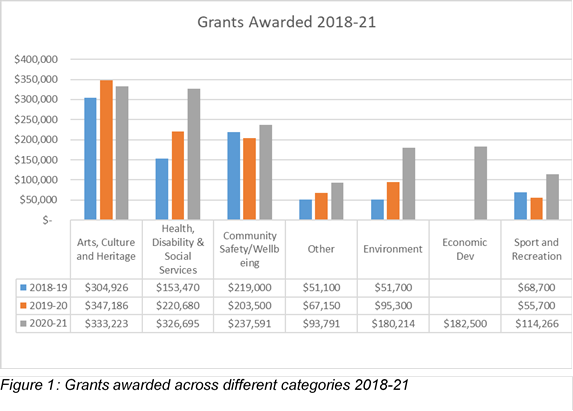 |
The arts, culture and heritage sector has received the most financial support from Council in the last three years. Funding to this sector is dominated by the annual amounts paid to the Art Deco Trust and Creative Arts Napier under their respective service agreements. The combined value of these two agreements was $247k in the 2020/21 financial year.
Health, disability and social services have received approximately $700k of community funding in the past three years. This funding is primarily in the form of smaller grants from the Community Services and Community Development Funds. Funding to this sector was more dispersed when compared to arts, culture and heritage and recognises the many small non-profit groups active locally in this sector.
Community safety and well-being covers initiatives relating to community safety such as CCTV and Community Patrol but also covers projects which support general community well-being and do not fall within the social services category. Projects in this area included the Te Oranga Pūmanawa Project and Napier Neighbourhood Support.
Council support for projects targeting environmental well-being is growing and this sector received a boost in funding with the Te Puawaitanga fund introduced in 2020. Other projects supported include the Enviroschools programme through the Council Projects Fund.
Sport and recreation received 7% of total community grants and funding during the past three years with key grants made to Sport Hawke’s Bay, Blokart Hawke’s Bay and the Regional Indoor Sports and Events Centre. While this sector does not receive a high proportion of Council funding, it does receive significant financial support from other funding providers such as gaming trusts.
Community funding being applied to support Economic Development emerged in 2020 as a part of the Council’s COVID-19 Recovery Plan. The Recovery Projects Fund allowed small businesses and social enterprise to obtain financial support from the Council for their projects. This area of funding has not been the focus of community grants and funding previously, but opportunities may exist in this space, particularly with regard to support for start-up businesses.
The 6% of funding categorised as ‘other’ primarily captures funding specifically targeted to youth and also captures some other small grants which don’t fit into one of the other main categories.
3.3 Issues
Grants Review
The current format of the grants programme is currently under review, with a draft report expected to be completed by June 2022. A framework for the review has been designed by the project group and the analysis work for the review relies heavily on the information in the 2018-21 Activity Report (Attachment 1). It should be noted that the two most recent financial years reported on contain funding related to the COVID-19 recovery efforts and are not representative of a normal year.
The one-off funds introduced in response to COVID-19 made grants accessible to groups which had previously been ineligible for funding (e.g. social enterprise). They were a highlight of the past three years and took a more innovative approach to funding which produced some success stories such as the Meke Meter and Pod Gym in Maraenui.
3.4 Significance and Engagement
It is recognised that this information is likely to be of significance to organisations receiving funding from the Council and the wider community. As well as being used to inform the community funding review, this report will be published to the Council website and circulated amongst community organisations the Council has a relationship with.
3.5 Implications
Financial
In the 2020/21 financial year the Council distributed approximately $1.4m (excl. GST) of rates funding across the Programme. This includes COVID-19 recovery funding and was distributed across 9 different funds to over 100 groups and individuals with amounts ranging from $200 to $179,000. For most funds, the total amounts are adjusted annually in accordance with the Local Government Cost Index (LGCI). Council also administers the Creative Communities grants which are funded by Creative New Zealand. These grants were valued at $52k in the 2020/21 financial year and were distributed across 33 projects.
Social & Policy
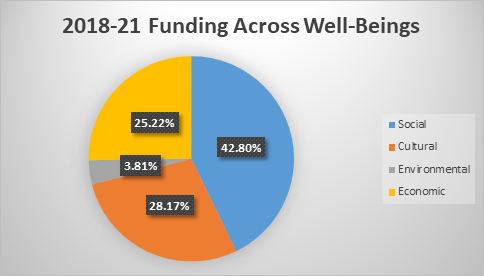
The Community Grants and Funding Programme supports projects which deliver on all four aspects of community well-being. The programme reaches a broad range of activities and is essential to the sustainability of many community groups.
How the Programme currently supports community well-being has been analysed through the Community Funding Review. The below graph illustrates that social well-being is the most supported aspect of community well-being through the grants programme with environmental well-being being the least.
Risk
N/A
3.6 Options
N/A
3.7 Development of Preferred Option
N/A
1 2018-21 Community Funding Activity Report (Under Separate Cover)
Napier People and Places Committee - 03 February 2022 - Open Agenda
Napier People and
Places Committee
Open Minutes
|
Meeting Date: |
Thursday 4 November 2021 |
|
Time: |
10.00am – 11.39am |
|
Venue |
Simkin Room, Level 1 |
|
|
Livestreamed via Council’s Facebook site |
|
Present |
Councillor Boag (In the Chair), Mayor Wise, Deputy Mayor Brosnan, Councillors Chrystal, Mawson, McGrath, Price, Simpson, Tapine [via Zoom], Taylor and Wright |
|
In Attendance |
Chief Executive (Steph Rotarangi) Director City Services (Lance Titter) Director City Strategy (Richard Munneke) Director Community Services (Antoinette Campbell) Acting Director Corporate Services (Caroline Thomson) Acting Director Infrastructure Services, (Debra Stewart) Acting Manager Communications and Marketing (Julia Atkinson) Pou Whakarae (Mōrehu Te Tomo) [via Zoom] Māori Partnership Manager - Te Kaiwhakahaere Hononga Māori (Hilary Prentice) [via Zoom] Māori Partnership Manager - Te Kaiwhakahaere Hononga Māori (Beverley Kemp-Harmer) [via Zoom] Manager Water Strategy (Russell Bond) Economic Development Manager (Bill Roberts) Communications Manager (Jess Soutar Barron) Manager Community Strategies (Natasha Mackie) Team Leader Community Strategies (Emma Morgan) Senior Advisor Policy (Matt Adamson) Senior Advisor Policy (Michele Grigg) Senior Advisor Policy (Rebecca Peterson) Community Funding Advisor (Belinda McLeod) [via Zoom] Team Leader Governance (Helen Barbier) [via Zoom] |
|
Administration |
Governance Team (Anna Eady & Carolyn Hunt) |
Karakia
The Committee opened the meeting with a karakia.
Apologies
|
Councillors Mawson / McGrath That the apologies from Councillors Browne and Crown be accepted. Carried |
Conflicts of interest
Nil
Public forum
Jock Mackintosh - CEO Mitre 10 Park
Mr Mackintosh, displaying a PowerPoint presentation, gave a summary of what has been happening at the Mitre 10 Park over the last 15 years. The key points highlighted were:
· Mr Mackintosh has been CEO for ten years.
· The Mitre 10 Park came about as Nelson Park, which was located in Hastings, had outlived its usefulness. The site for the Park was chosen for its proximity to both Napier and Hastings and was opened in 2010 by Bill English.
· A world record was achieved at the first athletics meet, and since then there have been multiple significant athletic events held at the Park.
· 50,000 people were hosted over four days in 2017 at Te Matatini, a national Kapa Haka Festival.
· National athletic events cost the Park more to host than they receive in hire fees, however the benefit to the local economy outweighs the financial loss for the Park.
· A subset of attendees at athletic events were surveyed; it was found 74% of people had come from out of town and stayed in Hawke’s Bay for an average of 4.3 days, having positive impacts on the local businesses. Also sporting ‘heroes’ attend the events, inspiring local children to give sports a go.
· Regular community use of the facilities is important to the Park also.
· Netball facilities were the second core asset at the Park. Sponsorship of the facilities by businesses made them viable. The Park also hosts premier hockey venue, which can host international events, has eight other sports fields, and is a canoe polo venue.
· Two Trusts operate out of the Park, the Hawke’s Bay Regional Sports Park Trust, and the Community Fitness Trust (Graeme Avery) who have built a $20m indoor sports hall.
· To come is an indoor cricket training facility for the Central Districts Cricket Association which will cost $2m to build with 80% of the cost coming from non-rate payer sources, a covered outdoor cricket wicket, boxing centre, 50 meter indoor pool, and a 60 bed hostel for people who are participating in events at the Park.
· Operationally the model works well and is financially sustainable. Rate payers get a heavily subsidised service, with Council paying for approximately 35% of the running costs.
· Currently there is long term planning being carried out, with Council’s input, to determine what facilities need to planned for. 1 million people are expected to use the Park’s facilities in 2025.
·
|
Attachments 1 Mitre 10 Park Presentation |
Announcements by the Mayor
Nil
Announcements by the Chairperson
Nil
Announcements by the management
The Director of City Services gave an update on the current wet weather event, saying there have been no issues in the city so far. Council has also been in touch with Hawke’s Bay Regional Council and they had no issues to report. If the rain continues at its current level it is not anticipated any issues will arise.
The Director Community Services gave an update on the 2021 Social Monitor Survey, which will be formally presented to Council in the new year. The 2021 survey was conducted from mid-September to mid-October with 610 respondents. Overall perceptions of safety have increased since the March 2021 Community Safety Survey, with 56% of respondents feeling safe, this is up from 45%, and is in relation to feelings of safety when walking alone in neighbourhoods after dark, and going out at night in Napier. However this is still short of the 2020 Social Monitor Survey which found 73% of people felt safe, and for the current survey 51% of respondents reported feeling less safe than twelve months ago.
The survey was conducted using the usual channels, with a good representation of Māori in the sample.
In the meantime Council will continue to work with Police and stakeholders in targeted areas to address the lowered perceptions of safety and visable antisocial behaviour, this is in the areas of Marewa, Westshore and the Napier CBD.
The City Ambassador and CCTV projects are progressing well towards implementation from 1 July 2022.
Confirmation of minutes
|
Councillors Mawson / Chrystal That the Minutes of the meeting held on 23 September 2021 were taken as a true and accurate record of the meeting.
Carried |
Agenda Items
1. Community Grants and Funding Review
|
Type of Report: |
Information |
|
Legal Reference: |
N/A |
|
Document ID: |
1373601 |
|
Reporting Officer/s & Unit: |
Matt Adamson, Senior Advisor Policy |
1.1 Purpose of Report
To provide information on the review of Napier City Council’s community grants and funding programme.
|
At the Meeting The Council Officer spoke to the report and it was noted: · The community grants and funding Programme is a significant part of Council’s support for Napier’s community sector, and in the near future the Community Strategies team will be reporting to Council the grants and funding activity over the last three years. · The largest portion of the community funding comes through service agreements Council has entered into with community organisations who provide services to Napier residents. The combined value of these is $628,000. · Community Service Fund is an annual contestable grant that awards smaller grants for projects or service delivery costs. It also funds a rates subsidy to non-profit groups who own a commercially rated building. The fund is worth $115,000. · Community Development Grants are open all year round for applications and support smaller community led projects such as Waitangi Day celebrations are supported through this fund. It has $100,000 allocated to it in this financial year. · Council Projects Grants support larger proposals, typically over $30,000, and there is $100,000 available in this fund. Not all of this fund has been allocated for this financial year yet. · The Youth Development Grants provide local rangitahi financial assistance. This fund is worth $7000. · There is a $50,000 allocation to the Arts and Culture Policy Fund, this is for the development of art in Napier · There are two small bequest funds which are administered by the Community Strategies Team which provide a modest return depending on interest rates. · The Community Strategies team also administer the Creative Communities fund which has two funding rounds a year. Councillor Simpson left the meeting at 10.23am and returned at 10.28am In response to questions from the Committee it was clarified: · Elected Members can pass any thoughts they have for the review onto Councillor Boag or Councillor Wright to bring to the internal project group for consideration. There will also be a workshop with Elected Members soon about the review. · All of the parameters of each of the funds will be tested against the funds criteria, and recommendations will be made. · Whether Council is contributing enough to community need, whether new funding categories are needed, if Council messaging is reaching all groups who could qualify for funding, and having the ability to be responsive to ad hoc funding requests will be looked at. · Any changes to the programme will be implemented in the next financial year or as part of an Annual Plan (AP) or Long Term Plan (LTP) process. There may also be recommendations presented to Council once the review is complete. · Streamlining the administration of funds from different parts of Council may occur. The aim is to be responsive to the changing needs of the community.
|
|
Committee's recommendation Councillors Wright / Chrystal The Napier People and Places Committee: a. Note the framework and criteria to be used in the review b. Note that Councillors Boag and Wright are part of the review working group c. Note that a range of community stakeholders will be engaged during this review.
Carried |
2. Safer Napier's Reaccreditation Application
|
Type of Report: |
Information |
|
Legal Reference: |
N/A |
|
Document ID: |
1388097 |
|
Reporting Officer/s & Unit: |
Michele Grigg, Senior Advisor Policy |
2.1 Purpose of Report
To provide an update on Safer Napier’s reaccreditation application.
|
At the Meeting The Officer spoke to the report and showed a short video which accompanied Napier City Council’s (NCC) application for reaccreditation. In response to questions from the Committee it was clarified: · Safer Napier is a member of the Pan Pacific Safe Communities Network (PPSCN). That network will continue to establish the framework for the reaccreditation and the accreditation model. · With the national Safe Communities Foundation of New Zealand ceasing to operate the current 20 accredited Safe Communities is working to establish a national network of communities. How this will operate and look will come back through Council. · The Child and Youth Wellbeing Strategy is currently being developed by NCC and has started a working partnership with the Napier Pilot City Trust on this. A workshop will be held on the 20th of November, which is International Children’s Day, which is seen as the beginning of the consultation process and will look at engaging with the Community around what they would like to see in the Strategy. · The development of a Multicultural Strategy is not on the current work programme, but will be coming up in the next year. · A number of years ago there was a Council group which morphed into the Safer Napier Strategic Group (SNSG). It is an operational working group rather than a governance group. Some of the members have Councillor representatives as part of them. There is recognition that Governance needs input into this group and that is why the Ambassador position was established for the Mayor. If it is decided that more governance input is required on the SNSG, Councillor portfolios could be looked at to see who might be most appropriate to include and Officers could provide feedback to Council about how it could work. |
|
Committee's recommendation Mayor Wise / Councillor Simpson The Napier People and Places Committee: a. Note the Safer Napier reaccreditation application, which was submitted on 1 October 2021. b. Note the outcome of the Safer Napier reaccreditation application will be confirmed on 1 December 2021. Carried |
PUBLIC EXCLUDED ITEMS
|
Councillors Mawson / Brosnan That the public be excluded from the following parts of the proceedings of this meeting, namely: 1. Art Deco Trust Loan 2. Napier Creative Communities Funding September 2021 Carried |
The general subject of each matter to be considered while the public was excluded, the reasons for passing this resolution in relation to each matter, and the specific grounds under Section 48(1) of the Local Government Official Information and Meetings Act 1987 for the passing of this resolution were as follows:
|
General subject of each matter to be considered. |
Reason for passing this resolution in relation to each matter. |
Ground(s) under section 48(1) to the passing of this resolution. |
|
1. Art Deco Trust Loan |
7(2)(b)(ii) Protect information where the making available of the information would be likely unreasonably to prejudice the commercial position of the person who supplied or who is the subject of the information 7(2)(h) Enable the local authority to carry out, without prejudice or disadvantage, commercial activities |
48(1)A That the public conduct
of the whole or the relevant part of the proceedings of the meeting would be
likely to result in the disclosure of information for which good reason for
withholding would exist: |
|
2. Napier Creative Communities Funding September 2021 |
7(2)(c)(i) Protect information which is subject to an obligation of confidence or which any person has been or could be compelled to provide under the authority of any enactment, where the making available of the information would be likely to prejudice the supply of similar information or information from the same source and it is in the public interest that such information should continue to be supplied |
48(1)A That the public conduct
of the whole or the relevant part of the proceedings of the meeting would be
likely to result in the disclosure of information for which good reason for
withholding would exist: |
The meeting moved into Committee at 11.05am
|
Approved and adopted as a true and accurate record of the meeting.
Chairperson .........................................................................................................................
Date of approval .................................................................................................................. |