|
Item 1 - Attachment 1 |
Ordinary Meeting of Council
Open Agenda
|
Meeting Date: |
Thursday 31 July 2025 |
|
Time: |
9.30am |
|
Venue: |
Large Exhibition Hall |
|
|
Livestreamed via Council’s Facebook page |
|
Council Members |
Chair: Mayor Wise Members: Deputy Mayor Brosnan, Councillors Boag, Browne, Chrystal, Crown, Greig, Mawson, McGrath, Price, Simpson, Tareha and Taylor |
|
Officer Responsible |
Chief Executive |
|
Administrator |
Governance Team |
|
|
Next Council Meeting Thursday 28 August 2025 |
Ordinary Meeting of Council - 31 July 2025 - Open Agenda
|
Chairperson |
Her Worship Mayor Kirsten Wise |
|
Deputy Chairperson |
Deputy Mayor Annette Brosnan |
|
Membership |
All elected members |
|
Quorum |
7 |
|
Meeting frequency |
At least 6 weekly and as required |
|
Executive |
Chief Executive |
Purpose
The Council is responsible for:
1. Providing leadership to and advocacy on behalf of the people of Napier.
2. Ensuring that all functions and powers required of a local authority under legislation, and all decisions required by legislation to be made by local authority resolution, are carried out effectively and efficiently, either by the Council or through delegation.
Terms of Reference
The Council is responsible for the following powers which cannot be delegated to committees, subcommittees, officers or any other subordinate decision-making body[1]:
1. The power to make a rate
2. The power to make a bylaw
3. The power to borrow money, or purchase or dispose of assets, other than in accordance with the long-term plan
4. The power to adopt a long-term plan, annual plan, or annual report
5. The power to appoint a chief executive
6. The power to adopt policies required to be adopted and consulted on under the Local Government Act 2002 in association with the long-term plan or developed for the purpose of the local governance statement, including the 30-Year Infrastructure Strategy
7. The power to adopt a remuneration and employment policy.
8. The power to establish a joint committee with another local authority or other public body[2].
9. The power to approve or change the District Plan, or any part of that Plan, in accordance with the Resource Management Act 1991.
10. The power to make the final decision on a recommendation from the Parliamentary Ombudsman, where it is proposed that Council not accept the recommendation.
11. The power to make a final decision whether to adopt, amend, revoke, or replace a local Easter Sunday shop trading policy, or to continue a local Easter Sunday shop trading policy without amendment following a review.[3]
Delegated Power to Act
The Council retains all decision making authority, and will consider recommendations of its committees prior to resolving a position.
Specific matters that will be considered directly by Council include without limitation unless by statute:
1. Direction and guidance in relation to all stages of the preparation of Long Term Plans and Annual Plans
2. Approval or amendment of the Council’s Standing Orders[4].
3. Approval or amendment the Code of Conduct for Elected Members[5].
4. Appointment and discharging of committees, subcommittees, and any other subordinate decision-making bodies[6].
5. Approval of any changes to the nature and delegations of any Committees.
6. Appointment and discharging of members of committees (as required and in line with legislation in relation to the role and powers of the Mayor) [7].
7. Approval of governance level strategies, plans and policies which advance council’s vision and strategic goals.
8. Resolutions required to be made by a local authority under the Local Electoral Act 2001, including the appointment of an electoral officer.
9. Reviewing of representation arrangements, at least six yearly[8].
10. Approval of any changes to city boundaries under the Resource Management Act.
11. Appointment or removal of trustees, directors or office holders to Council’s Council-Controlled Organisations (CCOs) and Council Organisations (COs) and to other external bodies.
12. Approval the Local Governance Statement as required under the Local Government Act 2002.
13. Approval of the Triennial Agreement as required under the Local Government Act 2002.
14. Allocation of the remuneration pool set by the Remuneration Authority for the remuneration of elected members.
15. To consider and decide tenders for the supply of goods and services, where tenders exceed the Chief Executive’s delegated authority, or where projects are formally identified by Council to be of particular interest. In addition, in the case of the latter, milestone reporting to Council will commence prior to the procurement process.
Ordinary Meeting of Council - 31 July 2025 - Open Agenda
ORDER OF BUSINESS
Karakia
Apologies
Nil
Conflicts of interest
Public forum
Topic - Land for Film Studio - Daniel Betty
Announcements by the Mayor including notification of minor matters not on the agenda
Note: re minor matters only - refer LGOIMA s46A(7A) and Standing Orders s9.13
A meeting may discuss an item that is not on the agenda only if it is a minor matter relating to the general business of the meeting and the Chairperson explains at the beginning of the public part of the meeting that the item will be discussed. However, the meeting may not make a resolution, decision or recommendation about the item, except to refer it to a subsequent meeting for further discussion.
Announcements by the management
Confirmation of minutes
That the Draft Minutes of the Ordinary Meeting of Council held on Monday, 21 July 2025 be confirmed as a true and accurate record of the meeting.................................................................................... 171
Information items
Agenda items
1 Council Projects Fund - Summer Festival Production Accountability Update................... 6
2 CCTV Monitoring.......................................................................................................... 15
3 Animal Control Facility Project Update.......................................................................... 19
4 Adoption of the Ahuriri Regional Park Masterplan......................................................... 27
5 Integrated Trade Waste and Wastewater Bylaw 2022 - Delegations............................. 36
6 Climate Change Risk Assessment Report and Regional Climate Action Collaboration.. 79
7 Local Water Done Well - Deliberations Report (To be circulated separately)................. 85
8 Urban Waterway Asset Ownership Transfer.................................................................. 87
9 Heretaunga Water Storage Project Shareholder Committee Participation..................... 93
10 Civic Precinct Progress Report..................................................................................... 96
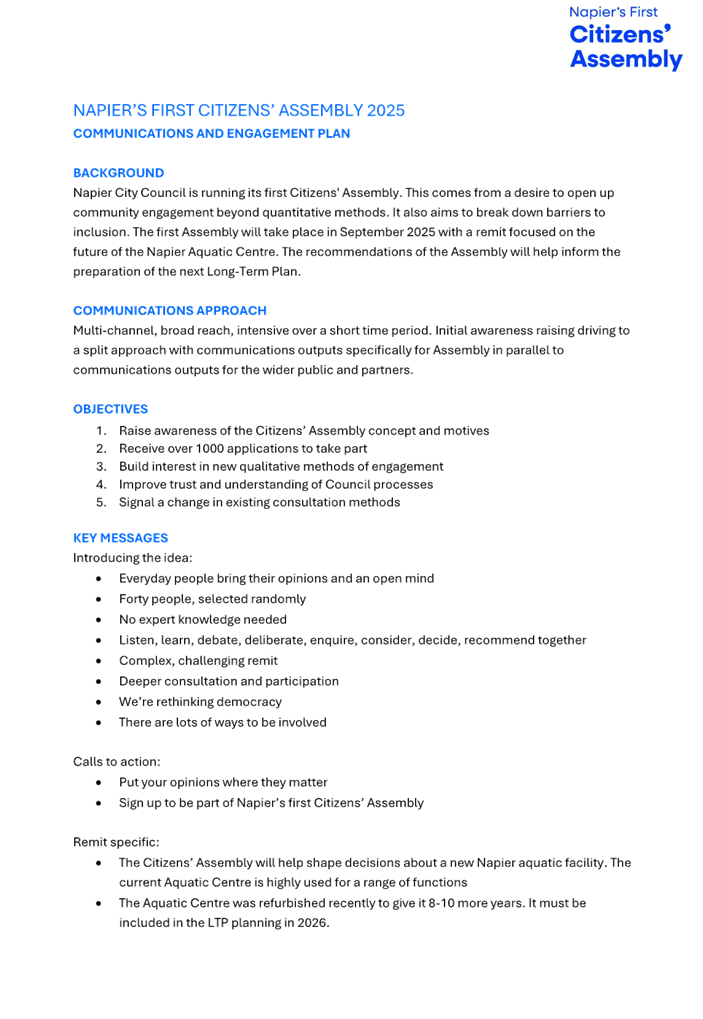
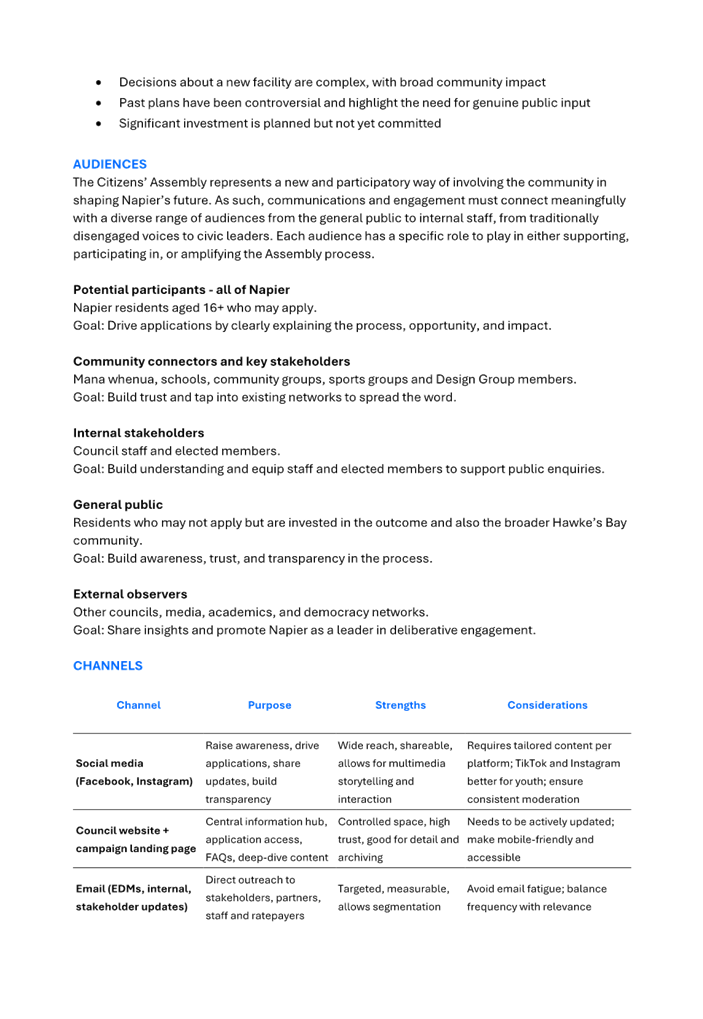
11 Citizens Assembly 2025 : Remit and Council Commitment......................................... 107
12 NCC Investment Portfolio and Ahuriri Investment Management Limited Establishment 121
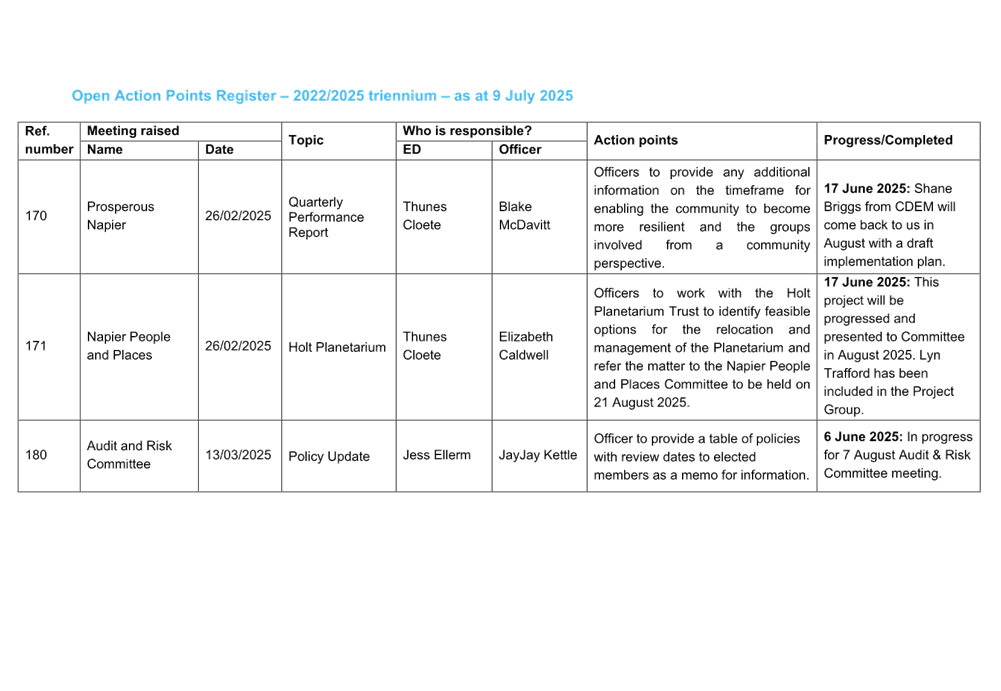
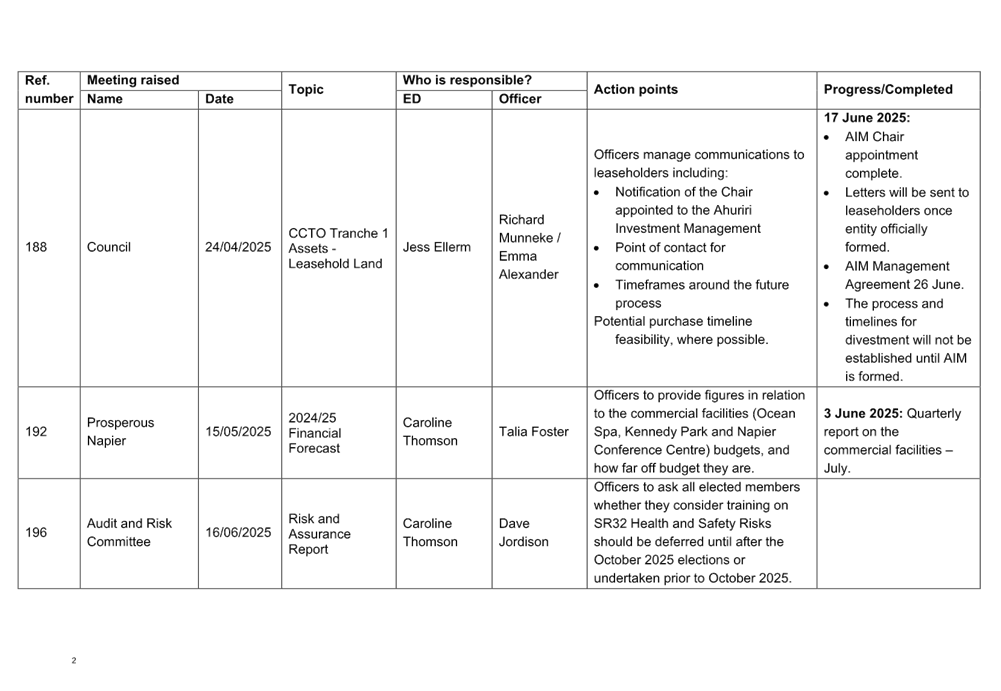
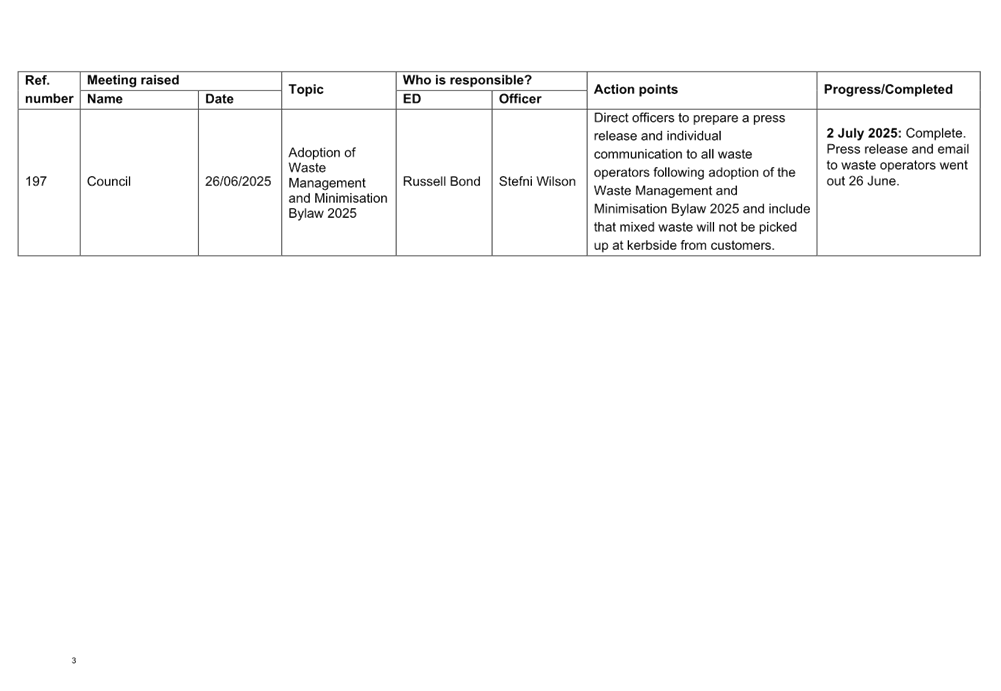
13 Action Points Register as of 9 July 2025..................................................................... 139
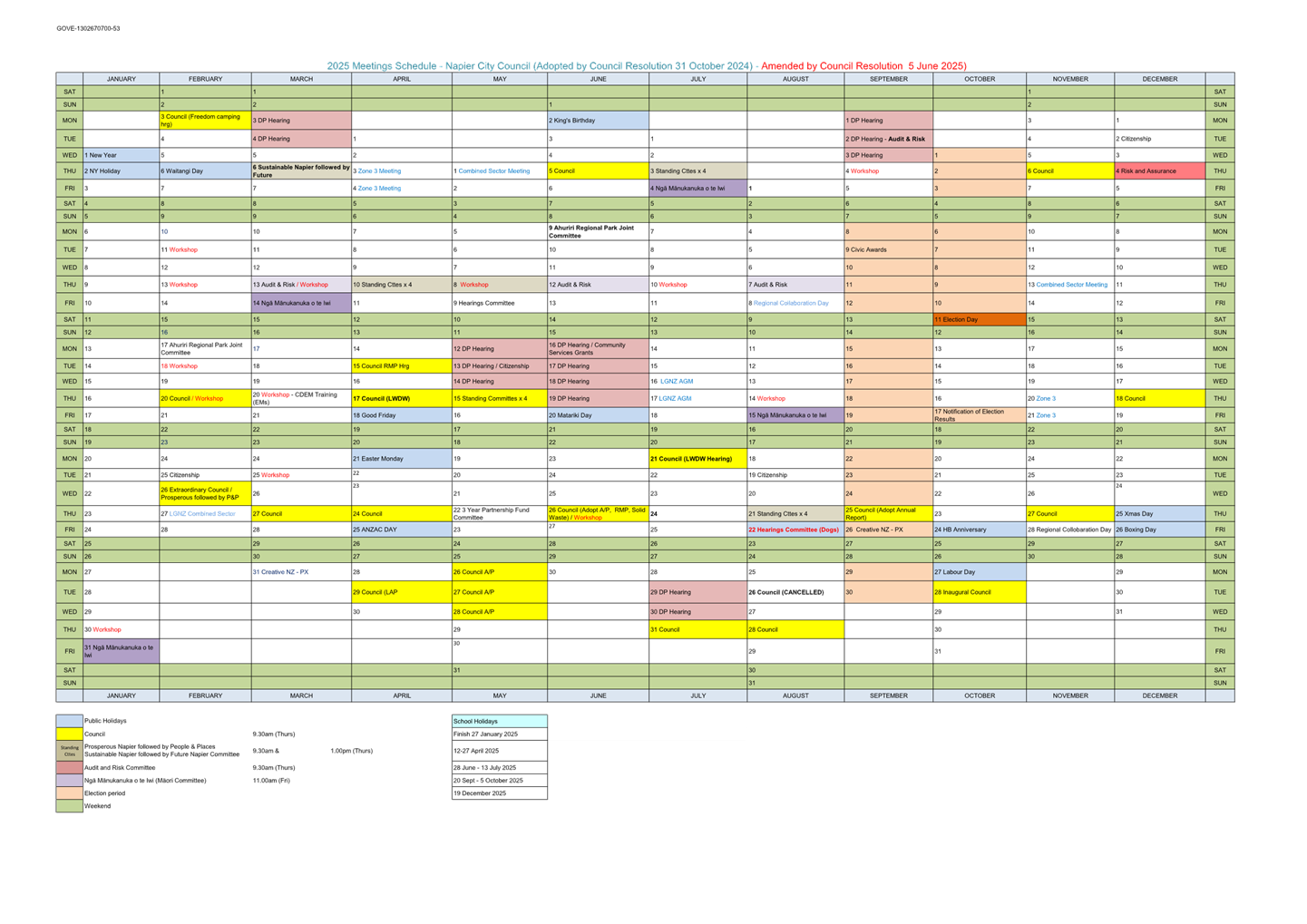
14 Amendment to the 2025 Meeting Schedule................................................................. 144
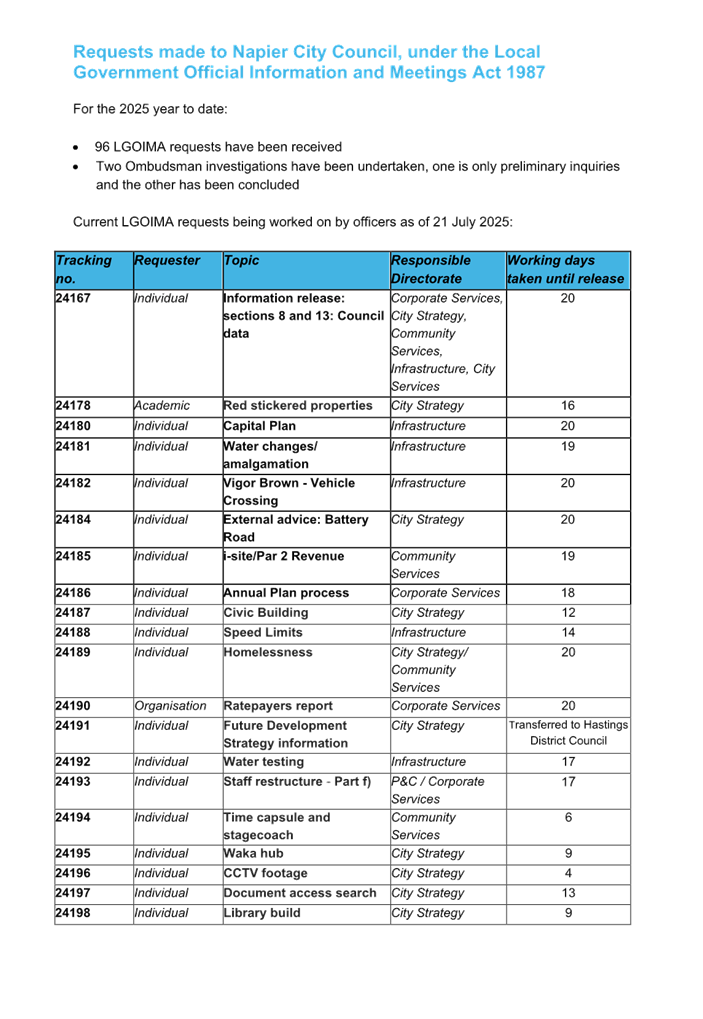
15 Official Information Requests as at 21 July 2025......................................................... 149
16 Local Government New Zealand Four-Monthly Report: March to June 2025............... 153
17 Summary of Ngā Mānukanuka o te Iwi Recommendations for Ratification.................. 154
Minor matters not on the agenda – discussion (if any)
Reports under Delegated Authority
1 Tenders Let................................................................................................................ 167
Recommendation to Exclude the Public............................................................... 168
Ordinary Meeting of Council - 31 July 2025 - Open Agenda Item 1
Agenda Items
1. Council Projects Fund - Summer Festival Production Accountability Update
|
Type of Report: |
Information |
|
Legal Reference: |
N/A |
|
Document ID: |
1865098 |
|
Reporting Officer/s & Unit: |
Margot Wilson, Team Leader Community Strategies Roger Morrison, Community Funding Advisor |
|
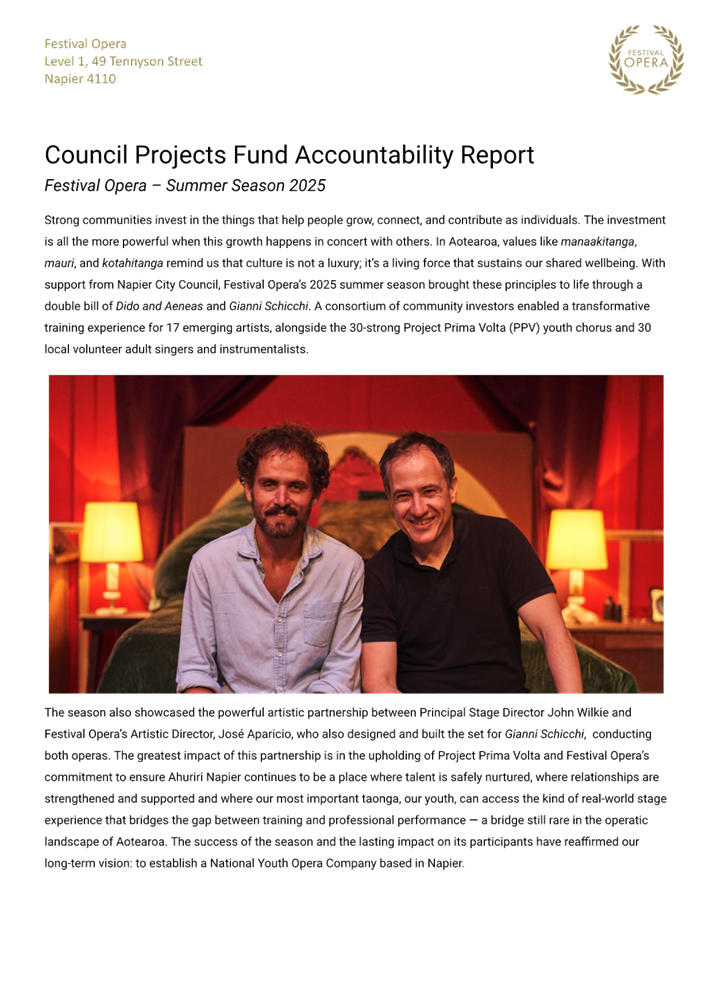
To provide an opportunity for Anna Pierard to present to Council an accountability report on the Summer Festival Production funded through the Council Projects Fund. |
Officer’s Recommendation
That Council:
a) Receive the report titled “Council Projects Fund – Summer Festival Production Accountability Update” dated 31 July 2025.
1.2 Background Summary
In December 2024, Council approved a new Grants and Funding Policy Framework. This Framework established clear direction and guidelines for the allocation of Council’s grant budgets. As part of the updated Reporting and Accountability requirements for the Council Projects Fund, successful applicants are now expected to provide both a written report and a face-to-face presentation to Council.
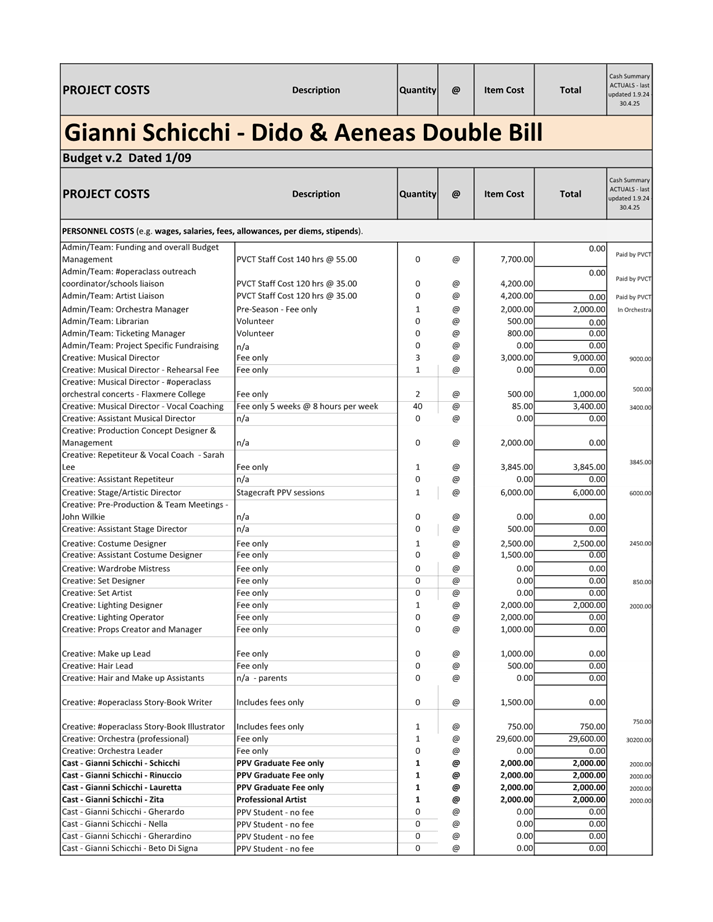
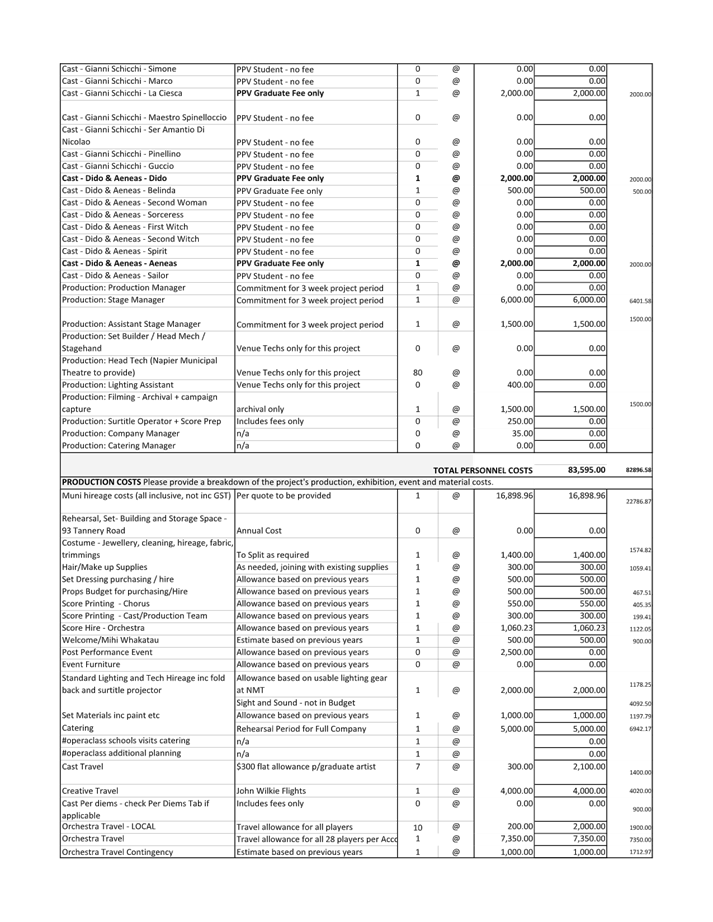
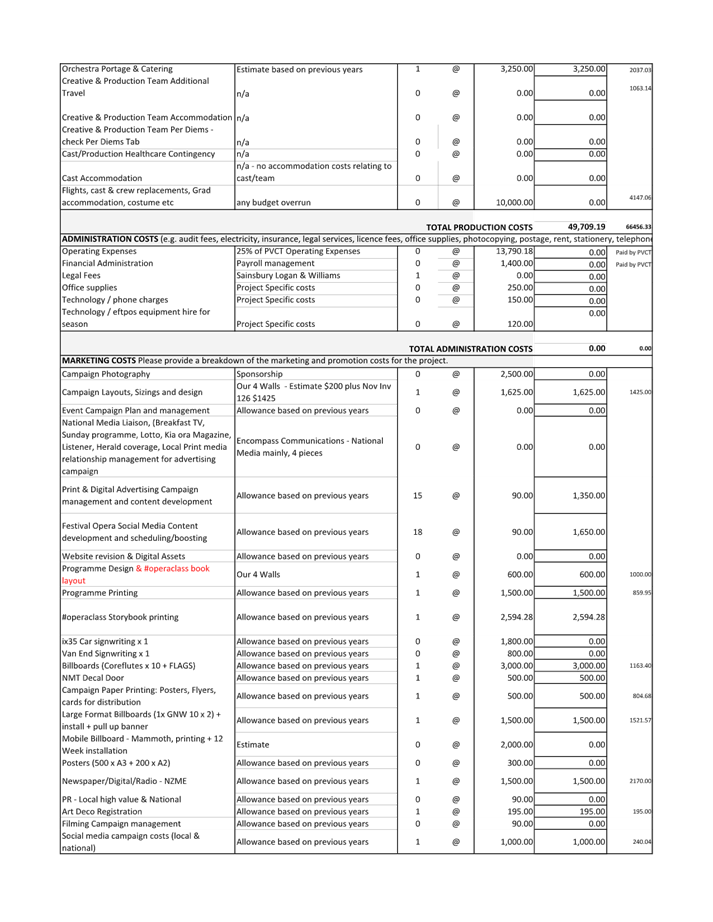
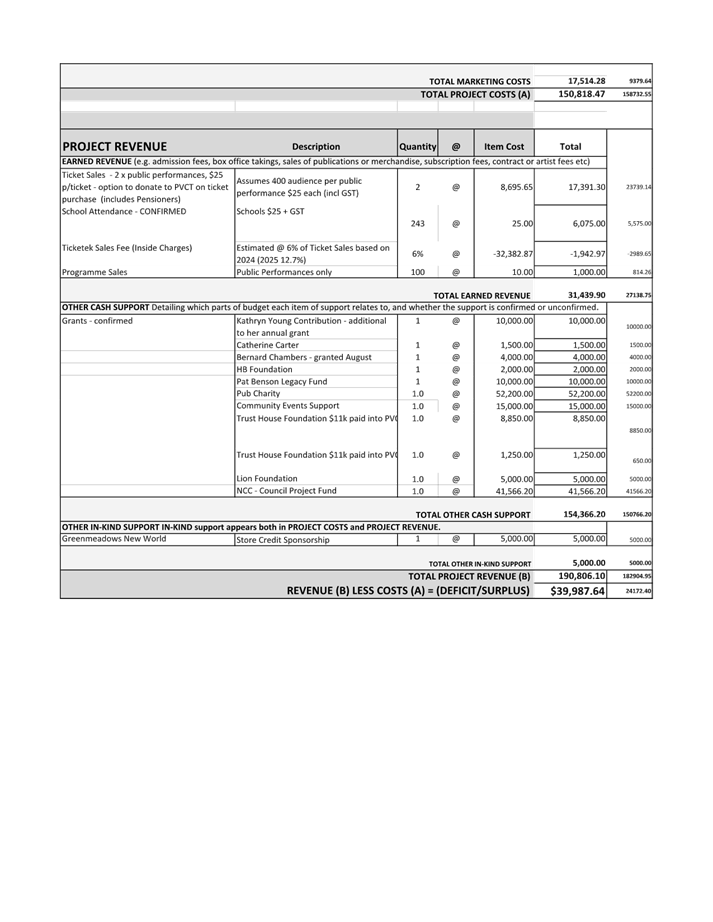
The Council Projects Fund allows Council to make discretionary grants in response to opportunities that are clearly beneficial for Napier. Under this Fund, in December 2024, Council approved a grant of $41,566.20 to Festival Opera to support the delivery of their summer festival. Today Anna Pierard from Festival Opera will provide a summary of the programme delivered.
1 Anna Pierard update report (Doc Id 1864646)
2 Accountability Budget - Anna Pierard (Doc Id 1864647)
Ordinary Meeting of Council - 31 July 2025 - Open Agenda Item 2
2. CCTV Monitoring
|
Type of Report: |
Operational |
|
Legal Reference: |
N/A |
|
Document ID: |
1864258 |
|
Reporting Officer/s & Unit: |
Luke Johnson, Manager Regulatory Solutions |
|
2.1 Purpose of Report The purpose of this report is to seek Council approval for a temporary change to the level of service for Napier Assist Āwhina Tāngata, enabling the introduction of night-time CCTV monitoring within existing staffing levels.
This temporary arrangement will remain in place until a preferred long-term level of service can be determined through a funding review as part of the development of Council’s financial strategy for the Long Term Plan.
The report also seeks Council’s direction on a preferred ongoing level of service for Napier Assist, to inform the funding review and support the development of sustainable funding options for future consideration. |
That Council:
b) Consider the options for a preferred ongoing level of service for Napier Assist and make a recommendation to inform a review of the CCTV service as per Section 101(3) of the Local Government Act to ensure suitability as an activity and that it is appropriately funded.
Napier Assist Āwhina Tāngata launched in July 2022 and is in its third year of operation. The service involves street patrols combined with monitoring of a CCTV network. Due to the popularity of the service, Council is constantly managing stakeholder expectations and is balancing resourcing requirements with the adopted service design and planned maturity model in mind.
Despite the efforts of the Napier Assist team, there has been an increase in crime within our CBD and other Napier shopping precincts. According to Police data over the last two years, there has been an increase in crime in our city of approximately 12%.
Council continues to work closely with Hawkes Bay Police, Napier City Business Inc (NCBI), and other local agencies to support their operations in response to this crime. One support measure previously implemented was to temporarily extend the hours of CCTV monitoring to cover 9:00pm – 6:00am. This initiative was to support the Hawke's Bay Police response at night. The temporary change was achieved by reducing the daytime level of service (patrolling and CCTV monitoring) to cover night-time CCTV monitoring shifts. Whilst this was done temporarily, it was unsustainable long term due to the minimum staff required to provide the usual level of service throughout the day and to ensure sufficient staff numbers for safety.
In June 2025, NCC agreed to provide Hawke's Bay Police with a digital feed of our CCTV coverage via vGRID. Police will not actively monitor this feed, but it will serve as a useful tool, offering Police access to Council’s camera coverage when they deem it appropriate and necessary for the prevention and detection of crime and to maintain public safety.
Hastings District Council (HDC) currently provides CCTV Monitoring service, which is staffed by a team independent of their City Assist ambassadors. There are limitations to the HDC offering, which limit it being a full 24/7 service. The limitations are the same faced by us and include staffing constraints across day/night rostering. However, the HDC service allows for the flexibility to respond to crime trends or circumstances observed within the city and alter day and/or night monitoring accordingly. The monitoring service is partially ratepayer-funded and also subsidised by a Central Business District targeted rate.
Hawke’s Bay Police have indicated that the preferred approach to CCTV monitoring is for it to remain with Napier Assist; however, they are unable to contribute to funding.
NCC has received a request from NCBI for overnight CCTV monitoring.
2.3 Issues
In response to increased crime at night, it is now timely for NCC to consider establishing night-time monitoring. This could be achieved in the short-term by adjusting the daytime service temporarily to accommodate night-time monitoring. The temporary change would be accommodated within the existing staffing level and will continue to be funded through the Parking Reserve Account for now. This temporary change can be put in place by 1 September and communicated to local stakeholders (Hawkes Bay Police, retailers, and our community).
The temporary service change would continue until 31 June 2026 when Council has had the opportunity to properly review the appropriate level of service for Napier Assist on an ongoing basis. This would be done as part of the Council’s financial strategy for the Long Term Plan and in accordance with section 101(3) of the Local Government Act. Through this process, officers will ascertain who benefits from the service and consequently who should bear the cost of this, and what the apportionment of cost may be.
The Parking Reserve Account exists to support a vibrant and innovative city that works for everyone. It currently funds services such as Parking and Napier Assist in their present forms. To ensure the long-term sustainability of this fund - and to continue investing in improvements to the CBD - a stable and balanced funding model must be maintained. If demand on the account outpaces its replenishment, it would undermine the viability of the funding approach originally approved when the Reserve was established.
Given this, a review of the funding model is necessary to understand the impact of any proposed service level changes and to identify the most appropriate way to fund the services going forward. Additionally, implementing any rate changes mid-year is challenging, particularly when they may negatively affect ratepayers. Therefore, any adjustments would need to be considered through a variation to the Long Term Plan as part of the Annual Plan process.
2.4 Options
The options available to Council for a long-term preferred level of service are as follows:
a. Retain existing staff numbers (nine FTE), reducing daytime levels of service to introduce permanent night-time monitoring. To achieve this option, Napier Assist staffing numbers undertaking daytime monitoring will be reduced. This would resemble between 3 to 5 staff each day, and one staff member monitoring overnight.
i. Key benefits to this option include utilising our team and their knowledge of the city, the camera network, and key entry and exit points in and out of the city. There is also the benefit of upskilling our staff along with continuing to build on already strong working relationships with Police and frontline staff. Monitoring is undertaken on a real-time basis whereby if observations are made, contact can be made immediately with local Police patrols in the area without having to contact 111 and go through the national call centre.
ii. Consideration must also be given to the disadvantages of this option, which include a reduction in the presence of the Napier Assist officers throughout the city during the daytime. There may also be unforeseen effects as a consequence of the reduced daytime visibility; however, there is an opportunity to adapt the service level offering in response to crime data from Hawkes Bay Police and feedback from retailers and other stakeholders.
b. Maintain the existing level of (daytime) service and introduce night-time monitoring seven nights per week through the addition of three FTE (12 FTE total). It is considered that to maintain the current (daytime) service level offering and include overnight monitoring would necessitate the addition of three team members (3 FTE) to the Napier Assist team.
i. Increased team numbers to 12 FTE allows for the minimum service level (as determined at inception of the Napier Assist) to be maintained whilst introducing the night-time monitoring seven days per week.
ii. Benefits of this option include maintaining the popular daytime service, focusing on enhancing the visitor experience of our CBD centres, and providing better support to the Police to respond to retail crime at night.
c. Status Quo – continue CCTV monitoring with our current levels of service.
Napier Assist Officers are rostered seven days per week between 7:30am – 5:30pm. Whilst Police report an increase in crime in the patrol areas, only some of this is occurring outside the hours of Napier Assist monitoring CCTV.
i. Advantages of this option would be in continuing the popular daytime service as established, focusing on the ‘city ambassador’ approach, enhancing CBD users and visitors' safety and experience during the day.
ii. Disadvantages to be considered include the risk of continued break-ins at night without real-time CCTV support to Police, however Police are now able to access coverage via vGRID.
Note for options ‘a’ and ‘b’ above:
· Through a review of the CCTV service as per Section 101(3) of the Local Government Act, officers will ascertain who benefits from the change in level of service and consequently who should bear the cost of this addition to the existing service and what the apportionment of cost may be.
· It would be unsustainable to fund the delivery of these options solely with the parking reserve fund on an ongoing basis.
2.5 Significance and Engagement
Public safety is an issue of significance for our community, and as such, the Napier Assist initiative was consulted on as part of the Long-Term Plan (LTP) for 2021-31. NCC received a strong mandate to proceed with 75% of submitters supporting the proposal to investigate the ambassador model further. The service design adopted by Council included the aspiration of night-time CCTV monitoring as the service matured and funding became available.
The funding review as part of Council’s Long Term Plan process will provide for comprehensive public consultation as per the Local Government Act 2002.
Nil
Ordinary Meeting of Council - 31 July 2025 - Open Agenda Item 3
3. Animal Control Facility Project Update
|
Type of Report: |
Enter Significance of Report |
|
Legal Reference: |
Enter Legal Reference |
|
Document ID: |
1864954 |
|
Reporting Officer/s & Unit: |
David Whyte, Team Leader Animal Control Emma Alexander, Programme Manager - Transformation - Strategy and Transformation |
|
3.1 Purpose of Report The current Animal Control Facility is no longer fit for purpose, compromising both safety and animal welfare An upgrade or replacement of the facility was signaled in the 2024–2027 Three-Year Plan, with an initial budget allocation of $1.5 million. This figure was a preliminary estimate and developed without the benefit of feasibility work or detailed design planning. In March 2025 a project was initiated to explore viable options through feasibility analysis. This report provides a summary of the existing issues with the current facility, outlines the three options considered, and recommends a preferred direction and funding pathway to progress the project to the next stage. |
That Council:
a. Approve Officers to progress with designing a new build option for Council’s Animal Control Facility on the following basis:
i. design in a manner, where practicable, delivery can be phased with phasing focused on resolving compliance issues first;
ii. design in a manner that if the business case proves prohibitive, design work can be repurposed for the hybrid option;
iii. the business case for the facility covers on-going operating costs, and also costs of a wider operating model, a process and systems work stream and benefits from that workstream; and funding options;
b. Delegate to the Deputy Chief Executive approval of the design project budget, within the remaining ~$1.35m budget allocation under the 2024-2027 Three-Year Plan with the expectation that a portion of this funding will be available to complete at least the first delivery phase.
3.2 Background Summary
The Council Animal Control Team (Team) and Animal Shelter (Shelter) play a vital role in protecting public safety and ensuring the welfare of animals in our community. They provide care and shelter for stray, surrendered, seized, abandoned, and dangerous dogs until they are reunited with their owners, adopted, or humanely euthanised where necessary.
Beyond sheltering, the Shelter and Team supports adoption programmes, promotes responsible pet ownership, and delivers community education on animal welfare.
With approximately 8,400 registered dogs in Napier, the Team and Shelter operate under the requirements of the Dog Control Act 1996, Section 67, which mandates that councils provide appropriate custody, care, and exercise for impounded or seized dogs.
The Team and Shelter currently:
· Handle between 500 and 800 dogs annually;
· Respond to between 2500-3000 dog-related service requests;
· Support education programmes that reach over 1,100 students;
· Investigate approximately 150 dog attacks annually which includes investigating the incident, preparing the relevant files for Court or Council Hearings.
1.3 Summary of Issues
Current state
The current Shelter is no longer fit for purpose. The current Shelter facility and wider service face the following challenges:
a) Facility Limitations
· Developed incrementally over time and is no longer fit for purpose.
· Fails to meet modern health, safety, and animal welfare standards.
· Poor internal workflow design and inadequate public access.
· Insufficient water pressure and poor drainage impede kennel cleaning.
· No resilience infrastructure.
b) Staffing and Safety
· Animal Control Officer’s offices are ~200m from the kennels, reducing operational efficiency.
· Safety concerns from aggressive or threatening behaviour by some dog owners.
· Lack of interview rooms, secure workspaces, and retreat areas.
· Staff retention issues linked to inadequate facilities and safety risks.
c) Animal Welfare and Capacity
· Inadequate kennel capacity, with no dedicated quarantine, isolation, or puppy areas.
· Poor hygiene controls and limited exercise spaces.
· Limited accommodation for dangerous dogs, whelping bitches, or injured animals.
d) Public and Owner Experience
· Restricted hours and poor visitor facilities.
· Frustration among dog owners and adopters due to limited access and inadequate services.
e) Compliance and Risk
· A March 2017 Ministry for Primary Industries (MPI) investigation noted that on the day of inspection animals were in good health and body condition, well-ventilated pens and the facility was clean and sanitary. However, several non-compliances were identified:
- All processes described met minimum standards but there was no auditable standard procedures or records to verify.
- The main building deficiency, is the open nature of the pound and inability to maintain temperatures throughout the year.
- The lack of ability to assess and triage animals in an appropriate area before entering the main pound facility has a significant impact on the biosecurity of the facility and overall documentation and record keeping of incoming animals.
- Poor documentation
· The facility must meet statutory requirements and prepare for potential future policy changes.
Feasibility Study
A project to upgrade or replace the facility was included in the 2024–2027 Three-Year Plan, with an initial budget allocation of $1.5 million. This figure was a preliminary estimate made without the benefit of feasibility or design planning.
In March 2025, architectural firm Etch was engaged to assess the facility and provide a feasibility analysis. A set of requirements was defined with the core outcome being a modern, fit-for-purpose facility that:
· Resolves compliance with legal obligations,
· Delivers safer working conditions for staff,
· Provides higher welfare standards for animals.
The Feasibility Study and preliminary design has cost approximately $150k and has been funded from the $1.5m budget allocation included in the 2024–2027 Three-Year Plan. This leaves estimated ~$1.35m for future phases.
Options
The current facility consists of 25 kennels and lacks critical infrastructure, including fit for purpose or dedicated spaces for puppies, isolation or quarantine facilities.
Areas for public interface are also limited, with only one counter and limited customer space.
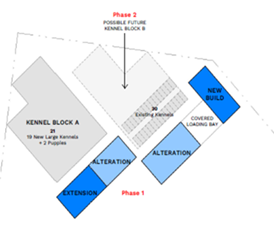
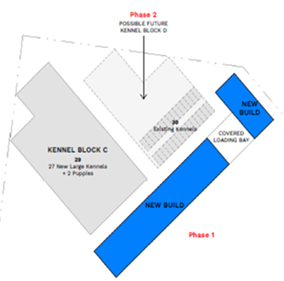
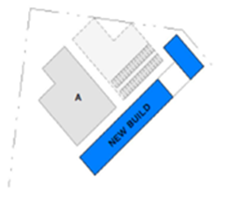
Three viable options have been identified through the feasibility work undertaken by Etch Architects.
Each option addresses the core operational and animal welfare requirements to varying degrees, and all have been designed with the potential for a future Phase 2 expansion. This would be adding an additional 20 kennels at an estimated cost of $1.5m should demand and funding allow.
|
· 27 new design kennels o 6 smaller, quarantine kennels o 25 existing smaller kennels o 2 puppy kennels · 253m² building footprint
Estimated Construction Cost: $2.9M |
|
|
Pros |
Cons |
|
· Utilizes existing structures · Lower capital costs · Enables continued occupation albeit more complex than rebuild options |
· High-cost investments in low-value assets (i.e. garages) · Limited improvement in workflow efficiency · Greater ongoing maintenance costs · Less space for kennels now and in the future · Greater cost risk with alterations · Limited improvements to the customer experience |
|
· 35 new kennels o 27 new large o 2 new puppy kennels o 6 smaller quarantine kennels o 25 existing kennels allow for redesign · 240m² building footprint
Estimated Construction Cost: $3.85M |
|
|
Pros |
Cons |
|
· Allows for continued operation during construction, simpler than option 1 · Allows for construction sequencing · Optimal workflow efficiency · Significantly improved customer experience · Lower ongoing maintenance costs · Enables continued occupation, less complex than option 1 · More space for kennels in the future (now and in the future) · Less cost risk with new build projects |
· Higher capital cost |
· 27 new design kennels o 6 smaller quarantine kennels o 25 existing smaller kennels o 2 puppy kennels · 240m² building footprint
Estimated Construction Cost: $3.3M |
|
|
Pros |
Cons |
|
· Significantly improved customer experience · Lower ongoing maintenance costs · Enables continued occupation, less complex than option 1 · Reduced initial capital costs |
· Less new kennels. 27 compared to 35 in Option 2 · Less space for kennels now and in the future · Higher chance an additional 20 kennel block needed in next 5 to 10 years. |
Operating Model, Processes and Systems
A new facility presents not only an opportunity to address critical infrastructure but also to transform the broader operating model, systems, and service delivery of the activity. This will in turn enable the Animal Control Team to improve productivity and visibility, and through greater capacity have an increased presence in the community leading to:
· Increase revenue through improved capacity for enforcement, infringements, and registrations; and
· Improved services such as community education and animal adoption.
Progress to Date
While the project so far has focused primarily on the physical shelter design, it is closely aligned with a wider organisational review of the City Operations team “ways of working”. Through the wider programme opportunities to improve the overall customer and internal processes and systems have already been identified and a number of practical process and technology improvements have been implemented. Examples of some quick wins implemented include:
· Email registration: Converting ~1700 owners from post to email for receiving their registration notices;
· Registration process: A review of the registration process which has increased the daily registration from ~75 per day to between 300 and 500 a day. This is also being managed with existing resourcing where previously a temporary resource for about five weeks was bought in for the task.
· Digitised Registration Forms: Enable on the-spot dog registration in the field, improving compliance and reducing administrative delays.
· GIS Mapping Access: Real-time field access to GIS maps showing property details, dog registration status, and classification (e.g. pet, menacing, or dangerous), enhancing situational awareness and officer safety.
· Proactive Service Request Logging: Ability to create service requests while on patrol, supporting targeted enforcement and identifying areas that require focused attention.
· Immediate Access to the National Dog Database: Allows officers to access the most up-to-date information on dogs and their owners, improving the customer experience by enabling registered dogs to be returned directly - avoiding unnecessary impoundment.
· Integration with the Companion Animal Register: Ability to access microchip and ownership data stored by local veterinarians, further aiding in the quick return of lost pets.
· Access to Relevant Legislation: Mobile access to key Acts and regulations governing Animal Control operations, supporting informed decision-making in the field.
· Identification of High-Risk Addresses: Quick reference to addresses flagged as safety risks to ensure appropriate precautions and officer safety.
· Portable Radios with GPS Panic Alerts: Deployment of radios equipped with GPS-enabled panic buttons linked to a live mapping system, allowing immediate location alerts in the event of an emergency.
Other opportunities Officers would look to explore in a wider end to end review of the Animal Control activity would be:
· Deeper end-to-end process review and re-engineering focusing on further uplifting the quality of public experience, improved data and analytics, and improved productivity.
· Coupled with process re-engineering would be in-field technology solutions to enable more immediate recoding and signing of statements, digitally issuing infringement notices as examples.
· Base technology – currently Animal Control data doesn’t have a single home and Magiq (core finance and rates system) is used for registrations. A modern fit for purposes animal control / animal welfare system may unlock greater potential and enable benefits of improved processes and systems without retro fitting the service into core Council systems.
· Ensuring the facility design considers future information technology solutions such as digital devices at each dog kennel to allow live access to records and live record keeping.
· Reviewing national and international models to explore options such as “once and done” registration, annual registration with a permanent tag or microchip linked model, and alternative sources of revenue.
The hypothesis is that a work stream focused on the Operating Model, Processes and Systems will deliver an improved service offering, increased revenue, and cost savings.
Officer’s recommendation
The Feasibility Study and preliminary design has highlighted the current capital budget of $1.5m set aside in the 2024-2027 Three-Year Plan is insufficient to achieve the core objectives of delivering a modern, fit-for-purpose facility that resolves compliance with legal obligations, delivers safer working conditions for staff, and provides higher welfare standards for animals.
Officer’s preferred option is Option 2 (New Build), noting that Option 3 (Hybrid) is reasonable and workable.
It is recommended that Council approve Officer’s progress with designing the New Build option on the following basis:
o design in a manner, where practicable, delivery can be phased prioritizing resolving compliance issues first;
o design in a manner that if the business case proves prohibitive, design work can be repurposed for the hybrid option;
o the business case for the facility covers on-going operating costs (e.g. all of life costs), and costs of the wider operating model, process and systems work stream and benefits from that workstream; and funding options; and
o delegate to the Deputy Chief Executive approval of the design project budget, within the remaining ~$1.35m budget allocation under the 2024-2027 Three-Year Plan with the expectation that a portion of this funding will be available to complete at least the first delivery phase.
3.3 Significance and Engagement
N/A
3.4 Implications
Financial
The overall funding required is greater than the budget allocation in the 2024 - 2027 Three-Year Plan. The recommended approach is to progress with design and use the business case to inform how remaining budget allocation is used before the 2027 - 2030 Long Term Plan is approved.
The table below provides an indicative range of scenarios:
|
Scenario |
Estimated capex |
Annual debt servicing* |
Change to Revenue & Financing Policy |
|
Alteration & extension |
$2.9m |
~$200k |
Yes |
|
New build |
$3.85m |
~$280k |
Yes |
|
Hybrid |
$3.3m |
~$250k |
Yes |
*based on a 25 year term.
The current Revenue and Financing Policy requires the Animal Control activity to recover between 50-60% of costs from non-rate sources (e.g. registration and impounding fees).
Servicing a $3.85m loan (option 2) adds approximately $280k per year in costs. To accommodate this, the cost recovery target would need to increase to 60-70%.
The Animal Control activity is currently exceeding its recovery target by approximately $300k, making the proposed increase achievable. This is without deeper analysis of the operating model, process and system changes. The business case phase will also assess all of life operating cost of the new facility. The hypothesis is that the new build option would have a lower operating cost model than the hybrid option.
All Council activity cost recovery targets are under review as part of the Revenue and Financing policy review. Any changes will be consulted with the community as part of the Annual Plan 2026/27 and any changes would take effect from 1 July 2026.
Social & Policy
N/A
Risk
There are two core risks in relation to this decision point:
1. The cost of a new build is prohibitive once the full business case is pulled together.
This risk will be managed by resolution to design in a manner that if the business case proves prohibitive, design work can be repurposed for the hybrid option.
2. Funding to complete the project is not approved as part of the 2027 - 2037 Long Term Plan.
This risk is managed by the resolution to design in a manner, where practicable, delivery can be phased with phasing focused on resolving compliance issues first.
3.4 Options
N/A
3.5 Development of Preferred Option
N/A
Nil
Ordinary Meeting of Council - 31 July 2025 - Open Agenda Item 4
4. Adoption of the Ahuriri Regional Park Masterplan
|
Type of Report: |
Procedural |
|
Legal Reference: |
N/A |
|
Document ID: |
1864685 |
|
Reporting Officer/s & Unit: |
Connie Whelan-Mills, Strategic Planning Lead |
|
4.1 Purpose of Report To adopt the Ahuriri Regional Park Masterplan
|
That Council:
a. Receive the report titled “Adoption of the Ahuriri Regional Park Masterplan” dated 31 July 2025.
b. Adopt the Ahuriri Regional Park Masterplan (Doc Id 1866366)
c. Note that adoption of the masterplan does not commit Council to implementation funding. Placeholder funding has been signalled in the Long Term Plan from 2028, but this will be subject to future budget decisions.
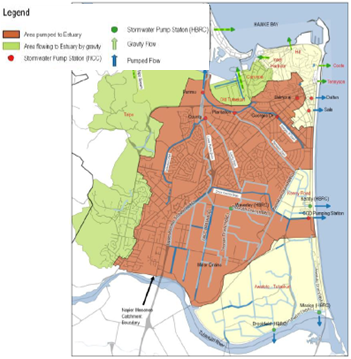 |
This discharge consent expires in 2040 and sets out a staged programme of investigations and implementation to improve water quality, including at-source, in-stream, and end-of-line treatment methods.
The ARP provides the key mechanism for delivering end-of-line treatment via constructed wetlands, complementing other ongoing initiatives such as the Proposed District Plan’s stormwater provisions, the Stormwater Bylaw, the Environmental Solutions Team’s work programmes, and Three Waters’ stream restoration and diversion projects. Collectively, these efforts position Napier City Council favourably for re-consenting the urban discharge, with the ARP wetlands expected to significantly enhance stormwater quality entering Te Whanga.
Utilising the Lagoon Farm site for stormwater improvements, alongside biodiversity enhancement, cultural narratives have also been identified through the Lagoon Farm Strategy for Future Land use (2020), Napier City Stormwater Masterplan (2020), Stormwater Quality and Flooding Options (2023) and Te Muriwai o Te Whanga Plan (2024).
The Ahuriri Regional Park Joint Committee (ARP-JC) was established in 2023 to oversee the project through a co-governance arrangement involving Napier City Council, Hawke’s Bay Regional Council, and Mana Ahuriri Trust. Its purpose is to lead the development of the park in a way that actively restores the health and wellbeing of the estuary, reflecting shared governance responsibilities and cultural values.
To support the Joint Committee, a Technical Advisory Group (TAG) was formed in 2024. This multidisciplinary group brings together expertise in ecology, mātauranga Māori, flood protection, avifauna, parks, and planning from across the partner organisations, along with representatives from the Department of Conservation and Hawke’s Bay Airport Limited.
The ARP-JC has set a clear vision for the park; to create a resilient, ecologically rich landscape that enhances water quality, supports biodiversity, and enables sustainable cultural and recreational opportunities.
The Masterplan focuses on promoting climate resilience, restoring natural estuarine margins, and improving the health of stormwater systems discharging into Te Whanga. Key project drivers include the establishment of stormwater treatment wetlands, recognition of the park as a regionally significant infrastructure for water quality, and advancing shared aspirations to return mauri (life force) to the estuary, uphold ecological integrity, and maintain a predominantly natural environment.
Development Process:
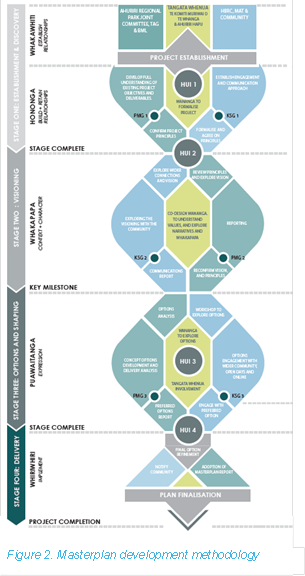 The development of the Ahuriri Regional Park Masterplan
followed a structured, four-phase process (Figure 2), established at the
project’s inception:
The development of the Ahuriri Regional Park Masterplan
followed a structured, four-phase process (Figure 2), established at the
project’s inception:
1. Establishment and Discovery,
2. Visioning,
3. Options and Shaping, and
4. Delivery.
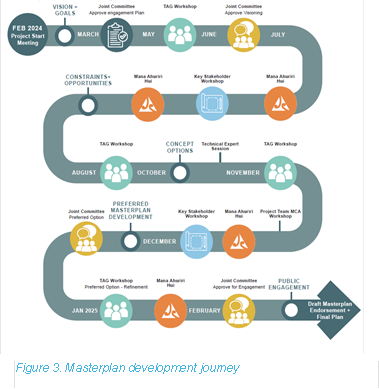
A clear and shared vision was central to the project. It was developed early in the process by the Ahuriri Regional Park Joint Committee and Project Team, and later reconfirmed through engagement with key stakeholders and Mana Ahuriri. This vision informed the generation of early concept options, which were explored in targeted workshops involving key partners, including Mana Ahuriri.
Specialist input was sought to inform the process, including avifauna expertise and direct engagement with Hawke’s Bay Airport. These inputs played a critical role in shaping the draft concept and will continue to guide the delivery of specific elements of the park.
The Technical Advisory Group (TAG) provided technical oversight and played a vital role throughout the options development phase. TAG served as a critical checkpoint to ensure that design decisions remained aligned with project drivers and key performance measures. A Multi-Criteria Analysis (MCA) was undertaken by the project team and reviewed in collaboration with TAG to assess and identify a preferred concept.
Following the identification of the preferred option, informed by TAG, Mana Ahuriri, and key stakeholder input, the draft masterplan was endorsed by the Joint Committee and released for public consultation in April 2025.
The masterplan now presented for adoption is a refined version of that preferred concept, shaped by feedback from the public, further technical input from TAG, and the recommendations of the Joint Committee at its meeting on 23 May 2025. It includes a suite of sub-projects, with several core initiatives identified for early implementation.
All projects within the masterplan will require further technical investigations, detailed design, and cost estimation prior to progressing through formal approvals and into delivery. Later-stage initiatives (Stages 2 and 3) are aspirational in nature and will depend on future funding, partnerships, and the preparation of robust business cases to confirm feasibility and long-term sustainability.
 |
Key initiatives include:
· Constructing a 100+ hectare treatment wetland at Lagoon Farm to intercept and filter stormwater from urban catchments such as the Pūrimu before it reaches the estuary. The wetlands have been sized to accommodate all of Napier’s urban stormwater being discharged into Te Whanga excluding Taipo and Pandora.
· Undertaking large-scale revegetation with native forest, shrubland, and wetland ecosystems to support future mahinga kai (traditional food gathering) practices.
· Embedding cultural values, histories, and stories throughout the park.
· Developing recreational pathways and park facilities that align with low-impact, nature-compatible use.
· Exploring partnerships for the development of public amenities and complementary commercial facilities.
All elements of the masterplan will be subject to further design, consenting, and business case evaluation (where appropriate) to ensure long-term ecological and financial sustainability. This process will also include assessment and mitigation of operational risks, including the potential for bird strike in proximity to airport operations.
In addition to outlining key initiatives, the masterplan provides a detailed analysis of the site’s constraints and opportunities. This includes consideration of hydrology, pedestrian connectivity, habitat restoration, airport flight paths, bird strike risk, viewshafts, historic land use patterns, and floodplain dynamics.
Masterplan Staging
Following public feedback, the ARP-JC reviewed of all the proposed initiatives within the masterplan. The Committee was conscious of the need to ensure that the plan remained fiscally responsible and deliverable. The review centred on identifying only the essential projects that align with the core objectives of the park specifically improving stormwater quality, restoring ecological and cultural values, and providing accessible public space.
The ARP-JC consolidated the masterplan to prioritise essential projects, deferred lower-priority projects for future consideration, and identified opportunities for external funding or public-private partnerships labelling these clearly as ‘non-funded’. Each initiative has been critically assessed, with a particular focus on maximising delivery efficiencies for example, bundling works by reusing earth from wetland construction to naturalise existing channels and create walking paths.
The outcome of this effort has resulted in three distinct phases:
1) Core Regional Park Programmes (page 38)
To be implemented over the next 10 years
2) Stage 2 Regional Park Programmes (page 39)
Projects build upon core initiatives, staged for years 6-20
3) Non-funded Potential Future Partnership Opportunities (page 40)
Aspirational projects intended to come online from year 8 onward as external funding or delivery partnerships emerge
It is important to note that a masterplan is a spatial planning tool. It identifies potential co-located activities that, when implemented together, can deliver greater collective outcomes. The timing and configuration of individual projects may evolve over time, provided they remain consistent with the intent and vision established for each area of the park.
Next Steps
In accordance with the direction of the ARP-JC, the project team will prepare an information pack for partner councils and Mana Ahuriri Trust ahead of the next Long Term Plan development cycle. This pack will include a detailed phasing plan, indicative budget for each initiative, and a draft procurement plan to provide greater certainty on the timing, resourcing, and sequencing of works within each stage of the masterplan. It is anticipated that the pack will be completed by April 2026, enabling informed consideration of project implementation as part of each organisation’s Long Term Plan development.
The ARP-JC has recommended that partner councils and Mana Ahuriri Trust:
· Adopt the Ahuriri Regional Park Masterplan;
· Note the inclusion of a phasing framework and cost planning work underway; and
· Maintain high-level funding placeholders in each organisation’s Long Term Plan budgets.
4.3 Issues
Bird Strike
The proximity of Hawke’s Bay Airport has been recognised from the outset as the primary risk to the success of the ARP project. The project team has been proactive in managing this issue. Engagement with Hawke’s Bay Airport Limited (HBAL) has included a series of meetings with both the Board, senior leadership and staff, involving ARP-JC members and officers. HBAL staff have been embedded in the TAG, and more recently, HBAL’s Chief Executive has joined the ARP-JC in a non-voting capacity to support strong alignment and oversight.
To inform risk mitigation, the project has engaged an avifauna specialist to assess potential bird strike risk and provide design recommendations, which have been incorporated into the masterplan. To further strengthen this understanding, a Bird Strike Risk Assessment has been commissioned. The scope of this assessment was developed in collaboration with HBAL and is expected to be completed by the end of the 2025 calendar year.
Should the assessment confirm that the park can be managed in a way that avoids any net increase in bird strike risk and ideally reduces residual risk compared to current conditions, the next step will be to develop a Wildlife Monitoring and Maintenance Plan. This plan will be prepared prior to advancing any elements of the park to detailed design or construction, and will be developed in collaboration with HBAL, airspace users, and specialist interest groups.
Value Management
As with any large-scale infrastructure or environmental project, managing cost escalation presents an ongoing challenge. To address this, a dedicated funding investigation is underway to explore alternative funding mechanisms beyond traditional local government sources. This includes identifying opportunities for central government investment, public-private partnerships, and philanthropic or environmental grant funding to reduce the burden on ratepayers.
In parallel, the project’s forward work programme has included the early and ongoing engagement of a Quantity Surveyor (QS). The QS will participate in design workshops and is embedded throughout each stage of design to provide real-time cost advice, track design implications, and ensure that cost considerations are fully integrated into project decisions. This approach supports value-based design and disciplined delivery.
Naming of the Project/ Space
The term Ahuriri Regional Park has been used throughout the development of the masterplan as a working title. From the outset, the project team acknowledged that this name is provisional, pending a more appropriate and culturally grounded identity for the space. Through public feedback and stakeholder engagement, it has become increasingly clear that the word “Park” can unintentionally signal a recreational or leisure-focused purpose where people come to “stay and play” which does not reflect the vision or function of the space.
To address this, the project team has initiated a naming process in collaboration with Te Waka Rangapū, under the guidance of co-partner Mana Ahuriri Trust. The ARP-JC has formally recognised the need to investigate a more meaningful and accurate name, and it is recommended that Council likewise note this commitment. Any proposed name will return to the ARP-JC for endorsement prior to formal consideration by partner councils.
Managing Perception of Masterplan Adoption
It is important to clearly communicate that adopting the Ahuriri Regional Park Masterplan does not represent a commitment to immediate construction. Rather, the masterplan provides a high-level spatial framework that outlines a long-term vision and identifies a suite of potential projects for further development.
Adoption of the masterplan is a strategic milestone that enables further investigation and refinement of individual initiatives, including concept and detailed design, business case development, procurement planning, and staged implementation. Some of these initiatives may span multiple decades or generations. The purpose of adopting the masterplan is to signal Council’s support for the vision and direction of the project, not to approve or commit construction funding (aside from ongoing consulting) at this stage.
4.4 Significance and Engagement
The development of the masterplan followed an engagement plan formally endorsed by the ARP-JC. The engagement plan identified high interest groups likely to have a strong connection to, or be directly affected by, the future park, including:
· Parklands and Poraiti Community
· Ahuriri Estuary Protection Society
· Ahuriri Catchment Group
· User Groups including – walking and cycling, bike Hawke’s Bay, water sports clubs, scouts
Engagement methods included:
· A regularly updated webpage
· Two wānanga hui with Mana Ahuriri Trustees
· Two evening workshops with key stakeholders
· A stall at the Napier City Council ‘Open House’ event
· Social media drive including a Facebook event and web videos
· Say It! webpage
· On site open day
Smaller, more focused workshops were also held with key stakeholders to explore their visions for the space and to share more detailed information about the project’s drivers and objectives. These sessions were well attended and generated engaged, constructive feedback.
Public feedback on the draft masterplan was sought through a non-statutory process, as there is currently no legal requirement for formal consultation at this stage. However, the ARP-JC felt it was important to involve the community early to help shape the direction of the project. Formal consultation will be required in the future, particularly as funding for specific projects is sought through the Long Term Plan process.
Submissions and feedback were received from a diverse range of individuals and organisations, including:
· Individuals
· Biodiversity Hawke’s Bay
· Birds NZ
· New Zealand Air Ambulance Service/ Skyline Aviation
· Air Napier Limited
· Waka Ama Kaungunu
· Hawke’s Bay Airport Limited
4.5 Implications
Financial
There are no additional financial implications for Napier City Council resulting from the adoption of the Ahuriri Regional Park Masterplan.
The masterplan has been developed within the existing budget allocation, jointly funded by Napier City Council and Hawke’s Bay Regional Council. The current 2024–2027 Three Year Plan allocated just under $300,000 for the preparation of the masterplan over three years. This budget will continue to support the development of Stage 1 initiatives through to initial implementation phases; however, it is not sufficient to fully fund all preparatory work for Stage 1. Rather, it will serve as a contribution toward the broader delivery of those projects.
Napier City Council’s LTP includes a funding allocation of $13.2 million for the implementation of core park initiatives from 2028 onwards, with Hawke’s Bay Regional Council having committed approximately $9 million from 2032. These core initiatives (listed on page 38 of the masterplan) will be developed to project-level detail prior to the next LTP funding cycle, with an intention to seek formal adoption of project level budget in 2027.
Social & Policy
The masterplan aligns with several of Council’s strategic goals and supports regional efforts to improve water quality, build climate resilience, restore ecological health, and enhance public access to open space. The vision and process underpinning the masterplan are consistent with partnership and co-governance approaches, particularly with Mana Ahuriri Trust, and reflect a commitment to sustainable, intergenerational outcomes.
Risk
Throughout the development of the ARP Masterplan a risk matrix was developed, monitored and reported on. The diagram below outlines the project structure for the development of the masterplan. Following adoption (if adopted), the risk framework may be subject to change to respond to the needs of the project.
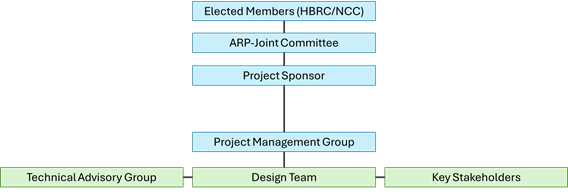
Day to day decisions and risk mitigation is managed by the Project Controller within the Project Management Group, with this group providing the first point of escalation. The next escalation point is the Project Sponsor/ Senior Responsible officer, who in this instance is the Director of City Strategy. Their primary responsibility is to provide overall strategic direction and support, aligning the project's objectives with the organisation's goals. Risk has been periodically reported to the ARP-JC via project managers updates throughout the development of the masterplan.
The primary risk between adopting the masterplan and implementation is the bird strike matter. This has been reported on above and methods of risk management are being followed. The Chair of the ARP-JC has confirmed that the masterplan will not follow through to implementation if bird strike risk increases beyond what can be mitigated.
4.6 Options
The options available to Council are as follows:
a. Adopt the Ahuriri Regional Park Masterplan recognising that Core Programs are currently funded through the Napier City Council Long Term Plan from 2028 onwards.
b. Recommend changes to the Ahuriri Regional Park Masterplan before reconsidering the document for adoption.
c. Not adopt the Ahuriri Regional Park Masterplan
4.7 Development of Preferred Option
The preferred option has been centred around providing the maximum space feasible for stormwater wetlands, as advised by the Lagoon Farm Stormwater Diversion Project. The masterplan has been developed with the needs of our partners and the feedback from the community. The joint committee interrogated three different options: one with a recreational forward focus, another with a nature-first approach, and a third with interwoven land use. The preferred option integrates aspects of both the interwoven land use and nature-first options to create a comprehensive and balanced masterplan.
1 Draft Ahuriri Regional Park Masterplan (Doc Id 1866366) (Under separate cover 1)
Ordinary Meeting of Council - 31 July 2025 - Open Agenda Item 5
5. Integrated Trade Waste and Wastewater Bylaw 2022 - Delegations
|
Type of Report: |
Operational and Procedural |
|
Legal Reference: |
Local Government (Rating) Act 2002 |
|
Document ID: |
1865608 |
|
Reporting Officer/s & Unit: |
Laura Rolls, Environmental Compliance Officer |
|
.1 Purpose of Report The purpose of this report is to confirm that the delegation review requirement outlined in the Council’s resolution of 12 December 2024 has been satisfied and to seek Council delegation to the Chief Executive. It provides a summary of the legal and procedural work undertaken in relation to the Integrated Trade Waste and Wastewater Bylaw 2022 and seeks Council’s confirmation that no further action is required. This report also reaffirms the Chief Executive’s (CE) delegated authority and outlines the safeguards in place for matters requiring Council oversight.
|
That Council:
a) Note that the review of delegations under the Integrated Trade Waste and Wastewater Bylaw 2022 (Doc Id 1859654) has been completed as part of the legal review process.
b) Delegate authority to the Chief Executive all duties and actions under the Integrated Trade Waste and Wastewater Bylaw 2022; and
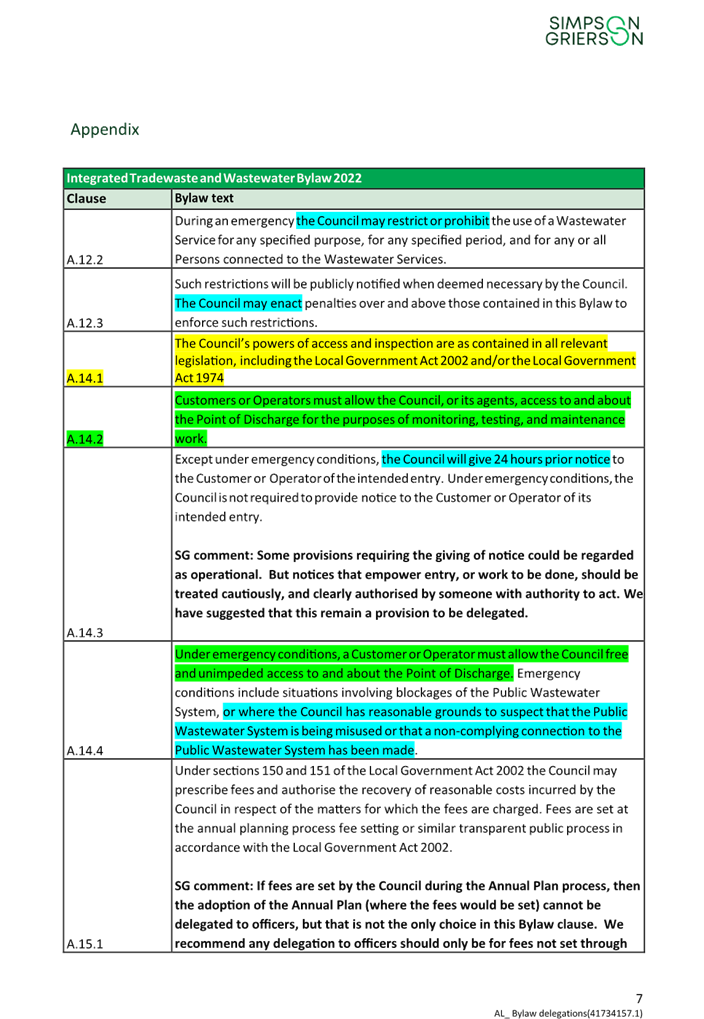
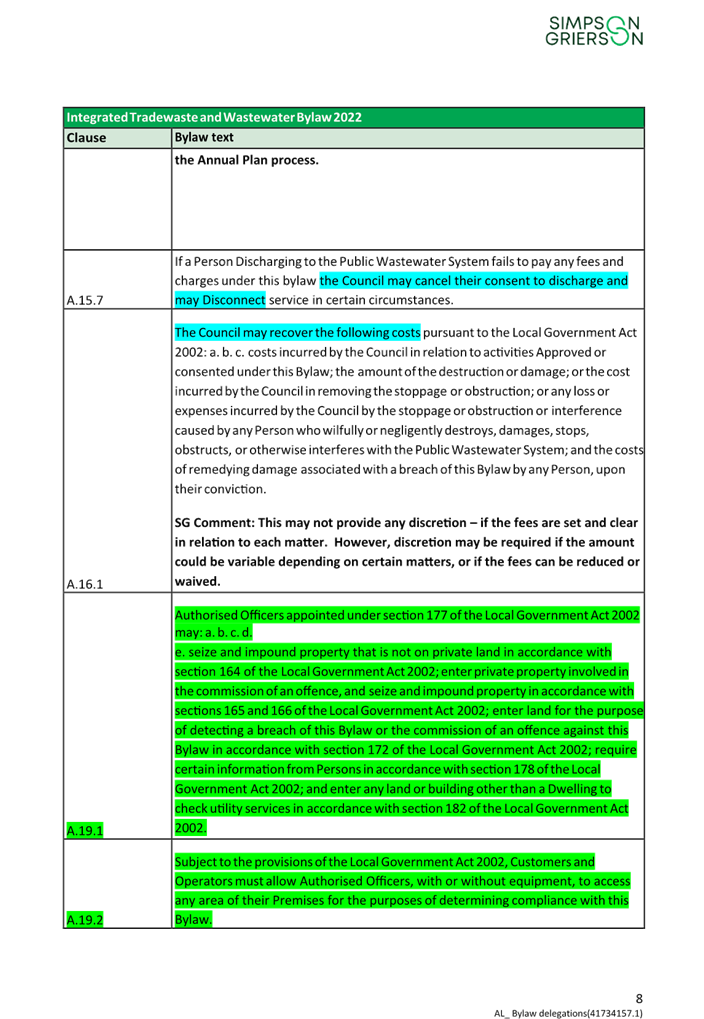
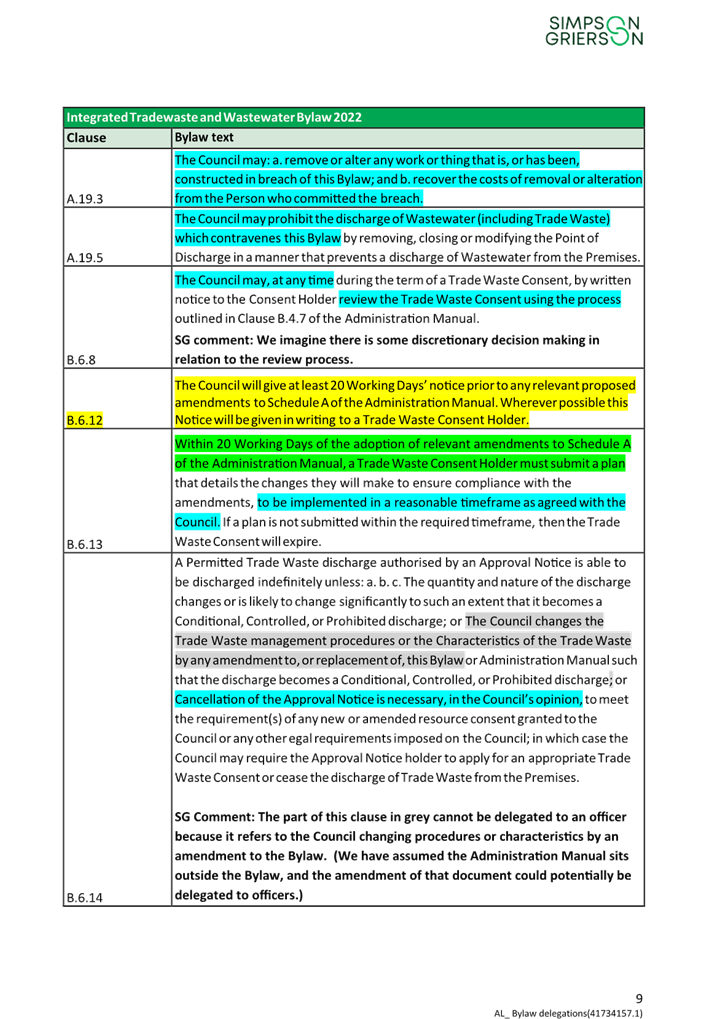
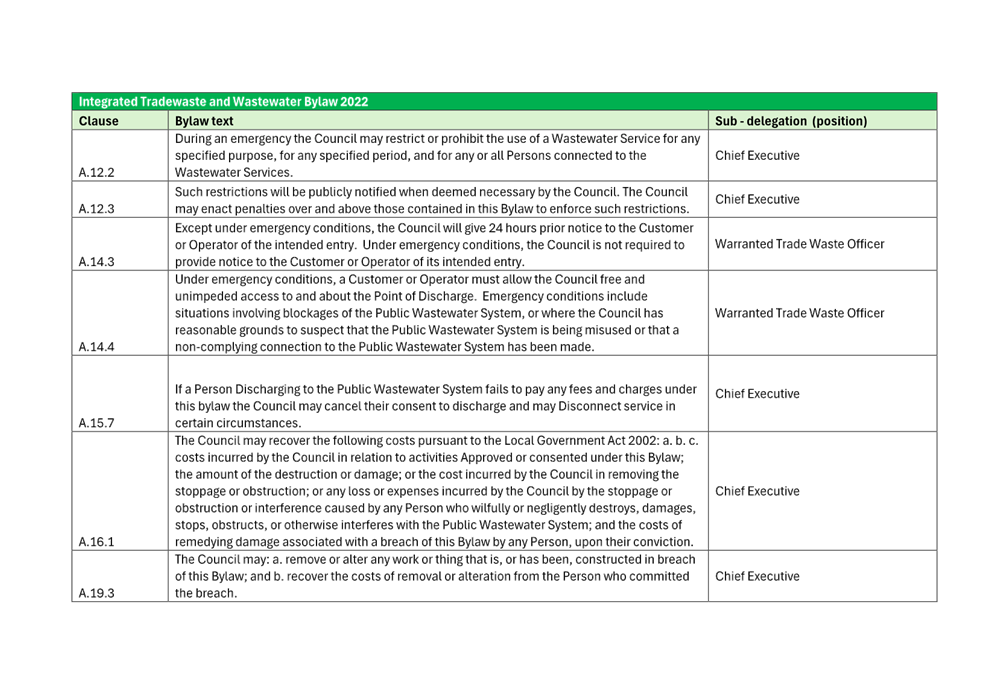
c) Note that Officers will seek sub-delegation from the Chief Executive to perform the duties and decision making required under the bylaw, outlined in the attached document Integrated Tradewaste and Wastewater Bylaw 2022 – Sub-delegations. (Doc Id 1866221).
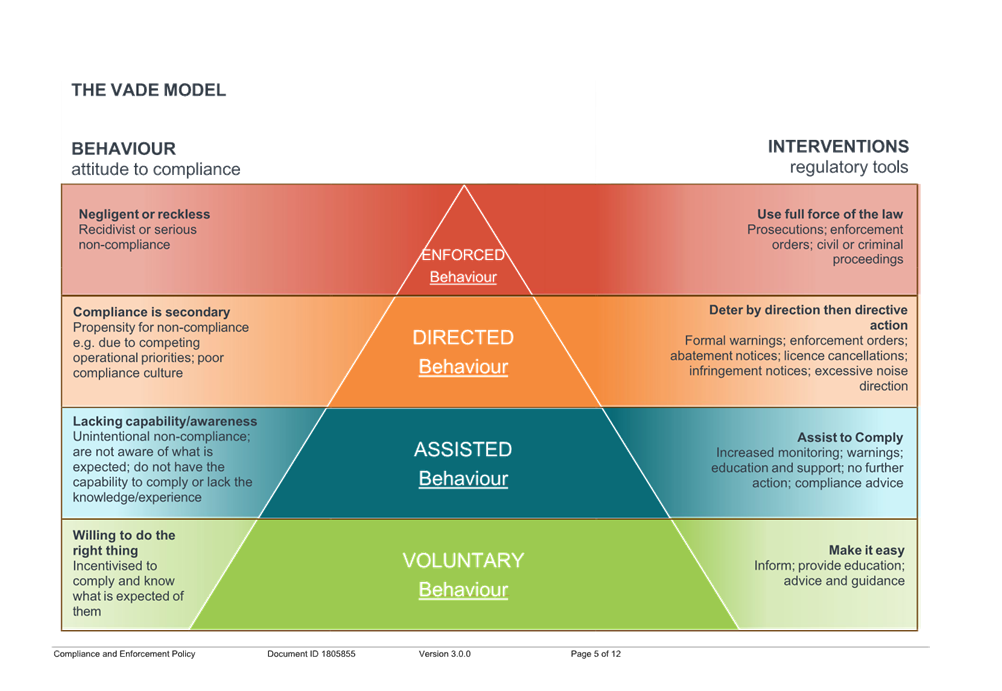
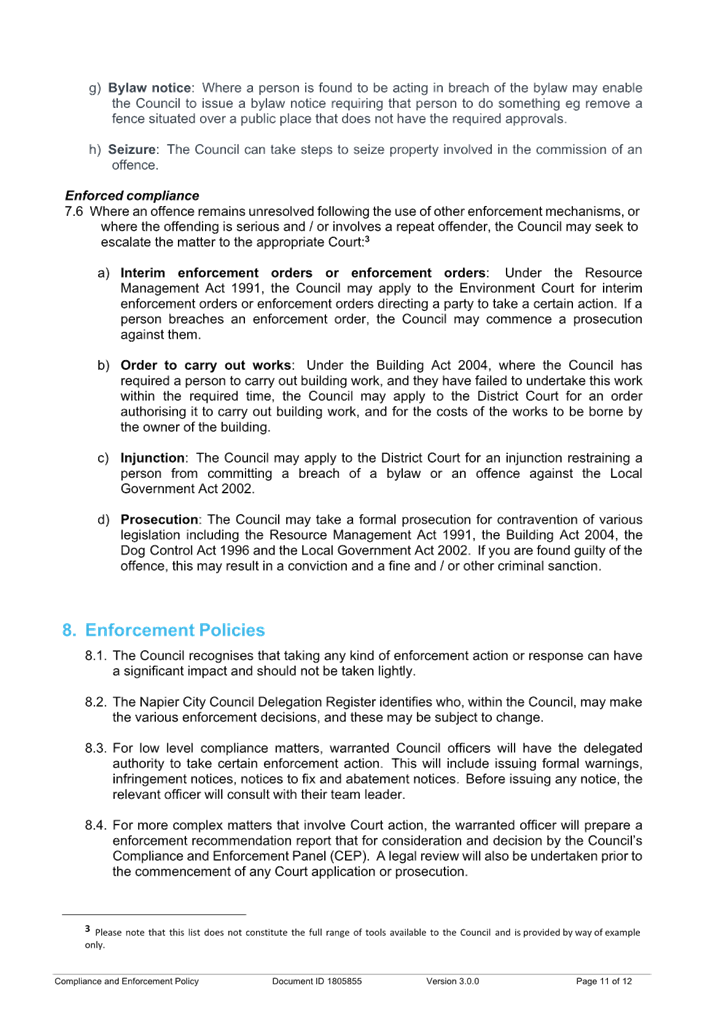
d) Confirms that any compliance and enforcement decision relating to the Integrated Trade Waste and Wastewater bylaw (2022) is subject to the Compliance and Enforcement Policy (Document Id 1805855),
e) Note that any person objecting to a decision of the Chief Executive under the Integrated Trade Waste and Wastewater Bylaw and Compliance and Enforcement Policy shall have a right of objection to the Hearings Committee, with the objector responsible for all costs associated with the objection process.
f) Delegate to the Chief Executive all other aspects of the administration and enforcement of the Trade Waste Bylaw, consistent with this resolution.
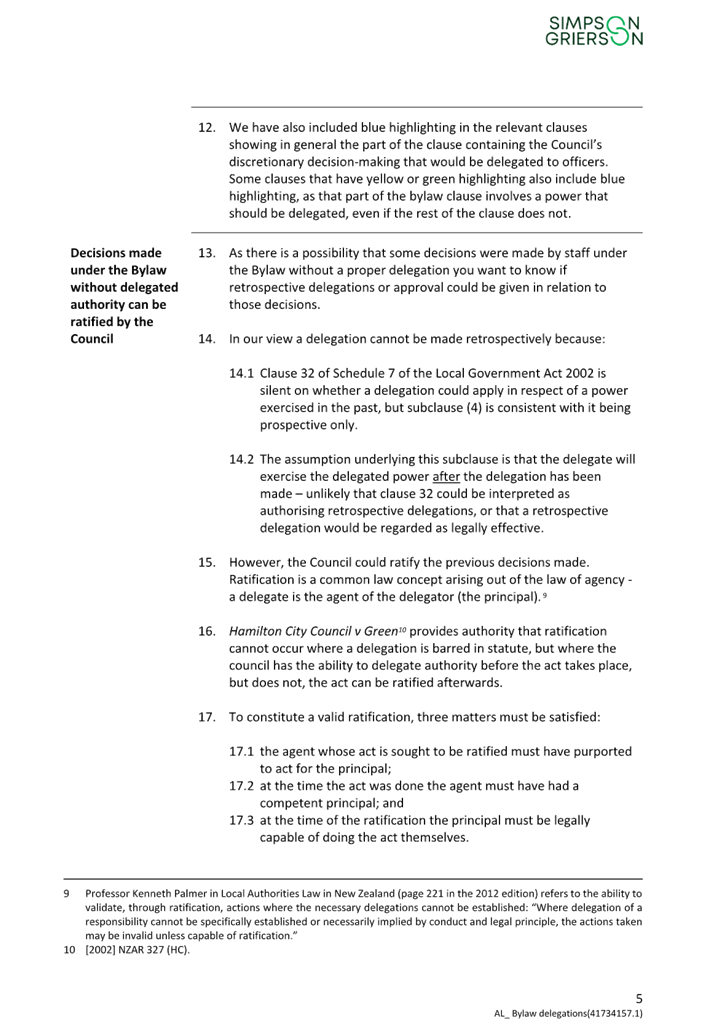
The Integrated Trade Waste and Wastewater Bylaw 2022 was formally adopted by Council, effective 1 August 2022. Duties and actions under the bylaw require delegation by Council to the CE to ensure Napier City Council can adequately manage its wastewater services and the associated network. Officers identified that this delegation was not obtained when the bylaw was adopted by council.
This report confirms the requirements of the Council resolution from 12 December 2024 regarding the delegation of authority under the Integrated Trade Waste and Wastewater Bylaw 2022 have been met.
Council resolved:
“Delegate authority to the Chief Executive to exercise all the Council’s duties and actions under the Integrated Trade Waste and Wastewater Bylaw 2022, subject to a review of delegations being undertaken as part of the Tradewaste Bylaw review to be brought back to Council in March 2025.”
This report outlines the work undertaken to review delegations and associated bylaw, and provides assurance that no further action is required to satisfy this requirement.
The independent Trade Waste Bylaw review was presented to Council on 26 June 2025. Officers understood this to satisfy the above requirement. However, clarification was sought by Council regarding whether the delegation review component had been sufficiently addressed.
.3 Issues
The Chief Executive does not currently have delegation under the Integrated Trade Waste and Wastewater 2022 bylaw. Decision making required by staff under the Bylaw has paused while we rectify this issue.
Multiple pieces of work have been undertaken. These include:
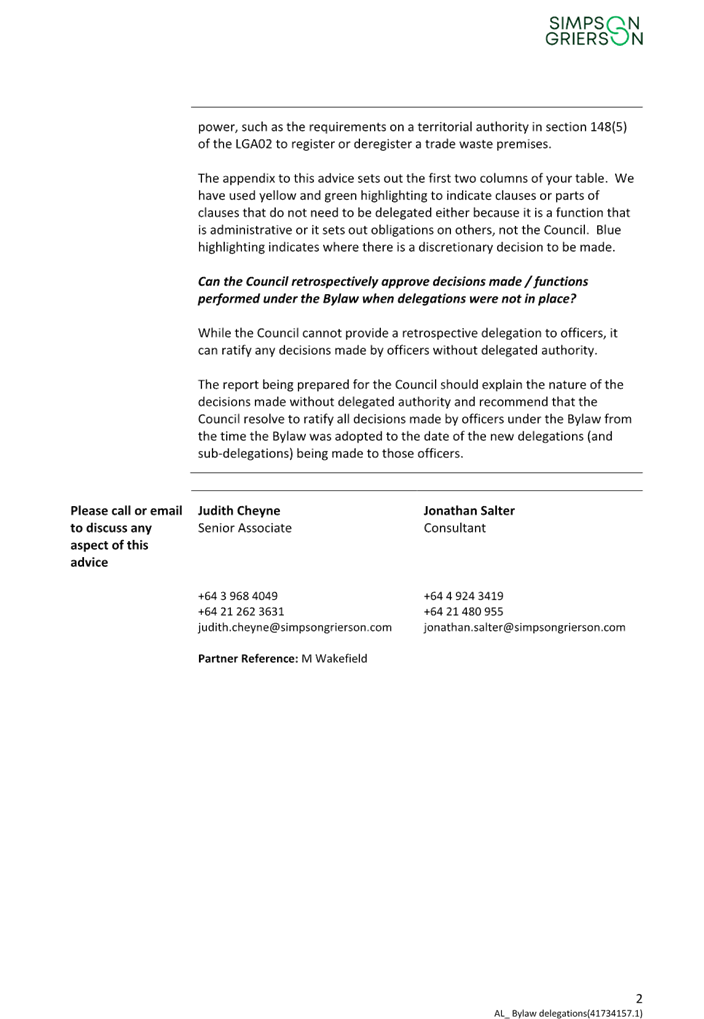
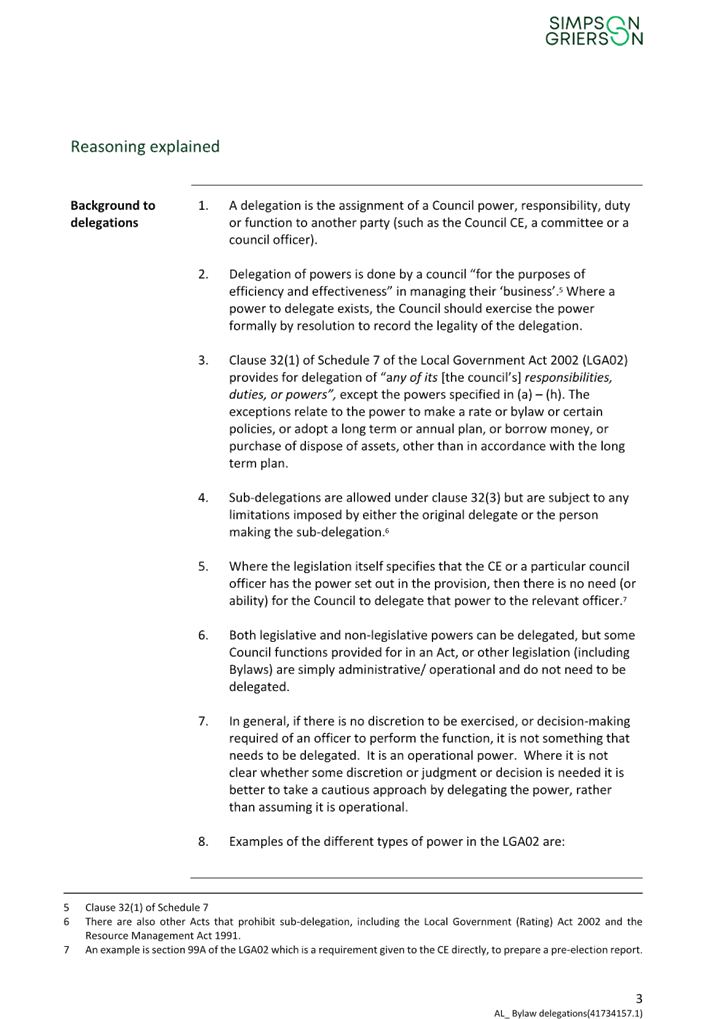
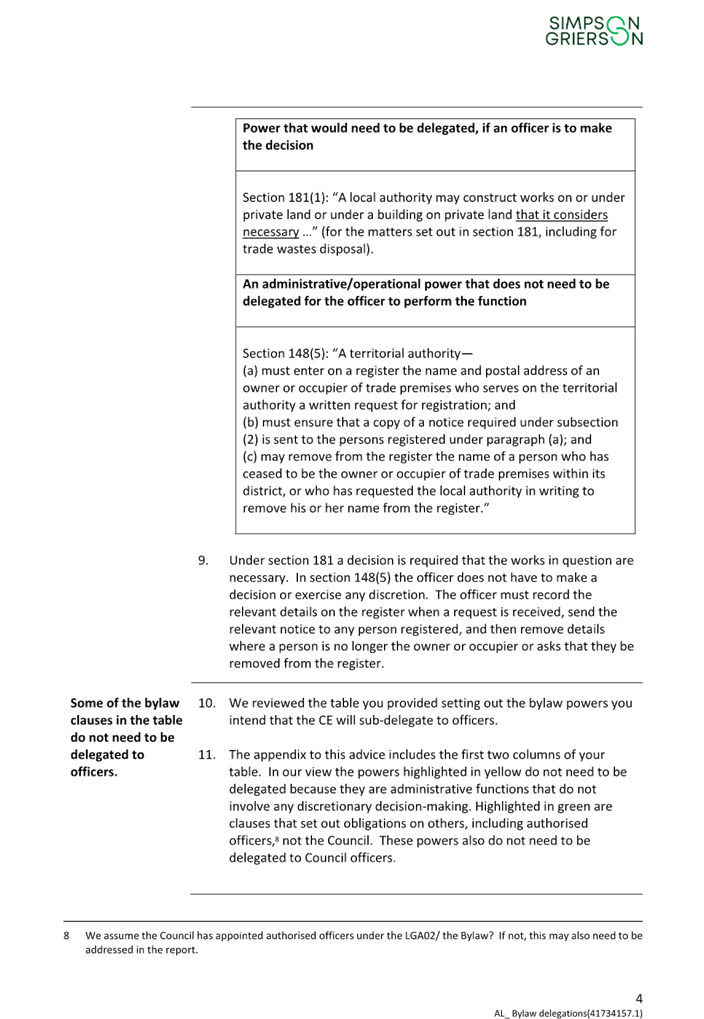
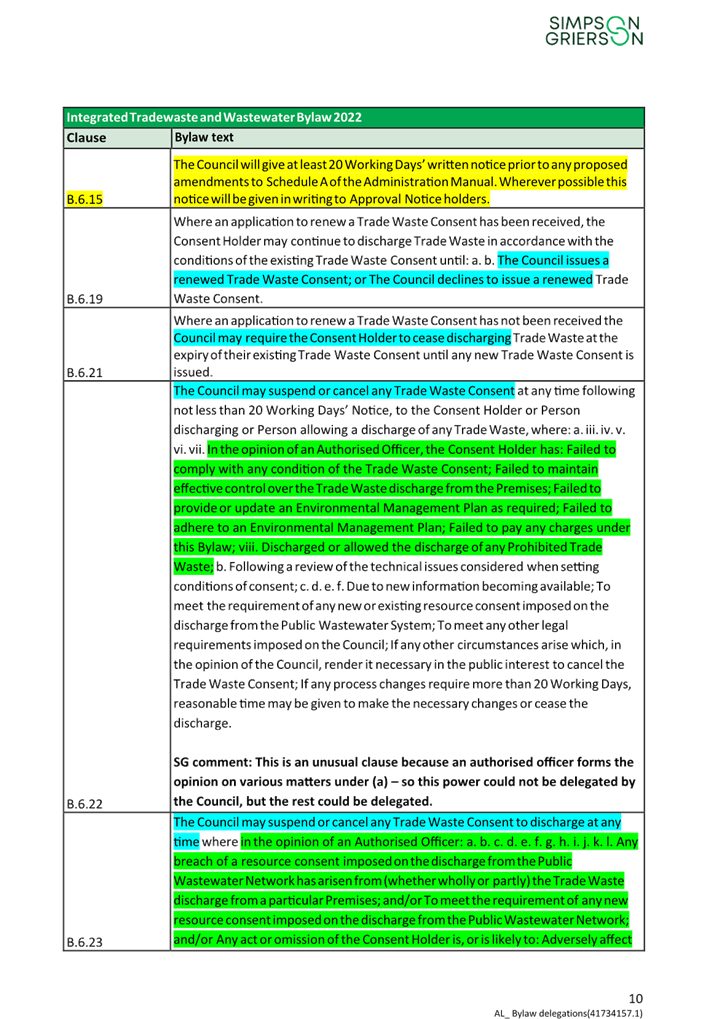
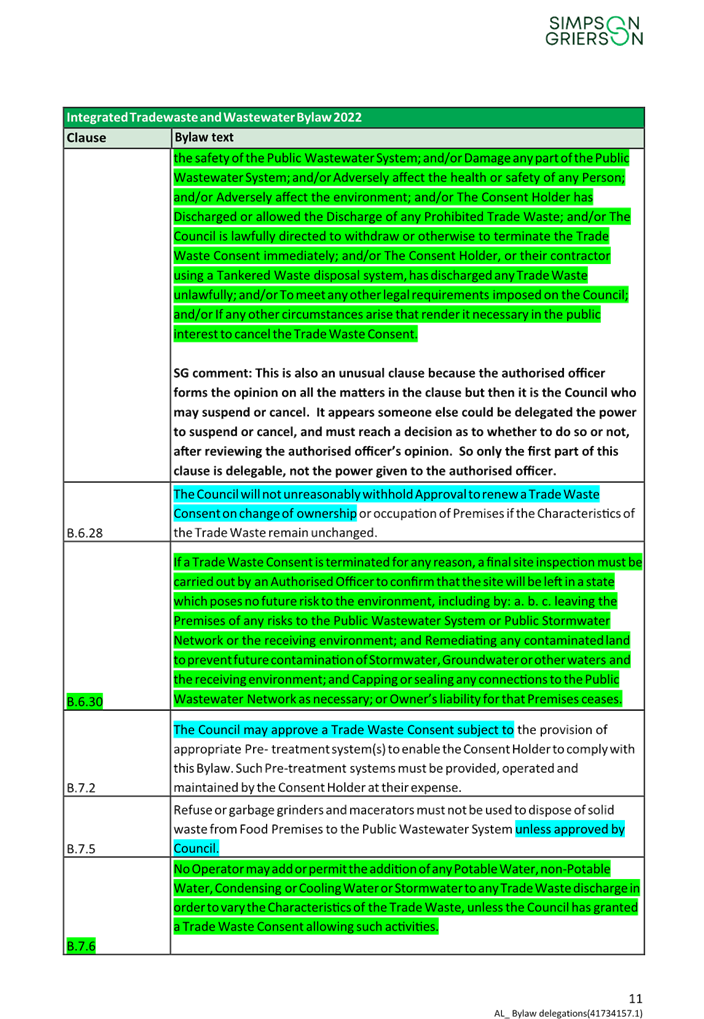
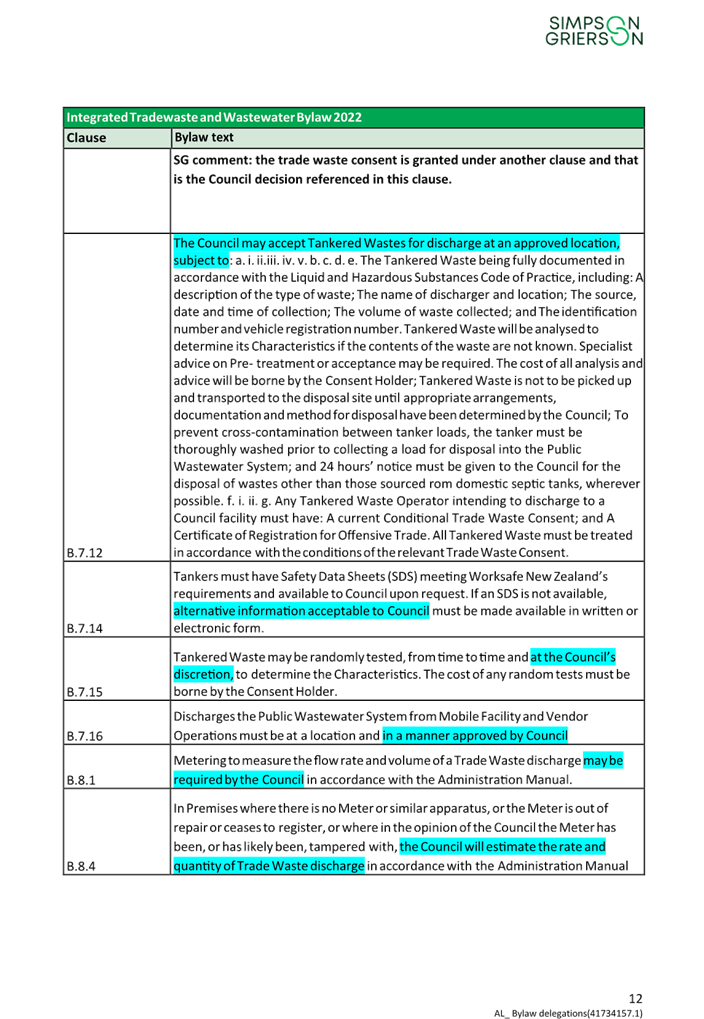
· A legal review of delegations specific to the bylaw – Legal advice has been obtained on this matter. Refer to attachment, legal review of delegations by Simpson Grierson (Attachment 2).
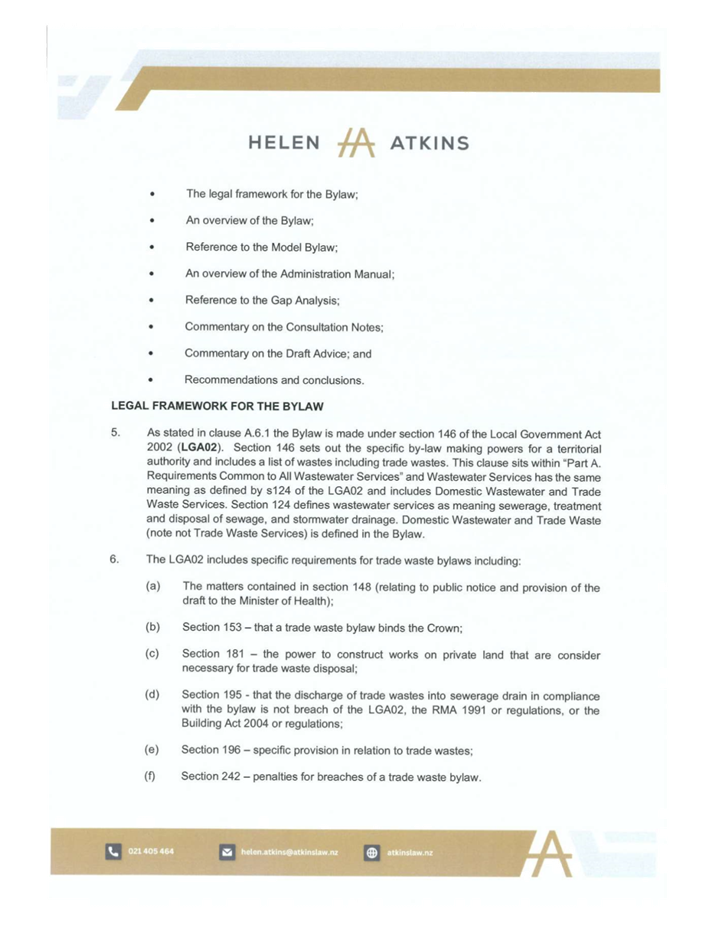
· A legal review of the following, completed by Helen Atkins, Atkins Law (Attachment 3):
o The legal framework for the Bylaw
o An overview of the Bylaw
o Reference to the Model Bylaw
o An overview of the Administration Manual
o Reference to the Gap Analysis
o Commentary on the Consultation Notes
· An independent review of the Trade Waste Bylaw led by Richard Bax Consulting. Recommendations from this review were presented to Council and endorsed on the 26 June 2025.
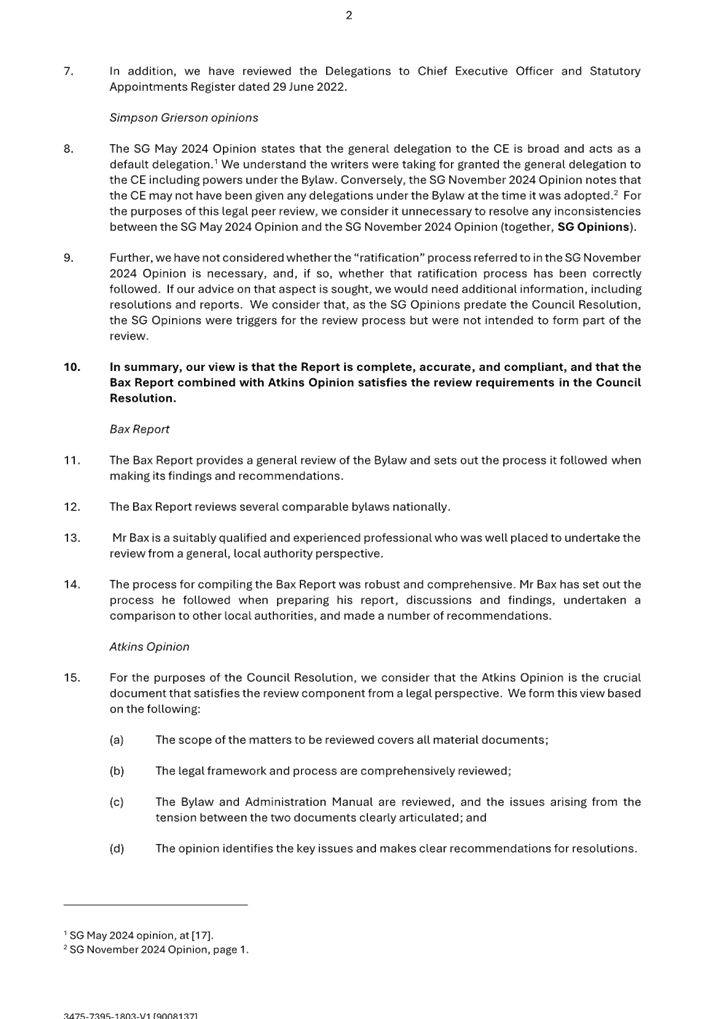
· Peer Legal review completed by Willis Legal (Attachment 4) of the entirety of this work to ensure the recommended delegations align with regulatory requirements, Council Policy and best practice.
Based on these interpretations, officers are confident that the intent of the Council resolution has been met through the work already undertaken.
Compliance and Enforcement
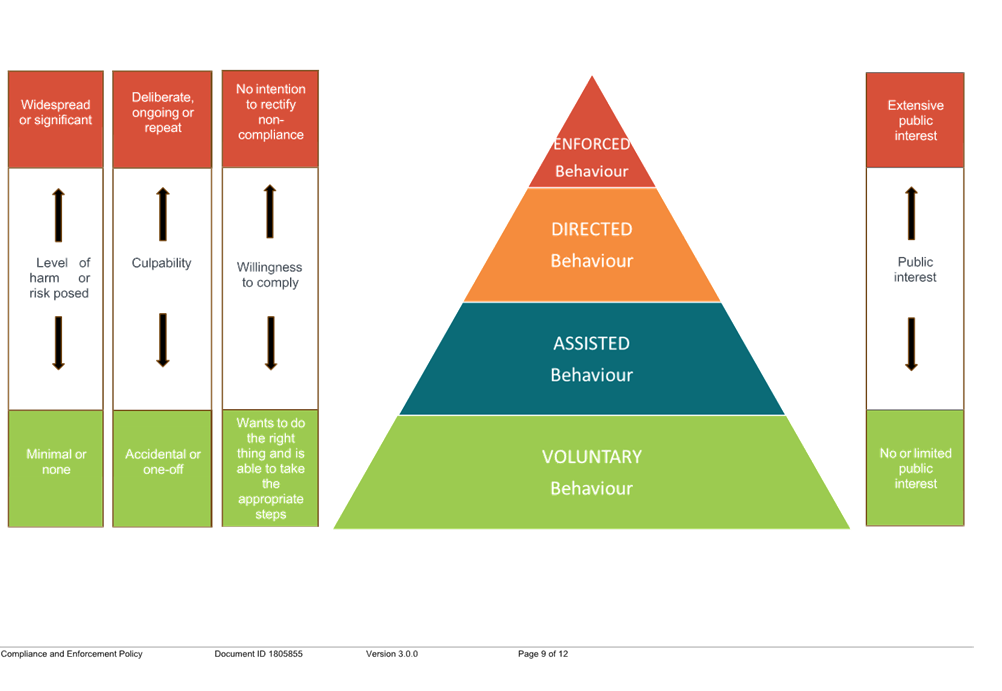
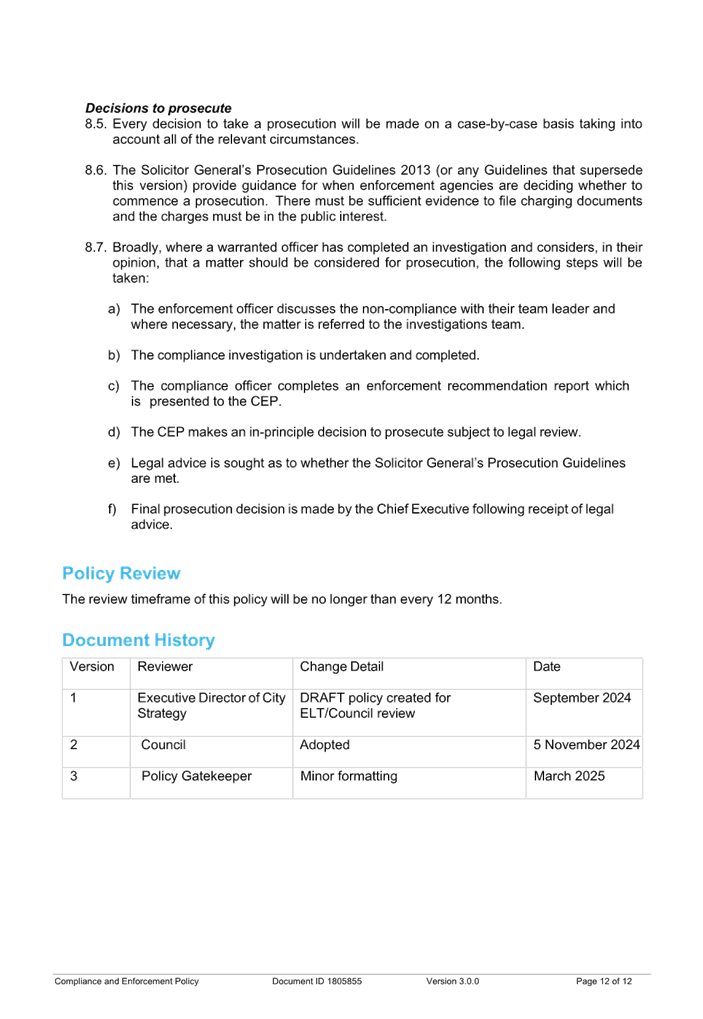
The Compliance and Enforcement Policy (CEP) (Attachment 5), adopted by Council on 5 November 2024, outlines the enforcement process for addressing non-compliance. Where a matter involves significant risk, harm, or public interest, it is escalated to the Compliance and Enforcement Panel (CEP) for assessment. Following this assessment, the final decision on whether to proceed with prosecution rests with the Chief Executive (CE), based on legal advice received. For further detail, please refer to Section 8 of the CEP.
Delegations Framework
The following clause from the Delegations to Chief Executive Officers and Statutory Appointments Register is relevant to note:
“The Council encourages the Chief Executive to report to Council if any matter is considered difficult, is of particular political importance or sensitivity, where there is special community interest in it, or where the matter relates to a subject area where council policy is unclear.”
This provides a safeguard for matters that may require further Council oversight even where delegation to the CE exists.
Additionally, the delegation granted by Council in the register mentioned above includes the power to sub-delegate:
“The Council specifically delegates authority to the Chief Executive the power to sub-delegate to other officers any or all of the powers or authorities delegated to him or her. All sub-delegations must be given by the Chief Executive in writing.”
Conclusions
Officers consider that the delegation review requirement has been met through the legal review process already undertaken. No further work is required to satisfy the 12 December 2022 resolution. This report serves to formally document that conclusion and provide assurance to Council that appropriate processes are followed.
.4 Significance and Engagement
N/A
.5 Implications
Financial
N/A
Social & Policy
This Bylaw is mandated to be reviewed within five (5) years from 1 August 2022; however, following the Council meeting held on 26 July 2025, Council endorsed a review of the Integrated Napier City Council Trade Waste and Wastewater Bylaw 2022, noting that this will trigger a full bylaw review process. Without delegation being given to the CE, officers are unable to seek sub-delegation to undertake the actions set out in the current bylaw.
Risk
The risk associated with approving the delegation to the Chief Executive is low.
.6 Options
The options available to Council are as follows:
a. Issue delegation to the Chief Executive to perform the duties outlined in the bylaw.
b. Do not delegate authority to the Chief Executive the duties under the Bylaw.
.7 Development of Preferred Option
Option a) Delegation issued to Chief Executive at close of meeting. Officers to seek sub-delegation from the Chief Executive in due course.
1 Integrated Tradewaste and Wastewater Bylaw 2022 - Sub-Delegations (Doc Id 1866221)
2 Simpson Grierson Bylaw Delegations Review (Doc Id 1865605)
3 Helen Atkins - Legal Review (Doc Id 1865606)
4 Willis Legal Peer Review (Doc Id 1865604)
5 Compliance and Enforcement Policy (Doc Id 1866222)
|
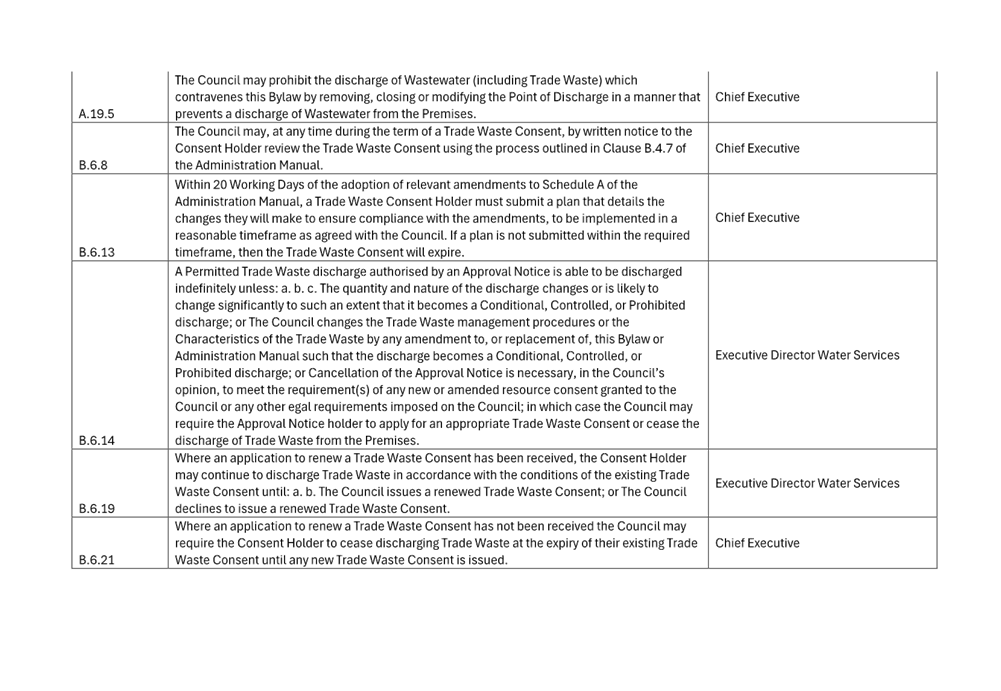
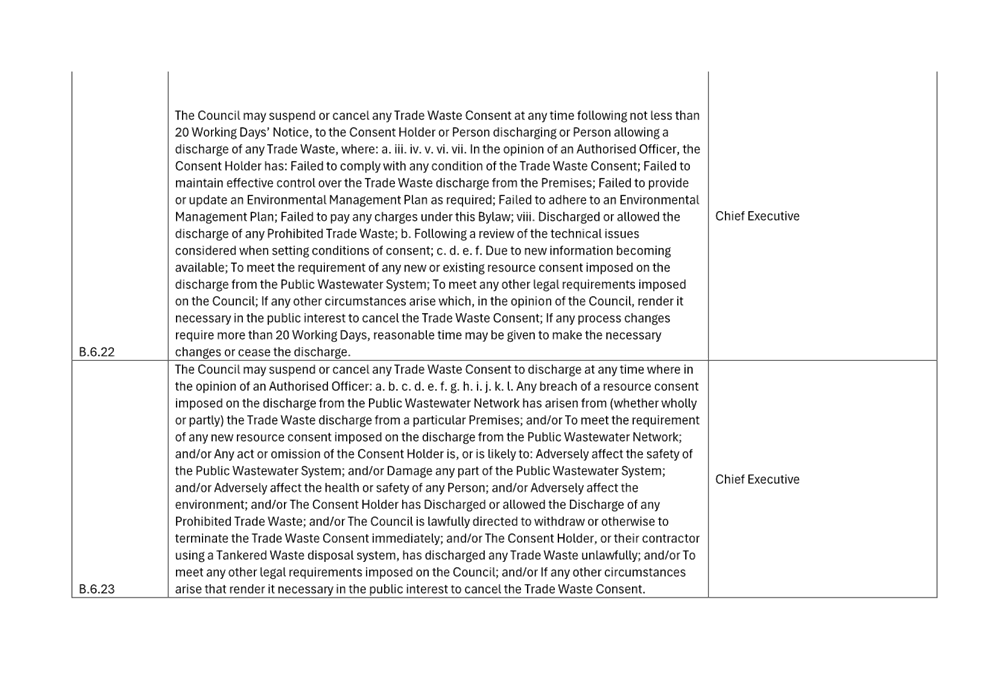
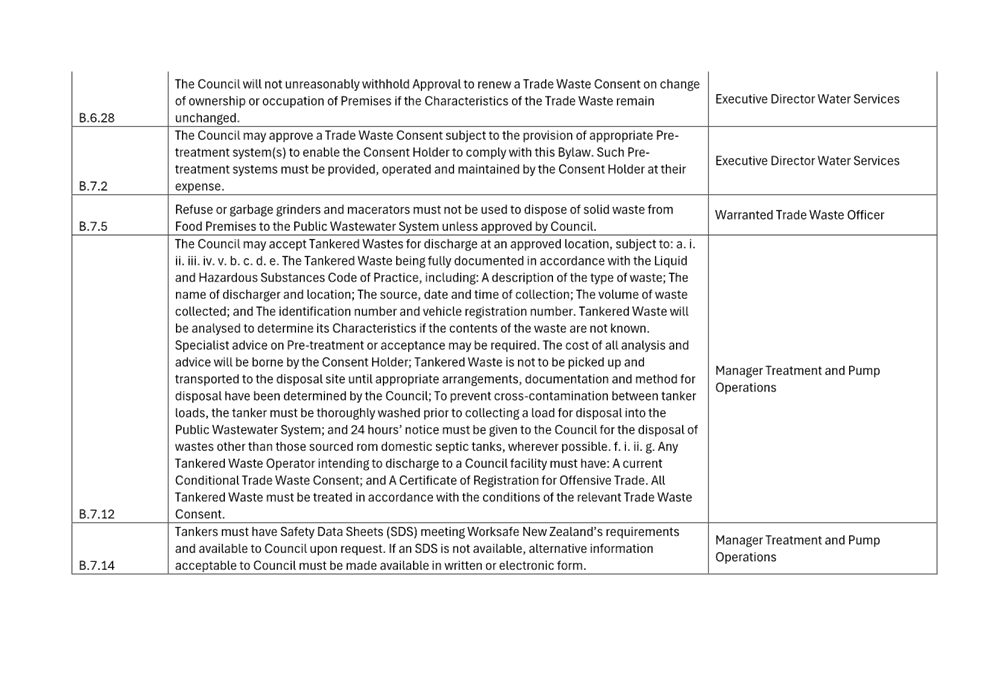
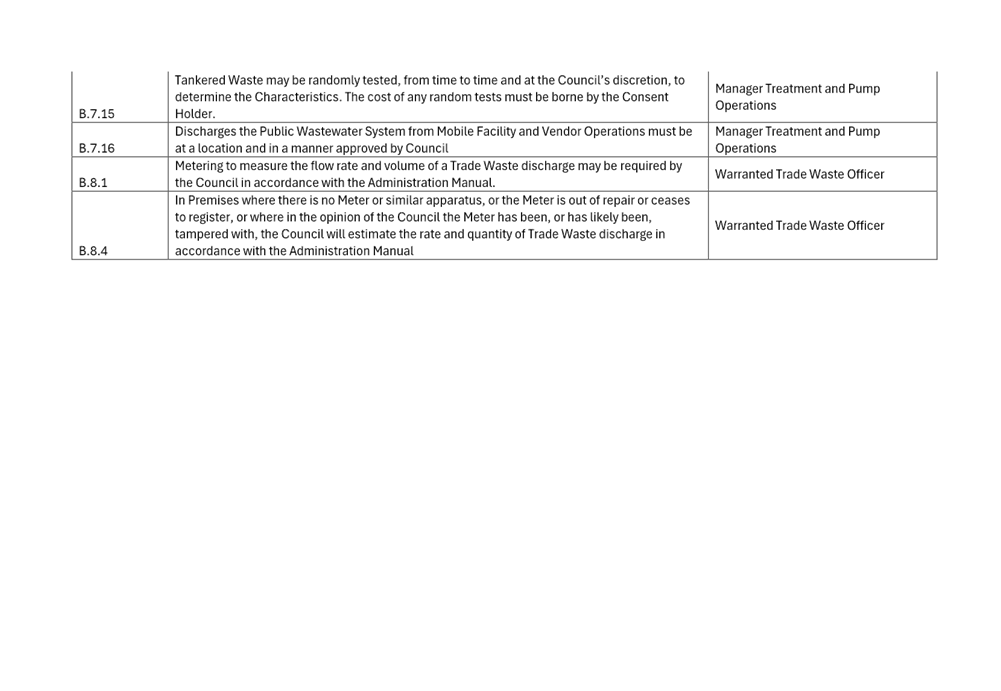
Integrated Tradewaste and Wastewater Bylaw 2022 - Sub-Delegations (Doc Id 1866221) |
Item 5 - Attachment 1 |
Ordinary Meeting of Council - 31 July 2025 - Open Agenda Item 6
6. Climate Change Risk Assessment Report and Regional Climate Action Collaboration
|
Type of Report: |
Information |
|
Legal Reference: |
Enter Legal Reference |
|
Document ID: |
1864100 |
|
Reporting Officer/s & Unit: |
Michele Grigg, Senior Policy Analyst |
|
6.1 Purpose of Report This report asks Council to receive the Hawke’s Bay Climate Change Risk Assessment technical report, note the resolutions from the May 2025 Climate Action Joint Committee meeting and note. The report also indicates Napier City Council’s intent for future climate action work, including continued regional collaboration.
|
That Council:
a) Receive the independent Hawke’s Bay Climate Change Risk Assessment technical report produced by Urban Intelligence for the Climate Action Joint Committee.
b) Note the resolutions from the Climate Action Joint Committee meeting held on 9 May 2025.
c) Note there are no property level implications arising from the report, including for Land Information Memoranda (LIMs).
d) Note Napier City Council’s commitment to continued regional climate action collaboration.
e) Note an update on planning for a Napier City climate work programme will be provided to the Future Napier Committee.
1.2.1 Climate Change Risk Assessment report, CAJC resolutions, and property level implications
In August 2024, the Hawke’s Bay Climate Action Joint Committee (CAJC) commissioned a regional Climate Change Risk Assessment (CCRA) report, based on existing data and information, marking this as the first climate change risk assessment for the region.
The Technical Advisory Group (TAG) subsequently engaged independent experts, Urban Intelligence, to undertake the assessment. Data was drawn from national and local sources, including from Napier City Council, other CAJC member councils, and Hawke’s Bay Civil Defence and Emergency Management (HBCDEM).
Climate change risk assessments are a key tool for informing adaptation planning and building resilience. They provide climate-focused evidence and analysis to support pro-active decision making. Many councils throughout Aotearoa have undertaken their first local climate change risk assessments[9], including since publication of the first National Climate Change Risk Assessment in 2020.[10]
The Hawke’s Bay CCRA is a public-facing technical report (see Attachment 1 for the full report). The risk assessment relies on existing data sets held by the relevant councils. It presents a summary of climate risk information at both the regional and territorial authority level (see Attachment 2 for the Napier City Snapshot summary). The report forms a shared evidence base about known climate risks and is a foundation for further climate risk and adaptation work across the region. The report is available via both our Natural Hazards web page[11] and the regional online platform.[12]
On 9 May 2025, the CAJC formally received the CCRA report and passed a series of resolutions (see below). These included acknowledging the collaborative effort to produce the report, sharing key findings with a range of partners, and recommending that the five partner councils note the report’s publication, consider its findings, commit to ongoing collaboration, and allocate resources in the 2027-2037 Long Term Plan to enable a future risk assessment update. The CAJC also requested that TAG report back with options for a regional climate data investment strategy and governance models to support future collaboration by 30 September 2025.
Resolutions from Climate Action Joint Committee, 9 May 2025 (unconfirmed)
That the Climate Action Joint Committee:
1.1. Receives and considers the Hawke’s Bay Climate Change Risk Assessment staff report.
1.2. Receives the independent Hawke’s Bay Climate Change Risk Assessment technical report produced by Urban Intelligence.
1.3. Recognises and acknowledges the collaborative effort to deliver a public-facing assessment that forms the first shared evidence base of climate risk for the region.
1.4. Shares the key findings and opportunities for further work set out in the Hawke’s Bay Climate Change Risk Assessment technical report with the five partner councils, our regional PSGEs and Taiwhenua organisations, HB CDEM Group Joint Committee, HB Lifelines organisations, the Regional Planning Committee and Central Government partners.
1.5. Requests that the TAG reports back to the CAJC on options to progress a region-wide climate data investment strategy/roadmap and regional climate change collaboration governance models, considering the roles and responsibilities of Emergency Management and councils by 30 September 2025.
1.6. Recommends to the five partner councils that they:
1.6.1. Note the publication of the Hawke’s Bay Climate Change Risk Assessment technical report.
1.6.2. Consider the findings and opportunities for further work outlined in the Hawke’s Bay Climate Change Risk Assessment technical report, including how to integrate climate risk information into decision-making at all levels.
1.6.3. Commit to providing staff resource and funding for ongoing collaboration on climate action, including allocating budget in the next Long Term Plan to enable a future iteration of the Hawke’s Bay Climate Change Risk Assessment to be undertaken during the 2027-2037 period.
1.6.4. Commit to regional collaboration on climate action to continue building resilience.
1.6.5. Commit to processes of continuous improvement to address the impacts of climate change on vulnerable communities including tangata whenua.
The resolutions under item 1.6 above are directed to the five CAJC partner Councils. Some request future commitments, such as LTP budget provision, while others seek in-principle support for continued collaboration and integration of climate risk into decision-making. In response, Napier City Council has taken, or intends to take, the following actions:
· Promotion and accessibility of the CCRA: We have actively promoted the CCRA report through our communication channels and made it available on our website (Resolution 1.6.1).
· Commitment to informed decision-making: Council remains committed to ensuring our community has access to the best available information, including through LIMS and other LGOIMA mechanisms. We will continue to integrate climate risk considerations into Council decision-making processes (Resolutions 1.6.2 and 1.6.5).
· Ongoing resourcing for climate action: Council intends to maintain its current level of climate action resourcing. This will be reviewed as part of developing the 2027-2037 Long Term Plan (Resolution 1.6.3).
· Continued regional collaboration: Although Napier City Council is no longer a member of the CAJC, we remain committed to on-going officer-level collaboration with the other Hawke’s Bay Councils. We anticipate this will continue into the new triennium, regardless of any governance arrangements that may be established in the new term. Our focus will be on embedding climate action within Napier’s strategic planning framework while supporting regional alignment where appropriate (Resolution 1.6.4).
Property level implications
As mentioned earlier, the CCRA report utilises existing data held by the relevant Councils. It is a technical report intended to guide future decision-making at a city/district/regional level. As such, it does not identify risks at a property (or even localised) level. While the report and summaries have been made publicly available, there is no requirement to reference the report on land information memoranda (LIMs) under either s44B of the Local Government Official Information and Meetings Amendment Act 2023, which came into force on 1 July 2025, or Regulations 7 and 10 of the Local Government (Natural Hazard Information in Land Information Memoranda) Regulations 2025, which come into effect from 17 October 2025.
The CCRA report is clear that it is not a property specific assessment and as it is based on existing modelling, information identifying the relevant hazard(s) are already included on the necessary LIMs. This understanding aligns with that of colleagues at Hastings District Council.
Officers provided earlier input into the Department of Internal Affairs’ ‘Guidance for Natural Hazard Information in LIMS’, released this month. The guidance provides a summary of the requirements for territorial authorities and regional councils from the changes to the LGOIMA Act and Regulations and answers a number of frequently asked questions. We are also in discussions with HBRC about their planned review of the Hazard Portal and have expressed an interest in ongoing involvement in that review.
1.2.2 Napier climate action work programme
Napier City Council is committed to strengthening its approach to climate action by embedding climate considerations into a refreshed strategic planning framework, following the organisation’s recent redesign. This will include identifying key climate-related outcomes and aligning these within Council’s wider strategic priorities. A shift towards outcomes-focused reporting will enhance our ability to track progress and improve transparency for both Council and the community.
As part of this work, we will develop a climate work programme that builds on existing foundations and sets out priority actions. Current initiatives aiming to contribute to climate action include the collaborative Ahuriri Regional Park Masterplan, the Natural Hazards variation to the District Plan, ongoing stormwater infrastructure upgrades, implementation of the Emissions Reduction Action Plan, and participation in regional projects such as the Reimagining Flood Resilience initiative and the Coastal Hazards Strategy. Together, these support both climate mitigation and adaptation.
We also acknowledge our obligations under the Local Government Official Information and Meetings Act 1987 (LGOIMA) to provide relevant natural hazard information through Land Information Memoranda (LIMs). This includes disclosure of known natural hazard risks such as sea level rise and flooding. Making this information accessible supports informed decision-making by current and prospective property owners. We will continue to improve how we communicate risk and adaptation responses as we build our climate programme.
We continue to deliver on our statutory responsibilities under both the Local Government Act 2002 and the Resource Management Act 1991. Under the Local Government Act, climate change must be integrated into strategic planning, investment decisions, and community engagement. The Resource Management Act requires consideration of climate change in resource management policy development and consenting processes, including through natural hazard assessments, land use planning, and infrastructure investment. This work remains ongoing and will evolve as national direction develops.
The recently released Proposed Approach for New Zealand’s Adaptation Framework[13] highlights the urgent need to change the way New Zealand adapts to climate change. It recommends a move towards a mature adaptation framework that includes planned adaptation responses to reduce risk to life, property and infrastructure, and to minimise economic loss and fiscal pressure on the Crown, local government and other agencies. We will consider the recommendations of this report as we develop our climate action work programme.
6.3 Issues
This first Hawke’s Bay CCRA report is an independently prepared technical report. It compiles relevant data and information available at the time of preparation and presents this alongside expert analysis, mapping, and interpretation. Commissioned by the CAJC to be prepared at pace, the report presents a snapshot of current climate change risks in the region. It serves as a foundation for further work. It also identifies limitations in available climate hazard data and highlights opportunities for improvement.
As noted earlier, although Napier City Council is no longer a member of the CAJC, officers will continue to collaborate regionally on climate-related matters (eg, inputting into regional spatial planning to identify how the region can grow in resilient areas).
6.4 Significance and Engagement
The CCRA report was prepared by an independent consultancy, Urban Intelligence, specialists in climate risk who have completed similar assessments for several other councils across New Zealand. They also support the work of the Climate Change Commission on national adaptation.
Urban Intelligence worked collaboratively with the five Hawke’s Bay councils and HBCDEM to gather data for the assessment. Council staff, HBCDEM, mana whenua, and lifelines representatives contributed to validating the findings and identifying regional and district-level risks through in-person workshops. Draft findings were also presented to a workshop with the CAJC, which includes Council and tangata whenua representatives.
HBRC received the final CCRA report at their meeting on 25 June 2025. We understand the other CAJC member councils are taking the report to their elected members in July and August 2025.
6.5 Implications
Financial
There are no financial or resourcing implications arising from the recommendations of this paper. Likewise, there are no direct financial implications arising from the resolutions agreed by the CAJC, given Napier City Council’s decision to withdraw from the Committee as of 1 July 2025 and the direction given to staff to continue collaborating on regional climate initiatives within existing delegations and budgets.
Future Council decisions relating to the resourcing of climate action, integration of climate considerations across the organisation, and opportunities for regional collaboration may carry financial or resourcing implications, which will need to be considered at that time.
Social & Policy
The CCRA report provides an important foundation to support future conversations with communities, particularly in relation to adaptation planning.
It can also inform Council’s planning and work programmes across a range of areas, including asset management, water security, land use, flood management and biodiversity. Additionally, the report highlights current knowledge gaps, informing us on how best to obtain further information to support climate decision making.
The report is also a useful resource for the community, including developers, sector groups, and the wider community, to inform their own activities, particularly in relation to future development and adaptation planning.
Risk
The CCRA is based on existing information about the current state and does not account for potential future changes such as land use, population growth, or investment in risk reduction measures. There are known variations in data quality and coverage across the region, which limit the ability for direct comparisons between the district-level findings. These inconsistencies highlight an opportunity for coordinated regional investment in hazard modelling to inform future decision-making.
The CCRA does not identify risks at the property (or small local-scale) level but provides a city-wide understanding of climate risk.
6.6 Options
The options available to Council are as follows:
a. Receive the Hawke’s Bay Climate Change Risk Assessment technical report, released by the Climate Action Joint Committee on 9 May 2025.
b. Do not receive the Hawke’s Bay Climate Change Risk Assessment technical report released by the Climate Action Joint Committee on 9 May 2025.
6.7 Development of Preferred Option
Option a is preferred. The CCRA report provides Napier City Council with a snapshot assessment of climate related risks for Napier, the first of its kind for the city. It highlights relevant data gaps that Council or the region’s Councils can address over time and is a starting point for continued conversations about climate risk and adaptation.
1 Hawke's Bay Climate Change Risk Assessment report (Doc Id 1865172) (Under separate cover 1)
2 Napier City Snapshot - HB Climate Change Risk Assessment report (Doc Id 186517) (Under separate cover 1)
Ordinary Meeting of Council - 31 July 2025 - Open Agenda Item 7
7. Local Water Done Well - Deliberations Report (To be circulated separately)
|
Type of Report: |
Operational and Procedural |
|
Legal Reference: |
N/A |
|
Document ID: |
1867097 |
|
Reporting Officer/s & Unit: |
Andrew Lebioda, Manager Water Reforms Transition |
This report will be circulated separately.
Ordinary Meeting of Council - 31 July 2025 - Open Agenda Item 8
8. Urban Waterway Asset Ownership Transfer
|
Type of Report: |
Operational and Procedural |
|
Legal Reference: |
Local Government Act 2002 |
|
Document ID: |
1864990 |
|
Reporting Officer/s & Unit: |
Andrew Lebioda, Manager Water Reforms Transition |
|
8.1 Purpose of Report The purpose of this Report is to have Napier City Council endorse the proposed plan for receiving responsibility for, and ultimately ownership of, the Napier Urban Waterways assets currently owned by Hawkes Bay Regional Council. |
That Council:
a. Receive the report titled “Urban Waterway Asset Ownership Transfer” dated 31 July 2025.
b. Endorse the plan for the transfer of Napier Urban Waterways assets from Hawkes Bay Regional Council to the Napier City Council asset register, or any Water Services CCO subsequently established consistent with Council’s response to Local Water Done Well.
c. Approve the development of a combined Asset Management Plan with Hawkes Bay Regional Council to guide Officers in the investment, management and operational direction required for the Napier Urban Waterway stormwater network.
d. Approve the transfer of management for the Hawkes Bay Regional Council assets within the Napier Urban Waterway stormwater network, as described by this report, on 1 July 2026 or earlier if practicable.
e. Note the significance the report and the need for a joint community engagement process between Napier City and Hawkes Bay Regional Councils
f. Note that Officers will request Council approval before any transfer of asset ownership to Napier City Council or Water Services CCO subsequently created factoring in any consultation requirement.
A widespread open drainage network provides stormwater drainage and management for most of the Napier urban environment. Some waterways were originally designed to provide land drainage to rural environments, however now form a critical part of Napier City Council’s (NCC) stormwater network.
Pieces of the network assets are separately owned, operated and managed by Hawkes Bay Regional Council (HBRC) and NCC. The network assets include pump stations, detention dams, flood gates, and culverts, as well as open waterways. Maintenance and operation of the waterways is currently carried out by both HBRC and NCC. The two Councils have structured regular meetings to co-ordinate stormwater activities at both Strategic and Operational levels, and more recently to develop a single delivery plan.
The current ownership and management arrangement was determined in the last reform of local government in 1989.
A review of urban stormwater network service delivery was initiated in 2021 to primarily address:
· The need to provide a consistent level of service for stormwater services within Napier’s urban areas.
· The need for a coordinated and consistent investment approach for Napier’s stormwater services.
· Lack of accountability with roles and responsibilities not clearly defined.
· Lack of clarity around ownership and operational responsibilities.
· Potential to increase risk for incident response without a suitable framework in place.
· The need for effective ownership, governance and management arrangements for Napier’s urban stormwater to be in place prior to the establishment of any potential three waters entity in Hawke’s Bay
A detailed business case for the transfer of asset ownership based on geographic location has been developed by Morrison Low and is anticipated to be finalised before mid-August and will be made available to Council.
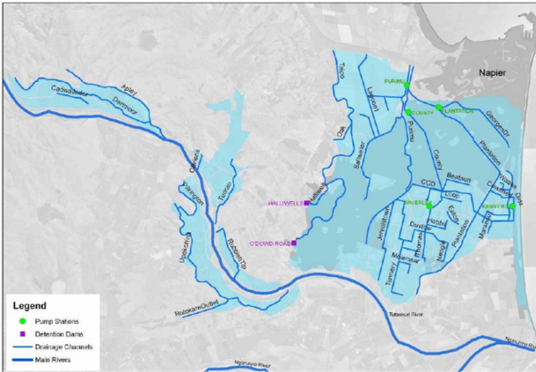
Figure 1: Napier Urban stormwater drainage area showing open waterway and pump station locations and names
8.2 Issues
Key issues presented by the current arrangement are summarised below;
· Levels of Service – Existing levels of service for some drainage catchments are based on land drainage levels of service and not clearly aligned to urban stormwater levels of service.
· Roles and Responsibilities – There is no contract or formal arrangement in place between the two Councils regarding management of the waterways. There is no single ‘source of truth’ formalised documentation about roles and responsibilities.
· Accountability – Accountability is not clear across the stormwater activity with regards to waterways maintenance and operation. Public and communities are not clear who is responsible for what.
· Ownership – Land, assets and equipment may have different ownership e.g. pump station owned by HBRC but SCADA system installed by NCC, who operate the pump station.
· Investment and Decision Making – Level of investment may not be consistent across both councils which could have downstream impacts. Each council makes investment decisions based on their own ‘risk appetite’ with limited coordination. A whole of network approach is required for planned future investment in drainage assets which is more challenging under joint ownership and operation. Officers currently aim to address this through regular coordination meetings.
· Compliance – There is an increasing need for accurate asset data, and performance and consent monitoring.
· Uncertainty around 3-Waters reforms – Future 3 Waters service delivery is still largely unknown through implementation of the Local Water Done Well (LWDW) policy. The establishment of a new water services entity may alter opportunities to transfer drainage schemes.
8.3 Significance and Engagement
NCC taking management and operational responsibility for the additional urban stormwater assets under contract to HBRC has been assessed as follows.
· Assessed under the NCC Significance and Engagement Policy as low significance not requiring consultation. While the Stormwater group of assets is considered Strategic by Council, the proposed transfer relates to a minor portion of the overall asset. No nett financial impact is expected for rate payers. The asset transfer should result in a positive impact to Level of Service.
Legal opinion from Simpson Grierson concluded any transfer of asset responsibility and ownership will ultimately require community consultation. This consultation is anticipated to occur in the future in advance of the asset transfer being executed.
8.4 Implications
Financial
The transfer of assets is expected to have the following financial impacts (assessment based on 2023/24 operating budgets, which will be updated in finalising the Business Case).
· Implementation costs in the range of $150,000 to $250,000, including an estimate for internal staff costs, to be shared between NCC and HBRC.
· Approximately $1,245,000 of additional annual operating expenditure being borne by NCC, with a commensurate reduction at HBRC. Both Councils have agreed for HBRC to continue collecting targeted stormwater rates from impacted properties which will be passed through to NCC.
· No anticipated increase in resource requirement within NCC.
· Approximately $650,000 of unfunded overheads (including employment costs) remaining within HBRC.
· Transfer of assets with a book value of $10,012,000 (as at 30 June 2023) from HBRC to NCC. This equates to approximately 4% of HBRC’s total assets, and 0.4% of NCC’s total assets. Asset values will be agreed by Councils at the time of transfer.
The Business Case will not account for any increased efficiency of delivery, however these are likely to exist following transfer. Detailed analysis of future funding requirements will take place as part of the transfer process.
It is unlikely any transfer of debt or financial reserves will take place.
Social & Policy
NCC taking responsibility for the urban waterways is consistent with current policy settings.
No updates to the NCC Stormwater Bylaw 2020 will be required as a result of the proposed change.
Risk
LWDW Bill 3 requirements for a Stormwater Risk Management Plan.
NCC assuming responsibility for the urban waterways has potential to improve the overall Level of Service, mitigating community risk.
Up to 399 easements have been identified as potentially being required to complete the asset transfer. Investigation of the legal requirement and status of these easements is yet to be conducted.
NCC agreed the following risks and potential benefits during an August 2024 workshop with Councillors.
· Heightened flood risk
· Continued confusion
· Inability to fund necessary capital work
· Increased cost to community
· Resourcing
8.5 Options
Ten options are being considered in the Business Case, which are noted below.
a) Status Quo – maintain current arrangements.
b) Enhanced Status Quo – Current practice operationalised, documented and collated into a structured and combined format.
c) Enhanced Status Quo with Rationalisation of Contracts – option b, plus additional improvements through rationalisation of contracts.
d) Enhanced Status Quo with Waterways Asset Management Position Established – option b, plus establishment of a new role to oversee the management of the urban waterways as a combined activity.
e) Assets Split on a Geographic Basis – open drainage assets transferred based on their geographical location such as catchment boundaries or urban boundary.
f) Assets Split by Function – each council has full ownership and responsibility for a specific asset “function” or activity.
g) All Assets Transferred to One Council – one council has full responsibility for ownership and management of all open waterways within Napier City Council boundary.
h) Full Shared Services Jointly Managed Between HBRC and NCC.
i) CCO/CCTO owned by Council/s – transfer of the urban waterways into a newly established CCO/CCTO.
j) Council Forms an Alliance Arrangement to Manage and Deliver the Urban Waterways.
Option e. above (labelled Option 3a in the Business Case) is preferred by both NCC and HBRC.
8.6 Development of Preferred Option
Shortlisted options are considered in the Business Case. The options were assessed against the following consideration factors:
· Finance
· Risk
· Assessment against investment objectives and business needs
The preferred option to “transfer of assets between the two organisations with assets split on a geographic basis” will be further presented in the Business Case.
a. Draft Schedule for Transition
A schedule for the transfer of assets will be developed and agreed by Council Officers based around the milestone dates below.
· A single Asset Management Plan will be developed with HBRC for the Napier Urban Waterway stormwater network before NCC take responsibility for the additional assets.
· NCC will provide management and operation of HBRC assets from 1 July 2026, or earlier if practicable.
· Ownership of assets will transfer to NCC on 1 July 2027, or earlier to align with the transfer of NCC assets into any Water Services CCO created in line with NCC’s response to LWDW.
A number of factors for the transition schedule remain unresolved, including:
· Establishment of a WSCCO presents a risk to the proposed schedule. Transition of ownership may be accelerated after consideration of the WSCCO schedule.
· The required consultation by both Councils at each stage of the process.
b. Assets Beyond the Considered Napier Urban Environment
Council Officers will investigate whether HBRC owned stormwater assets exist within NCC territory outside of the currently considered area, and whether they warrant inclusion in any transfer.
Nil
Ordinary Meeting of Council - 31 July 2025 - Open Agenda Item 9
9. Heretaunga Water Storage Project Shareholder Committee Participation
|
Type of Report: |
Procedural |
|
Legal Reference: |
N/A |
|
Document ID: |
1864996 |
|
Reporting Officer/s & Unit: |
Russell Bond, Executive Director Infrastructure Services |
|
9.1 Purpose of Report The purpose of this report is to approve the appointment of two elected members to the Heretaunga Water Storage Project Shareholder Committee, which is being established and led by an independent Chair |
That Council:
a) Receive the report titled “Appointments – Heretaunga Water Storage Project Shareholder Committee Participation” dated 31st July 2025.
b) Approve that Napier City Council should be a member of the Heretaunga Water Storage Shareholder Committee
c) Approve the appointment of Councillors Keith Price and Greg Mawson to the Heretaunga Water Storage Shareholder Committee for the Heretaunga Water Storage project.
In June 2025, Hawke’s Bay Regional Council (HBRC) presented to Napier City Mayor and Chief Executive Officer with an overview of the Heretaunga Water Storage Project (the Project).
The Project is for a medium-sized water storage scheme that would deliver environmental, economic, and well-being benefits to Heretaunga. It would improve supply security to all current water users, enhance environmental outcomes by augmenting lowland stream and river flows during summer, and provide water for growth in our towns, cities, and industry.
It is a local water storage project to serve Heretaunga.
The beneficiaries of enhanced water security and supply would be shared across all people of the region: households, landowners and producers, industry, growing towns and cities. The environmental benefits of augmenting flow to offset groundwater abstraction are a primary driver for the project.
The project is well-sized and located to deliver social, economic, and environmental benefits to people, businesses, and growers on the Heretaunga Plains, including the towns and cities.
At the Governance lever, HBRC is proposing to form a directly owned company, 1/3 owned by each of the three key stakeholder groups:
Legal form: Limited liability company incorporated under the Companies Act 1993
Shareholders: 99 shares issued at $1 each:
· 33 shares – Napier City Council/Hastings District Council collectively
· 33 shares – Mana whenua/iwi groups collectively
· 33 shares – legal entity formed to represent extractive water users
Governance arrangements:
1) Shareholder committee
a) 2 x representatives from each Water User stakeholder group (nominated and appointed by the respective groups)
b) 1 x independent Chair (nominated and agreed to by appointed representative group)
c) Shareholder Committee is established to provide representative governance on behalf of the found shareholding groups and to collectively manage these groups interests
2) Professional Board of Directors
A three – five person professional, skills-based board, responsible for project delivery governance
Napier City Council has been invited to nominate two Councillors to sit on the Project’s Shareholder Committee to:
a) participate in the establishment of the Board of Directors; and
b) provide representative governance on behalf of the founder shareholding groups and to collective mange these groups interests.
9.3 Issues
No Issues
9.4 Significance and Engagement
Nil at this point as there is no significant change.
9.5 Implications
Financial
Membership on the Heretaunga Water Storage Project Shareholder Committee require time commitment only at this time. NCC anticipates that outputs from the Project will initially inform their 2027-2037 Long Term Plan decision-making.
Social & Policy
The outcomes of this project are expected to extend over the long-term and Council has a role in contributing to shaping and guiding the outcomes.
Risk
Council governance would be providing strategic oversight and confirming project recommendations to the Board of Directors in relation to an activity that is typically outside the scope of territorial local authorities. However, the project has the potential to significantly impact on and influence the Napier community, hence the recommendation to be involved.
There may be a perceived conflict of interest with Napier City Council’s regulatory role in an operational solution similar to Hawke’s Bay Regional Council's, although this is likely limited to consent consultation as an affected party.
9.6 Options
The options available to Council are as follows:
a. Approve that Napier City Council should be a member of the Heretaunga Water Storage Project Shareholder Committee and the appointment of Councillors Keith Price and Greg Mawson to the Committee.
b. Do not approve Napier City Council’s participation in the Heretaunga Water Storage Project Shareholder Committee.
9.7 Development of Preferred Option
The preferred option is Option A so that HBRC is able to progress with establishing the Project’s governance arrangements including forming the Heretaunga Water Storage Project Shareholder Committee.
Nil
Ordinary Meeting of Council - 31 July 2025 - Open Agenda Item 10
10. Civic Precinct Progress Report
|
Type of Report: |
Operational and Procedural |
|
Legal Reference: |
Enter Legal Reference |
|
Document ID: |
1853751 |
|
Reporting Officer/s & Unit: |
Darran Gillies, Strategic Programmes Manager |
|
10.1 Purpose of Report To provide council with a Civic Precinct project progress update.
|
That Council:
a. Receive the report titled “Civic Precinct Progress Report” dated 31 July 2025.
The Civic Precinct is made up of a public realm that spans an area from the lane running east-west adjacent to the Court House and Dalton House on the southern edge, Hastings Street on the east, Station Street on the north and Dalton Street on the west. Sitting within that area sits three interconnected buildings – the Library, Council Chambers, and the Office accommodation building.
The below diagram illustrates the extent of the precinct.
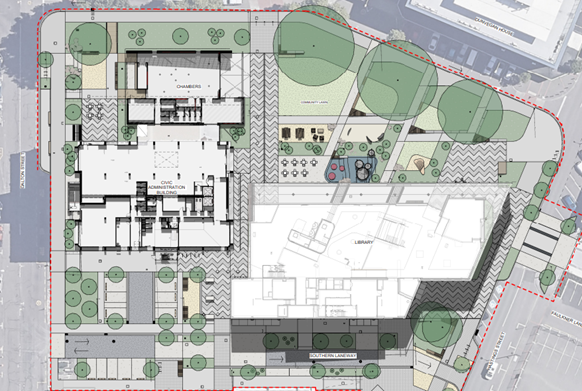
10.3 Issues
With the project receiving the relevant building consents and the signing of the contract, the timely mobilisation of the main contractor marks the beginning of the construction stage in good health. For projects of this scale and complexity, tight controls are in place to ensure that any issues that arise can be addressed with the appropriate treatments in a timely manner.
10.4 Significance and Engagement
The Strategic Programmes team, MCL Stead, and other council officers have been meeting with stakeholders to provide updates on the project, seek feedback, and gauge interest in involvement both now and after completion. The table below provides a brief overview of these interactions.
|
Stakeholder Group |
Att. |
Summary of Feedback |
Lead by |
|
Nga Toi Hawkes Bay |
5 |
· Excited about the possibility of collaborating · Hopes for a bold and inclusive vision for the operating of the creative space · Keen to share experience and expertise |
NCC |
|
Creative Arts Napier |
1 |
· Excited about the possibility of collaborating · Didn’t realise the project was three buildings |
NCC |
|
Eastern & Central Community Trust |
2 |
· They wish to be shown what community needs are being addressed and how they are being resolved. · ECCT sighted the Digital Gap (very prevalent in Napier) and social isolation. · Emphasis on creating safe places for Rangitahi, spaces for homework. · |
NCC |
|
Pilot City Trust |
5 |
· Rauwharo was mentioned and whether he would have a presence in the building / public realm. · Pilot City Trust work closely with Toi Matarua research (rangitahi) as well as with the Director of Research at EIT. · Pleased to see the focus on youth and how the space will be inclusive of Rangitahi. |
NCC |
|
Ahuriri Business Association |
8 |
· Comments around being better informed about the development · Could the building have been located on the foreshore instead. Positivity in creating more amenity and transport options in Clive Square |
NCC |
|
NCC Youth Council |
13 |
· Very interested in the innovation spaces. · Questioned carparking and how much would be allocated · representative been keen to be involved with Ahuriri Libraries Foundation. · General agreement that dedicated teenage-only spaces are not the preferred approach. Instead, the vision is for the entire facility to offer inclusive, flexible spaces that cater to teenagers alongside other community members. |
NCC |
|
Hawke’s Bay Secondary Principal Association |
10 |
· Praised the co-design with mana whenua and the incorporation of cultural elements within the building and public realm. · Questioned if meeting spaces were going to be charged. · Requested visits to their schools to present to the students · Overall enthusiasm for the entire build and what options and opportunities presents to Rangitahi |
NCC |
|
Napier Host Lions |
20 |
· Interest in the innovation spaces and the various proposed uses. · Interested in parking solutions |
NCC |
|
Napier City Business Inc (NCBI) |
8 |
· Endorsement of the Broader Outcomes and acknowledgement of the benefits this approach will bring to the CBD. |
NCC |
|
Precinct Neighbours |
15 |
· Construction Noise · Carparking · Hours of work · Volume of workers per day · Programme · Air Quality Monitoring |
MCLStead |
Precinct Name Gifting
On the 19th of June, the laying of three of the four Mauri stones, accompanied by a blessing, took place on site, marking a significant milestone for the project. The ceremony also provided an opportunity to welcome the key members of the MCL Stead team into our project whānau.
During the ceremony, our Mana Whenua partners presented the gift of a name for the Civic Precinct and its associated cultural narrative – Te Kete. This gifting symbolises both the strength of our partnership and the significance of the site.
The gifting of the name and the narrative brings both mana and opportunity to the project. This process should be given time to be developed and presented back through Ngā Mānukanuka o te iwi and the council.
Communication
With the commencement of construction, we have enhanced our communication efforts through the council’s regular channels, keeping the community informed about on-site activities with video content and press releases. In the coming months, the project will have its own dedicated website, where we will highlight the positive impact of construction on the local economy through both local and national channels.
As noted in the table above, MCL Stead has taken the lead in communicating with neighbours directly affected by the construction.
The Precinct Advisory Board will also support the project with strategic communication advice to promote the benefits of the development during construction.
Library & Precinct Foundation
Work is progressing on the Ahuriri Library Foundation with the legal framework in place. The foundation will operate as an independent fundraising and advocacy body that will support the ongoing success of the activities that will take place in the precinct.
We are currently seeking members for the foundation with interest being expressed by members of our Youth Council, business groups and the wider community.
A Summary of decisions
The Civic Precinct has been a significant project for our community and elected members since 2017, when the council vacated the Civic and Library Building due to its identification as earthquake prone. Below is a summary table of the numerous Council and Committee meetings held throughout the duration of the project.
|
Committee |
Decision |
|
|
27 November 2018 |
COMMUNITY SERVICES COMMITTEE |
· Adoption the Napier Library Strategy 2018 |
|
11 December 2018 |
Council |
· Approval of the Napier Library site evaluation method |
|
9 April 2020 |
Council |
· Civic Precinct Steering Group · Receive and accept in principle the recommendation from the library site project steering group to pursue the development of the library on the Station Street site. · Endorse the formation of a Civic Precinct Steering Group. · Endorse the Civic Precinct Steering Group Terms of Reference. · Note that the Civic Precinct Steering Group will undertake comprehensive master planning for the Civic Precinct including any important linkages beyond that site, keeping Council informed ahead of specific recommendations to Council on the master planning. · Note that the Civic Precinct Steering Group will recommend key consultation steps to Council for the project · Note the annual plan will include the preferred site for the library, and that any feedback on this through the annual plan can be forwarded to the Civic Precinct Steering Group for consideration in the master plan development |
|
30 July 2020 |
Future Napier |
· Civic Precinct Project Update |
|
12 August 2020 |
Council |
· Annual Plan Inform - Council received 266 submissions on the return to the original library site, of which 207 submitters provided comments in support of their submission. |
|
22 October 2020 |
Future Napier |
Civic Precinct Framework |
|
June 2021 |
Council |
LTP Consultation Item with budget update |
|
11 Nov 2021 |
Future Napier |
· Receive the feedback on the Draft Library and Civic Area Plan · Adopt the Library and Civic Area Plan (Doc Id 1396319) |
|
16 June 2022 |
Future Napier |
· Endorse the Design Brief and Business Case for the Station Street Community Facility. · Approve the procurement of a design team to execute Concept Design for the Station Street Community Facility |
|
13 Sept 2023 |
Ngā Mānukanuka o Te Iwi |
· Endorse the Te Aka Cultural Narrative. |
|
12 October 2023 |
Council |
· Endorse The Concept Design for Te Aka. · Approve to proceed into the next stages of the Architectural Design process. · Endorse The Construction Strategy for Te Aka |
|
01 Feb 2024 |
Council |
· Endorse The Preliminary Design for Te Aka. · Approve to proceed into the next stages of the Architectural Design process. · |
|
08 Feb 2024 |
Prosperous |
· Receive The Due Diligence Report of the Civic Accommodation Business Case. · Approve option 5a from the Civic Accommodation Business Case (Doc Id 1690557) – The NCC lead Redevelopment of the library to be the preferred option within the Long-Term Plan consultation; and to proceed into the next stages of the programme of work to support that option. |
|
10 May 2024 |
Ngā Mānukanuka o Te Iwi |
· Receive the report updating the development of the Mahi Toi for the Te Aka project. · Endorse the direction of the cultural narrative for Te Aka. · Support, in principle, the procurement of Ahuriri hapu/Ngāti Kahungunu artists for the delivery of the Mahi Toi in Te Aka. |
|
24 June 2024 |
Council |
LTP Adoption Including the delivery of LCAP2 by Council Officers |
|
15 Aug 2024 |
Council |
· Endorse the latest architectural design stages for the Civic Precinct · Approve to progress to the design documentation stages to enable the Building Consent application process and the release of the main contractor tender to market. |
|
05 Sept 2024 |
Audit & Risk |
· Endorse Civic Precinct Main Contractor Procurement Approach (Doc Id 1783631). · Note The Civic Precinct Main Contractor Probity Plan (Doc Id 1783634). |
|
29 Nov 2024 |
Audit & Risk |
· Receive Civic Precinct Main Contractor Procurement Update |
|
24 April 2024 |
Council |
· Note the price was within 1% of the Quantity Surveyor Estimate for construction. · Delegate authority to enter into a 3910 2013 construction contract to deliver the construction of the Civic Precinct to the value of $75,094,934.90, on behalf of Council, to the Chief Executive or delegate. · Note this delegation authority only applies for this specific contract execution. · Note All payment claims are managed through the terms of the contract and require Quantity Surveyor and Engineer to Contract verification before approval is given to process any contract payments. · Note Value Management opportunities will be explored with the contract awardee at the earliest opportunity. Any cost savings identified will be used to increase the levels of construction contingency. The realisation of the value management opportunities will be reported upon though project governance structure and through to council. · Note This paper will be made publicly available once all contract negotiations have been completed with the awardee. · Direct the Chief Executive to consider the te aka / Maranga ongoing resourcing recommendations from the Independent Advisory Board, and report back to Council’s June agenda with an update on Programme resourcing. |
Programme Update and key activity
The table below highlights the key milestones for the project. Now that building consent has been confirmed, the Main Contractor will, over the coming weeks, finalise a more detailed programme of works. The project team will identify key activities of interest to stakeholders and the wider community, which will be reported on and communicated more widely through our communication channels. These activities will include the removal of the library façade, the pouring of foundations, and the installation of mass timber.
|
Milestone |
Date |
Status |
|
Main Contractor Works to begin |
19 June 2025 |
On Track |
|
Workplace Fit-Out Detailed Design drop |
5 September 2025 |
On Track |
|
Office Accom. Completed Works |
16 April 2027 |
On Track |
|
Chambers Completed Works |
16 April 2027 |
On Track |
|
Library Completed Works |
02 November 2027 |
On Track |
Design Update
· Finalising shelving layout and design for Te Aka
· Integration of AV and IT design for the Council Chambers and ground floor the accommodation tower.
· Detailed design of the office fit-out
Construction Updates
· Maranga Building Consent was approved on 10 July, and Te Aka on 15 July.
· Central Demolition has demobilised from the site, and the project team is currently reviewing the completed works against their agreed scope.
· MCLStead took possession of the site on 23 June 2025. They are currently undertaking works related to site establishment, including site accommodation, hoardings, and traffic management.
· A 51-metre, 100-tonne crane was mobilised on site for work on the library tower refurbishment on 10 July.
· The removal of London Plane Trees 4 and 5 is scheduled for the week of 14 July.
· The procurement of long lead-time items, such as glass for the façade, is underway.
· Shop drawings and detailing have commenced for reinforcement and structural steel.
10.5 Implications
Financial
The project remains within budget, with the council approving the tender value on the 24th of April. WT Partners (QS) are developing a new monthly financial dashboard, which will be issued once the cash flows have been agreed with MCLStead. This will be reported monthly to the Programme Advisory Board and quarterly to Audit and Risk.
To date, $7.85 million has been spent on this project. This includes the cost of demolishing the Civic Building and the Library Tower enabling works, as well as the design fees and associated professional services up to the detailed design and consenting documentation.
Value Management opportunities identified at tender are progressing positively. Now that the various building consents have been approved, which in turn triggers the for-construction design sets, we can begin to issue the relevant instructions to the contractor to realise the cost-saving opportunities. These will be reported alongside the financial reports that go to Audit and Risk.
Social & Policy
Broader Outcomes
Positive discussions have been held with MCL Stead regarding the achievement of the Broader Outcomes outlined in the accepted tender proposal. These outcomes will be reported on a quarterly basis. The main contractor is currently in the process of procuring subtrades to meet the Māori and Pacific employment and business targets specified in their proposal. These targets will also be reported on once the trades are confirmed. Additionally, the employment of Cultural Monitors is underway to ensure the appropriate processes are followed during site excavations.
Risk
Contract Execution
Now awarded, the contract has been executed using NZS3910:2013 - Conditions of contract for building and civil engineering construction.
· Engineer to Contract is Stuart Lyons of The Building Intelligence Group.
· Engineer ‘s Representative is Michael Gilbertson of The Building Intelligence Group.
· Quantity Surveyor is Richard Van Looy of WTP
· Delegated Officer is Darran Gillies NCC Strategic Programme Manager
The first of the Main Contract payment claims has been lodged and processed as per the contract and included all the site establishment works typical of a project of this scale and complexity.
Health and Safety
Health and Safety is a critical undertaking for the project, with both the council and the Independent Programme Board setting high expectations for practice, reporting, and oversight. The team has been in communication with the chair to ensure a comprehensive briefing of the requirements. The levels of Health and Safety reporting and layers of oversight are detailed below:
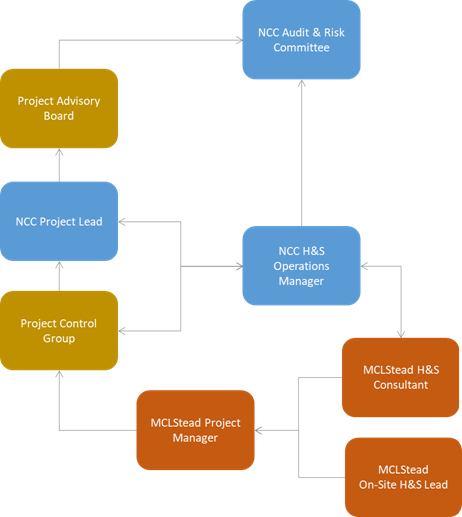
The NCC Health and Safety team, MCL Stead's H&S Representative, the Project Engineer's Representative, the NCC Client Representative, and MCL Stead’s independent Health and Safety advisor have completed the pre-start requirements. Contractor documentation has been reviewed and approved by NCC. Additionally, MCL Stead's Environmental Plan has also been approved by NCC.
Safety and Design
One of the key discussion points during the Annual Plan with the proposed closure of the interim library in the MTG was security. A clearer understanding of the measures implemented for the precinct is essential to provide clarity and process to stakeholders and future users.
The Strategic Programmes team is leading the collation of safety design considerations undertaken by the project team, starting from the design brief in 2022 through the various design stages, and what needs to be embedded in the future precinct operating model.
The Operating Model will guide the set-up and operation of public-facing activities across the precinct. Importantly, it will continue the principle of ‘health and safety by design’ from the design phase into the usage and management of the buildings and spaces.
The report will be presented to the Programme Advisory Board for feedback and endorsement before being submitted to the NCC ELT and Audit and Risk.
Strategic Risk Register
Below is the list of key strategic risks from the Strategic Risk Register updated monthly for the Programme Board
|
Risk |
Previous RAG |
Current RAG |
Inherent Risk |
Treatments |
|
Workplace Health & Safety Incident |
• Contractor Prequalification's / Minimum Requirements • Safety Policies and Procedures • Pre-Start Meetings & Inspections and Task Analysis / JSAs • Regular Inspections & Safety Training • Hazard Reporting & supervision |
|||
|
Variations to Workplace Brief lead to budget blow-outs |
• Early stakeholder engagement. • Change Management process in place. • Variation Controls in place – Prelim confirmation |
|||
|
Disturbance to stakeholder operations through construction activities |
The risk that construction activities negatively impact surrounding businesses |
|||
|
Slow decision-making and input from others |
The PSG is clear on their role. The project team need to communicate the impact of delayed decision-making on the project. |
|||
|
NCC Organisational Change (NEW Strategic Risk 10/02/25) |
During a change process BAU and project input can slowdown or stop. Support from ELT and CEO vital to mitigate risk |
10.6 Options
The options available to Council are as follows:
a) Receive Civic Precinct Progress Report
10.7 Development of Preferred Option
The project team will continue to report to council and through the established project governance process.
Nil
Ordinary Meeting of Council - 31 July 2025 - Open Agenda Item 11
11. Citizens Assembly 2025 : Remit and Council Commitment
|
Type of Report: |
Operational and Procedural |
|
Legal Reference: |
N/A |
|
Document ID: |
1865643 |
|
Reporting Officer/s & Unit: |
Julia Stevens, Manager Communications and Marketing |
|
11.1 Purpose of Report The purpose of this report is to: 1. Update Council on the establishment and planning of Napier's first Citizens' Assembly, scheduled for September 2025. 2. Seek Council endorsement of the proposed remit for the Citizens' Assembly which is to develop recommendations on the future of the Napier Aquatic Centre. 3. Secure a formal public commitment from Council to consider and respond to the Assembly’s recommendations in good faith and transparency. |
That Council:
a) Endorses the remit for the Citizens' Assembly:
What type of aquatic facility - and at which of the two locations - would best meet the needs, values, and priorities of the Napier community?
b) Commits to a formal public promise to the Assembly, outlining how the Council will consider and respond to the Assembly’s recommendations.
c) Notes the Citizens' Assembly will inform early strategic planning for the 2027–2037 Long Term Plan (LTP).
Napier City Council will convene its first Citizens' Assembly in late 2025, as part of a broader shift toward more deliberative and community-led decision-making. The Assembly will consist of approximately 40 randomly selected residents who reflect the demographic makeup of Napier. Over four weekends, they will learn about a specific issue, deliberate with expert support, and produce considered recommendations for Council.
The Assembly will act as a pilot initiative for participatory governance in Napier, with the potential to influence future engagement practice and community trust in Council.
11.3 Assembly Remit: The Future of the Napier Aquatic Centre
After careful consideration and engagement with internal teams, elected members and the Citizens' Assembly Design Group the following remit has been crafted.
Context: Napier City needs to build a new aquatic facility. Two possible sites are being considered. There is a clear budget.
Proposed remit:
What type of aquatic facility - and at which of the two locations - would best meet the needs, values, and priorities of the Napier community?
The Assembly should deliberate on what kind of new aquatic facility Napier needs, where it should be located and why. How to fund, design, deliver or operate any new aquatic facility remains with Council and subject-matter experts.
|
IN SCOPE |
OUT OF SCOPE |
|
A new pool (can be built on the same site) |
Status quo |
|
Decision between two possible sites (Onekawa and Prebensen) |
Any location |
|
Cost – setting a clear budget and indicating the value and effect of this |
Operational considerations, including user charges, funding sources and financial sustainability |
|
Features, purpose and financial impact of these (eg healing pool, wellness, recreation vs competitive swimming) |
Features that do not directly relate to Aquatic centre eg café, transport |
|
Partnerships (Community, wider network of pools, eg sports clubs, schools) |
Design specification |
|
Inclusion of pūrākau and local histories of the site and pool |
|
Rationale
· The Aquatic Centre is a long-standing and high-use community facility with over 400,000 visits per year.
· It is over 50 years old in parts and requires long-term strategic decisions.
· The site has been subject to extensive public debate, a halted redevelopment project, and a judicial review.
· Council has committed to keeping the current facility operational for another 8-10 years (through to ~2034-2035).
· Budgeting and planning for a replacement facility must begin through the 2027–2037 Long Term Plan.
· Key issues include location, purpose, services offered, accessibility, and alignment with regional aquatics infrastructure.
· This remit is specific, within Council’s control, and well-suited to deliberative processes that engage values, trade-offs, and long-term impacts.
1.4 Council Commitment to the Assembly
Council’s leadership and integrity in this process are vital to its legitimacy. To that end, Council is asked to make a public statement that articulates their level of commitment to actioning recommendations made by the Assembly.
This act of committing publicly to accepting, considering or including in long-term planning the Assembly’s recommendations aligns with best practice in deliberative democracy and reinforces Council’s intention to honour the work of the Assembly and endorse it as an effective and viable mechanism for community input.
Public commitments vary depending on the council and the remit but act as an essential guardrail to help inform the work of the Assembly. The commitment may include - but is not limited to - the actions the Council will make, the timeframe in which those actions will take place, and the mechanism through which any actions will be implemented. The intention and wording of the pledge will be confirmed by the Council through a workshop process to ensure it can be upheld once Assembly recommendations are presented to the Council.
Timeline
|
Month |
Activity |
|
July/August 2025 |
· Recruitment campaign launched. · Final Assembly question released. · Council promise issued. · Participants selected. |
|
Sept/Oct 2025 |
· Assembly convenes over four weekends. |
|
Nov 2025 |
· Assembly delivers recommendations. |
|
Q1 2026 |
· Council issues formal response. · Assembly insights incorporated into LTP direction setting. |
11.5 Significance and Engagement
This matter is of moderate to high significance under Council’s Significance and Engagement Policy, as it relates to a major community asset and strategic planning for future infrastructure investment.
The Citizens' Assembly process is itself an intensive engagement process that complements and enhances wider community consultation planned for the Long Term Plan.
11.6 Financial Implications
Funding for the Citizens' Assembly is included in the 2024/25 Annual Plan.
Social & Policy
N/A
Risk
N/A
11.4 Options
The options available to Council are as follows:
a. Endorse the remit for the Citizens' Assembly and commit to a formal public promise to the Assembly, outlining how the Council will consider and respond to the Assembly’s recommendations; or
b. Do not endorse the remit for the Citizens' Assembly or commit to a formal public promise to the Assembly, outlining how the Council will consider and respond to the Assembly’s recommendations.
11.5 Development of Preferred Option
Endorse the remit for the Citizens' Assembly and commit to a formal public promise to the Assembly, outlining how the Council will consider and respond to the Assembly’s recommendations.
1 Citizens' Assembly Communications and Engagement Plan (Doc Id 1865672)
2 Citizens' Assembly: Context and Lessons (Doc Id 1865670)
Ordinary Meeting of Council - 31 July 2025 - Open Agenda Item 12
12. NCC Investment Portfolio and Ahuriri Investment Management Limited Establishment
|
Type of Report: |
Legal and Operational |
|
Legal Reference: |
N/A |
|
Document ID: |
1864623 |
|
Reporting Officer/s & Unit: |
Emma Alexander, Programme Manager - Transformation - Strategy and Transformation |
|
12.1 Purpose of Report This report concludes a series of Council decisions to implement a new investment management approach, as signalled in the Three-Year Plan 2024-27 (TYP). As part of TYP consultation, Council proposed establishing a new structure for managing its investment assets. The proposal included the creation of a ring-fenced investment portfolio, and the establishment of a Council-Controlled Trading Organisation (CCTO) to manage these assets on Council’s behalf. Following consultation, Council adopted this direction in the final 2024-27 Three-Year Plan. This paper sets out the policy and legal arrangements which provide the necessary guardrails to safeguard Council’s investments while enabling an arm’s length, commercially focused structure for their management. Specifically, the report seeks a set of approvals from Council to: · Define the portfolio of ring-fenced investment assets, to be known as the NCC Investment Portfolio; · Establish Ahuriri Investment Management Limited (AIM) as a NZ registered company and a CCTO; · Appoint AIM as Council’s investment manager for the NCC investment Portfolio; and · Enable AIM to operate in a commercial arm’s length manner. Subject to Council approvals, the arrangement between Council and AIM will be in place from 1 August 2025. |
That Council:
AIM Constitution
a. Approve the draft Ahuriri Investment Management Limited Constitution (Doc Id 1866978)
c. Approve Officers to complete the incorporation of Ahuriri Investment Management Limited, effective 1 August 2025.
d. Note Council’s Prosperous Committee decision on 29 August 2024 and Council’s decision on 24 April 2025 that the inaugural Board for Ahuriri Investment Management Limited will consist of 3 independent directors and 2 Elected Member Directors, and that appointment of the Elected Member Directors will be deferred until after the 2025 triennial elections.
Investment Policy
e. Approve the debt facility of $30m approved on 12 December 2024 for the Parklands residential development project to be available for all commercial projects within the NCC Investment Portfolio, noting the Management Services Agreement sets out expectations for management of the debt facility.
f. Approve the draft Investment Policy including the Opening Statement (Doc Id 1865616).
g. Approve the Deputy Chief Executive to update the Opening Statement following the approval of the 30 June 2025 Financial Statements and the completion of ring-fencing the NCC Investment Portfolio within Council’s financial system.
Delegations to the Chief Executive Officer
h. Approve the following delegations to the Chief Executive in respect of the ring-fenced NCC Investment Portfolio:
i. The power to enter contracts for the supply of goods and services with the following limitations:
a) the power to enter into contracts for the supply of goods and services to a value less than $5,000,000 (plus GST) can be sub-delegated to officers.
b) contracts for the supply of goods and services to a value exceeding $5,000,000 (plus GST) must be accompanied by an Ahuriri Investment Management Limited company resolution; and
c) the power to enter contracts for the supply of goods and services to a value exceeding $5,000,000 (plus GST) can only be sub-delegated to the Deputy Chief Executive.
ii. The power to enter unconditional contracts for the sale or purchase of land or an interest in land with the following limitations:
a) the power to enter unconditional contracts for the sale and purchase of individual residential property sites within a land development project can be sub-delegated to officers;
b) unconditional contracts for the sale and purchase of land excluding individual residential property sites within a land development project must be accompanied by an Ahuriri Investment Management Limited company resolution; and
c) the power to enter unconditional contracts for the sale and purchase of land excluding individual residential property sites within a land development project can only be sub-delegated to the Deputy Chief Executive.
iii. The power to enter unconditional leases whether as landlord or tenant for a term of 2 years or more with the following limitations:
a) such leases must be accompanied by an Ahuriri Investment Management Limited company resolution; and
b) the power to enter such leases can only be sub-delegated to the Deputy Chief Executive.
i. Approve the Delegations to the Chief Executive Officer and Statutory Appointments Register (Doc Id1865617) noting that in addition to documenting the above delegations there have been minor amendments to update titles reflecting recent changes to the Council Executive Director structure.
Disposal of Surplus Assets Policy
j. Approve the following principles for the disposal of surplus assets:
i. Maximizing Value: All asset disposals should aim to achieve the maximum reasonable return while considering both financial and strategic outcomes for the Council and its constituents.
ii. Transparency: The disposal process must be conducted in a transparent manner, ensuring all transactions follow due process and are open to scrutiny.
iii. Retention of Valuable Assets: The Council should evaluate the potential future strategic value of assets before making a decision to dispose of them. Retention should be considered if assets may contribute to long-term objectives or provide ongoing benefits.
iv. Conflict of Interest: Staff members are prohibited from personally benefiting from the sale of Council assets to prevent conflicts of interest and unethical behaviour. While staff may purchase surplus assets through appropriate processes, all sales must be conducted at market value, and staff must not engage in on-selling for personal profit.
v. Compliance and Accountability: All disposals must comply with relevant legislation and policies, with all actions documented for accountability.
k. Approve draft Disposal of Surplus Assets Policy (Doc Id 1865615).
Management Services Agreement
l. Approve the draft Management Services Agreement between Council and Ahuriri Investment Management Limited (Doc Id 1866963).
m. Approve delegation to the Chief Executive to sign the Management Services Agreement on behalf of Council.
2025/2026 Statement of Expectation
n. Approve the revised draft 2025/2026 Statement of Expectation (Doc Id 1866870);
o. Approve delegation to the Mayor to sign the Statement of Expectations and issue it to Ahuriri Investment Management Limited on 1 August 2025.
12.2 Background Summary
Council has defined the purpose of the NCC Investment Portfolio:
“To
operate an inter-generational investment portfolio
that builds financial resilience and
reduces future reliance on ratepayers for funding activities.”
Over the past 12 months, Council and officers have progressed the detailed work required to define and create the NCC Investment Portfolio, establish AIM, and appoint AIM to manage the NCC Investment Portfolio on Council’s behalf.
A key principle underpinning this work has been the separation of governance and management. Council’s role is to set the strategic direction and establish appropriate guardrails and expectations while enabling AIM to operate independently in a commercial, arm’s length capacity.
Several interconnected documents are required to establish the arrangement. The following section describes the context and purpose of each document along with key points within the document.
While the documentation may look complex, in essence it is achieving is:
· Council retaining ownership of the assets and appointing AIM as its Investment Manager.
· Council having clear guardrails, ensuring investments are protected, while enabling AIM to operate independently and commercially.
· AIM providing strategic direction and deeper commercial focus to enhance the performance of the portfolio.
· An annual planning and reporting process to ensure alignment between the parties including agreed performance measures in place to which Council holds AIM accountable.
· AIM overseeing the management of the assets and the delivery of its strategy supported by the Council team (e.g. the internal Commercial & Property Team). This could include the development, acquisition or divestment of assets.
· The NCC Investment Portfolio making an annual cash payment to Council.
· Delegations and financial arrangements are structured to reflect and achieve the above.
12.3 Issues
Process
The legal documents have been drafted by Mark Goodson of Willis Legal. The Council policies and other related documents have been drafted by Emma Alexander Programme Manager – Transformation.
The documents have been reviewed by:
· Relevant subject matter expects across Council including the Deputy Chief Executive and Chief Financial Officer;
· Scott Hamilton, Rautaki Consulting. Scott has served as an advisor to Council throughout the process of establishing the NCC Investment Portfolio and AIM; and
· The inaugural Chair of AIM.
To provide assurance:
· The Independent Chair of Council Audit and Risk Committee has reviewed the following four documents: AIM Constitution, Delegation to the Chief Executive; Investment Policy; and Management Services Agreement. This review provided some valuable suggestions which have been included and supported the arrangement.
· The Mayor and Chair of Council’s Prosperous Committee also have reviewed the documents and had a feedback meeting with Willis Legal, the Deputy Chief Executive and Programme Manager – Transformation. The outcome of this review was that this paper, and the documents are in line with expectations and appropriate for presentation to Council.
Document overview
The full set of documents is extensive. To support transparency and understanding, an overview of each document is provided below which outlines the document’s purpose, intent and its role within the overall arrangement. The overviews are not intended to replicate the drafting within each document unless specific to a Council resolution.
Each document overview is structured as follows:
· Context.
A brief description of the document’s role in the arrangement, the
parties to the document, whether it’s new of an existing document being
amended.
This section uses the following key:
|
· Governing legislation |
· Document type |
|
·
|
· N = New document |
|
·
|
· A = Amendment to an existing document |
|
·
|
· E = An exisitng document and no amendment required. |
|
·
|
· Document overview. A brief description of the key points in the document that are important regarding the parameters, terms, and nature of the arrangement. Where a Council decision is required, there is relevant information to support the decision.
· Decision(s) being sought: What is being sought through the resolution.
 AIM Constitution (Attachment 1 / Doc Id 1866978)
Context
· A constitution serves as the foundational governing document that sets out the internal rules and procedures for the company. It includes provisions for the management of the company, the rights of shareholders, the powers of directors, and procedures for meetings and decision-making.
Document overview
Set out below is a summary of the key terms of the AIM Constitution. The references relate to the sections and clauses.
· Council is the 100% shareholder of AIM.
· The Constitution may be changed by a 75% majority of shareholders(s). [Clause 3]
· Key shareholder rights include the appointment or removal of directors, approval or alteration of the Constitution, and approval of major transactions (as defined in the Companies Act). [Clause 5.1]
· The minimum and maximum number of directors along with the mix:
|
|
Minimum |
Maximum* |
|
Total |
3 |
7 |
|
Independent Directors** |
2 |
4 |
|
Elected Member Directors |
1 |
3 |
|
* The Independent Directors are to outnumber the Elected Member Directors **Council to appoint one of the Independent Directors to be the Chairperson. |
||
|
[Clause 13.1, 14.1, 14.3] |
||
· There is a temporary exception clause allowing the minimum and maximum numbers to vary from time to time, and for Council to rectify this as soon as possible. This clause has been designed to support the transition of Elected Member Director appointments at the end of the Council triennium. [Clause 14.2]
· The Mayor cannot be a Director. There is provision for an Elected Member acting as Mayor under delegation to be an Elected Member Director. [Clause 14.5]
· A Director may be appointed for a term of up to three-years and can be re-appointed for up to nine years. [Clause 14.9]
· Elected Member Directors to vacate office if they cease to be an Elected Member or if they become Mayor. [Clause 14.5 and 16.1]
· A quorum is a majority of Directors, and no less than three of which at least one must be an Elected Member Director. [Schedule 3 Clause 7]
· There is no casting vote. Decisions must be made by majority. [Clause 11]
· Requires an annual Statement of Intent to be produced in line with the Local Government Act [Clause 24]
· The Board must make decisions in accordance with the Constitution and the Statement of Intent. [Clause 2]
· The Board’s powers, subject to the Companies Act and the Constitution, are:
o the business and affairs of the company must be managed by, or under the direction or supervision of, the Board; and
o the Board has all the powers necessary for managing, and for directing and supervising the management of, the business and affairs of the company. [Clause 18.1]
· Directors must act in good faith and in the company’s best interests. [Clause 18.3]
Decision(s) being sought
Officers are recommending:
· Approval of the draft Ahuriri Investment Management Limited Constitution (Attachment 1 / Doc Id 1866978);
· Approval for delegation to the Chief Executive to sign the Ahuriri Investment Management Limited Constitution;
· Approval for Officers to complete the incorporation of Ahuriri Investment Management Limited, effective 1 August 2025; and
· Council note Council’s Prosperous Committee decision on 29 August 2024 and Council’s decision on 24 April 2025 that the inaugural Board for Ahuriri Investment Management Limited will consist of 3 independent directors and 2 Elected Member Directors, and that appointment of the Elected Member Directors will be deferred until as soon as practicable after the 2025 triennial elections.
·
 Appointments and Remuneration for Directors of Council Organisations
Policy (Doc ID 913652)
Appointments and Remuneration for Directors of Council Organisations
Policy (Doc ID 913652)
Document context
· Section 57 of the Local Government Act (LGA) requires Council to have a policy for the objective and transparent appointment and remuneration of Directors of Council Organisations (including CCTOs), as well as a process for identifying and considering the skills, knowledge, and experience required of Directors of a Council Organisation.
Overview
· Council’s Appointment and Remuneration Policy for Directors of Council Organisations meets the LGA requirement.
· The latest version of the Appointment and Remuneration Policy for Directors of Council Organisations was adopted at Council’s Prosperous Committee meeting on 3 July 2025 and can be found on Council’s website: Appointments-and-Remuneration-for-Directors-of-Council-Organisations-Policy-WEB1.pdf
· Appointment and Remuneration Policy for Directors of Council Organisations is referenced in the AIM Constitution as a policy that must be followed.
· Nothing in the AIM Constitution conflicts with the policy.
Decision(s) being sought
No decisions are currently required in relation to this document.
Investment Policy (Attachment 2 / Doc Id 1865616)
Context
· Section 105 of the LGA requires an Investment Policy which “must state the local authority’s policies in respect of investments, including:
o the mix of investments, and
o the acquisition of new investments, and
o an outline by which investments are managed and reported on to the local authority, and
o an outline of how risks associated with investments are assessed and managed”.
· Council’s Investment Policy applies to all Council Investments being the NCC Investment Portfolio and Council Investments not part of the NCC Investment Portfolio.
· This is a key document that establishes the guardrails for the manager(s) of Council investments.
· The Investment Policy has some general sections that apply to all investments and then separate sections for the NCC Investment Portfolio and one for Council Investments not part of the NCC Investment Portfolio. No change has been made to this later section other than removing references to the assets anow solely included Iin the NCC Investment Portfolio.
· The Management Services Agreement sets the expectation that AIM will comply with the Investment Policy.
Document overview
Set out below is a summary of the key areas covered in the draft Investment Policy. Capitalised words relate to terms defined in the Investment Policy.
· The Investment Policy defines Council’s General Investment Objectives as:
· investment assets be managed to balance:
o growth in an annual cash return for the benefit of today’s Council and ratepayers; and
o capital growth for the benefit of future Council and ratepayers;
· responsible investment standards are demonstrated in relation to the management of investment assets; and
· investment assets are managed in an active and prudent way to achieve the above objectives.
· Defines the NCC Investment Portfolio as a ring-fenced portfolio of assets with the purpose of being “an inter-generational investment portfolio that builds financial resilience and reduces future reliance on ratepayers for funding activities.”
· Council expects AIM to develop an investment strategy for the NCC Investment Portfolio and in doing so consider the NCC Investment Portfolio Purpose and Council’s General Investment Objectives as well as considering:
· the mix of assets to achieve growth and income objectives;
· assets being appropriately diversified to provide resilience and buffer Council from the impact of economic cycles and localised disasters; and
· a distribution policy that reflects the asset mix, potential volatility, and balances growth in the annual cash return for Council with capital growth of the NCC Investment Portfolio.
· Acknowledges a natural tension may arise between a commercial focus for the NCC Investment Portfolio and the ratepayer expectations regarding regional benefits and outcomes. In this context, Council reaffirms the primary objective of the NCC Investment Portfolio, is to make a commercial return for Council.
· Acknowledges that, by their nature, investment portfolios can be volatile, and the value will naturally go up and down over time. This may mean that at points in time the Total Net Value is less than the starting value or the Inflation-Adjusted Net Value. This does not mean something is wrong or that the fund is failing – it’s a normal part of investment cycles. The goal is to grow the value over decades not just year to year.
· A Volatility Reserve is defined to protect against short-term volatility and create future certainty for the Annual Cash Payment along with a Portfolio Reserve. It should be noted that it could take some time for both the Volatility Reserve and Portfolio Reserve to build up.
· Financial Performance Measures are defined, and these will apply for forecasting and performance reporting purposes.
· Reference to the NCC Investment Portfolio being managed in accordance with Council’s Risk Management Framework and Risk Management Policy.
· Documents that AIM is responsible for investment decisions of the NCC Investment Portfolio:
· through this the individual assets of the NCC Investment Portfolio are expected to change over time as individual assets are sold, and new assets are acquired.
· decisions need to be made using sound commercial judgment and in accordance with applicable Council polices.
· where a specific investment asset is a named as Strategic Asset (e.g. Hawkes Bay Airport Shares) Council’s Significance and Engagement Policy, then that Policy, and the LGA, must be followed in relation to any disposal.
Debt
· On 12 December 2024 Council approved a $30m debt facility to be available to support the Parklands residential development project. This is in line with the TYP and within forecast calls on Council’s debt headroom.
· To allow AIM capacity to explore commercial opportunities across the wider portfolio (e.g. develop vacant land) Officers recommend the $30m debt facility be made available for opportunities in the wider NCC Investment Portfolio, not just Parklands. Thirty million dollars is about ~15% of the NCC Investment Portfolio value.
· Beyond this facility, any further debt that may be required to achieve commercial objectives for the NCC Investment Portfolio would require further Council approval.
· The Management Services Agreement has a clause that sets the expectation of AIM managing the debt facility, including arranging servicing and repayments, utilising the debt facility in line with the Statement of Intent to achieve the Financial Performance Targets, and in line with Council’s risk polices.
· At a more operational level, AIM is required to provide regular cashflow forecasting and budgeting information to Council. This will allow Officer’s monitoring visibility of the debt facility.
Opening Statement
· The Investment Policy sets out the NCC Investment Portfolio Opening Statement as of 1 July 2025.
· The Opening Statement documents the individual assets Council approved on 12 December 2024 and 24 April 2025 to be included in the NCC Investment Portfolio and creates the baseline for tracking and reporting going forward. The values set out in the draft Investment Policy are indicative. The actual values will be added when the 30 June 2025 financial statements have been finalised, and Officers have completed ring-fencing the NCC Investment Portfolio within Council’s financial system.
Decision(s) being sought
Officers are seeking:
· Approval for debt facility of $30m approved on 12 December 2024 for the Parklands residential development project to be made available for all commercial projects within the NCC Investment Portfolio, noting the Management Services Agreement sets out expectations for management of the debt facility.
· Approval for the draft Investment Policy including the Opening Statement.
· Approval for the Deputy Chief Executive to update the Opening Statement following the approval of the 30 June 2025 Financial Statements and the completion of ring-fencing the NCC Investment Portfolio within Council’s financial system.
Significance & Engagement Policy (Doc ID 88316)
Note: This section focuses on the relevance of the Significance & Engagement Policy for the establishment of the NCC Investment Portfolio. This section does not cover the community consultation, in line with the Significance & Engagement policy as part of the TYP consultation and the subsequent decision to create a ring-fenced portfolio if investment assets and to establish a Council-Controlled Trading Organisation (CCTO) to manage the assets.
Document context
· The Significance and Engagement Policy provides clarity on when and how the community is to be engaged in decision making processes.
· For strategic assets the policy sets out that any decision to transfer ownership or control of a strategic assets requires consultation. The policy includes a schedule of strategic assets.
Document overview
· Consultation on the FY25/26 Annual Plan included consultation in relation to adding the inflation-adjusted net value of the NCC Investment Portfolio as a strategic asset in Council’s Significance and Engagement Policy.
· Through consultation there was strong support for this with 52% of responses (98% when excluding non-responses) supporting the proposal.
· On 27 May 2025 Council adopted an amended Significance and Engagement Policy to add the inflation-adjusted net value of the NCC Investment Portfolio as a strategic asset. A copy can be found on Council’s website: Significance-Engagment-Policy-WEB.pdf
· The LGA also defines Council’s shareholding in the Hawke’s Bay Airport as a strategic asset.
· The Investment Policy and Management Services Agreement both make clear that when making investment decisions, AIM must comply with Council’s Significance and Engagement Policy.
Decision(s) being sought
No decisions are currently required in relation to this document.
Delegations to the Chief Executive Officer and Statutory
Appointments Register (Attachment 3 / Doc ID 1865617)
Context
Schedule 7 of the LGA enables Council to delegate various matters to the Council Chief Executive (CE), and subject to any conditions or limitations set by Council, gives the CE the authority to subdelegate to Council Officers.
This section focuses on delegations relevant to the NCC Investment Portfolio and not the wider delegations.
Document overview and discussion
· Council, under the current delegation’s policy, has not delegated the following:
o the power to enter contracts for the supply of goods and services for a value exceeding $5m (plus GST);
o the power to enter unconditional contracts for the sale or purchase of land or an interest in land; and
o the power to enter unconditional leases whether as landlord or tenant for a term of 2 years or more.
· When applied to the NCC Investment Portfolio the current delegations are not aligned with Council’s principle of enabling AIM the freedom and delegation to operate in an arm’s length and commercial manner.
· Officers recommend that alternative enabling delegations are applied to the ring-fenced NCC Investment Portfolio. These alternative delegations move, for certain transaction types, governance from Council to the AIM board. The table below summarises what is represented in the drafting of the resolution.
|
Delegation |
General Council |
NCC Investment Portfolio transactions only |
|
Goods & Services Contracts / Transactions |
• Max value of $5m delegated to the CE • Sub-delegations are documented in the CE approved Financial Delegations Policy. |
• Unlimited value delegated to CE. • A company resolution must be approved by the AIM Board for all contracts/transactions over $5m • Transactions over $5m can only be sub-delegated to the Deputy CE. • CE can sub-delegate up to $5m to Officers. |
|
Enter unconditional sale and purchase agreements excl. individual land development sites |
• No delegation. Council resolution required. |
• A company resolution must be approved by the AIM Board for all contracts/transactions over $5m • Can be executed by CE, who can sub-delegated to Deputy CE only. |
|
Sale and purchase agreements for individual land development sites |
• Delegation to CE |
• Delegation to CE • Can be sub-delegated to Officers |
|
Enter unconditional lease for a term of more than 2 years |
• No delegation. Council resolution required. |
• A company resolution must be approved by the AIM Board for all contracts/transactions over $5m • Can be executed by CE, who can sub-delegated to Deputy CE only. |
· This recommendation is made in the context of the following controls:
o The Management Services Agreement requires an AIM company resolution is to be approved by the Board for the following transactions:
- contracts for the supply of goods and service of more than $5m (plus GST);
- sale and purchase agreements excl. individual site in land development projects (e.g. Parklands)
- entering unconditional leases, either as a landlord or a tenant for a term of 2 years or more.
o The sub delegation for the above transactions be limited to the Deputy Chief Executive and the execution must be done alongside receiving a copy of the AIM company resolution.
o Regular reporting and cashflow forecasting required by AIM which will give Officers regular visibility of activity.
o The NCC Investment Portfolio will be ring-fenced in Council’s finance system and separate delegations can be applied in the purchase order system.
o Council must approve all new borrowing.
o Assets listed as strategic in the Significance & Engagement Policy can’t be transacted on without Council involvement.
o Council’s annual audit.
· Officers will define an auditable workflow process for implementing the delegations and this will be documented as part of the CE’s internal Financial Delegations Policy.
Decision(s) being sought
Officers are recommending:
· Council approve the following delegations to the Chief Executive in respect of the ring-fenced NCC Investment Portfolio:
o The power to enter contracts for the supply of goods and services with the following limitations:
§ the power to enter into contracts for the supply of goods and services to a value less than $5,000,000 (plus GST) may be sub-delegated to officers.
§ contracts for the supply of goods and services to a value exceeding $5,000,000 (plus GST) must be accompanied by an Ahuriri Investment Management Limited company resolution; and
§ the power to enter contracts for the supply of goods and services to a value exceeding $5,000,000 (plus GST) may only be sub-delegated to the Deputy Chief Executive.
o The power to enter unconditional contracts for the sale or purchase of land or an interest in land with the following limitations:
§ the power to enter unconditional contracts for the sale and purchase of developed individual residential property sites within a land development project may be sub-delegated to officers; and
§ unconditional contracts for the sale and purchase of land excluding individual residential property sites within a land development project must be accompanied by an Ahuriri Investment Management Limited company resolution;
§ the power to enter unconditional contracts for the sale and purchase of land excluding individual residential property sites within a land development project man only be sub-delegated to the Deputy Chief Executive.
o The power to enter unconditional leases whether as landlord or tenant for a term of 2 years or more with the following limitations:
§ such leases must be accompanied by an Ahuriri Investment Management Limited company resolution; and
§ the power to enter such leases may only be sub-delegated to the Deputy Chief Executive.
· Council approve the draft Delegations to the Chief Executive Officer and Statutory Appointments Register (Attachment 3 / Doc ID 1865617) noting that in addition to the above delegation amendment there have been minor amendments to update titles reflecting recent changes to the Council management structure.
Disposal of Surplus Assets Policy
(Attachment 4 / Doc Id 1865615)
Document context
· This is an existing Council policy that sets guardrails for the disposal of surplus assets. It was first created in 1991 and had its last review in 2019.
· The 2019 version of the policy only covers Land and Buildings and Plant and Vehicles.
Document overview
· Officers have undertaken a review of the policy with revised drafting to include recommended principles and a section for Information Technology Equipment.
· Subsequently the policy has been reviewed and edited to exclude the NCC Investment Portfolio from its scope. This is because the Investment Policy has a section covering the disposal of assets in the NCC Investment Portfolio.
Decision(s) being sought
Officers are seeking:
· Approval of the following principles for the disposal of surplus assets:
o Maximising Value: All asset disposals should aim to achieve the maximum reasonable return while considering both financial and strategic outcomes for the Council and its constituents.
o Transparency: The disposal process must be conducted in a transparent manner, ensuring all transactions follow due process and are open to scrutiny.
o Retention of Valuable Assets: The Council should evaluate the potential future strategic value of assets before making a decision to dispose of them. Retention should be considered if assets may contribute to long-term objectives or provide ongoing benefits.
o Conflict of Interest: Staff members are prohibited from personally benefiting from the sale of Council assets to prevent conflicts of interest and unethical behaviour. While staff may purchase surplus assets through appropriate processes, all sales must be conducted at market value, and staff must not engage in on-selling for personal profit.
o Compliance and Accountability: All disposals must comply with relevant legislation and policies, with all actions documented for accountability.
· Approval of the draft Disposal of Surplus Assets Policy (Attachment 4 / Doc Id 1865615)
Management Services Agreement (Attachment 5 / Doc Id 1866963)
Context
· The Management Services Agreement (MSA) is a legal contract that:
o Appoints AIM as the investment manager of the NCC Investment Portfolio;
o Sets out Council’s expectations of AIM; and
o Sets out the services AIM will provide Council, and the support Council will provide AIM.
Document overview
Set out below is a summary of the key terms of the AIM Constitution. The references relate to the sections and clauses.
· Council and AIM acknowledge their relationship is to be conducted on a “no surprises” basis with two-way communication on both an executive and a governance basis. [Clause 15.1]
· [Schedule 1] The core service AIM is to provide is managing the assets with a commercial focus to achieve the objectives agreed between Council and AIM, which are documented in the annual Statement of Intent, which includes but is not limited to Financial Performance Targets. The performance measures are defined in the Investment Policy. This includes:
· Developing and executing an investment strategy for the NCC Investment Portfolio;
· Overseeing the day-to -day manage of the assets;
· Ensuring company resolutions are in place as required by the Delegations to the CE;
· Ensure risk management is embedded into AIMs strategy development, strategy execution, decision making, and operating culture including applying Council’s Risk Management Framework and Risk Management Policy to the NCC Investment Portfolio;
· Not changing ownership or control of a Strategic Asset without following terms of Significance & Engagement Policy
· Managing the debt facility made available for the NCC Investment Portfolio including arranging of the servicing of repayments, utilising the debt facility in line with the Statement of Intent to achieve the Financial Performance Targets, and in line with Council’s risk polices.
· Follow Council policies (set out in Schedule 2), accounting standards and provide input into annual and long-term planning processes.
· [Schedule 3] Council will support AIM by:
· By 30 June 2026 reviewing relevant polices to ensure they are clear in relation to NCC Investment Portfolio and don’t unreasonably inhibit a commercial arm’s length focus;
· If AIM identifies a Council policy unnecessarily or unreasonably hinders AIM delivery its services Council will review the policy.
· Providing appropriate support resource specifically dedicated to supporting the transition of the NCC Investment Portfolio from Council to AIM; asset support (e.g. Commercial & Property Team, project management); administrative support (e.g. technology, finance, human resources); and project management / strategic advice and capability to suitably induct the AIM Board and support the development of the AIM investment strategy and initial reporting.
· Providing access to a Council approved $30m debt facility to support the NCC Investment Portfolio strategy.
· Each year AIM and Council will agree an NCC Investment Portfolio operating budget which will include costs related to developing and executing an investment strategy; the day-to-day management of the assets; the operation and administration of AIM; the support provided by Council; and the servicing of related debt facilities. [Clause 9]
· The MSA covers key requirements of the reporting includes what is required under the LGA, a review of the NCC Investment Portfolio performance, a certificate from AIM confirming it has operated within the required Council policies. [Clause 13]
· Allows for regular reviews the MSA including the services expected from AIM and support from Council. In acknowledgement this is a new arrangement and the operating model will evolve, the reviews are to be at least annually for the first three years and bi-annually thereafter. [Clause 14]
· There are confidentiality provisions that in essence require both parties to keep commercial transaction information confidential but does allow disclosure if mutually agreed or if required under the Local Government Official Information and Meetings Act and/or the LGA. [Clause 16]
· The MSA will be in place until it is terminated. The Council may terminate with three-months’ notice. AIM has no right to terminate. [Clause 12.1]
Decision(s) being sought
Officers are recommending:
· Council approve the draft Management Services Agreement between Council and Ahuriri Investment Management Limited (Attachment 5 / Doc Id 1866963); and
· Approve delegation the Chief Executive to sign the Management Services Agreement on 1 August 2025 on behalf of Council.
Statement of Expectations (Attachment 6 / Doc Id 1866870)
Context
· The Statement of Expectation (SOE) is a document defined in Section 64B of the LGA.
· A SOE allows shareholder(s) of a CCTO to set out how the CCTO is to conduct its relationships, along with other expectations the shareholder(s) may have.
· On 12 December 2024 Council approved a draft SOE. This draft has guided the drafting of the Constitution, Investment Policy, and Management Services Agreement.
· The original draft SOE has been refined to reflect the wider set of documents, however remains aligned to the draft approved in December in terms of messaging and expectations.
· Council should produce a SOE for AIM each year before 1 March to help inform AIM’s annual Statement of Intent.
Document overview
· The SOE sets out a brief history of Council investments, background to the establishment of AIM, Council’s purpose for the NCC Investment Portfolio, Council’s general investment objectives, and Council’s expectations of AIM in terms of its relationship with council, reporting, partnerships, relationships and co-investments.
· To ensure key expectations are embedded into enduring documents, both the Investment Policy and Management Services Agreement have both been reviewed against the draft SOE.
Decision(s) being sought
Officers are recommending:
· Council approve the revised draft Statement of Expectations; and
· Council delegate to the Mayor approval to sign the Statement of Expectations and issue it to Ahuriri Investment Management Limited on 1 August 2025.
Statement
of Intent
Context
· The Statement of Intent (SOI) is a document defined Section 64 of the LGA. The purpose of a statement of intent is to:
o state publicly the activities and intentions of the CCTO for the year and the objectives to which those activities will contribute; and
o provide an opportunity for shareholders to influence the direction of the organisation; and
o provide a basis for the accountability of the directors to their shareholders for the performance of the organisation.
· AIM will develop its initial draft SOI by 1 November 2025 with the objective of it being finalised by 15 December 2025. Thereafter AIM is required to provide a draft SOI by 1 March each year.
· Council expects AIM to develop an Investment Strategy for the NCC Investment Portfolio which includes a distribution policy that balances growth in the annual cash return for Council with capital growth of the NCC Investment Portfolio.
· The Investment Strategy will inform future SOE’s, SOI’s and AIM’s contribution to the 2027-37 Long Term Plan.
Decision(s) being sought
No decisions are currently required in relation to this document.
·
12.4 Significance and Engagement
The Issues section above address the Significance and Engagement Policy.
12.5 Implications
Financial
The TYP approval include the financial impact of the NCC Investment Portfolio and AIM.
Social & Policy
N/A
Risk
The Investment Policy and Management Services Agreement both embed consideration of risk management.
12.6 Options
N/A
12.7 Development of Preferred Option
N/A
1 AIM Constitution (Doc Id 1866978) (Under separate cover 2)
2 Investment Policy (Doc Id 1865616) (Under separate cover 2)
3 Delegation to Chief Executive and Statutory Appointment Register (Doc Id 1865617) (Under separate cover 2)
4 Disposal of Surplus Assets Policy (Doc Id 1865615) (Under separate cover 2)
5 Management Services Agreement (Doc Id 1866963) (Under separate cover 2)
6 2025/2026 Statement of Expectation (Doc Id 1866870) (Under separate cover 2)
Ordinary Meeting of Council - 31 July 2025 - Open Agenda Item 13
13. Action Points Register as of 9 July 2025
|
Type of Report: |
Operational |
|
Legal Reference: |
N/A |
|
Document ID: |
1864664 |
|
Reporting Officer/s & Unit: |
Anna Eady, Team Leader Governance |
|
13.1 Purpose of Report The Action Points Register (Register) records the actions requested of Council officials in Council and Committee meetings. This report provides an extract from the Register for Council to note. It does not include action points that were requested in public excluded Council or Committee meetings. |
That Council:
a. Note the extract from the Action Points Register as of 9 July 2025 (Doc Id: 1864665).
Officers have prepared the Action Points Register (Register) to keep track of action points raised at Council and Committee meetings in this triennium.
13.3 Issues
The Register includes action points from all Council and Committee meetings, including public excluded sessions of those meetings. The attached extract from the Register includes all action points of this triennium, other than those that were requested in a public excluded Council or Committee meeting. Action points from public excluded meetings are provided to Council for noting in the public excluded session.
The Register does not include actions that flow from Council and Committee meetings if those actions are part of Council’s ‘business as usual’. For example, if Council agrees to increase an application fee, it does not include the action that Council staff would need to implement that increase. However, if staff, for example, agree to arrange a further meeting or make additional information publicly available after a meeting, those actions would be included in the Register.
Once an action point has been completed, it will only be included in the Register for Council’s consideration once. Once Council has noted that an action point has been completed, it will be removed from the Register. Action points that have not been completed will continue to be provided to Council until they have been completed.
13.4 Significance and Engagement
N/A
13.5 Implications
Financial
N/A
Social & Policy
N/A
Risk
N/A
13.6 Options
N/A
1 2025-07-31 Open Action Points Register.pdf
14. Amendment to the 2025 Meeting Schedule
|
Type of Report: |
Procedural |
|
Legal Reference: |
Local Government Act 2002 |
|
Document ID: |
1863479 |
|
Reporting Officer/s & Unit: |
Anna Eady, Team Leader Governance |
|
14.1 Purpose of Report The purpose of this report is to consider an amendment to the 2025 meeting schedule, which was adopted on 31 October 2024.
It is proposed that the meeting schedule be amended as outlined in the recommendation of this report. |
That Council:
a) Adopt the following amendment to the 2025 meeting schedule:
|
· Hearings Committee (Menacing Dog Classification) |
New Meeting |
9.30am |
22 August 2025 |
The Local Government Act 2002, Schedule 7, Clause 19 states:
…
(4) A local authority must hold meetings at the times and places that it appoints.
(5) …
(6) If a local authority adopts a schedule of meetings -
a) the schedule-
i) may cover any future period that the local authority considers appropriate, and
ii) may be amended; and
b) notification of the schedule or of any amendment to that schedule constitutes a notification of every meeting to the schedule or amendment.
Council must hold the ordinary meetings as scheduled but may amend the meetings schedule to enable business to be managed in an effective way.
Although staff attempt to meet Council’s needs in planning the schedule, it is inevitable that Council will need to amend the schedule from time to time. If approved, the proposed amendment will be notified to elected members via the Councillor diary.
While the schedule serves to give elected members notice of the upcoming meetings, there is still a requirement under the Local Government Official Information and Meetings Act 1987 for the public to be advised on a regular basis of the meetings scheduled for the next month.
The schedule includes council meetings and the meetings of all committees, not only so that members can plan ahead, but also to ensure that meeting days are in fact available. If a scheduled meeting is not required, officers will advise members of the cancellation as early as possible.
14.3 Issues
No issues have been identified with this report.
14.4 Significance and Engagement
The amendment to the meeting schedule does not trigger the Significance and Engagement Policy or any other consultative requirements.
14.5 Implications
Financial
N/A
Social & Policy
There are no social or policy implications in relation to this report.
Risk
Changes to the meeting schedule can result in difficulty finding a suitable venue and increased costs.
14.6 Options
The options available to Council are as follows:
a. To amend the 2025 meeting schedule as proposed.
b. Not to amend the 2025 meeting schedule as proposed.
14.7 Development of Preferred Option
It is recommended that the amendment to the 2025 meeting schedule be adopted as proposed.
1 Amended 2025 Meeting Schedule
Ordinary Meeting of Council - 31 July 2025 - Open Agenda Item 15
15. Official Information Requests as at 21 July 2025
|
Type of Report: |
Information |
|
Legal Reference: |
Local Government Official Information and Meetings Act 1987 |
|
Document ID: |
1864734 |
|
Reporting Officer/s & Unit: |
Anna Eady, Team Leader Governance |
|
15.1 Purpose of Report To present the year-to-date Official Information Request statistics. |
That Council:
a. Receive for information the report Official Information Requests as at 21 July 2025.
The Local Government Official Information and Meetings Act 1987 (LGOIMA) aims to increase the availability of official information held by local authorities:
· to enable members of the public to participate in decision making more effectively; and
· to promote accountability of local authorities.
LGOIMA requires that, unless there is a good reason for withholding information, it must be made available on request.
Local authorities must answer official information requests within 20 working days. Extensions to the due date can be made if officers require more time to gather and assess information for the response.
Statistics on the Official Information requests received by Napier City Council are attached.
15.3 Options
The options available to Council are as follows:
a. Receive the report for information.
b. Do not receive the report for information.
1 2025-07-31 LGOIMA Reporting for Council Meetings (Doc Id: 1864669)
Ordinary Meeting of Council - 31 July 2025 - Open Agenda Item 16
16. Local Government New Zealand Four-Monthly Report: March to June 2025
|
Type of Report: |
Information |
|
Legal Reference: |
N/A |
|
Document ID: |
1864739 |
|
Reporting Officer/s & Unit: |
Anna Eady, Team Leader Governance |
|
16.1 Purpose of Report The purpose of this report is to provide for information the report “LGNZ four-monthly report for member Councils” for the period March to June 2025.
|
That Council:
a. Receive for information the report titled “LGNZ Four-Monthly Report for Member Councils” for the period March to June 2025 (Doc Id 1864736).
The four-monthly report summarises Local Government New Zealand’s (LGNZ) work on behalf of member councils. It is designed to be put on a council agenda for discussion and feedback. LGNZ will produce three four-monthly reports each year.
The four-monthly report complements the LGNZ regular communication channels (including the fortnightly e-newsletter ‘Keeping it Local’), providing a more in-depth look at what LGNZ does.
16.3 Options
The options available to Council are as follows:
a. To receive for information the report titled “LGNZ Four-Monthly Report for Member Councils”, OR
b. To not receive the report titled “LGNZ Four-Monthly Report for Member Councils” and notify LGNZ of any concerns raised with the report.
1 LGNZ four monthly report for members June 2025 (Doc Id 1864736) (Under separate cover 1)
Ordinary Meeting of Council - 31 July 2025 - Open Agenda Item 17
17. Summary of Ngā Mānukanuka o te Iwi Recommendations for Ratification
|
Type of Report: |
Information |
|
Legal Reference: |
N/A |
|
Document ID: |
1865523 |
|
Reporting Officer/s & Unit: |
Anna Eady, Team Leader Governance |
|
17.1 Purpose of Report The purpose of this report is to advise that recommendations from the Ngā Mānukanuka o te Iwi meeting held on 4 July 2025 require ratification by Council.
A copy of the 4 July 2025 minutes are attached for information.
To view the full agendas relating to these minutes please refer to the Napier City Council website at https://napier.infocouncil.biz |
That Council:
a) Receive the report titled “Ngā Mānukanuka o te Iwi Recommendations for Ratification” dated 31 July 2025.
b) Receive for information the minutes of the Ngā Mānukanuka o te Iwi meeting held on 4 July 2025.
c) Ratify the following recommendations from the Ngā Mānukanuka o te Iwi meeting of 4 July 2025:
1. Waka Hub Cultural Narrative & Mahi Toi Procurement
a) Endorse the Waka Hub Cultural Narrative
b) Receive the report updating the development of the Mahi Toi for the Waka Hub project.
c) Recommend that a representative from the Mana Whenua Mahi Toi design team be included in the ongoing governance or asset management arrangements for the Waka Hub, to ensure the cultural integrity, appropriate care, and long term stewardship of the mahi toi elements.
2. Introduction of Napier City Council's Inaugural Citizens' Assembly
a) Receive the report on the upcoming Citizens’ Assembly for Napier.
b) Note the importance of ongoing partnership with mana whenua throughout the planning, design, and delivery of the Assembly.
c) Endorse mana whenua representation and involvement in the Assembly’s advisory and design processes.
d) Nominate Beverley Kemp-Harmer and Matiu Eru to join the Napier Citizens’ Assembly Design Group.
e) Nominate Mara Andrews to participate in the Citizens’ Assembly.
3. 3 Waters Project Update
a) Receive the information provided on the current progress of significant 3 Waters projects being delivered by Napier City Council.
b) Note that Mana Ahuriri will be present at the 3 Waters Projects Updates.
4. Te Waka Rangapū update
a) Note the update from Te Waka Rangapū dated 4 July 2025.
.2 Background Summary
· N/A
17.3 Issues
N/A
17.4 Significance and Engagement
N/A
17.5 Implications
Financial
N/A
Social & Policy
N/A
Risk
N/A
17.6 Options
The options available to Council are as follows:
a) To receive the Ngā Mānukanuka o te Iwi minutes and ratify the recommendations of 4 July 2025.
b) Not to receive the minutes or ratify the recommendations of the Ngā Mānukanuka o te Iwi.
17.7 Development of Preferred Option
N/A
1 Minutes of the 4 July 2025 Ngā Mānukanuka o te Iwi
Ordinary Meeting of Council - 31 July 2025 - Open Agenda Item 1
Reports under Delegated Authority
1. Tenders Let
|
Type of Report: |
Information |
|
Legal Reference: |
N/A |
|
Document ID: |
1860229 |
|
Reporting Officer/s & Unit: |
Debbie Beamish, Executive Assistant to the Chief Executive |
|
1.1 Purpose of Report To report the Tenders let under delegated authority for the period 16 June 7o 11 July 2025. There were no tenders let during this period.
|
That Council:
a) Receive the report titled “Tenders Let” dated 31 July 2025.
b) Note there were no tenders let for the period 16 June to 11 July 2025.
Nil
Ordinary Meeting of Council - 31 July 2025 - Open Agenda
Recommendation to Exclude the Public
That the public be excluded from the following parts of the proceedings of this meeting, namely:
Agenda Items
1. Local Water Done Well - Heads of Agreement (To be circulated separately)
2. Hawke’s Bay Museum Joint Working Group Update
3. Ahuriri Investment Management Independent Director Appointment
4. Action Points Register (Public Excluded) as of 9 July 2025
5. Ngā Mānukanuka o te Iwi Summary of Recommendations for Ratification
The general subject of each matter to be considered while the public was excluded, the reasons for passing this resolution in relation to each matter, and the specific grounds under Section 48(1) of the Local Government Official Information and Meetings Act 1987 for the passing of this resolution were as follows:
|
General subject of each matter to be considered. |
Reason for passing this resolution in relation to each matter. |
Ground(s) under section 48(1) to the passing of this resolution. |
Plain English reason for passing this resolution in relation to each matter |
|
Agenda Items |
|||
|
1. Local Water Done Well - Heads of Agreement (To be circulated separately) |
7(2)(h) Enable the local authority to carry out, without prejudice or disadvantage, commercial activities 7(2)(i) Enable the local authority to carry on, without prejudice or disadvantage, negotiations (including commercial and industrial negotiations) |
48(1)(a) That the public
conduct of the whole or the relevant part of the proceedings of the meeting
would be likely to result in the disclosure of information for which good
reason for withholding would exist: |
Sensitive information |
|
2. Hawke’s Bay Museum Joint Working Group Update |
7(2)(g) Maintain legal professional privilege |
48(1)(a) That the public
conduct of the whole or the relevant part of the proceedings of the meeting
would be likely to result in the disclosure of information for which good
reason for withholding would exist: |
Awaiting legal approval from IPONZ |
|
3. Ahuriri Investment Management Independent Director Appointment |
7(2)(a) Protect the privacy of natural persons, including that of a deceased person |
48(1)(a) That the public
conduct of the whole or the relevant part of the proceedings of the meeting
would be likely to result in the disclosure of information for which good reason
for withholding would exist: |
Paper sets out recommendation for appointment of two independent directors for for Ahuriri Investment Management Limted. |
|
4. Action Points Register (Public Excluded) as of 9 July 2025 |
6(d) Likely to endanger the safety of a person 7(2)(i) Enable the local authority to carry on, without prejudice or disadvantage, negotiations (including commercial and industrial negotiations) 7(2)(j) Prevent the disclosure or use of official information for improper gain or improper advantage |
48(1)(a) That the public
conduct of the whole or the relevant part of the proceedings of the meeting
would be likely to result in the disclosure of information for which good
reason for withholding would exist: |
To protect privacy, conduct negotiations, and protect safety. |
|
5. Ngā Mānukanuka o te Iwi Summary of Recommendations for Ratification |
7(2)(g) Maintain legal professional privilege |
48(1)(a) That the public
conduct of the whole or the relevant part of the proceedings of the meeting
would be likely to result in the disclosure of information for which good
reason for withholding would exist: |
The names require support from a range of stakeholders and they are subject to legal registration with IPONZ. |
|
Public Excluded Text |
|||
|
Council has considered the public interest in the information above and balanced those interests with the reason(s) for withholding this information. This ensures Council has met the requirements for withholding information under section 7(2) of the Local Government and Official Information and Meetings Act 1987. |
|||
Ordinary Meeting of Council - 31 July 2025 - Open Agenda
Ordinary Meeting of Council
Open Minutes
|
Meeting Date: |
Monday 21 July 2025 |
|
Time: |
9.30am – 12.00pm (Local Water Done Well Hearing) |
|
Venue |
Large Exhibition Hall |
|
|
Livestreamed via Council’s Facebook page |
|
Present |
Chair: Mayor Wise Members: Deputy Mayor Brosnan, Councillors Boag, Browne, Chrystal, Crown, Greig, Mawson, McGrath, Price, Simpson and Taylor |
|
In Attendance |
Acting Chief Executive (Jessica Ellerm) Executive Director Infrastructure Services (Russell Bond) Manager Water Reforms Transition (Andrew Lebioda) Sign Language Interpreters: Sarah Billing and Cathie Siebert |
|
|
Submitters Speaking: Jon Nichols, Bob Howe, Mark Plested, Angie Denby and Sue McDonald (Ahuriri Estuary Protection Society), Pauline Doyle, Warwick Marshall and Dr Nicolas Jones (Health New Zealand) |
|
Administration |
Governance Advisors (Carolyn Hunt and Jemma McDade) |
Ordinary Meeting of Council – Open Minutes
Table of Contents
Order of Business Page No.
Karakia
Apologies
Conflicts of interest
Public forum
Announcements by the Mayor
Announcements by the management
Confirmation of minutes
Agenda Items
1. Local Water Done Well - Submissions
Minor matters
Order of Business
The meeting opened the Council karakia.
|
Councillors Crown / Price That the apology for lateness from Deputy Mayor Brosnan be accepted. Carried |
Councillor Tareha did not attend at the meeting.
Conflicts of interest
Nil
Nil
Announcements by the management
Nil
|
Council resolution |
Councillors Mawson / Taylor That the Draft Minutes of the Ordinary meeting held on 26 June 2025, including the Public Excluded minutes previously circulated, be confirmed as a true and accurate record of the meeting.
Carried |
1. Local Water Done Well - Submissions
|
Type of Report: |
Legal and Operational |
|
Legal Reference: |
Local Government (Water Services Preliminary Arrangements) Act 2024 |
|
Document ID: |
1864148 |
|
Reporting Officer/s & Unit: |
Andrew Lebioda, Manager Water Reforms Transition
|
|
1.1 Purpose of Report Under the Local Government (Water Services Preliminary Arrangements) Act 2024, Council is required to publicly consult on the options evaluated for the delivery of water services in response to Local Water Done Well (LWDW) policy. The purpose of this report is to: a) Provide the opportunity to those who chose to speak to their submissions on the consultation, and; b) Provide Council with a summary of the outcomes of this public consultation.
|
|
PRESENTATION OF ORAL SUBMISSIONS The following submitters spoke to their submissions in relation to the Local Water Done Well options. |
|
|
Jon Nicols (#234) spoke to his submission in support of the Region-wide council controlled organisation (CCO). Mr Nicols highlighted the following points: · Having a larger asset and customer base enables fixed overhead costs to be spread better. · Large scale operations can encourage contractors to set up a base in the region with a depot and training centre. · A larger entity would allow for standardisation on replacements and new assets and doing it the Hawke’s Bay way. · Any Board set up to run this entity will want good people in the regulatory space, so larger scale enables this to happen and easier to afford investment and technology. · The Asset Management Plan needs to ensure that it is reflective of the four communities, and the new entity is well governed with clear expectations from the owners. · Establishment of foundational documents are crucial to form a truly regional company with assets in the billions. · This entity will be the biggest limited liability company in Hawke’s Bay and should deliver better and more cost-effective outcomes. Councillor Browne withdrew from the meeting at 9.39am |
|
|
Bob Howe (#6) spoke to his submission opposing Council’s preferred option of regional delivery and preferred to have the in-house delivery model. Councillor Browne rejoined the meeting at 9.42am Mr Howe advocated setting up a water model with no water meters and built by Team Napier and operated out of the Napier City Council Depot by waterworks staff. Councillor Mawson withdrew from the meeting at 9.55am
|
|
|
Mark Plested (#11) spoke to his submission in support of Council’s preferred option for regional water delivery. Mr Plested highlighted the following points: Councillor Mawson rejoined the meeting at 9.57am · Concerns raised in his submission were substantially allayed when he viewed the 2020 Morrison Low Water Services Plan report and the Local Water Done Well report. · The recommended future delivery option requires good, stable planning, funding and information managements and interaction between Council and the CCO to be efficient and effective. · Maintaining institutional knowledge will be a challenge and need to ensure systems track stages of development. · CCO must be held accountable. · There are risks in preparing any document and uncertainties however, there needs to be a section within the document that discusses the risks and uncertainties and not presented as error bars and confuse the general message. The risks need to be disclosed. |
|
|
Angie Denby (Ahuriri Estuary Protection Society) (#650) spoke to her submission in support of the Region-wide CCO. She displayed a PowerPoint presentation (Doc Id 1866291) highlighting the importance of putting adequate resources into cleaning up stormwater and acknowledged planning is established for Ahuriri Regional Park Stormwater wetlands. However, she expressed major concerns about how much of the stormwater could be diverted to these wetlands. |
|
|
Warwick Marshall (#633) spoke to his submission and did not support Council’s preferred option of a regional CCO as felt it could be subsidising what they want. Mr Marshall supported an in-house model. Deputy Mayor Brosnan joined the meeting at 10.24am The Estuary has a critical function to drain the water from Bay View and be maintained to be fit for purpose as a drain. It can work together with the environment but must be kept in balance. Mr Marshall expressed concern if the project gets out of hand, the cost and the benefits. |
|
|
The meeting adjourned at 10.30am and reconvened at 11.00am |
|
|
Presentation of Officer’s Report |
|
|
The Manager Water Reforms Transition, Mr Lebioda took the report as read which outlined a brief summary of the 666 submissions received and analysis following public consultation. A total of 79% of submissions chose Council’s preferred option of a CCO owned by the four councils of Central Hawke’s Bay District Council, Hastings District Council, Napier Cit Council, and Wairoa District Council.
Mr Lebioda advised that key themes of submissions were affordability, potential loss of local voice, water metering and investment and transparency of where money is going if there were conflicting priorities. There is no mention of water metering in the preferred option. However, there is mention under Bill 3 when it is enacted that Water Organisations will have five years to transition from any capital value or land based charging to an alternative revenue collecting stream. The four Councils all consulted on the Regional CCO as their preferred option. Central Hawke’s Bay met on 3 July 2025 to continue with a Regional CCO, Wairoa District will meet this week and both Napier City and Hastings District Councils will meet on 31 July 2025 to make the final decision. |
|
|
Oral Submissions (contd.) Pauline Doyle (#323) spoke to her submission in support of Council’s preferred option of a Regional CCO and supported permanent water treatment plants to replace the ten incident standard chlorinators. Ms Doyle also displayed at the meeting a response to an official information request made in 2018 (Doc Id 1865366) in regard to water chlorination. She advised that Hastings District Council are considering universal water meters. Ms Doyle was pleased to hear that Napier City Council had allocated $26.14m in the Long-Term Plan from 2029 to support the installation of universal water meters across the city. Metering will ensure a fairer consumption approach and more responsible approach to water use. It was noted that water meters were included in the 3 Year Plan and the decision to adopt the Plan with 12 For and 1 Against
Councillor Taylor left the meeting at 11.20am |
|
|
The meeting adjourned at 11.20am and reconvened at 11.53am
|
|
|
Dr Nicholas Jones (Health New Zealand) (#601) spoke to his submission in support of Council’s preferred option of a Regional CCO. Dr Jones highlighted the following: · The preferred option seems to be the most cost effective of the Government supported options. · The proposed CCO structure has potential to enable a more co-ordinated and effective response to climate related challenges. · Look at amalgamating water in some way expertise and finance. · Noted that some detail including Government arrangements are yet to be finalised. · Will be important to mitigate risk · Health New Zealand is no longer a regulator but is responsible for surveillance and management of water borne illness and they work closely with Taumata Arowai. They also wish to continue to work closely with Councils.
|
|
|
Council resolution |
Mayor Wise / Councillor Price That Council: a) Receive the report titled Local Water Done Well – Submissions dated 21 July 2025. b) Note that officers will prepare a report for the 31 July 2025 Council Meeting to further deliberate and resolve a substantive decision on the preferred delivery model to inform a Water Services Delivery Plan. c) Note the points made by submitters and thanks the community for their engagement. ACTION: Direct officers to respond to the following questions asked by the Ahuriri Estuary Protection Society at the meeting: - If the ‘In-House’ solution is chosen, what hasn’t gone well up till now? - If a ‘Consortium’ is chosen, our concerns are: will the service and skill base be spread too thin? - Will the Napier person who is focused on Ahuriri Estuary be competing with Wairoa? - Will the knowledge base within NCC that know the history of the Ahuriri Estuary and waterways be available? - Where has the 2018 Ahuriri Estuary and Coastal Edge Masterplan gone? The changes are not transparent to the public. - Who will own the waterways? Who will benefit?
Direct officers to respond to the following questions asked by Mr Marshall Has a cost benefit analysis been done on this proposed project? - whatever option is adopted will have a very significant effect on many households, what consideration is given to them? - given that you have shown varying costs for these options, please provide justification for those costs by describing exactly what actually will be done also management costs? - please confirm that all costs relating to water, stormwater and sewage currently included in our rates will be removed for our rates i.e. they would then be paid separately to the new provider. - The development / financial contributions collected over recent years, where has that money gone? - for those areas in a better situation some others will they be subsidizing those where more work is required? - What if any assistance does central government give to local government to undertake their policies?
Carried |
|
|
Attachments 1 Angie Denby, Ahuriri Estuary Protection Society Presentation (Doc Id 1866291 |
There were no matters to discuss.
The meeting closed with a karakia at 12.00pm
|
Approved and adopted as a true and accurate record of the meeting.
Chairperson .............................................................................................................................
Date of approval ...................................................................................................................... |
[1] Schedule 7, clause 32. Local Government Act 2002.
[2] Schedule 7, clause 30A
[3] Shop Trading Hours Act 1990, section 5D.
[4] Schedule 7, clause 27,
[5] Schedule 7, clause 15,
[6] Schedule 7, clause 30,
[7] Schedule 7, clause 30,
[8] Local Electoral Act 2001, section 19H.
[9] Including for example: Otago Regional Council (2021), Bay of Plenty Regional Council (2023), Nelson City Council & Tasman District Council (2023), Wellington City Council & partner councils (2023).
[10] https://environment.govt.nz/publications/national-climate-change-risk-assessment-for-new-zealand-main-report/
[11] https://www.napier.govt.nz/our-council/natural-hazards/ (see Climate Change page also).
[13] Independent Reference Group on Climate Adaptation. 2025. A proposed approach for New Zealand’s adaptation framework. https://environment.govt.nz/assets/publications/climate-change/A-proposed-approach-for-New-Zealands-adaptation-framework-final.pdf