|
Item 1 - Attachment 1 |


Extraordinary Council
Open Agenda
|
Meeting Date: |
Tuesday 9 September 2025 |
|
Time: |
4.00pm (LWDW - Transitional Governance Group Delegations) |
|
Venue: |
Ikatere Room |
|
Council Members |
Chair: Mayor Wise Members: Deputy Mayor Brosnan, Councillors Boag, Browne, Chrystal, Crown, Greig, Mawson, McGrath, Price, Simpson, Tareha and Taylor |
|
Officer Responsible |
Chief Executive |
|
Administrator |
Governance Team |
Extraordinary Council - 09 September 2025 - Open Agenda
|
Chairperson |
Her Worship Mayor Kirsten Wise |
|
Deputy Chairperson |
Deputy Mayor Annette Brosnan |
|
Membership |
All elected members |
|
Quorum |
7 |
|
Meeting frequency |
At least 6 weekly and as required |
|
Executive |
Chief Executive |
Purpose
The Council is responsible for:
1. Providing leadership to and advocacy on behalf of the people of Napier.
2. Ensuring that all functions and powers required of a local authority under legislation, and all decisions required by legislation to be made by local authority resolution, are carried out effectively and efficiently, either by the Council or through delegation.
Terms of Reference
The Council is responsible for the following powers which cannot be delegated to committees, subcommittees, officers or any other subordinate decision-making body[1]:
1. The power to make a rate
2. The power to make a bylaw
3. The power to borrow money, or purchase or dispose of assets, other than in accordance with the long-term plan
4. The power to adopt a long-term plan, annual plan, or annual report
5. The power to appoint a chief executive
6. The power to adopt policies required to be adopted and consulted on under the Local Government Act 2002 in association with the long-term plan or developed for the purpose of the local governance statement, including the 30-Year Infrastructure Strategy
7. The power to adopt a remuneration and employment policy.
8. The power to establish a joint committee with another local authority or other public body[2].
9. The power to approve or change the District Plan, or any part of that Plan, in accordance with the Resource Management Act 1991.
10. The power to make the final decision on a recommendation from the Parliamentary Ombudsman, where it is proposed that Council not accept the recommendation.
11. The power to make a final decision whether to adopt, amend, revoke, or replace a local Easter Sunday shop trading policy, or to continue a local Easter Sunday shop trading policy without amendment following a review.[3]
Delegated Power to Act
The Council retains all decision making authority, and will consider recommendations of its committees prior to resolving a position.
Specific matters that will be considered directly by Council include without limitation unless by statute:
1. Direction and guidance in relation to all stages of the preparation of Long Term Plans and Annual Plans
2. Approval or amendment of the Council’s Standing Orders[4].
3. Approval or amendment the Code of Conduct for Elected Members[5].
4. Appointment and discharging of committees, subcommittees, and any other subordinate decision-making bodies[6].
5. Approval of any changes to the nature and delegations of any Committees.
6. Appointment and discharging of members of committees (as required and in line with legislation in relation to the role and powers of the Mayor) [7].
7. Approval of governance level strategies, plans and policies which advance council’s vision and strategic goals.
8. Resolutions required to be made by a local authority under the Local Electoral Act 2001, including the appointment of an electoral officer.
9. Reviewing of representation arrangements, at least six yearly[8].
10. Approval of any changes to city boundaries under the Resource Management Act.
11. Appointment or removal of trustees, directors or office holders to Council’s Council-Controlled Organisations (CCOs) and Council Organisations (COs) and to other external bodies.
12. Approval the Local Governance Statement as required under the Local Government Act 2002.
13. Approval of the Triennial Agreement as required under the Local Government Act 2002.
14. Allocation of the remuneration pool set by the Remuneration Authority for the remuneration of elected members.
15. To consider and decide tenders for the supply of goods and services, where tenders exceed the Chief Executive’s delegated authority, or where projects are formally identified by Council to be of particular interest. In addition, in the case of the latter, milestone reporting to Council will commence prior to the procurement process.
Extraordinary Council - 09 September 2025 - Open Agenda
ORDER OF BUSINESS
Karakia
Apologies
Nil
Conflicts of interest
Announcements by the Mayor
Announcements by the management
Agenda items
1 Hawke's Bay Water Services Council Controlled Organisation - Transitional Governance Group Terms of Reference.................................................................. 5
Recommendation to Exclude the Public
Nil
Extraordinary Council - 09 September 2025 - Open Agenda Item 1
Agenda Items
1. Hawke's Bay Water Services Council Controlled Organisation - Transitional Governance Group Terms of Reference
|
Type of Report: |
Legal and Operational |
|
Legal Reference: |
Local Government Act 2002 |
|
Document ID: |
1873375 |
|
Reporting Officer/s & Unit: |
Andrew Lebioda, Manager Water Reforms Transition Russell Bond, Executive Director Water Services |
|
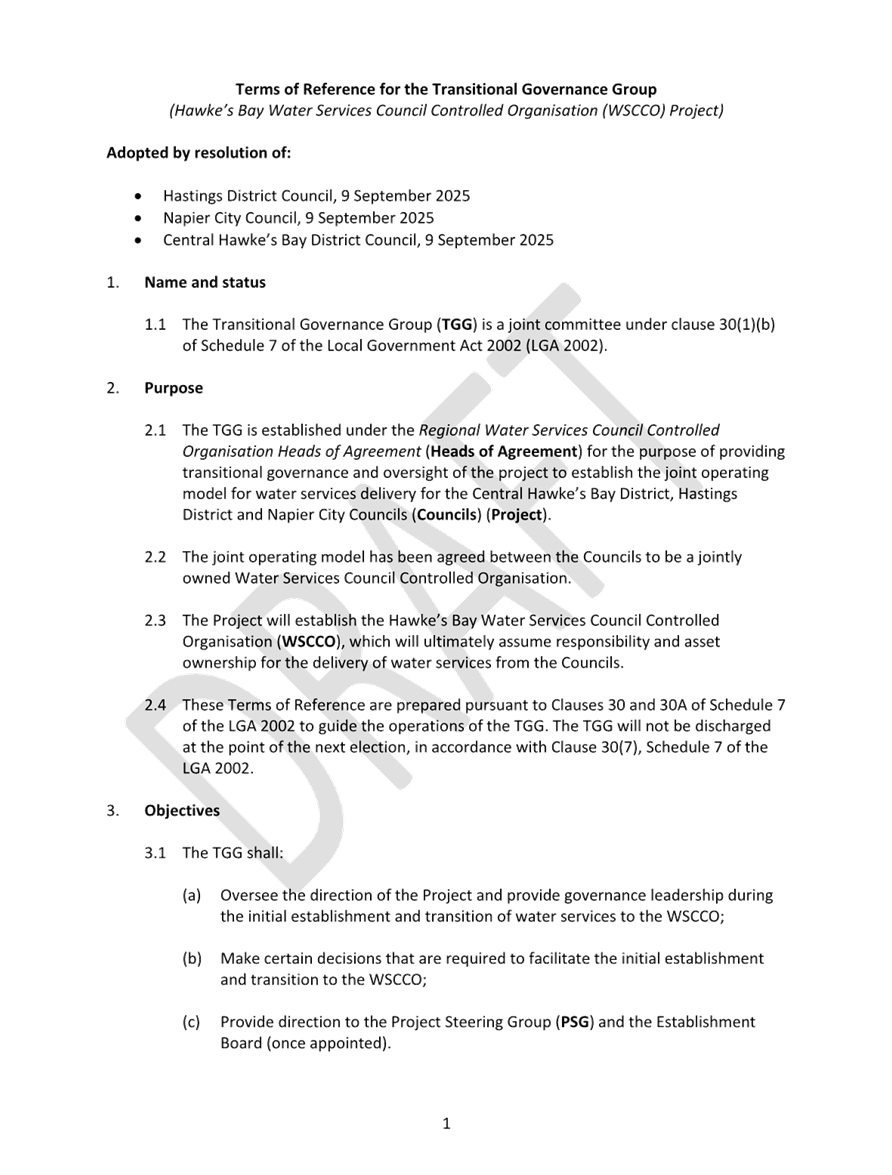
1.1 Purpose of Report The purpose of this report is to appoint the Transitional Governance Group (TGG) as a joint committee of the Council, adopt the Terms of Reference (ToR) for the TGG, delegate appropriate authority to the TGG, and confirm Napier City Council’s (NCC) appointees to the TGG. |
That Council:
a. Receive the 9 September 2025 report titled Hawke's Bay Water Services Council Controlled Organisation - Transitional Governance Group Terms of Reference.
b. Appoint, pursuant to Clause 30(1)(b) of Schedule 7 of the Local Government Act 2002 (the Act), the Transitional Governance Group (TGG) as a joint committee of the Council together with the participating councils of Hastings District Council (HDC) and Central Hawke’s Bay District Council (CHBDC).
i. Note the TGG will not be discharged at the point of the next election, in accordance with Clause 30(7), Schedule 7 of the Act.
b. Adopt the Terms of Reference (TOR) for the Transitional Governance Group Joint Committee (Attachment 1).
c. Delegates to the TGG all powers, duties and functions needed for it to carry out its responsibilities.
d. Appoint Napier City Council representatives to the Transitional Governance Group Joint Committee – Mayor Wise and Councillor Price.
e. Note that the participating councils of Hastings District Council and Central Hawke’s Bay District Council are also set to take decisions on Tuesday 9 September 2025.
This report presents the Terms of Reference (TOR) of the Transitional Governance Group (TGG) for the Council’s consideration and adoption (Attachment 1).
In accordance with the TOR, the report also asks Council to appoint Napier City Council representatives to the TGG – Mayor Wise and Councillor Price.
The TGG is established under the Regional Water Services Council Controlled Organisation Heads of Agreement (Heads of Agreement) for the purpose of providing transitional governance and oversight of the project to establish the joint operating model for water services delivery for the Central Hawke’s Bay District, Hastings District and Napier City Councils.
Council endorsed entering into the Heads of Agreement at the meeting of 31 July 2025. Late Agenda of Ordinary Meeting of Council - Thursday, July 31, 2025, and delegated authority to the Chief Executive to sign the Heads of Agreement on behalf of the Council.
The TGG will be a joint committee of the three participating councils. TOR for the TGG are prepared pursuant to Clauses 30 and 30A of Schedule 7 of the Local Government Act 2002 (the Act) and set out the responsibilities and delegated authority of the TGG, and its membership and decision-making arrangements. The TGG will not be discharged at the point of the next election, in accordance with Clause 30(7), Schedule 7 the Act.
The other parties to the Heads of Agreement, HDC and CHBDC, are also considering the TOR of the TGG at Extraordinary Council meetings on Tuesday 9 September 2025.
1.2 Background Summary
As agreed at the meeting on 31 July 2025, Council has agreed to establish a WSCCO with HDC and CHBDC as the joint operating model for water services delivery under the Local Water Done Well (LWDW) requirements.
The Heads of Agreement agreed by Council on 31 July 2025 provides for the establishment of the TGG as a part of the overall governance and implementation of the Hawke’s Bay WSCCO between Central Hawke’s Bay District Council, Hastings District Council and Napier City Council.
The objectives of the TGG are to:
· Oversee the direction and provide governance leadership during the initial establishment and transition of water services to the WSCCO.
· Make certain decisions that are required to facilitate the initial establishment and transition to the WSCCO.
· Provide direction to the Project Steering Group (PSG) and the Establishment Board (once appointed), and
· Ensure that the joint Water Services Delivery Plan (WSDP) and WSCCO establishment process reflects the Councils’ objectives and statutory requirements.
Council endorsement of the TOR and formal establishment of the TGG as a joint committee in accordance with Clauses 30 and 30A of Schedule 7 in the Act is required before the TGG can undertake their work.
Council endorsement of the TOR and formal establishment of the TGG as a joint committee in accordance with Clauses 30 and 30A of Schedule 7 in the Act is required before the TGG can undertake their work.
1.3 Discussion
Membership, voting and meetings
The Heads of Agreement and TOR provide for seven members of the TGG, including:
· Two members from each of the Councils (one of which must be the Mayor); and
· An Independent Chair appointed at the first meeting of the TGG by unanimous agreement of the other members of the TGG.
The TGG will use best endeavours to make decisions by consensus decision. Where consensus cannot be reached, the matter will be escalated to the Councils for resolution and may then be referred back to the TGG for a formal decision. Where voting is required, each member (other than the Independent Chair) has one vote.
The TOR provide for the TGG to meet at least monthly, or a such other times and frequency as it determines.
Quorum will consist of a majority of members, but there must be at least one member from each council.
Supporting Advice
In addition to the TGG, the Heads of Agreement outlines the governance and project management model:
· A Project Steering Group (PSG), made up of the Chief Executives (or nominee) of each of the councils, responsible for appointing members to the Project Team, approving the Project Plan, approving the Project Budget, and reporting to the TGG.
· A Project Team, made up of one named officer/external appointee from each council (with one appointed as Project Team Lead), responsible for preparing the Project Plan and developing documentation for review and approval by the PSG.
Responsibilities and delegated authority
The TOR provide for the TGG to be responsible for providing governance and oversight, in accordance with Schedule 2 of the Heads of Agreement. This includes:
· Overseeing the development of the Project Plan and monitoring progress against key milestones as set out in the Heads of Agreement and WSDP;
· Monitoring progress and risks based on reporting from the PSG and Project Team; and
· Appointing the Establishment Board for the WSCCO and advising on the appointment of the Establishment Chief Executive.
By approving the TOR, Council is approving the necessary delegated authority for the TGG to undertake its responsibilities.
Substantive decisions relating to the final joint operating model foundational documents remain the responsibility of each council separately.
The TGG will not be discharged at the point of the next election, in accordance with Clause 30(7), Schedule 7 the Act. This means it will be a standing joint committee, as is the case for joint committees such as the Hawke’s Bay Civil Defence Emergency Management Group Joint Committee.
1.4 Significance and Engagement
The formation of the TGG and the delegation of decision-making authority represent a governance shift that may affect Council’s control over strategic matters. While such delegation is procedurally supported under clause 30(1)(b) of Schedule 7 of the Act, the overriding purpose of the TGG, which is to oversee the creation of a new water organisation, elevates the significance of this decision.
This new entity will involve the transfer of strategic water assets and is expected to have material impacts on service delivery, community outcomes, and stakeholder engagement. Given the scale and public interest in water infrastructure, this initiative meets several thresholds under the Council’s Significance and Engagement Policy and is therefore considered to have high significance, warranting appropriate engagement and transparency measures.
However, the preceding decisions regarding LWDW have also been assessed as a high degree of significance. In response to this Council fulfilled a full public consultation in line with the legislated requirements set out in the Local Government (Water Services Preliminary Arrangements) Act 2024. The transfer of strategic water assets and the formation of the new water organisation formed a part of this formal consultation. Although the proposed transitional governance structure, including the TGG were not specifically identified at that stage, it was implicit that there would have to be a mechanism for coordinated decision-making by the participating councils during the establishment phase.
A key workstream currently in development and intended to be presented to the TGG for approval is a formal communication and engagement strategy that will outline the proposed timing and channels for ongoing communications and engagement.
Mana Whenua
The establishment of the TGG is the initial step in the process of appointing the enduring governance of the proposed WSCCO. Under the Heads of Agreement, it is acknowledged that at least one director of the WSCCO is to be appointed with knowledge of Te Ao Māori. To ensure this appointment meets the expectation of mana whenua partners strong engagement will be required. Under the Heads of Agreement, each council will also be responsible for deciding how to reflect their mana whenua relationships within the Shareholders Representative Forum.
As well, at a project level, a regional approach to mana whenua engagement is commencing to ensure strong alignment in the proposed organisation at an operational level as well as a governance level.
1.5 Implications
Financial
The Heads of Agreement outlines the cost share to be borne by each council during the establishment phase of the Project. The costs associated with the administration of and the legal documentation required to establish the TGG will be factored into the establishment phase and shared accordingly.
Social & Policy
N/A
Risk
Risks presented as disadvantages in options section.
1.6 Options
The options available to Council are as follows:
a. Approve the establishment of the TGG, adopt the ToR as proposed and appoint Mayor Wise and Councillor Price as the TGG representatives (Recommended)
i. Advantages:
1. Legal and procedural clarity operating under formal delegations and TOR providing a clear framework to project governance.
2. Promotes regional cohesion by aligning councils under a unified governance structure, strengthening strategic direction and credibility.
3. Accelerated decision making as delegations will empower the TGG to make decisions more quickly without the need to refer decision back to each shareholding council. This can reduce delays and enable the TGG to respond more quickly to emerging issues and key project milestones.
ii. Disadvantages:
1. Delegating authority means that decisions may be made without full council input, which could lead to concerns about transparency or accountability.
2. There is potential administrative burden as establishing and maintaining the TGG requires ongoing administrative support, which can be resource intensive. However, this administrative support would be required for any structure.
b. Make amendments to the attached proposed TOR of the Transitional Governance Group Joint Committee.
i. Advantages:
1. Same as above.
ii. Disadvantages:
1. Potential need for further legal advice on a modified ToR and coordination between the other councils.
c. Do not establish the TGG and therefore not adopt the TOR of the TGG and continue under alternative arrangement such as further Memorandum of Understanding or a Working Group.
i. This option is not recommended as these alternatives would not be able to operate with delegated authority to allow decision-making by the TGG, as contemplated by the Heads of Agreement.
1.7 Development of Preferred Option
The Council decisions arising from this report will be advised to the other partner councils, and Council’s Local Governance Statement will be updated.
Provided all partner councils resolve to appoint the TGG and adopt the TOR, the first meeting of the TGG will be on 16 September 2025.
1 TGG Terms of Reference (Doc Id 1873444)