|
Napier People and Places Committee - 29 April 2021 - Attachments
|
Item 1 Attachment a |
Napier People and Places Committee
Open Agenda
|
Meeting Date: |
Thursday 29 April 2021 |
|
Time: |
10.00am |
|
Venue: |
Council Chambers
Livestreamed to Council’s Facebook site |
|
Committee Members |
Mayor Wise, Councillor Boag (In the Chair), Deputy Mayor Brosnan, Councillors Browne, Chrystal, Crown, Mawson, McGrath, Price, Simpson, Tapine, Taylor and Wright |
|
Officer Responsible |
Director Community Services |
|
Administration |
Governance Team |
|
|
Next Napier People and Places Committee Meeting Thursday 1 July 2021 |
Napier People and Places Committee - 29 April 2021 - Open Agenda
ORDER OF BUSINESS
Karakia
Apologies
Nil
Conflicts of interest
Public forum
Announcements by the Mayor
Announcements by the Chairperson including notification of minor matters not on the agenda
Note: re minor matters only - refer LGOIMA s46A(7A) and Standing Orders s9.13
A meeting may discuss an item that is not on the agenda only if it is a minor matter relating to the general business of the meeting and the Chairperson explains at the beginning of the public part of the meeting that the item will be discussed. However, the meeting may not make a resolution, decision or recommendation about the item, except to refer it to a subsequent meeting for further discussion.
Announcements by Management
Confirmation of minutes
That the Minutes of the Napier People and Places Committee meeting held on Thursday, 18 March 2021 be taken as a true and accurate record of the meeting........................................................................ 38
Agenda items
1 Napier Social Monitor Report 2020................................................................................. 3
2 Safer Napier Programme - Annual Update.................................................................... 15
3 Faraday Centre Business Case.................................................................................... 32
Minor matters not on the agenda – discussion (if any)
Public excluded ............................................................................................................. 34
Napier People and Places Committee - 29 April 2021 - Open Agenda Item 1
1. Napier Social Monitor Report 2020
|
Type of Report: |
Information |
|
Legal Reference: |
N/A |
|
Document ID: |
1302437 |
|
Reporting Officer/s & Unit: |
Michele Grigg, Senior Advisor Policy |
1.1 Purpose of Report
To provide a summary of findings from the 2020 Napier Social Monitor report.
|
The Napier People and Places Committee: a. Receive the Napier Social Monitor report 2020.
|
A Social Monitor survey has been commissioned by Napier City Council biennially since 1998. In 2019, the Social Monitor was reviewed to more appropriately reflect the re‑instated role of local government in improving and monitoring community wellbeing. The survey is now undertaken annually by SIL Research. The most recent survey was conducted in August/September 2020. This report presents an overview of the survey and key findings.
1.2.1 Survey purpose and objectives
The purpose of the Social Monitor is to provide information to inform the development of policies and initiatives to enhance social wellbeing in Napier. The survey collects information about the quality of life of Napier residents. Specifically, it measures:
· Quality of life
· Social connection and diversity
· Safety
· Accessibility
· Community mental wellbeing and health status
· Housing and neighbourhood
· Volunteering and employment
· Emergency management.
Composite measures for social connections and mental wellbeing are derived from responses to a set of individual questions. A social index measure is also included, which is derived from responses to questions designed to evaluate residents’ quality of life.
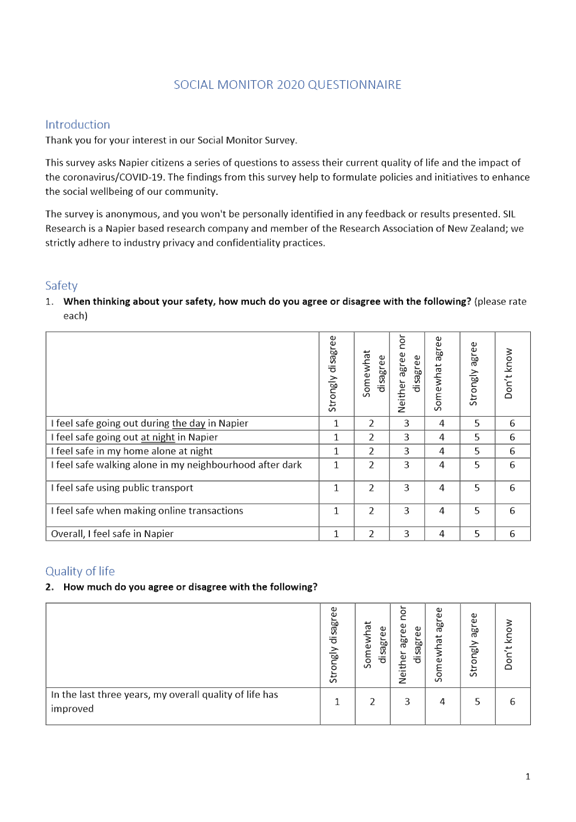
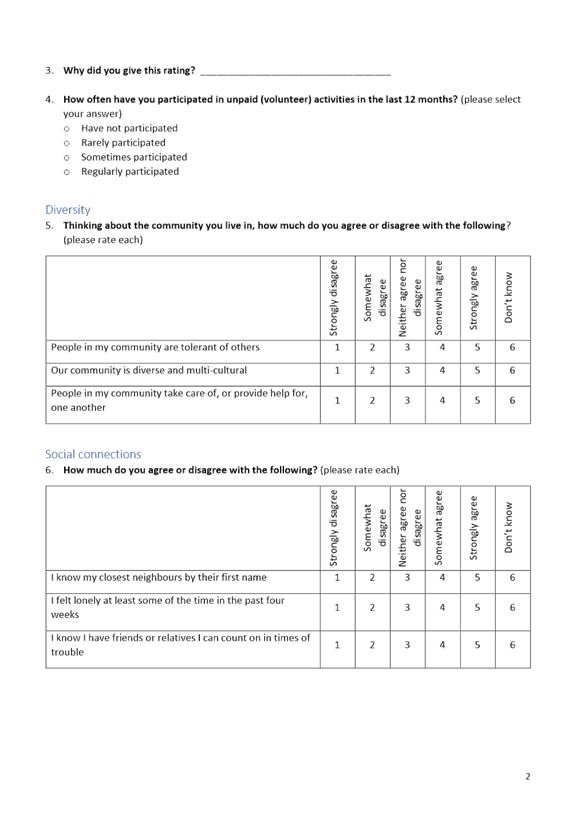
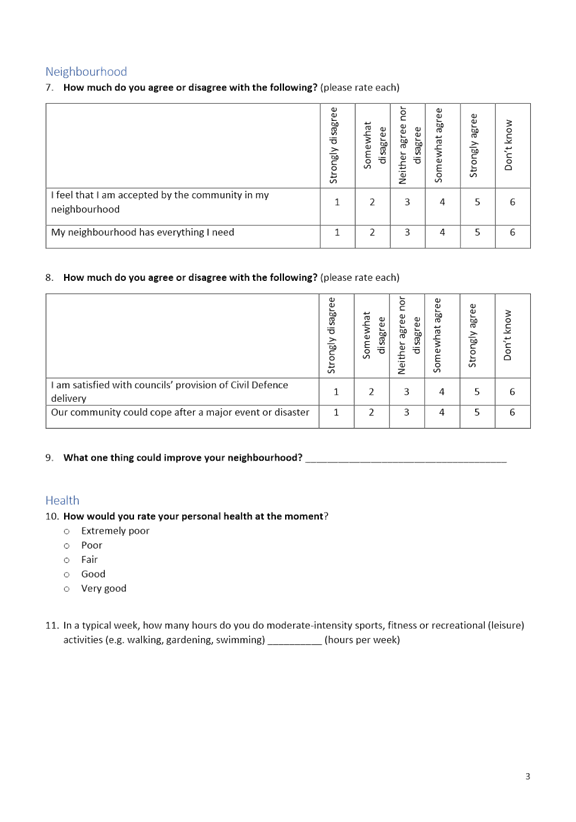
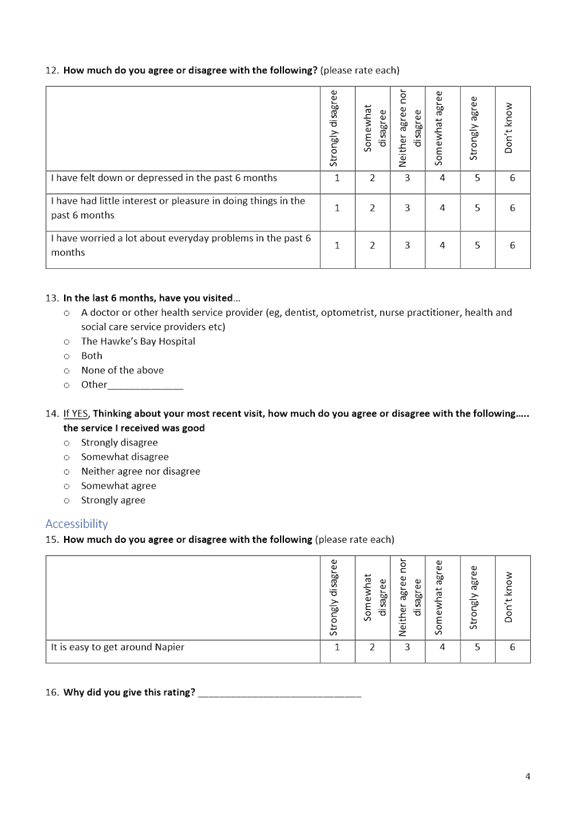
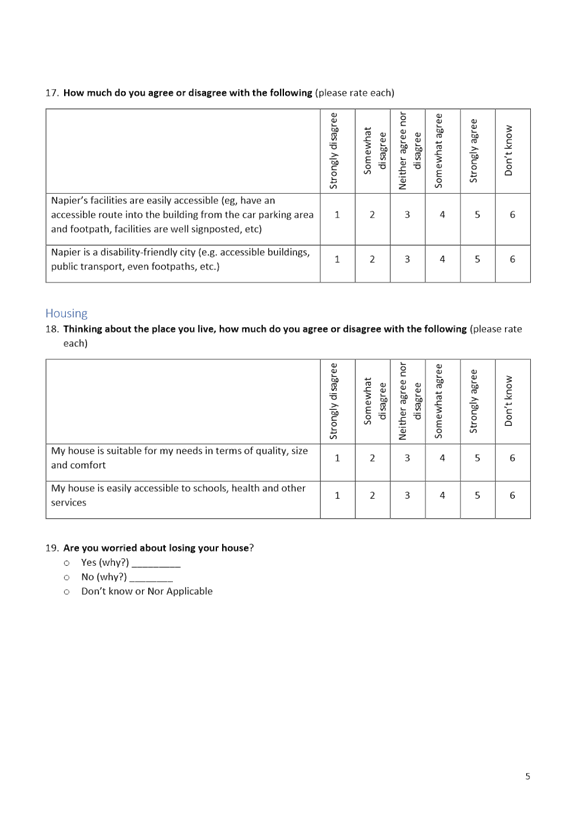
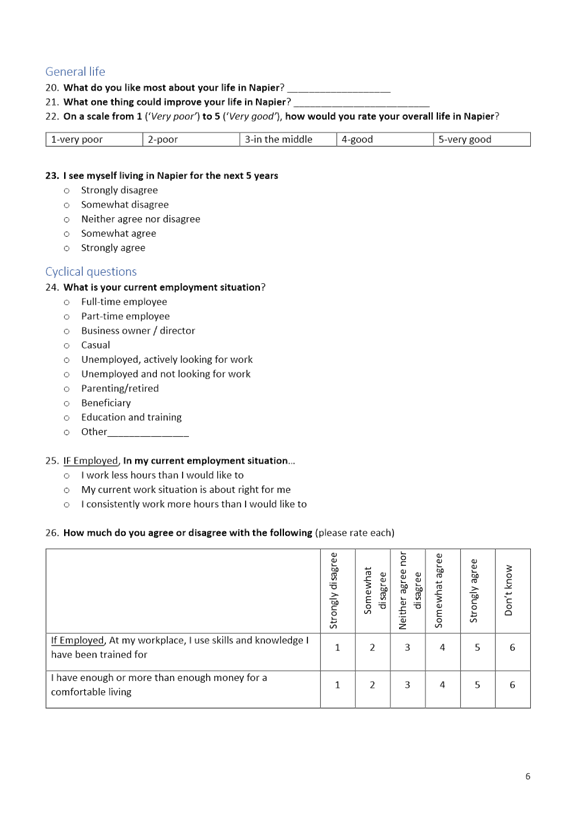
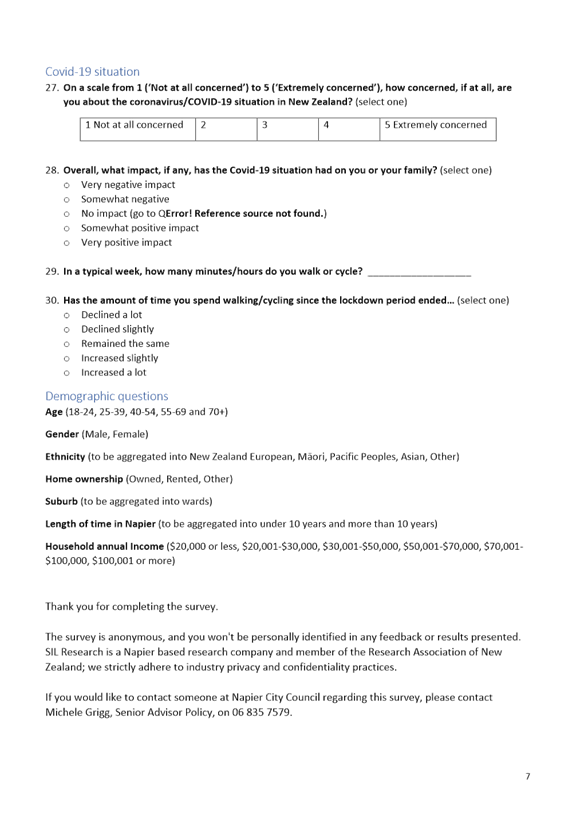
The 2019 Social Monitor questionnaire was used again in 2020 (Attachment A) to enable tracking over time. The 2020 Monitor also included a set of questions to determine the impact of COVID-19 on the wellbeing of residents. These replicated questions included in the Napier COVID-19 Wellbeing Survey, conducted by Council during June 2020 when the country was at Alert Level 3. Where relevant, findings are compared to that survey as well as to the 2019 Social Monitor.
Note that the Social Monitor differs from the quarterly Napier City Council Residents Satisfaction and Service Delivery Survey, which focuses on gaining regular feedback from residents on Council services and facilities.
1.2.2 Survey methodology
The slightly revised 2020 Social Monitor survey was tested prior to starting data collection, which occurred between 11 August and 21 September 2020. The same sampling approach was used as for the 2019 survey, to ensure a proportional spread of respondents from each of the four electoral wards, by age and gender.
Data collection methods employed to ensure residents had an opportunity to complete the survey included: telephone surveys, social media links to the online survey, and postal survey forms to 500 letterboxes.
1.2.3 Data analysis
Data underwent a quality control check before analysis. A total of 450 surveys (ages 18+ years) were used in the final analysis. This sample size provides for accurate reporting at the 95% confidence level.
Responses were statistically weighted. Weighting ensures that specific demographic groups are neither under nor over-represented in the final data set and that each group is represented as it would be in the population. Gender, ethnicity, and age weightings were applied to the data to reflect the 2018 Census.
The main groups analysed in the report are: ward, age, gender, ethnicity, home ownership, and length of time living in Napier. Only statistically significant differences are commented on (at the 95% confidence level). Where differences are not significantly different, no comment is made.
1.2.4 Survey findings
The Social Monitor report (Attachment B) presents findings from the survey. It compares findings to the 2019 Social Monitor, and to the 2020 COVID-19 Wellbeing Survey where applicable.
Overall, in 2020, the most important aspects of overall community life in Napier were similar to or improved, compared to 2019. The composite Social Index measure (a sum of scores measuring residents’ quality of life) was 71.4 in 2020 (a good level), which was a slight improvement on 2019’s score of 68.8. The main area with lower ratings was perceived community safety.
Main findings are listed below, with changes since the 2019 survey listed first.
Key changes between 2019 and 2020
· ñ The percent of residents with social connections increased in 2020 (78%, compared to 73% in 2019).
· ñ The percent of residents with friends or relatives they can count on in times of trouble increased in 2020 (89%, compared to 81% in 2019).
· ñ Ratings for self-reported good health increased in 2020 (70%, compared to 58% in 2019).
· ò Fewer residents said their quality of life had improved in 2020 (34%, compared to 42% in 2019), although more believed their quality of life had remained the same.
· ò The percent of residents concerned about the COVID-19 situation decreased (49%, compared to 61% in the June 2020 Wellbeing Survey 61%).
· ñ Ratings for feeling unsafe in Napier increased in 2020 (17%, compared to 13% in 2019).
Ward differences
· Taradale (83%) and Ahuriri (88%) residents were more likely to report their life in Napier as good or very good (compared to 79% of all residents)
· The proportion of residents who felt safe was similar across the wards. However, Onekawa-Tamatea (25%) and Nelson Park (27%) residents were less likely to feel safe walking alone in their neighbourhood after dark (compared to 36% of all residents)
· Residents from Nelson Park were less likely to agree their neighbourhood had everything they need (61%, compared to 69% of all residents)
· Fewer residents from Onekawa-Tamatea felt their community could cope after a major event or disaster (39%, compared to 44% overall)
· All four wards showed an improved social connection score for ‘I know I have friends or relatives I can count on in times of trouble’ compared to 2019, with Ahuriri ward showing the greatest improvement
o More residents in Ahuriri also agreed they know their closest neighbour by first name and feel accepted by the community, compared to 2019
o More residents in Onekawa-Tamatea agreed people in their community care for and help one another, and that they felt accepted by the community, compared to 2019
o Taradale ward showed the most consistent results between years for the social connection measures.
Impact of COVID-19
· Just under half of residents (49%) were concerned about the COVID-19 situation in September 2020, compared to 61% in June 2020. Younger residents were least concerned about this issue.
· 57% of residents said the COVID-19 situation had an overall negative impact on them or their family. There was no change in reported negative impact between June and September 2020.
· The impacts of COVID-19 and lockdown were named as the main reasons for quality of life declining in 2020.
· Residents who reported a positive COVID-19 impact were more involved in walking and cycling. In addition, 20% of residents said they had increased their walking/cycling since lockdown.
Other key findings
· 82% of residents saw themselves living in Napier in the next five years (76% in 2019).
· 79% said their life in Napier is ‘good’ or ‘very good’ (74% in 2019).
· 73% agreed they felt safe in Napier (75% in 2019)
· 70% agreed they were in good health (58% in 2019)
· The average agreement score for ‘social connections’ increased to 78% (73% in 2019)
· For ‘house and neighbourhood’ the average agreement score increased to 82% (77% in 2019)
· For ‘accessibility’ the average agreement score decreased slightly to 60% (63% in 2019)
· Four questions were asked to gain an approximate measure of community mental wellbeing (all refer to the previous six month time period):
o I have worried about a lot about everyday problems (39% somewhat or strongly agreed, down from 48% in 2019)
o I have felt down or depressed (37%, down from 42%)
o I have felt lonely at least some of the time (34%, down from 36%)
o I have had little interest or pleasure in doing things (22%, down from 28%).
· The overall mental wellbeing index therefore improved slightly between 2019 and 2020 with a score of 10.3 (10.7 in 2019, maximum score is 20). The most vulnerable groups were found to be 18-39 year olds, females, those with lower income (under $20,000), and those living in a rented property.
· Note this index is indicative only and does not infer mental health status.
Suggested improvements
Residents were asked what could be improved in Napier and in their neighbourhood.
· The most mentioned improvement was ‘safety/policing/reduce crime’ (21%) – compared to last year’s most mentioned improvement of ‘fix water’ (13%).
· The second and third most mentioned in 2020 were fix water (8%) and more activities/ activities for youth/things for kids (8%).
· 7% said nothing needed improving.
· The most cited improvements in each ward were:
o Ahuriri Ward – traffic, transport, and road control (18%)
o Onekawa-Tamatea Ward – security, safety, crime control, gangs (28%)
o Nelson Park Ward – security, safety, crime control, gangs (25%)
o Taradale Ward – security, safety, crime control, gangs (20%).
1.3 Issues
The Council’s key performance indicator for safety is collected via the Social Monitor. The safety question was altered slightly in the 2019 Social Monitor, which means information is not directly comparable to earlier years but presents a more accurate picture.
Levels of overall safety have declined slightly – 73% strongly or somewhat agreed they felt safe in Napier (compared to 75% in 2019). There continues to be an increase in the percentage of people feeling unsafe, from 5% in 2014 to 13% in 2019 and 17% in 2020.
Information from the COVID-19 Wellbeing Survey, conducted in June 2020, shows the community continued to experience impacts from COVID-19 and that some of these are positive – particularly building social connections and increased physical activity such as walking and cycling.
1.4 Significance and Engagement
A distribution plan has been prepared. This involves:
· Providing the full Social Monitor 2020 report to other Council departments to inform ongoing planning and delivery of services
· Sharing key findings with Council’s Community Network, which includes a range of social service organisations and government agencies
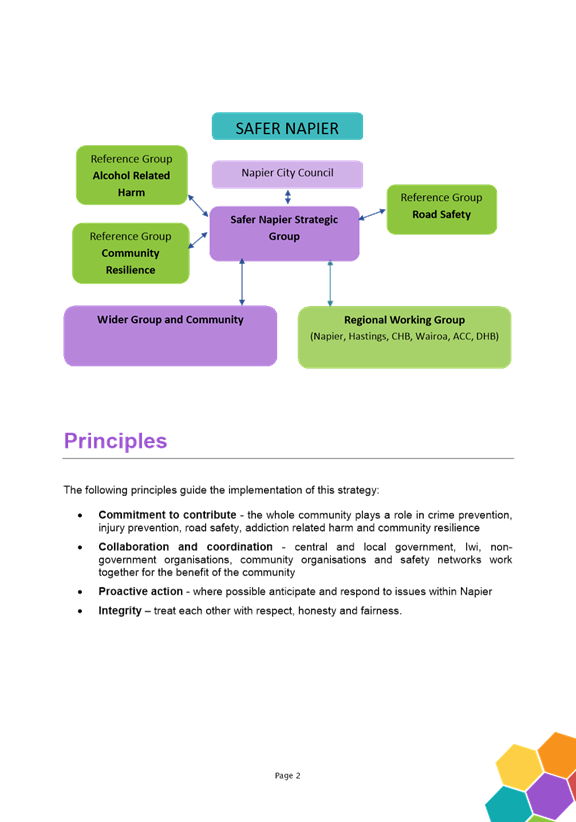
· Sharing key findings with the Safer Napier Strategic Group, which includes representatives from agencies including Hawke’s Bay District Health Board, Ministry of Social Development, New Zealand Police, ACC, Te Puni Kōkiri, Kāinga Ora, and a number of community organisations who have a focus on community safety
· Posting the full report on Council’s website (www.napier.govt.nz/napier/community-development/social-monitor/).
1.5 Implications
Financial
N/A
Social & Policy
Findings support the focus areas of the Safer Napier programme and service agreements held by Council with community organisations. They also help with the ongoing monitoring of Council’s programmes and strategies and with tracking progress for key measures of wellbeing.
The survey will continue annually to enable tracking of trends over time. The 2021 survey will be conducted in September.
Risk
N/A
1.6 Options
The options available to Council are as follows:
a. To receive the Napier Social Monitor report 2020.
1.7 Development of Preferred Option
N/A
a NCC Social Monitor Questionnaire 2020 ⇩
b NCC Social Monitor Report 2020 (Under Separate Cover) ⇨
2. Safer Napier Programme - Annual Update
|
Type of Report: |
Information |
|
Legal Reference: |
N/A |
|
Document ID: |
1302975 |
|
Reporting Officer/s & Unit: |
Rebecca Peterson, Senior Advisor Policy Michele Grigg, Senior Advisor Policy |
2.1 Purpose of Report
To provide a summary of the 2019-2020 year of the Safer Napier programme, including key highlights and benefits to Council and the Napier community.
|
The Napier People and Places Committee: a. Note the Safer Napier programme update.
|
As part of the international network of ‘Safe Communities’, Napier City Council (NCC) continues to work with other agencies to prevent harm from injury, crime and addiction and to help build resilience in our community. The COVID-19 pandemic has brought with it a number of challenges and opportunities for Safer Napier partner agencies, many of which were involved in the emergency welfare response. This report to Council was delayed due to the pressures of COVID-19 and the Napier Rainfall Event. The report highlights key projects and initiatives that have occurred over the past year and summarises the impact, range and reach of these safety projects in Napier. The Safer Napier programme is due for reaccreditation as an international safe community (every five years) later in the year. A subgroup of the Safer Napier Strategic Group is planning for this now. As an established and nationally recognised programme, reaccreditation requirements are less onerous while still requiring a high standard of application.
A number of incidents have occurred in our public places recently. This, along with continued concern regarding behaviour around Clive Square and Marewa has prompted the establishment of internal working group, with a focus on what Council can do and/or influence in response. This work contributes to the Safer Napier programme and vice-versa.
Programme Planning
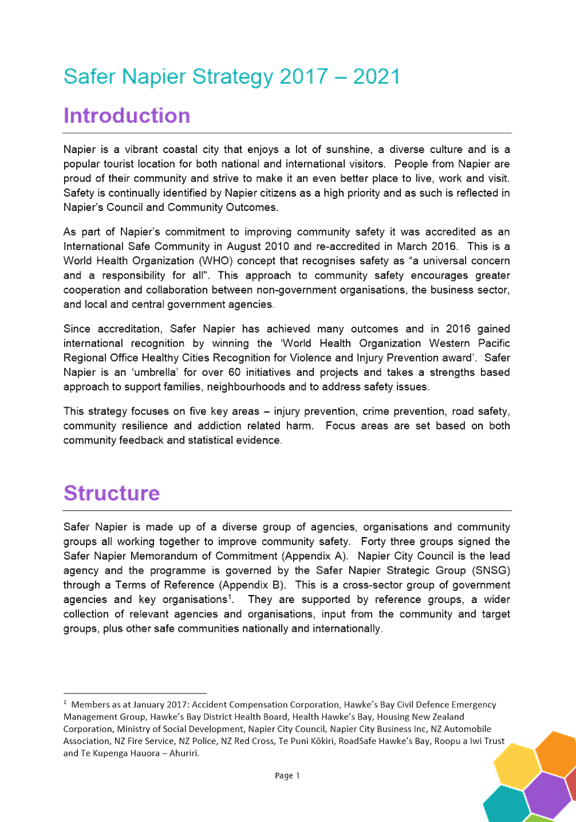
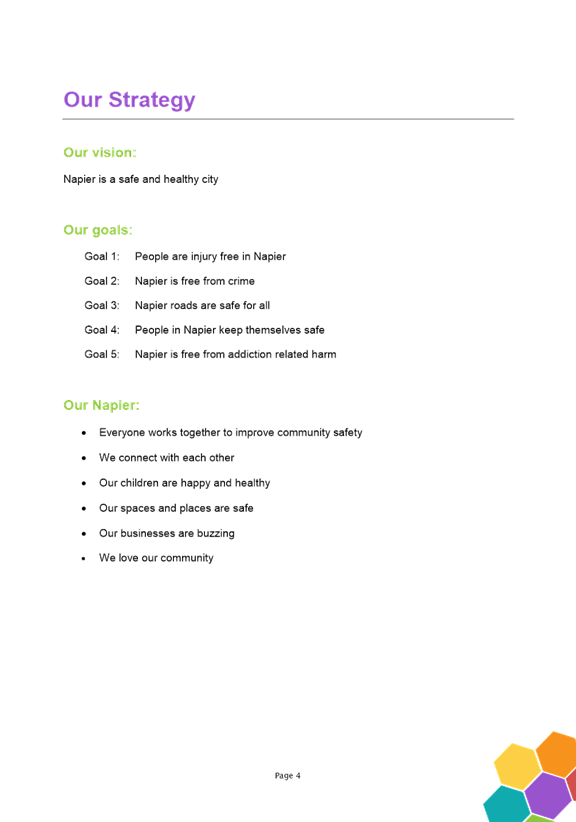
The Safer Napier Strategic Plan 2017-2021 continues to drive the vison and goals of the Safer Napier programme.
· People are injury free in Napier
· Napier is free from crime
· Napier roads are safe for all
· People in Napier keep themselves safe
· Napier is free from addiction related harm
After reaccreditation we will begin the process of reviewing the Safer Napier Strategy (Attachment A) including our vision, goals and if necessary the structure of how Safer Napier operates. Reviewing our strategic direction every few years, allows Safer Napier to incorporate the local knowledge of agencies, community voice, and align and contribute to relevant national and regional strategies.
The annual planning workshop, involving all Safer Napier signatories will also contribute to the development of the 2021-22 Safer Napier Action Plan. Safer Communities Foundation New Zealand (SCFNZ) request our Safe Napier Strategic Group complete an annual Governance Survey. The survey findings provide insights into how the programme is being governed, strengths and weaknesses, and offers suggestions for improvement. We are consistently in the target zone category overall (within the highest score zone).
Projects
The programme’s latest annual report 2019-2020 (Attachment B), highlights the range of projects delivered under Safer Napier for each goal area. This is also available on Council’s website (search keyword #safernapier) along with other Safer Napier documents, and a summary is published in Napier’s free community newspaper.
Project highlights for the 2019-2020 year include:
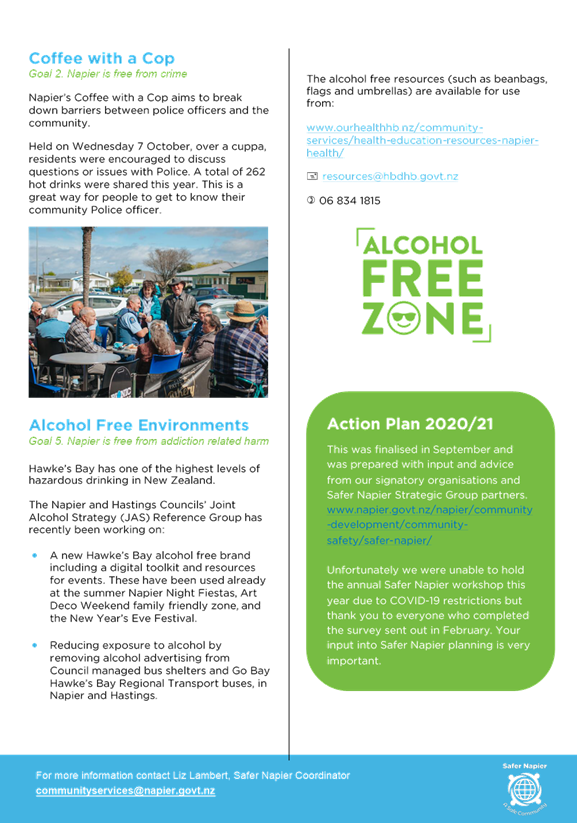
· Coffee with a Cop: In its third year, this project brings police officers and the community together, over coffee, to discuss issues, build trust and learn more about each other. This year we held Coffee with a Cop at six Napier locations, over 20 Police officers took part, and 199 hot drinks were shared. Issues raised were varied, and covered neighbourhood disputes, netsafe advice, traffic issues and home security. There was a high level of support for the initiative, with café’s and Police both 100% satisfied and keen to participate in Coffee with a Cop again.
· Hill Hosts: In a strong or long earthquake and tsunami event, an estimated 15,000 people are expected to evacuate to Napier Hill as this provides the only tsunami safe ground immediately north of the city centre. Building on Shake Out /Tsunami Hikoi, the Hill Hosts project is a partnership with Napier Hill residents, Napier Neighbourhood Support, Hawke’s Bay Civil Defence Emergency Management and Napier City Council. This involves increasing the understanding of hill residents of the situation and gaining a willingness to support tsunami evacuees. Council is looking at the condition of pathways, steps and lanes up and on the Hill, potential evacuation meeting areas, as well as likely corridors, some of which will have been damaged from the Napier Rainfall Event.
· Alcohol Free Environments: Hawke’s Bay has one of the highest levels of hazardous drinking in New Zealand. One of the key 2019/20 actions for the Napier and Hastings Joint Alcohol Strategy was to promote alcohol free environments at small and large events. The “Alcohol Free Zone” brand was developed including a digital toolkit for online promotions. The brand resources have been used at several key Napier events, youth council events and community events. Safer Napier worked with Hawke’s Bay Regional Council to remove all alcohol advertising from the Go Bay Hawke’s Bay public buses and Council managed bus stops.
· Look out for your Neighbour: This campaign was initiated in 2019 and has been promoted again following the COVID-19 lockdown and in early 2021. Using a range of online, print and radio media channels, the campaign features local Napier people to raise awareness and encourage the community to look out for vulnerable neighbours, especially the elderly.
2.3 Issues
Council provides ongoing funding for the part time Safer Napier Coordinator. Internal staff resource, costs incurred for programme coordination and to support projects is provided through NCC’s internal funding and staff from partner agencies. There is no funding available for local safe communities from the SCFNZ, ACC, DHB’s or Police.
SCFNZ (the national body) is part-funded by Te Hiringa Hauora (Health Promotion Agency). They are investigating other sustainable funding options following the withdrawal of funding by ACC, which was their major funder.
2.4 Significance and Engagement
The Safer Napier programme relies on open and transparent feedback and input from a range of sources, including our signatory partners, the community and official data. We facilitate an annual workshop which contributes to the setting of priorities and projects for the year ahead. At the end of the year, key achievements are reported back to the community, summarised in the local newspaper and programme documents made available online.
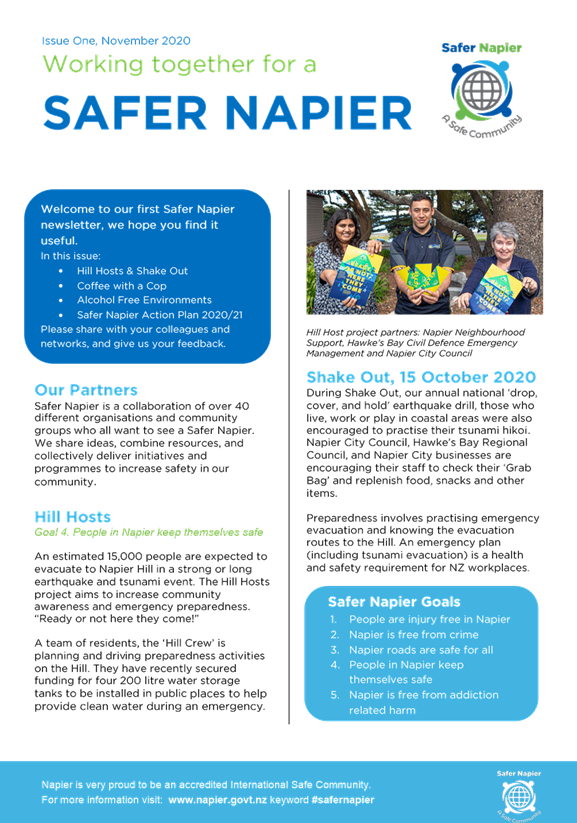
We have developed a quarterly newsletter that highlights key projects during the year (Attachment C) for signatory agencies to share with their organisations and key stakeholders. The need for more regular communication with our signatory agencies was identified through our annual Governance Survey.
2.5 Implications
Financial
Council’s Long Term Plan (LTP) 2021-31 includes ongoing baseline funding for delivery of the Safer Napier programme ($50,000 for part time contractor, accreditation costs and some project costs). Project funding is sought through external channels wherever possible, however this can at times be difficult to source. Partner agencies are often not in a position to fund the programme and funding sources for projects can be variable.
The programme remains viable through ongoing support from Council in the form of staff time and operational funding.
Social & Policy
There have been a number of opportunities and challenges throughout the year.
· During the COVID-19 response and the recent Rainfall event, the Safer Napier partners were a key resource helping establish the Network of Networks used to help coordinate the Hawke’s Bay CDEM welfare response.
· The Safer Napier Strategic Group completed the following submissions, Online gambling in New Zealand and the Napier Positive Aging Strategy.
· Safer Napier Strategic Group partners and Council staff attended Crime Prevention Through Environmental Design (CPTED) professional development training ensuring a consistent understanding and approach to safe environments in Napier.
· The Safer Napier Coordinator was appointed member of the Fire Emergency NZ Hawke’s Bay Local Advisory Committee providing independent advice on local needs, issues and risks and the Pan Pacific Safe Community Network Board (PPSCN) sharing knowledge and examples of best practice.
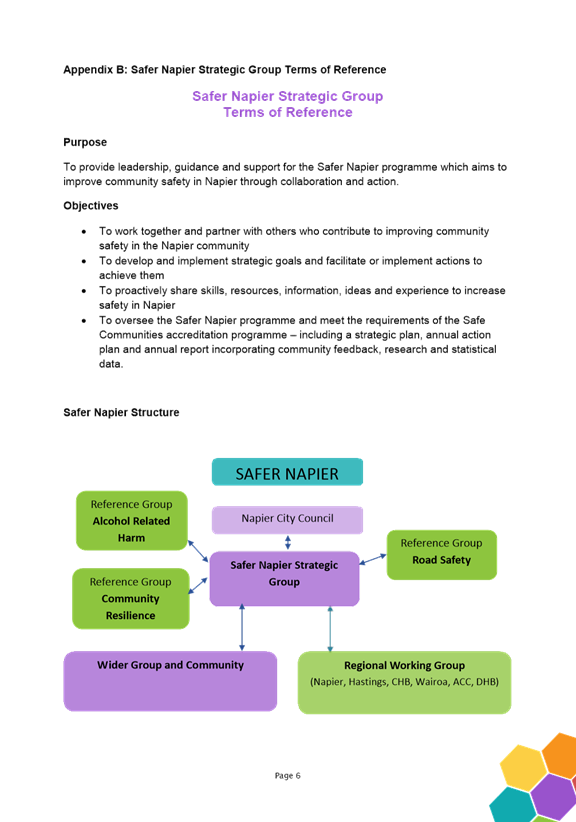
The Safer Napier Programme plays an important role in community safety as it demonstrates collective action across a range of Government and non-Government agencies under one umbrella. A large component of initiatives delivered under the programme focus on strengthening neighbourhoods and positive social connections which contribute to a higher degree of resilience and sense of security within the community.
Having an identified Ambassador for the programme, Mayor Wise, further strengthens its reputation, both locally and nationally.
Risk
As mentioned, Council is the primary funder for the delivery of Safer Napier and many of its flagship projects and events. Continued funding commitment is essential for the programme’s ongoing sustainability.
2.6 Options
The options available to Council are as follows:
a. Note the Safer Napier annual summary for 2019-20
2.7 Development of Preferred Option
N/A
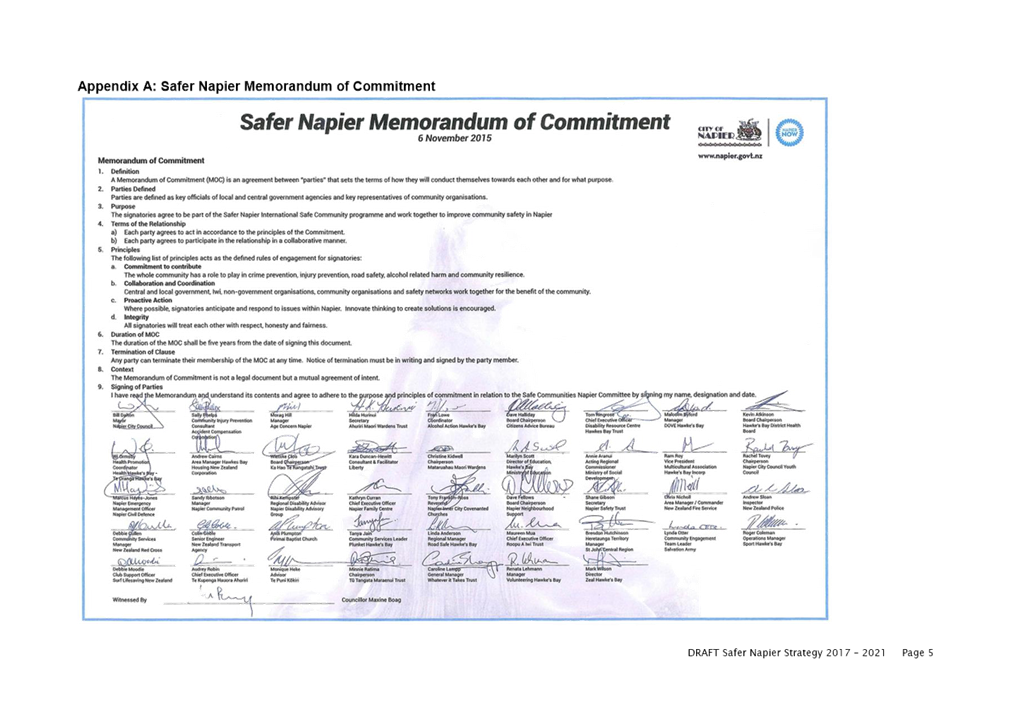
a Safer Napier Strategy 2017-2021 ⇩
b Safer Napier Annual Report - July 2019 to June 2020 (Under Separate Cover) ⇨
c Safer Napier Newsletter - Issue One, November 2020 ⇩
3. Faraday Centre Business Case
|
Type of Report: |
Information |
|
Legal Reference: |
N/A |
|
Document ID: |
1303314 |
|
Reporting Officer/s & Unit: |
Antoinette Campbell, Director Community Services |
3.1 Purpose of Report
To receive the Faraday Centre Business Case and note that it will be available to the public for the remainder of the 2021-31 Long Term Plan consultation.
|
The Napier People and Places Committee: a. Receive the Faraday Centre Business Case for information b. Note the Business Case and summary will be published on Council’s website c. Note the Business Case recommendations will be brought back to Council after 2021-31 Long Term Plan consultation, hearings and adoption. |
Until early 2019, the Faraday Centre had been largely run by volunteers, with some support from Council, by the provision of a part-time reception staff member. Due to the retirement of the volunteer facility managers (the Prebensons), Council was asked to step in to manage the facility until a suitable new model of operation was decided. A business case was therefore developed to investigate options for the ongoing governance and management of the facility and collections, and to recommend a preferred model of operations.
3.3 Issues
The Faraday Centre Business Case follows Treasury’s single stage better business case model. It was developed in consultation with Council officers, Faraday Centre and MTG staff, members of the Hawke’s Bay Museums Trust, and councillors. The following key challenges were identified:
1. The building the Faraday Centre is housed in has significant seismic and health and safety issues that pose a risk to the safety of both staff and visitors and deter some people from visiting
2. The Faraday Centre is tired and run-down, and lacks the appropriate functionality necessary to become an attractive and compelling destination in Napier for visitors and locals
3. The Faraday Centre’s operating model is not sustainable and fit-for-purpose.
In response to these challenges, three investment objectives were derived as follows:
1. To ensure the Faraday Centre meets the required seismic and health and safety standards to ensure the safety of its staff and visitors
2. To develop the Faraday Centre into an attractive and compelling destination in Napier for locals and visitors alike
3. To ensure the governance and operation of the Faraday Centre is effective, sustainable and fit-for-purpose.
A full range of options were identified to address the challenges across multiple dimensions including location, building issues, service delivery and the operating model. The options were evaluated against the investment objectives and the affordability and achievability critical success factors to arrive at the preferred option for each dimension. These preferred options informed the recommended way forward being that; the Faraday Centre remains at its current location, it is strengthened to meet greater than 67% NBS and redesigned so it is fit-for-purpose, it delivers a range of services including interactive exhibitions, educational programmes, events and functions and other programmes, and the operating model is delivered by an independent trust. The business case recommends that the preferred approach is implemented over three phases:
· The first phase resolves the immediate issues with the Faraday Centre, including resolving land ownership issues with the New Zealand Defence Force (NZDF), resolving the immediate building issues and improving the Centre’s governance and operating models
· The second phase sees the Faraday Centre redesigned to improve the functionality and layout, and
· The third, and much later phase if the Council decides, is to acquire the remaining NZDF land (subject to negotiations) and increase the Centre’s land footprint (indoor and outdoor).
The business case makes a number of recommendations which will come back to Council for decisions depending on the outcome of community consultation on the Long Term Plan.
3.4 Significance and Engagement
This matter triggers the criteria and thresholds of Council’s Significance and Engagement Policy and is therefore a specific consultation topic in the draft 2021-31 Long Term Plan consultation document. The community are being asked whether to keep the Faraday Centre open (preferred), or to close it down temporarily, until the preferred model of operations recommended by the business case can be implemented. Consultation commenced on 12 April 2021 with submissions closing on 12 May 2021. Submissions will be considered by Council at the Long Term Plan hearings on 8 – 10 June 2021. This report recommends that the Business Case is published on Council’s website to assist the Napier Community in forming their views on Council’s preferred option to keep the Centre open.
3.5 Implications
Financial
There are no financial implications associated with receiving the report. There are financial costs associated with the Faraday Business Case which are being consulted on through the Long Term Plan.
Social & Policy
N/A
Risk
N/A
3.6 Options
The options available to Council are as follows:
a. Receive the Faraday Centre Business Case and note that the Business Case and Summary will be publish online to further inform the community if forming their views on its future to be considered during the Long Term Plan hearings and deliberations.
a Faraday Centre Business Case (Under Separate Cover) ⇨
Napier People and Places Committee - 29 April 2021 - Open Agenda
That the public be excluded from the following parts of the proceedings of this meeting, namely:
AGENDA ITEMS
1. Appointment of Hawke's Bay Museum Trust Chairperson
2. Council Property - Sale
The general subject of each matter to be considered while the public was excluded, the reasons for passing this resolution in relation to each matter, and the specific grounds under Section 48(1) of the Local Government Official Information and Meetings Act 1987 for the passing of this resolution were as follows:
|
General subject of each matter to be considered.
|
Reason for passing this resolution in relation to each matter.
|
Ground(s) under section 48(1) to the passing of this resolution.
|
|
1. Appointment of Hawke's Bay Museum Trust Chairperson |
7(2)(a) Protect the privacy of natural persons, including that of a deceased person |
48(1)A That
the public conduct of the whole or the relevant part of the proceedings of
the meeting would be likely to result in the disclosure of information for
which good reason for withholding would exist: |
|
2. Council Property - Sale |
7(2)(i) Enable the local authority to carry on, without prejudice or disadvantage, negotiations (including commercial and industrial negotiations) |
48(1)A That
the public conduct of the whole or the relevant part of the proceedings of
the meeting would be likely to result in the disclosure of information for
which good reason for withholding would exist: |
Napier People and Places Committee - 29 April 2021 - Open Agenda
Napier People and Places Committee
Open Minutes
|
Meeting Date: |
Thursday 18 March 2021 |
|
Time: |
10.55am-11.12am and reconvened 11.13am-11.40am |
|
Venue |
Council Chambers
Livestreamed to Council’s Facebook site |
|
Present |
Mayor Wise, Councillor Boag (In the Chair), Deputy Mayor Brosnan, Councillors Browne, Chrystal, Crown, Mawson, McGrath, Price, Simpson, Tapine (via zoom link), Taylor and Wright |
|
In Attendance |
Chief Executive (Steph Rotarangi) Acting Director Corporate Services (Caroline Thomson) Director Community Services (Antoinette Campbell) Director City Strategy (Richard Munneke) Director Infrastructure Services (Jon Kingsford) Manager Community Strategies (Natasha Mackie) Manager Communications and Marketing (Craig Ogborn) Team Leader Governance (Helen Barbier) |
|
Administration |
Governance Advisors (Carolyn Hunt and Anna Eady) |
Karakia
The Elected Members opened the meeting with a karakia.
Apologies
|
Councillors Mawson / Chrystal That the apology from Mayor Wise to leave at 10.30am be accepted. Carried |
Conflicts of interest - Nil
Public forum
Citizens Advice Bureau – Dr Susan Jacobs and Greer Lean
The Chair welcomed DR Susan Jacobs, who had been a volunteer interviewer at the Citizens Advice Bureau for four years and Greer Lean who was in her last year of her degree in social work at EIT.
Dr Jacobs displayed a PowerPoint presentation (Doc ID 1299145) highlighting key issues that clients were experiencing and concerns of the Citizens Advice Bureau (CAB) noting the following points :
· CAB provided free confidential advice to people.
· There were 81 CABs in New Zealand and had a great data base with over 300 links to key information evidence based to 35,000 organisations around the country.
· CAB helped people to learn about rights and responsibilities and to advocate for themselves.
· Most common areas of concerns and problems included: Legal and government; Finance and benefits; Family and personal; Housing land; Employment and business; Consumer; Health; Education and Community
Councillor Tapine joined the meeting at 10.15am via zoom link
· Poverty was not abating and had been exacerbated with COVID19.
· CABNZ had collated data from client enquiries for the period January-December 2020 and found that Māori had been disproportionately affected and in desperate need.
· CABNZ were working with a wide range of agencies to pressure government to do more and particularly to raise benefit levels.
· CAB assisted people with speaking to government agencies, writing letters, filling in forms and finding legal assistance
· CAB provided the services of a Justice of the Peace for two hours per day and had a legal clinic for an hour on a Saturday.
· Currently looking for alternative premises as CAB had to vacate the Hastings Street premises by April.
· CAB were grateful to the Napier City Council who had supported Napier residents through the CAB and looked forward to continued funding support.
It was noted that funding was provided through a 3 year service agreement and would be looked at as part of the Long Term Plan plus applications to other funding opportunities.
K3 Kahungunu Property – Aayden Clarke & Rawinia Lewis
Mr Clarke together with Ms Lewis displayed a PowerPoint presentation (Doc ID 1299164) about K3 Kahungunu Property which had been established in September 2020 by the Kahungunu Asset Holding Company (KAHC) to increase the income and standard of living for Māori. The following points were highlighted:
· Māori unemployment rate was twice that of non-Māori and on average, employed Māori earned less than employed non-Māori.
· It was expected that Māori would be disproportionally affected by Covid-19 economic disruptions and Māori trade training was seen as an opportunity for many.
· The housing boom had disproportionally affected Māori, through increased rents, overcrowding, transience and decrease in home ownership rates.
· A significant proportion of homeless or transitional whanau with no permanent place to call home was made up of Māori.
· K3 had three purposes; growing people through trades training, building homes and supporting Māori trades and businesses across the district.
· Increasing living standards and income levels with employees on K3 construction projects being paid at least the living wage.
· There would be a number of apprenticeships available for those looking to get started in the industry.
· K3’s vision was for Māori to build homes for Māori, and to help whānau to achieve home ownership and stable employment in the process.
· K3 hoped to be developer with a difference with partnering to provide warm healthy homes that everyone would like to reside in.
· K3 was working with partners such as Kāinga Ora, Habitat for Humanity, Napier City Council and Hastings District Council.
· It was really important to join together to address the housing problem in the district.
· There are some great examples around the world of how to build affordable homes and communities that people actually wanted to live in.
· It was not about just dumping a box on a bare piece of land and hoping for the best.
· There was a desire to explore prefabrication for affordable home requirements and the need to use different materials and would provide an opportunity for unskilled labour.
· K3 wanted small Māori business to be able to compete with all businesses.
· Funding of $2m had been made available from Ministry of Business, Innovation & Employment (MBIE) which would control 50 Māori apprenticeships and improve ratios for academic journey of apprentices.
· K3 Māori apprentices would receive additional workshops in managing life outside of work.
Mayor Wise left the meeting at 10.35am
· K3 was not setting up to be a landlord and with Iwi having have different shared equity schemes the barrier of land, cost and what models could alleviate those issues.
· K3 were aware of the perception of prefabrication buildings, however it was important that the home built were desirable.
· K3 were looking at all options single traditional, two storey, Marae, Kainga Whenua, papakainga and communal abulution blocks.
· Bathroom and kitchens were the most expensive part of a home.
Announcements by the Deputy Mayor
Concept drawings for the restoration of the Napier War Memorial would be unveiled to the community at a public meeting to be held on Monday, 22 March 2021 at 5.30pm at the Napier War Memorial Centre.
Announcements by the Chairperson
Nil
Announcements by the management
Nil
Confirmation of minutes
|
Councillors Wright / McGrath That the Minutes of the meeting held on 4 February 2021 were taken as a true and accurate record of the meeting. Carried |
Agenda Items
1. Amendments to the 2021 Council/Committee Meeting Schedule
|
Type of Report: |
Procedural |
|
Legal Reference: |
Local Government Act 2002 |
|
Document ID: |
1291153 |
|
Reporting Officer/s & Unit: |
Helen Barbier, Team Leader Governance |
1.1 Purpose of Report
The purpose of this report was to seek approval for amendments to the schedule of Council and Committee meetings for 2021, as adopted on 22 October 2020 (Doc Id 1295698).
|
At the Meeting The Team Leader Governance, Mrs Barbier spoke to the report and advised the meeting of two additional changes to the schedule circulated.
The proposed two additional changes were: · An additional Hearings (for the consideration of Tenders) meeting on 22 June 2021 to accommodate two tenders that required finalisation in June; and · At the request of Audit New Zealand the Long Term Plan adoption date was moved from 29 June 2021 to 30 June 2021. |
||||||||||||||||||||||||||||||
|
Committee's recommendation Councillors Brosnan / Chrystal The Napier People and Places Committee: a. Received the report “Amendment to the 2021 Council/Committee Meeting Schedule” dated 18 March 2021. b. Adopt the amendments to the 2021 Meeting Schedule as below:
c. Note that a DECISION OF COUNCIL is required as the next meeting of Council scheduled for 22 April 2021, is too late to meet legislative requirements related to meeting notification. Carried |
|
DECISION OF COUNCIL |
||||||||||||||||||||||||||||
|
Council Resolution
|
Councillors Simpson / Browne That Council: a. Received the report “Amendment to the 2021 Council/Committee Meeting Schedule” dated 18 March 2021. b. Adopt the amendments to the 2021 Meeting Schedule as below:
Carried |
|||||||||||||||||||||||||||
PUBLIC EXCLUDED ITEMS
|
Councillors Mawson / Boag That the public be excluded from the following parts of the proceedings of this meeting, namely: 1. Council property - Bledisloe Road 2. Stakeholder Satisfaction Survey Carried |
The general subject of each matter to be considered while the public was excluded, the reasons for passing this resolution in relation to each matter, and the specific grounds under Section 48(1) of the Local Government Official Information and Meetings Act 1987 for the passing of this resolution were as follows:
|
General subject of each matter to be considered. |
Reason for passing this resolution in relation to each matter. |
Ground(s) under section 48(1) to the passing of this resolution. |
|
1. Council property - Bledisloe Road |
7(2)(i) Enable the local authority to carry on, without prejudice or disadvantage, negotiations (including commercial and industrial negotiations) |
48(1)A That the public conduct
of the whole or the relevant part of the proceedings of the meeting would be
likely to result in the disclosure of information for which good reason for
withholding would exist: |
|
2. Stakeholder Satisfaction Survey |
7(2)(a) Protect the privacy of natural persons, including that of a deceased person 7(2)(h) Enable the local authority to carry out, without prejudice or disadvantage, commercial activities 7(2)(i) Enable the local authority to carry on, without prejudice or disadvantage, negotiations (including commercial and industrial negotiations) |
48(1)A That the public conduct
of the whole or the relevant part of the proceedings of the meeting would be
likely to result in the disclosure of information for which good reason for
withholding would exist: |
The meeting adjourned at 10.55am to allow the open Prosperous Napier Committee
meeting to proceed and reconvened in the Public Excluded Session of the Napier People and Places Committee at 11.12am.
The meeting closed with a Karakia at 11.40am
|
Approved and adopted as a true and accurate record of the meeting.
Chairperson .............................................................................................................................
Date of approval ...................................................................................................................... |